Japanese Cuisine
Okonomiyaki (Osaka-Style Savory Pancake)
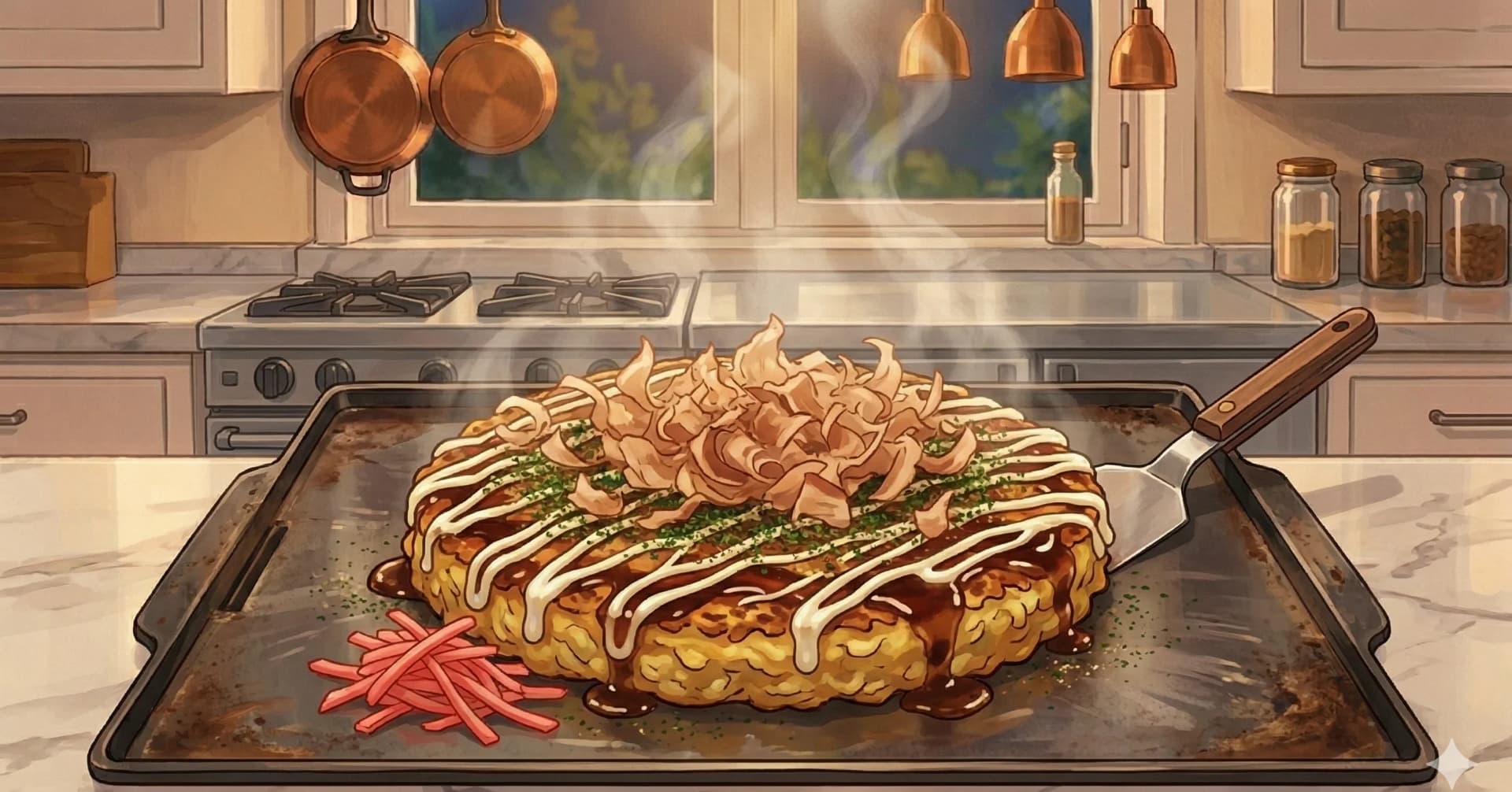
A thick, cabbage-laden savory pancake from Osaka, laced with dashi and crowned with sweet sauce, mayo, and dancing bonito flakes
The bonito flakes move first. Set on top of the finished pancake while it is still steaming, they curl and wave in the rising heat as though the dish itself is breathing. It is a small theatrical moment, unrehearsed and reliable every time, and it captures something essential about okonomiyaki: this is food that is alive at the table, assembled and eaten in the same warm space, never meant to sit quietly on a pass.
Okonomiyaki translates loosely to "grilled as you like it," and the name is honest. In Osaka, where this Kansai-style version originated, the dish functions as both street food and home cooking, a canvas for whatever ingredients are on hand. The base is always the same: shredded cabbage folded into a batter of flour, eggs, and dashi stock, then cooked on a flat griddle until golden and set. Pork belly is the most traditional protein, but shrimp, squid, cheese, mochi, and kimchi all make regular appearances. The Osaka style mixes everything into the batter before cooking, which distinguishes it from the Hiroshima style, where ingredients are layered with yakisoba noodles.
What makes the batter special is nagaimo, a starchy mountain yam that is grated raw into the mix. It creates an interior that stays custardy and soft even as the outside crisps, a contrast that defines great okonomiyaki. If you cannot find nagaimo, the pancake will still work, but the texture will lean denser and more bread-like. The toppings are non-negotiable: okonomiyaki sauce (a Worcestershire-like condiment with fruit and spice), Kewpie mayonnaise, bonito flakes, and powdered green aonori seaweed. Together they create a layered richness that is sweet, savory, smoky, and briny all at once.
At a Glance
Yield
4 servings (4 large pancakes)
Prep
20 minutes
Cook
30 minutes
Total
50 minutes
Difficulty
Medium
Ingredients
Pancake Ingredients
- 1 cupplain flour (all-purpose)
- ⅞ cupdashi stock, cooled (or 200 ml water with 5 g dashi powder)
- 4large eggs
- 3½ oznagaimo (Japanese mountain yam), peeled and finely grated, optional but recommended
- 1 tspsoy sauce
- —Pinch of fine sea salt
- 1 lbgreen cabbage (about ½–1 head), finely shredded (about a quarter of a medium head)
- 4scallions, thinly sliced
- 1½ oztenkasu (tempura scraps), or substitute crushed plain rice crackers
- 3¼ tbsppickled red ginger (benishoga), roughly chopped
- 7 ozthinly sliced pork belly (about 8–12 slices)
- 2 tbspneutral oil such as vegetable or rice bran
To Finish
- —Okonomiyaki sauce (or substitute a mix of 60 ml Worcestershire sauce, 30 ml ketchup, and 15 ml oyster sauce)
- —Kewpie mayonnaise
- —Katsuobushi (bonito flakes), a generous handful
- —Aonori (powdered green seaweed)
Method
- 1
Whisk together the flour, cooled dashi, and soy sauce in a large bowl until smooth. Avoid overworking the batter. If small lumps remain, that is fine. Let it rest for 15 minutes while you prepare the remaining ingredients. Resting allows the gluten to relax and the flour to hydrate evenly.
- 2
While the batter rests, shred the cabbage into thin strips no wider than 5 mm. The finer the shred, the more evenly it cooks and the better it binds with the batter. Slice the scallions and chop the pickled ginger.
- 3
After resting, add the grated nagaimo and one egg to the batter. Stir until the nagaimo is fully incorporated. The batter will become noticeably lighter and slightly slippery in texture.
- 4
Divide the shredded cabbage into four equal portions. Add one portion of cabbage, a quarter of the scallions, a quarter of the tenkasu, and a quarter of the pickled ginger to the batter. Crack one egg into the bowl. Fold everything together gently with a spatula, lifting from the bottom rather than stirring in circles. The cabbage should be coated but not compressed. Overmixing deflates the batter and produces a dense pancake.
- 5
Heat a large non-stick skillet or flat griddle over medium heat. Add about 7 ml of oil and spread it evenly. When the oil shimmers slightly, pour the cabbage-batter mixture into the center and use the spatula to shape it into a round disc about 2 cm thick and 18 cm across. Do not press down. The pancake needs height to stay custardy inside.
- 6
Lay 2 to 3 slices of pork belly across the top of the uncooked surface, arranging them so they cover most of the pancake. The pork will cook when you flip.
- 7
Cook undisturbed for 5 to 6 minutes over medium heat. Resist the urge to lift and check constantly. You will know the bottom is ready when the edges look set and dry, the pancake holds together when you slide a spatula underneath, and the underside is an even golden brown.
- 8
Flip the pancake in one confident motion. Use a wide spatula, and if you are nervous, slide the pancake onto a plate, invert it back onto the skillet pork-side down. The pork should now be on the bottom, sizzling against the hot surface. Cook for another 5 to 6 minutes until the pork is crisp and rendered and the second side is golden.
- 9
Flip once more so the pork side faces up. Lower the heat slightly and cook for another 2 minutes to ensure the interior is set. The center should feel firm but springy when pressed gently with a spatula, not liquid or wobbly.
- 10
Transfer the finished okonomiyaki to a plate. Immediately drizzle okonomiyaki sauce generously across the surface in broad zigzag lines. Follow with Kewpie mayonnaise in thinner crosshatch lines.
- 11
Pile a generous handful of bonito flakes on top while the pancake is still hot. Watch them curl and dance in the steam. Finish with a dusting of aonori powder.
- 12
Repeat steps 4 through 11 with the remaining three portions of cabbage and batter, adding one egg to each batch. Wipe the skillet clean between pancakes if residue builds up, and add fresh oil for each round.
- 13
Serve immediately. Okonomiyaki is best eaten hot, cut into wedges at the table. In Osaka, it is traditional to eat it with chopsticks directly from the griddle, but a fork works just as well.
Key Ingredient Benefits
Cabbage is an excellent source of vitamin C and vitamin K, and research suggests that cruciferous vegetables contain glucosinolates, compounds associated with antioxidant activity. Nagaimo contains a mucilage that has been traditionally used in Japanese and Chinese medicine to support digestion. Bonito flakes provide a concentrated source of inosinate, one of the key umami compounds, along with protein and B vitamins. Tenkasu (tempura scraps) add crunch but also absorb moisture during cooking, which helps prevent the pancake from becoming soggy.
Why This Works
The ratio of cabbage to batter is deliberately high. Okonomiyaki is not a pancake that happens to contain cabbage; it is a cabbage dish held together by just enough batter. The shredded cabbage provides moisture as it cooks, creating steam pockets that keep the interior soft and custardy. The flour and egg batter binds everything without making it dense or bready.
Nagaimo is the ingredient that separates good okonomiyaki from exceptional ones. When grated, it produces a viscous, starchy mucilage that aerates the batter and creates an almost mousse-like lightness. The effect is similar to adding whipped egg whites but more stable and less fussy. The interior stays creamy even as the exterior develops a firm, golden crust.
Cooking at medium heat rather than high allows the thick pancake to cook through without burning the outside. The 5 to 6 minutes per side gives enough time for the cabbage to soften and release its moisture, while the pork belly renders its fat directly into the cooking surface, essentially frying the pancake in its own drippings.
Substitutions & Variations
- Nagaimo: If unavailable, substitute 30 g grated potato mixed with 30 ml water. The result will be slightly denser but still good.
- Pork belly: Replace with peeled shrimp, sliced squid, thinly sliced beef, or leave the protein off entirely for a vegetarian version.
- Okonomiyaki sauce: A homemade version using Worcestershire sauce, ketchup, and oyster sauce is included in the ingredients list. Tonkatsu sauce also works.
- Hiroshima style: Layer the ingredients rather than mixing them. Pour a thin crepe of batter, top with cabbage, add yakisoba noodles, flip, and cook through. Finish with a fried egg on top.
- Modanyaki: Add a layer of cooked yakisoba noodles between the pancake and the toppings.
- Cheese okonomiyaki: Lay sliced mozzarella or cheddar on top before the final flip so it melts into the surface.
- Kimchi okonomiyaki: Replace the pickled ginger with 80 g chopped kimchi for a Korean-Japanese fusion version.
Serving Suggestions
Okonomiyaki is a complete meal on its own, but in izakaya-style dining it often appears alongside cold beer, edamame, and small plates. Serve with a bowl of miso shiru for a lighter accompaniment. In Japan, okonomiyaki is never served over rice, as it already contains flour and is considered a starch-based dish, though this convention is not universal outside Osaka. A simple green salad dressed with rice vinegar and sesame oil cuts through the richness nicely.
Storage & Reheating
Cooked okonomiyaki can be stored in the refrigerator for up to 2 days, wrapped tightly in plastic wrap. Reheat in a skillet over medium heat for 3 to 4 minutes per side until heated through and crisp again. The microwave will heat it but will not restore the crust. You can also freeze cooked pancakes, separated by parchment paper, for up to 1 month. Thaw in the refrigerator overnight before reheating in a skillet. Apply the sauces, bonito, and aonori fresh after reheating, not before storing.
Cultural Notes
Okonomiyaki (お好み焼き) translates literally as "grill what you like." That is the whole pitch. Okonomi means what you like, yaki means grilled, and the dish is built around the principle that the cook should add whatever protein and topping makes sense to them on top of a basic cabbage-and-flour batter. The dish belongs to Osaka and the broader Kansai region of western Japan, but the format itself is loose enough to absorb almost anything.
Two main regional traditions divide the modern okonomiyaki world. Kansai-style (Osaka and Kobe) is the more familiar version internationally: the ingredients get mixed into the batter before the pancake hits the griddle, producing a thick uniform round. Hiroshima-style takes the opposite approach: ingredients are layered sequentially on the hot griddle, thin batter on the bottom, then cabbage, then yaki-soba noodles, then egg, building a stacked structure that you can see in cross-section when you cut into it. The Hiroshima version uses the noodles as architecture. The Osaka version does not. The two cities have a long, affectionate rivalry over which approach is the real one.
The dish has working-class roots that explain a lot about its current cultural place. During the food shortages of World War II and the years immediately after, urban Japanese families turned to cabbage (cheap, abundant) and small rations of flour to build filling meals around whatever scraps of protein they could find. Okonomiyaki was a survival dish. The transformation from survival food into beloved everyday dish traces to the post-war Osaka recovery, when small okonomiyaki shops opened across working-class neighborhoods and gradually built the dish's reputation as the city's signature meal. The shops clustered around Dotonbori have now operated for decades.
Part of the appeal is the cooking itself. Most okonomiyaki restaurants set their tables around a built-in teppan (鉄板) griddle, which means you watch your meal cook in front of you, sometimes flipping the pancake yourself. The participation is half of why people love going out for it.
Nutrition Facts
Calories: 636kcal (32%)|Total Carbohydrates: 36g (13%)|Protein: 16g (32%)|Total Fat: 43g (55%)|Saturated Fat: 15g (75%)|Cholesterol: 230mg (77%)|Sodium: 780mg (34%)|Dietary Fiber: 3g (11%)|Total Sugars: 5g
You Might Also Like
Ratings & Comments
Ratings & Comments
Ratings
Share your thoughts on this recipe.
Sign in to rate and comment