Japanese Cuisine
Nikuman (Japanese Steamed Pork Buns)
Soft, pillowy steamed buns filled with a savory pork and ginger mixture, a wintertime comfort from every Japanese convenience store
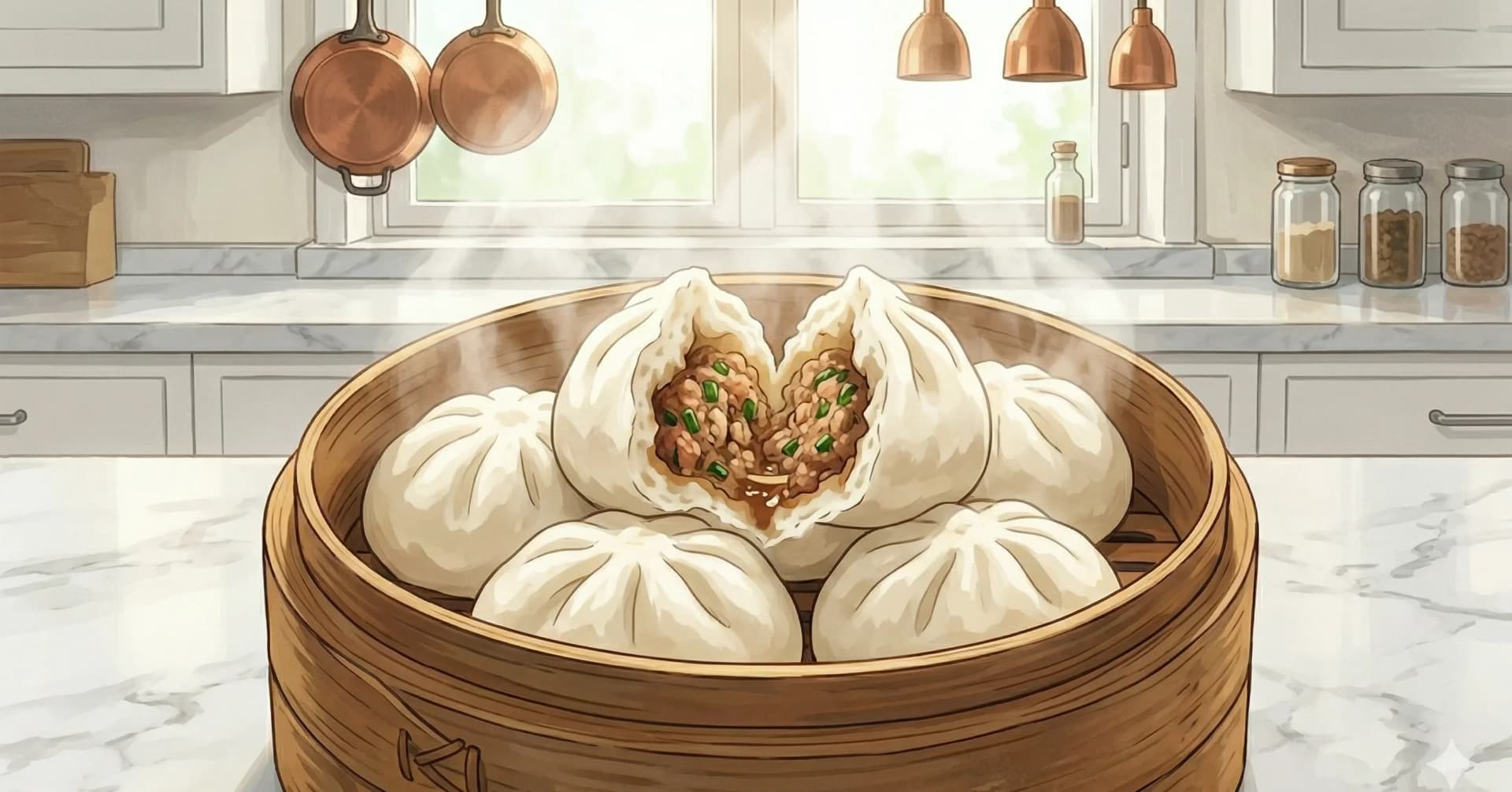
You smell them before you see them in every Japanese convenience store from November through March: that warm, yeasty, ginger-touched steam escaping from the glass cases near the register. Nikuman are as much a part of Japanese winter as hot canned coffee from vending machines and kotatsu tables. You hold one in both hands, partly because it is too hot for one hand and partly because the gesture itself is a small act of warming up. The first bite breaks through the smooth, white, slightly sweet dough into a filling that is juicy, savory, and fragrant with ginger and sesame.
Nikuman are the Japanese adaptation of Chinese baozi, the filled steamed buns that have been a staple of Chinese cuisine for over a thousand years. They arrived in Japan through Nagasaki, the port city that maintained trade with China even during Japan's isolationist Edo period, and gradually evolved to suit Japanese tastes. The Japanese version tends to be slightly sweeter in the dough, lighter in seasoning, and less aggressively spiced than its Chinese counterpart. The filling favors ginger over garlic, uses soy sauce and sesame oil rather than doubanjiang or five-spice, and often includes finely chopped cabbage or scallion for moisture and freshness.
Making nikuman at home is a weekend project, not because any single step is difficult, but because the dough needs time to rise and each bun must be individually assembled. The rhythm is meditative once you settle into it: flatten a disc of dough, spoon filling into the center, pleat the edges shut, twist the top closed, and set it on a small square of parchment to proof. A bamboo steamer is ideal, as it absorbs excess condensation that would otherwise drip onto the buns and create soggy spots. If you only have a metal steamer, wrap the lid in a kitchen towel to catch the drips.
At a Glance
Yield
12 buns
Prep
40 minutes (plus 1 hour rising)
Cook
20 minutes
Total
2 hours
Difficulty
Involved
Ingredients
Dough Ingredients
- 2⅓ cupplain flour (all-purpose), plus extra for dusting
- ¼ ozinstant dry yeast
- 2½ tbspsugar
- ½ tspfine sea salt (about half a teaspoon)
- 1 tbspneutral oil such as vegetable
- ⅔ cupwarm water (about 38 degrees Celsius)
- 1¼ tspbaking powder
Filling Ingredients
- ¾ lbpork mince (not too lean; 20 percent fat is ideal)
- 3½ ozgreen cabbage, very finely chopped
- 2scallions, finely chopped
- 2½ tbspfresh ginger, finely grated
- 1 tbspsoy sauce
- 1 tbspoyster sauce
- 2 tspsesame oil
- 2 tspsake
- 1¼ tspsugar
- 1⅞ tsppotato starch or cornstarch
- —Pinch of white pepper
Method
- 1
Make the dough. Combine the flour, yeast, sugar, salt, and baking powder in a large bowl. Add the oil and warm water. Stir with chopsticks or a fork until a shaggy mass forms, then turn it out onto a lightly floured surface and knead for 8 to 10 minutes. The dough is ready when it is smooth, soft, and springs back when pressed with a finger. It should feel like an earlobe: yielding but elastic.
- 2
Shape the dough into a ball, place it in a lightly oiled bowl, and cover with a damp cloth or plastic wrap. Let it rise in a warm spot for about 1 hour, or until it has doubled in size. In a cool kitchen, place the bowl in a turned-off oven with a pan of hot water on the rack below to create a warm, humid environment.
- 3
While the dough rises, prepare the filling. Place the pork mince in a bowl and add the soy sauce, oyster sauce, sesame oil, sake, sugar, starch, and white pepper. Mix in one direction (clockwise or counterclockwise) with chopsticks or a fork for 2 to 3 minutes until the mixture becomes sticky and cohesive. This one-directional mixing develops the myosin in the pork, creating a filling that holds together and has a bouncy texture rather than crumbling.
- 4
Add the chopped cabbage, scallions, and grated ginger to the pork mixture. Fold them in gently until evenly distributed. Cover and refrigerate until the dough is ready. A cold filling is easier to handle during assembly.
- 5
Cut 12 squares of parchment paper, roughly 8 by 8 cm, for lining the bottom of each bun.
- 6
Once the dough has doubled, punch it down gently and turn it out onto a lightly floured surface. Knead briefly for 30 seconds to release excess air. Roll it into a log and divide it into 12 equal pieces (about 42 g each). Cover the pieces with a damp cloth to prevent drying.
- 7
Take one piece of dough and roll it into a ball, then flatten it with a rolling pin into a disc about 10 cm in diameter. The center should be slightly thicker than the edges, as the center bears the weight of the filling and needs more structure. Rotate the disc as you roll to keep it round.
- 8
Place about 25 g of filling (roughly a heaped tablespoon) in the center of the disc. Gather the edges up around the filling, pleating as you go. Pinch and twist the top to seal it shut. The exact number and neatness of the pleats is a matter of practice and aesthetics; what matters functionally is that the bun is sealed with no gaps.
- 9
Place the assembled bun on a parchment square, seam side up. Repeat with the remaining dough and filling. Cover all the buns with a damp cloth and let them proof for 15 to 20 minutes. They should puff slightly and feel lighter when lifted.
- 10
Bring water to a boil in the base of your steamer. Arrange the buns in the steamer, leaving at least 3 cm of space between each one, as they will expand significantly during steaming. You will likely need to steam in two or three batches.
- 11
Steam over high heat for 15 minutes. Do not open the lid during steaming, as the sudden temperature drop can cause the buns to collapse and wrinkle. After 15 minutes, turn off the heat and let the buns sit in the closed steamer for 3 minutes before removing the lid. This gradual cooling prevents thermal shock.
- 12
Remove the buns from the steamer. They should be smooth, white, and puffy, with a slight sheen from the steam. Press one gently; it should spring back immediately. If it feels dense or doughy, steam for another 3 to 4 minutes. Serve hot, held in both hands.
Key Ingredient Benefits
Pork is one of the richest dietary sources of thiamine (vitamin B1), a nutrient research suggests is essential for carbohydrate metabolism and nerve function. Ginger provides gingerol, traditionally used across East Asian medicine for its warming properties and digestive support. Cabbage contributes vitamin C and dietary fiber, and its high water content helps keep the filling juicy during steaming. Fermented ingredients like soy sauce and oyster sauce provide amino acids and trace minerals produced during the fermentation process.
Why This Works
The combination of yeast and baking powder in the dough serves different purposes. Yeast provides the primary rise and develops the subtle, slightly sweet flavor of well-fermented dough. Baking powder adds a secondary lift during steaming, producing a lighter, more open crumb that stays soft even as the bun cools. Without baking powder, the buns tend to be denser and chewier, more like Chinese mantou. With it, they achieve the pillowy, almost cake-like softness characteristic of Japanese nikuman.
Mixing the filling in one direction is a technique borrowed from Chinese dumpling-making, and it matters more than it might seem. The one-directional motion aligns the myosin proteins in the pork, creating a matrix that binds the filling together and gives it a pleasantly bouncy, almost springy texture when cooked. Random mixing breaks these protein strands and produces a crumbly, loose filling that falls apart when you bite into the bun.
The resting period after steaming, with the lid kept closed for 3 minutes, prevents the surface of the buns from wrinkling. The sudden temperature change when the lid is removed causes the steam trapped inside the bun to contract rapidly, pulling the surface inward. A gradual cooldown minimizes this effect and keeps the buns smooth and attractive.
Substitutions & Variations
- Anman (sweet red bean): Replace the pork filling with 300 g of smooth or chunky anko (sweet red bean paste). These are the second most popular type of steamed bun in Japan.
- Curry man: Fill with leftover Japanese curry, thickened until it holds its shape. A popular convenience store variety.
- Pizza man: Fill with a mixture of pizza sauce, mozzarella, and chopped salami. Another convenience store classic, surprisingly satisfying.
- Vegetarian: Replace pork with a mixture of finely chopped shiitake mushrooms, firm tofu, and bamboo shoots, seasoned the same way.
- Oyster sauce substitute: Use hoisin sauce or an additional 5 ml of soy sauce mixed with a pinch of sugar.
- Flour alternative: Bread flour produces a slightly chewier, more elastic dough. Cake flour produces a softer, more delicate bun. All-purpose is the standard compromise.
Serving Suggestions
Nikuman is a snack food, meant to be eaten on its own as a between-meal bite or a warming winter treat. In Japan, it is not typically served as part of a larger meal, though there is no rule against it. For a home party, serve freshly steamed nikuman alongside gyudon and miso shiru for a cozy winter spread. Some people dip them in soy sauce mixed with karashi mustard, though purists eat them unadorned. A pot of hot green tea or hojicha is the ideal drink pairing.
Storage & Reheating
Nikuman freeze exceptionally well. Let the steamed buns cool completely, then place them in a single layer in a freezer bag, separating layers with parchment paper. They keep for up to 2 months. Reheat directly from frozen: steam for 8 to 10 minutes until heated through, or microwave for 1 to 2 minutes (wrap in a damp paper towel to prevent drying). The microwave is the standard reheating method in Japan and works well for nikuman because the dough is designed to stay soft. Refrigerated buns keep for 2 days; re-steam for 5 minutes.
Cultural Notes
Nikuman (肉まん), "meat bun," is the konbini (コンビニ, convenience store) dish of Japanese winter. From November through March, heated glass cases sit beside the register at almost every Japanese convenience store, and the buns inside them are one of the small comforts of a Japanese cold-weather city. The bun itself descends directly from the Chinese baozi (包子). It reached Japan in the late 19th and early 20th centuries through Chinese immigrants in the port cities of Yokohama and Kobe, then drifted inland. The Japanese version softened the dough, sweetened the filling, and shrank the portion a little.
The commercial story starts in 1925, when the Nakamura-ya bakery in Tokyo's Shinjuku district began producing nikuman in retail quantities. Nakamura-ya was founded in 1901 as a Western-style bakery, and it adapted the Chinese roubaozi (肉包子) recipe brought to Japan by Chinese refugees fleeing the upheavals of the early 20th century. The Nakamura-ya recipe became the template for the entire commercial Japanese nikuman industry.
Today the four big Japanese convenience-store chains, 7-Eleven, FamilyMart, Lawson, and Ministop, each run their own proprietary nikuman recipes through dedicated suppliers. Japanese food magazines publish annual taste-test comparisons. The classic butaman (豚まん, pork bun, sometimes used interchangeably with niku-man) leads sales, with anman (餡まん, sweet red bean) close behind. Pizzaman (ピザまん) and karē-man (カレーまん) followed later, both 1980s Japanese inventions for a younger market.
Half of the dish's appeal is what you do with it. You buy one hot, you wrap your hands around it on a cold Tokyo sidewalk, and you eat it while you walk. The hand-warming function is part of why the season for nikuman is also the season for layered coats.
Nutrition Facts
Calories: 191kcal (10%)|Total Carbohydrates: 22g (8%)|Protein: 7g (14%)|Total Fat: 5g (6%)|Saturated Fat: 2g (10%)|Cholesterol: 20mg (7%)|Sodium: 280mg (12%)|Dietary Fiber: 1g (4%)|Total Sugars: 3g
You Might Also Like
 Medium
Vietnamese Cuisine
Cháo Lòng (Vietnamese Pork Organ Rice Porridge)
2 hours 15 minutes
 Medium
Thai Cuisine
Boat Noodles (ก๋วยเตี๋ยวเรือ)
3 hours 15 minutes
 Easy
EasyVietnamese Cuisine
Cháo Gà (Vietnamese Chicken Rice Porridge)
1 hour 30 minutes
 Easy
EasyVietnamese Cuisine
Grilled Lemongrass Pork (Thịt Nướng)
2 hours 30 minutes
Ratings & Comments
Ratings & Comments
Ratings
Share your thoughts on this recipe.
Sign in to rate and comment