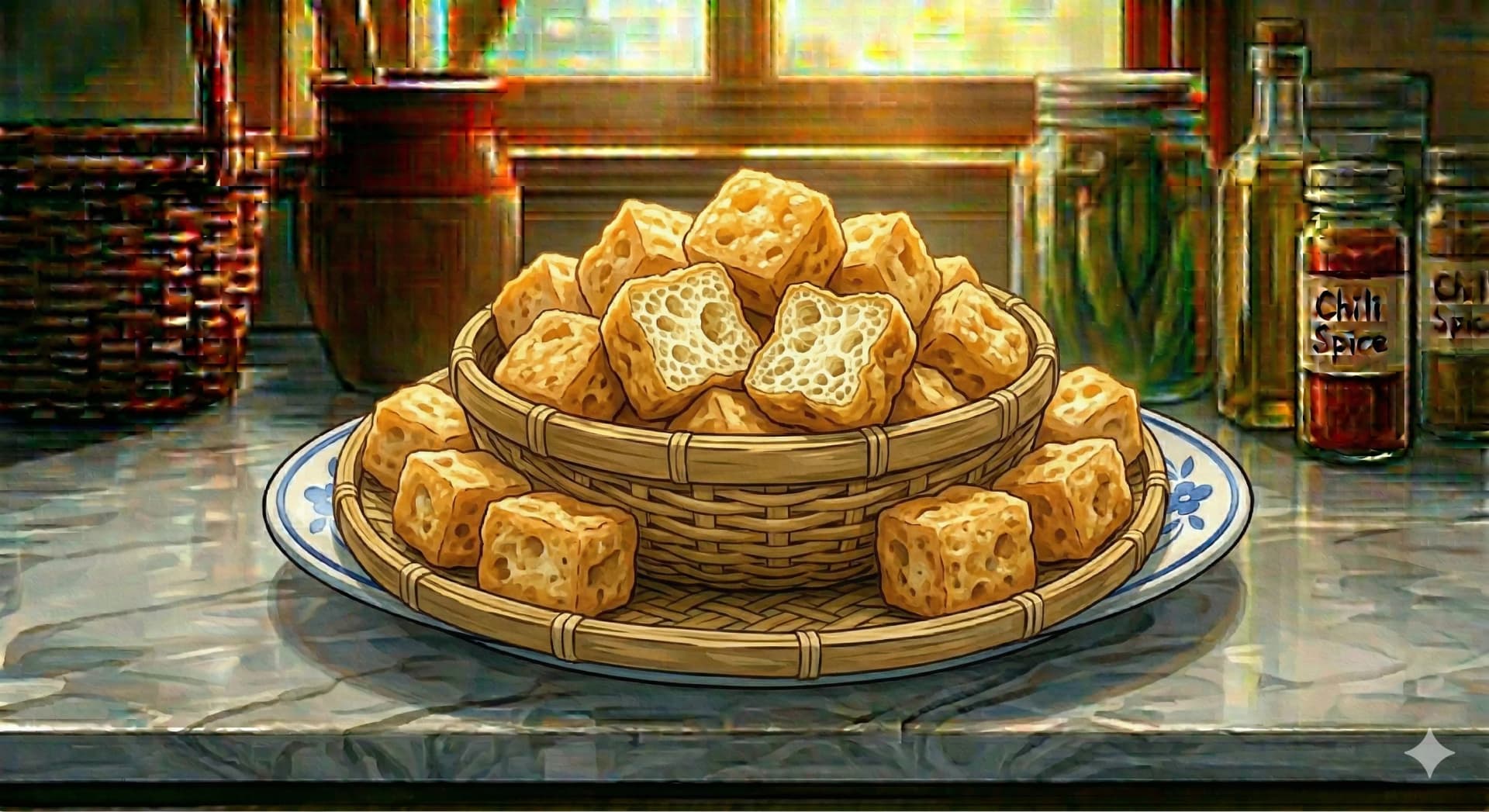
Tofu Puffs
Also known as: Dou Pao, Abura-age, Fried Tofu Puffs, Bean Curd Puffs, Taukwa Pok
Tofu puffs are pillows of tofu that have been deep-fried until their exterior turns golden and their interior becomes a honeycomb of air pockets — hollow, spongy, and capable of absorbing extraordinary amounts of the liquid around them.
They are not eaten for their flavor (which is mild and neutral) but for their texture and their function as a flavor sponge — submerged in a curry, laksa broth, or braise, they absorb the surrounding liquid and release it in concentrated bursts with each bite.
Key facts at a glance:
- Deep-fried tofu pillows — golden exterior with honeycomb of air pockets inside
- Function as a flavor sponge — absorbs surrounding liquid and releases it in concentrated bursts
- Tau pok in Hokkien — central to Southeast Asian Chinese cooking
- Abura-age in Japanese — used in miso soup, inari sushi, and udon
- Can be stuffed — creates an entirely new class of preparations
Flavor Profile
Origin
China, Japan, Southeast Asia
Traditional Medicine Perspectives
Traditional Chinese Medicine
Tofu puffs, as a fried tofu product, are considered neutral to slightly warm in TCM — the frying process adds warmth that moderates the otherwise cooling nature of plain tofu. Associated with the Spleen and Stomach, they are considered more easily digestible for people with cold-type Spleen conditions who find plain tofu too cooling.
Modern Scientific Research
The deep-frying process significantly changes the nutritional profile compared to plain tofu — fat content increases substantially.
They retain soy protein and isoflavones but in a higher-calorie package.
Research on fried soy products shows they retain isoflavone content despite the frying process.
Cultural History
Fried tofu puffs developed across the tofu cultures of East and Southeast Asia as a natural consequence of deep-frying tofu.
In Japan, abura-age is used in miso soup, inari sushi, and udon noodle soups.
In Southeast Asian Chinese cooking, tau pok (tofu puffs in Hokkien) appears in laksa, satay, and curry preparations with a frequency that reflects their perfect compatibility with coconut milk-based broths.
The ability to stuff tofu puffs created an entirely new class of preparations.
Culinary Uses
Add to curries and laksa broth — they absorb the flavorful liquid beautifully. Halve and add to hot pots and simmered soups.
Stuff with seasoned minced pork, shrimp, or fish paste. Add to braised vegetable dishes.
Make inari sushi by simmering in sweetened soy sauce and stuffing with seasoned rice.
Preparation Methods
Pour boiling water over tofu puffs and gently press to remove excess oil before using. Squeeze gently and pat dry.
For stuffed preparations: cut a pocket into one side and fill. For soups and hot pots: add directly.
Traditional Dishes
- Laksa with tofu puffs
- Stuffed tofu puffs (yong tau foo)
- Japanese inari sushi
- Hot pot tofu puffs
- Malaysian curry with tofu puffs
Comments
Share your thoughts on this ingredient.
Sign in to comment0 Comments