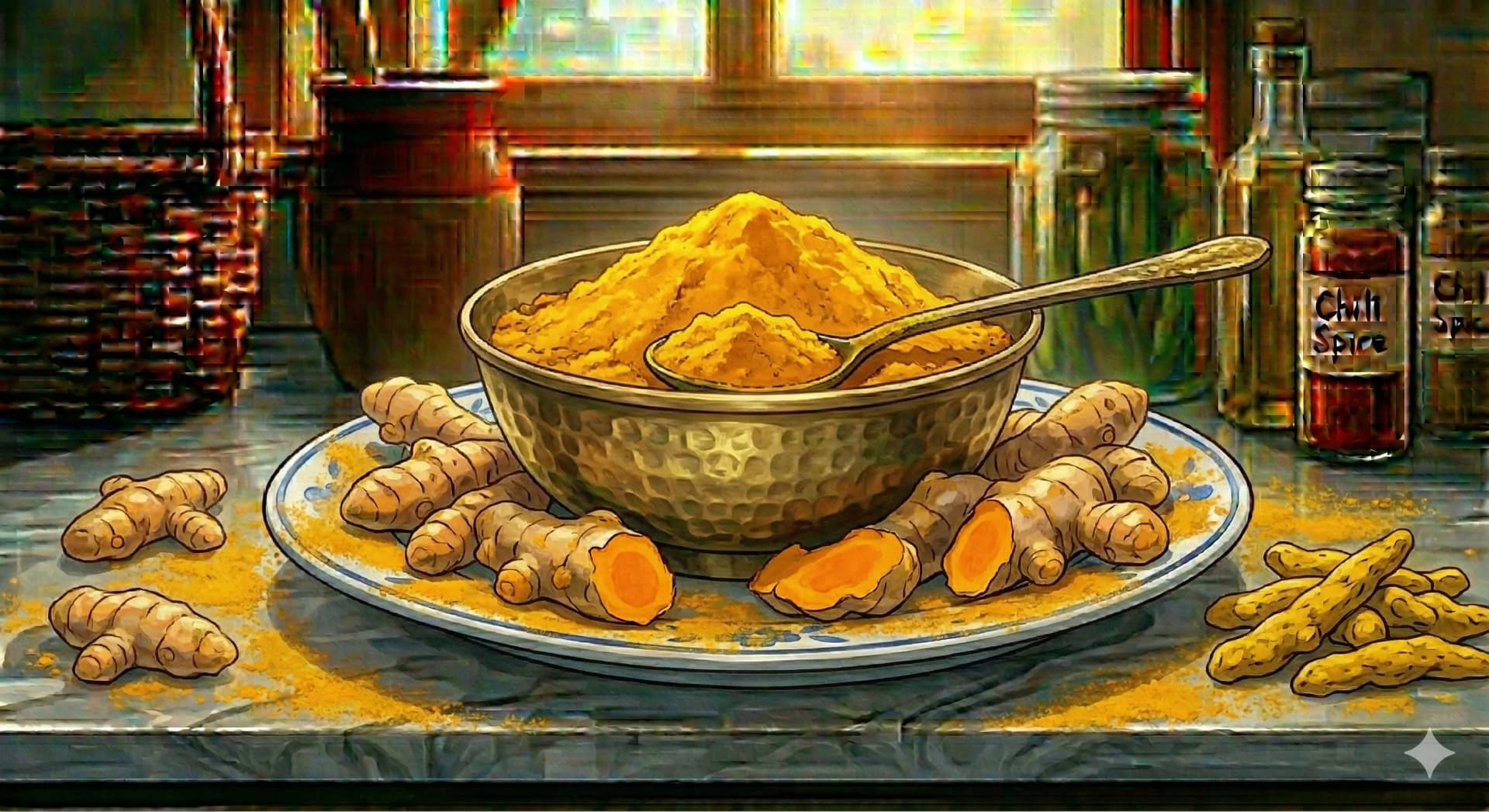
Turmeric
Also known as: Haldi, Curcuma longa, Indian Saffron
A rhizomatous plant in the ginger family, turmeric has been at the center of South Asian cooking and healing traditions for over four thousand years.
Its warm, slightly bitter flavor and vivid golden color make it one of the most recognizable spices in the world.
Key facts at a glance:
- Rhizomatous plant in the ginger family — over four thousand years of use in South Asia
- Curcumin — primary bioactive compound with anti-inflammatory and antioxidant properties
- Piperine from black pepper increases absorption by 2000% — always pair with black pepper
- Used in Ayurvedic medicine since 500 BCE — for digestive problems, skin conditions, and inflammation
- Golden milk — traditional nightly tonic of warm milk with turmeric, black pepper, and ghee
Flavor Profile
Origin
South Asia, Southeast Asia, India
Traditional Medicine Perspectives
Ayurveda
Turmeric is considered a tridoshic spice — it balances all three doshas (Vata, Pitta, and Kapha). It is classified as a deepana (digestive stimulant) and pachana (carminative). Ayurvedic texts recommend it for liver support, skin health, and as an anti-inflammatory agent.
Traditional Chinese Medicine
In TCM, turmeric (Jiang Huang) is classified as warming, acrid, and bitter. It is said to move Qi and Blood, relieve pain, and clear obstructions. It is used for menstrual irregularities, chest pain, and joint pain caused by cold-damp patterns.
Modern Scientific Research
Curcumin, the primary bioactive compound in turmeric, has been widely studied for its anti-inflammatory and antioxidant properties. Research suggests it may inhibit NF-kB, a molecule that activates genes related to inflammation.
Bioavailability is significantly enhanced when consumed with piperine (black pepper) — studies indicate a 2000% increase in absorption.
Research also indicates potential benefits for cognitive function and metabolic health, though most studies note that curcumin's low bioavailability remains a challenge in clinical applications.
Cultural History
Turmeric has been used in Ayurvedic medicine since at least 500 BCE, described in ancient texts as a remedy for digestive problems, skin conditions, and inflammation.
In South Asian households, it is as much a medicine cabinet staple as a pantry one.
Golden milk — warm milk with turmeric, black pepper, and ghee — has been consumed as a nightly tonic for generations.
Culinary Uses
Turmeric is fundamental to South Asian curries, dals, and rice dishes. It is used fresh (grated rhizome) in Southeast Asian cooking and dried/ground throughout South Asia and the Middle East.
Beyond flavoring, it acts as a natural dye, turning dishes a deep golden yellow.
It pairs naturally with black pepper, ginger, coconut milk, and warm spices.
Preparation Methods
Ground turmeric can be added directly to dishes. Fresh turmeric root should be peeled and grated or pounded.
Blooming ground turmeric in oil or ghee before adding other ingredients deepens its flavor and color.
Always pair with black pepper when seeking anti-inflammatory benefits.
Traditional Dishes
- Golden milk
- Dal tadka
- Biryani
- Aloo gobi
- Khichdi
Recipes Using Turmeric
- Chicken Chettinad
- Prawns in Coconut Cream (Chingri Malai Curry)
- Slow-Cooked Duck (Dum Ki Batakh)
- Carom-Spiced Fish Curry (Ajwaini Machi Curry)
- Fritters in Yogurt Curry (Kadhi Pakora)
- Gobi Mussallam
- Goan Green-Spiced Chicken (Galinha Cafreal)
- Spiced Minced Mutton (Mutton Keema)
- Bhindi Masala
- Paneer Bhurji
- Fish Moilee
- Chana Masala
- Palak Paneer
- Black Chickpea Dal (Maa Chana Dal)
- Tandoori Gobi
- Egg Curry (Anda Curry)
- Punjabi Kadhi
- Chicken Korma
- Chicken 65
- Paneer Tikka
- Goan Fish Curry
- Mixed Vegetables in Coconut (Avial)
- Bengali Dry Mutton Curry (Kasha Mangsho)
- Parsi Chicken with Potato Straws (Salli Murgi)
- Hilsa in Mustard Sauce (Sorshe Ilish)
- Mutter Paneer
- Kashmiri Fried Lamb Ribs (Tabak Maas)
- Sambar
- Tamarind Rice
Comments
Share your thoughts on this ingredient.
Sign in to comment0 Comments