Indian Cuisine
Potato & Sweet Potato Chaat (Aloo Shakarkandi Ki Chaat)
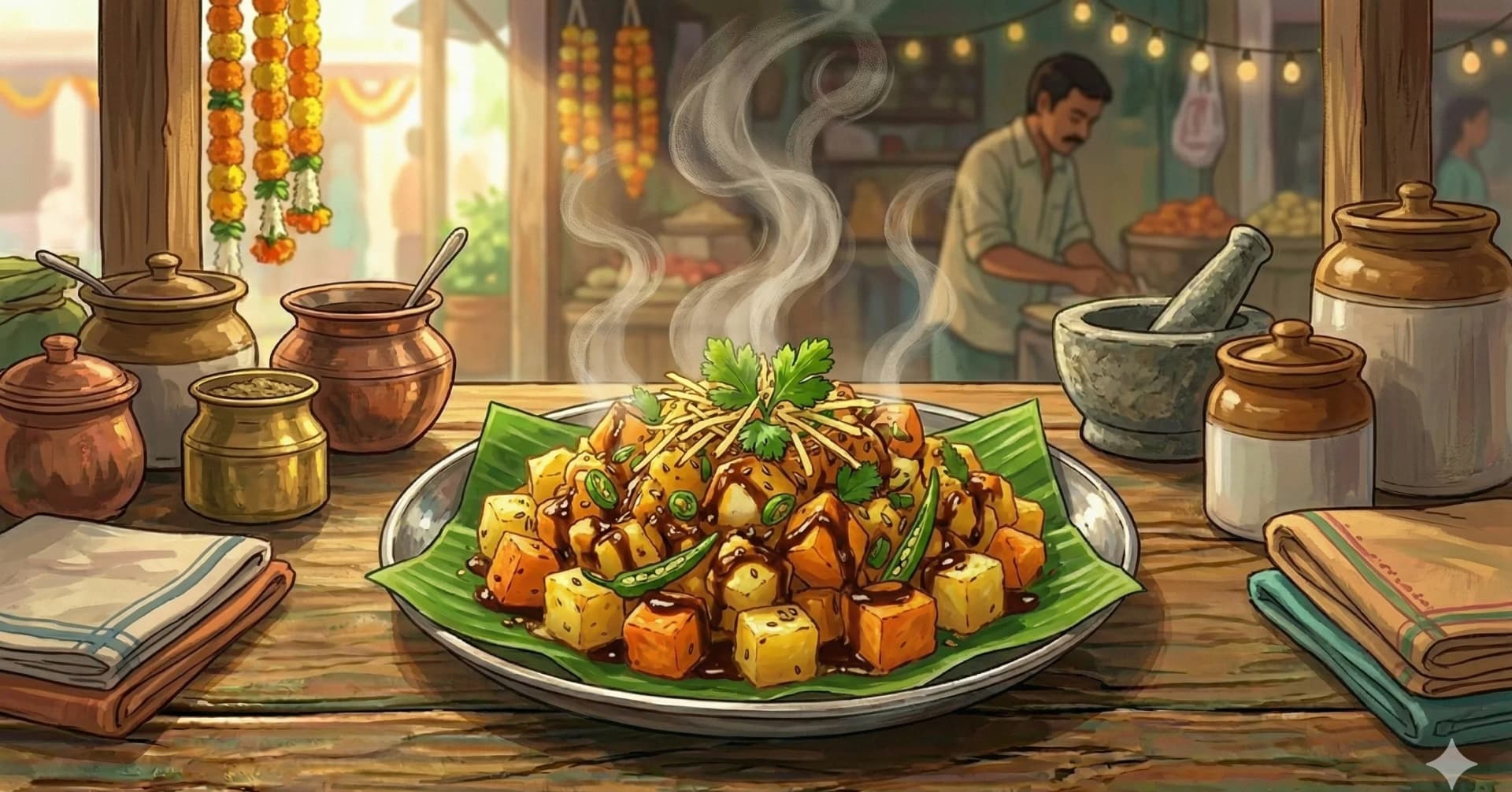
Golden-fried potato and sweet potato tossed in ghee with tamarind, black salt, and saunth chutney
Winter in North India belongs to the sweet potato. Carts appear on street corners roasting shakarkandi over coal, their skins cracking and the interior turning dense, sweet, and almost caramel-like. Aloo shakarkandi ki chaat captures this seasonal pairing: potato and sweet potato together, cubed and shallow-fried in ghee until golden at the edges, then tossed warm with the traditional chaat condiments: tamarind water, saunth chutney, black salt, and the sharp brightness of green chilli.
The contrast between the two is the point. Potato is starchy and neutral; sweet potato is dense and sweet. Pan-fried in ghee rather than boiled or steamed, both develop a slightly crisp exterior that holds up when tossed with the liquid condiments. The saunth chutney (dried ginger-tamarind sauce) adds a deep, complex warmth. Black salt (kala namak) provides its characteristic sulphurous, almost egg-like note that is so associated with North Indian chaat that its absence makes the dish seem incomplete.
This is a simple preparation made interesting by the layering of its seasonings: tangy, sour, warm, sharp, and salty in different measures, all arriving together on a warm cube of ghee-fried potato.
At a Glance
Yield
Serves 4
Prep
15 minutes
Cook
15 minutes
Total
30 minutes
Difficulty
Easy
Ingredients
- 1 lbpotatoes (about 3–3½ potatoes), peeled and cut into 2 cm cubes
- 1 lbsweet potatoes, peeled, roasted or boiled (about 3–3½ potatoes), cut into 2 cm cubes
- ½ cupghee (for shallow frying)
- ⅓ cuptamarind water, a small ball of tamarind dissolved in 100 ml warm water, strained
- ½ cupfresh ginger, cut into fine julienne
- 1½ tbspblack salt (*kala namak*), about 5 teaspoons
- 1½ cupsaunth chutney (dried-ginger and tamarind chutney), available at Indian grocery stores
- ¼ cupgreen chillies, finely chopped
- 1¼ cupfresh coriander, finely chopped
Method
- 1
Fry the potatoes (500 g). Heat the ghee (100 g) in a wide, heavy pan over medium-high heat. Add the diced potato and fry, stirring occasionally, for 10–12 minutes until golden and crispy at the edges and cooked through. Remove with a slotted spoon.
- 2
Warm the sweet potato. If the sweet potato is already roasted or boiled, add it to the same ghee for 2–3 minutes just to warm through and pick up some colour.
- 3
Toss together. Combine the fried potato and sweet potato in a wide bowl. Pour over the tamarind water (100 ml) and add the black salt (25 g), ginger (50 g) julienne, and chopped green chillies (25 g). Toss well.
- 4
Add saunth chutney (200 g). Drizzle the saunth chutney over the mixture and toss once more.
- 5
Garnish and serve. Scatter the fresh coriander (25 g) over the top and serve warm. This chaat is best when the potato is still hot and the condiments are fresh.
Key Ingredient Benefits
Black salt (kala namak) is a volcanic rock salt with a high sulphur content. It has a pungent, almost egg-like smell and a complex, savoury-smoky taste that is characteristic of North Indian chaat. Available from any Indian grocery store.
Saunth chutney is a prepared condiment made from dried ginger, tamarind, jaggery, and spices. It is the darker, more complex counterpart to fresh green chutney, and a key chaat ingredient. Many Indian stores carry it ready-made; it can also be made by combining tamarind paste, powdered dry ginger, black salt, and a little jaggery.
Why This Works
Frying in ghee rather than a neutral oil changes the flavour of the potato in a way that complements the sweet potato. Ghee's milk solids caramelise at relatively low temperatures, creating a complex, slightly nutty base note that no other fat provides. This richness is the foundation on which the sharp, sour, and spicy condiments play.
Black salt in chaat is not decorative. Its distinctive sulphurous quality directly triggers the savoury response the same way a squeeze of lime triggers sourness. The combination of black salt, tamarind water, and saunth in the same dish layers three different expressions of the same impulse: the need for contrast to balance the starchy sweetness of the main ingredients.
Substitutions & Variations
No ghee: Use neutral oil for a vegan version. The flavour will be different, cleaner but less round.
Roasted sweet potato: Roasting the sweet potato whole (at 200°C for 45 minutes) before cubing and adding produces a deeper, more concentrated sweetness than boiling.
Addition of papdi: Serving this chaat on a base of papdi (fried flour crackers) makes it more substantial.
Serving Suggestions
Serve warm, immediately after tossing. This chaat works as a street-food-style snack before a meal, or as an afternoon snack with chai. In the North Indian tradition, it is most associated with winter markets and seasonal fairs.
Storage & Reheating
Best eaten immediately. Leftovers can be refrigerated but the potato loses its crispness. Rewarm in a dry pan.
Cultural Notes
Aloo shakarkandi ki chaat (आलू शकरकंदी की चाट, "potato and sweet potato chaat") is the North Indian winter street snack of boiled potato and roasted sweet potato cut into rough chunks, tossed with chaat masala, lemon juice, black salt, chopped green chili, and a small handful of chopped cilantro, served warm. The dish is among the canonical Delhi-UP winter street foods, sold from the rolling carts of street vendors who appear in the cold months from November through February. The sweet potato roasting tradition specifically (the vendor roasts whole sweet potatoes over a coal brazier on the cart, peels them while still hot, and assembles the chaat to order) is one of the iconic Old Delhi street food images.
The winter context defines the dish's cultural role. Sweet potato (shakarkandi) is a winter root vegetable in India, harvested in the cool months and unavailable in the hot summer when most North Indian streets are dominated by other chaat preparations (pani puri, bhel puri, jhal muri). The seasonal availability gives shakarkandi chaat its specifically winter identity, and the dish's warming character (warm roasted sweet potato, the heat-generating effect of the spices, the cold-weather appeal of standing at a hot brazier on a chilly evening) suits the cold Delhi winter when daytime temperatures can drop into the single digits Celsius. The street vendors who specialize in shakarkandi chaat operate only during the winter months, packing up their carts when summer arrives and the sweet potato disappears from the markets.
The technique is fast and the spice mix matters more than precise quantities. Sweet potatoes (about a pound) are roasted directly on hot coals or in a hot oven (200°C for thirty to forty minutes) until the skins blacken slightly and the interiors become soft and sweet. Potatoes are boiled in salted water until tender (about twenty minutes), drained, and cooled. Both are peeled while still warm, cut into rough one-inch chunks, and combined in a serving bowl. The seasoning is added in this order: a generous shake of chaat masala, a pinch of black salt, a pinch of red chili powder, chopped green chili, finely chopped fresh ginger, and the juice of half a lime. The chaat is tossed gently to coat, scattered with chopped cilantro, and served warm in small bowls or in paper cones (the cone shape called thonga in Hindi street-food vocabulary). The dish is eaten standing at the cart, with a small steel toothpick or a small spoon, while the vendor prepares the next order on the brazier.
Nutrition Facts
Calories: 324kcal (16%)|Total Carbohydrates: 59g (21%)|Protein: 6g (12%)|Total Fat: 8g (10%)|Saturated Fat: 4.8g (24%)|Cholesterol: 19mg (6%)|Sodium: 2388mg (104%)|Dietary Fiber: 7.9g (28%)|Total Sugars: 7.7g
You Might Also Like
Ratings & Comments
Ratings & Comments
Ratings
Share your thoughts on this recipe.
Sign in to rate and comment