Indian Cuisine
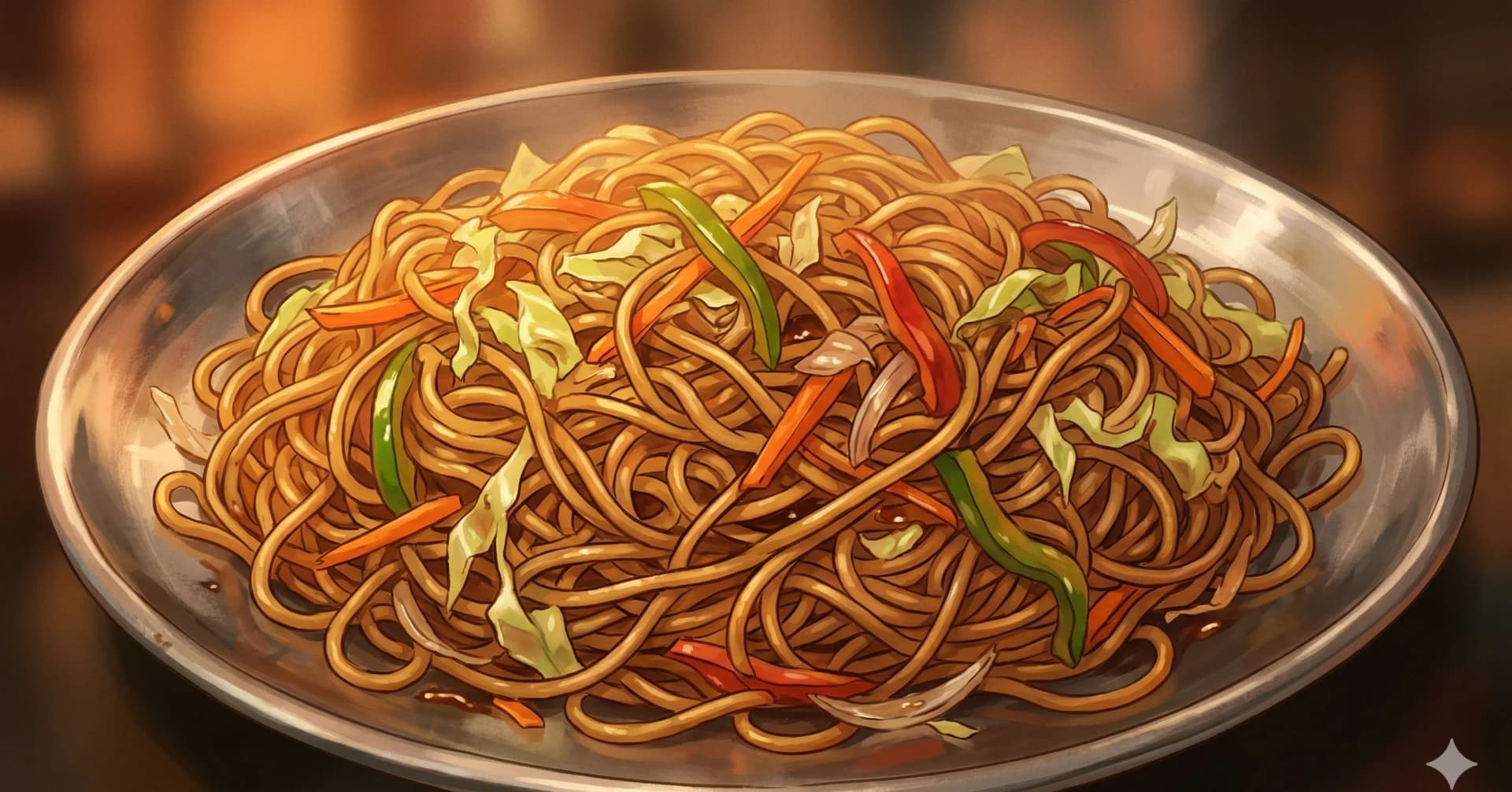
Kolkata-Style Stir-Fried Noodles (Kolkata Chowmein)
India's most beloved street noodle, hakka-style chow mein from the streets of Kolkata
Kolkata's relationship with Chinese food is unlike anywhere else in India. The city has had a significant Hakka Chinese community since the eighteenth century, and what emerged from that encounter (adapted to Indian spices, Indian sauces, Indian palates) became one of the most popular street foods in the country. Chowmein here does not pretend to be authentic Chinese cooking; it is something else entirely and proud of it.
The city version is cooked in a screaming-hot wok, the noodles slightly singed at the edges and darkened with soy. Cabbage goes in shredded, not wilted. It should still have some bite when it arrives. Capsicum stays bright. The chilli sauce adds heat on top of the soy's depth. A pinch of MSG, used openly and unashamedly in the original recipe and on every roadside stall, provides the umami baseline that makes this food addictive.
At home, the key is heat. A domestic hob cannot replicate a wok burner's intensity, but a cast-iron pan heated for a full two minutes before anything goes in comes close enough. Work in batches if necessary. Overcrowding produces soggy noodles, and that is the one thing this dish cannot be.
At a Glance
Yield
Serves 2–3
Prep
10 minutes
Cook
8 minutes
Total
18 minutes
Difficulty
Easy
Ingredients
- ½ lbhakka noodles or egg noodles, cooked according to package instructions, drained, and tossed with 1 teaspoon of oil to keep them from sticking
- 7 ozcabbage, finely shredded
- 1¾ ozcarrots (about ½–1 carrot), cut into fine julienne
- 1¾ ozbell pepper (capsicum), cut into fine julienne
- 1¾ ozonions, finely sliced
- 1¼ tbspsoy sauce
- 1¼ tbspchilli sauce (or to taste)
- ⅞ tspfine salt
- 2⅛ tspwhite pepper powder
- ¼ ozMSG (optional but traditional), about 1 teaspoon
- 3⅓ tbspneutral oil
Method
- 1
Prep everything before you start. This cooks fast. Have all vegetables cut, sauces measured, and noodles ready.
- 2
Heat the wok or pan. Set a large wok or cast-iron pan over the highest heat available. Let it heat for 2 full minutes until very hot.
- 3
Stir-fry the vegetables. Add the oil. When it shimmers, add the onions (50 g) and stir-fry for 30 seconds. Add the carrots (50 g), then the cabbage (200 g), then the capsicum (50 g). Stir-fry continuously over high heat for 2–3 minutes. The vegetables should be just beginning to soften at the edges but still have crunch.
- 4
Add the noodles. Add the boiled noodles. Toss and stir-fry over high heat for 1–2 minutes, pressing the noodles against the hot surface in intervals to get some colour.
- 5
Add sauces and seasoning. Pour the soy sauce (20 ml) and chilli sauce (20 ml) around the edges of the wok (not the centre, which is cooler). The edges are hotter and will reduce the sauce quickly. Add salt (1 teaspoon), white pepper (1 teaspoon), and MSG (1 teaspoon) if using. Toss everything together vigorously for 1–2 minutes until the noodles are uniformly dark and glossy.
- 6
Serve immediately. Chowmein waits for no one.
Key Ingredient Benefits
MSG (monosodium glutamate) is a sodium salt of glutamic acid, an amino acid found naturally in many foods. It's the direct compound behind umami perception. Research has not established harm from dietary MSG in normal culinary quantities, and it's freely used in restaurant cooking worldwide. Optional here, but it's part of the authentic Kolkata street-food character and every stall uses it.
Why This Works
Adding sauces around the edges of the hot wok (rather than directly onto the noodles) lets the liquid hit the hottest surface and reduce by a few seconds before contact. This gives a slightly caramelised quality to the sauce rather than the flat, wet result of sauce added to the centre.
White pepper provides heat that is different from chilli. It's sharper, more immediate, and specifically complementary to noodle and egg dishes. Its volatile compounds behave differently from capsaicin at high heat, which is why it's the standard spice in this style of cooking.
Substitutions & Variations
Egg addition: Scramble 1–2 eggs in the wok before adding vegetables for a more substantial dish.
Protein version: Add 150 g of shredded cooked chicken or prawns with the noodles.
Soy-free: Use coconut aminos plus a pinch of salt. The character will be milder.
Serving Suggestions
Serve immediately in bowls or on paper plates, Kolkata-style, with a small container of chilli sauce on the side. Goes well alongside Manchurian gravy, gobi 65, or any Indo-Chinese side dish. Best eaten standing up, from a roadside stall, as intended.
Storage & Reheating
Best eaten the moment it is made. Leftovers can be refrigerated for 1 day and re-fried in a hot pan to revive the texture.
Cultural Notes
Chowmein (also written chow mein) is the Indo-Chinese stir-fried noodle dish that developed in the Chinese-Indian community of Kolkata (Calcutta) in the late nineteenth and twentieth centuries and spread across India as one of the central preparations of the distinctly Indian style of Chinese-influenced cooking known as Indo-Chinese. The Indian chowmein uses thin wheat noodles stir-fried with shredded cabbage, julienned carrot, sliced bell pepper, onion, soy sauce, vinegar, green chili, and a generous amount of garlic, producing a heavily seasoned noodle dish that has only loose family resemblance to the Chinese chao mian (stir-fried noodles) from which it took its name.
The Indo-Chinese culinary tradition has a documented historical origin in the Kolkata Chinese community. Chinese migration to India began in significant numbers in the late eighteenth century, when Chinese sugar manufacturer Yang Tai Chow established a sugar mill on the outskirts of Calcutta in 1778 (the area still called Achipur in his memory). Subsequent waves of Chinese migration from the southeastern coastal provinces (Guangdong and Fujian) settled in the Tangra and Tiretti Bazaar neighborhoods of Kolkata, where they developed Chinese-style restaurants serving the local Bengali and Anglo-Indian clientele. The Indianized version of Chinese cooking that emerged was distinct from any regional Chinese cuisine: heavily seasoned with soy sauce and vinegar, layered with garlic and green chili, and adapted to Indian vegetarian customs (with paneer added as a Chinese-Indian innovation that has no parallel in Chinese cooking). The cuisine spread from Kolkata across India through Indian restaurant chains and street-cart adaptations, becoming one of the most widely consumed cuisines in modern urban India.
The technique adapts the Chinese stir-fry to the Indian street-food register. Wheat noodles are boiled in salted water with a small amount of oil until just al dente, drained, rinsed in cold water to stop cooking, and tossed with a small amount of oil to prevent sticking. A kadai or wok is heated to very high heat with a small amount of oil. Chopped garlic and ginger are added briefly, then shredded cabbage, julienned carrot, sliced onion, and bell pepper are added and stir-fried for three to four minutes (the vegetables should keep their crunch). Soy sauce, vinegar, green chili sauce, and a small amount of tomato ketchup (the Indo-Chinese sauce that gives the dish its slight sweet-sour-umami round) are added with the cooked noodles. The mixture is tossed vigorously over high heat for two more minutes until the noodles absorb the sauces. The dish is finished with sliced spring onion greens and served immediately in a deep bowl with a small side of chili-soy dipping sauce.
Nutrition Facts
Calories: 232kcal (12%)|Total Carbohydrates: 9g (3%)|Protein: 12.4g (25%)|Total Fat: 16.5g (21%)|Saturated Fat: 3.8g (19%)|Cholesterol: 310mg (103%)|Sodium: 552mg (24%)|Dietary Fiber: 2.8g (10%)|Total Sugars: 4.8g
You Might Also Like
Ratings & Comments
Ratings & Comments
Ratings
Share your thoughts on this recipe.
Sign in to rate and comment