Indian Cuisine
Crispy Layered Sweet (Khaja)
Bihar and Odisha's Flaky Layered Pastry Sweet
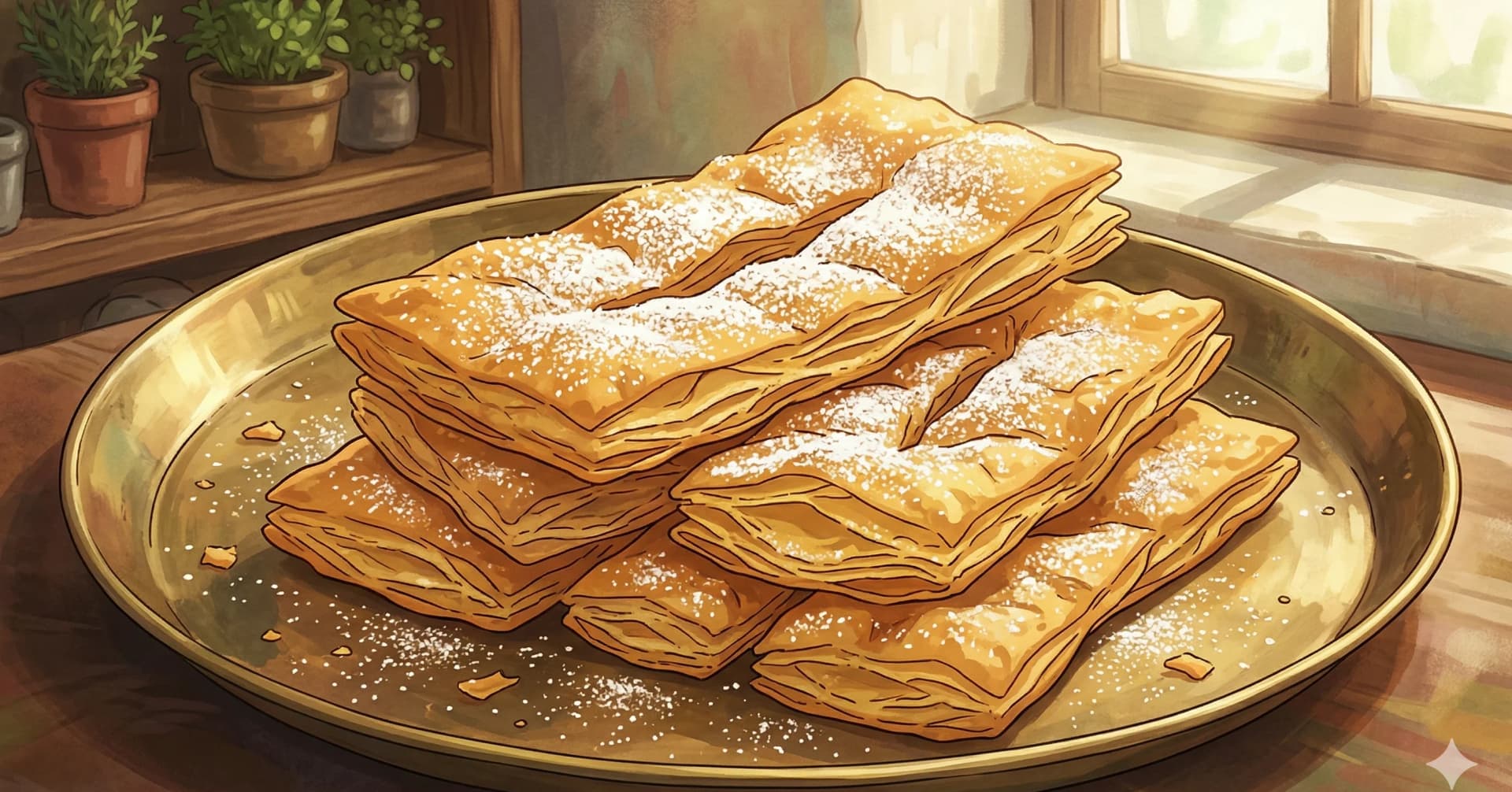
Khaja is not a recipe for the impatient. The rice must soak for three days, the water changed daily. The ghee paste must be beaten until it is light. The dough must be pounded on a grinding stone until smooth. The lamination (spreading, rolling, spreading again) must be done at least twice. The rounds must rest under a cold wet cloth. The frying must happen over a low flame, with ghee splashed continuously over the top, four pieces at a time, until the pastry turns white and crisp. Then the powdered sugar goes on.
This discipline is inseparable from what khaja is. The three-day rice soak develops a fine, slightly sour starch flour unlike anything that comes from raw rice. The repeated lamination with the ghee-rice paste creates dozens of thin layers within each pastry round, visible when you bite in. The sweet separates into pale, flaky strata that melt rather than crunch, dissolving on the tongue in successive waves of ghee-richness and barely-sweet pastry.
Khaja has deep roots in the Maithili and Odia culinary traditions. In Odisha, it is one of the 56 food offerings (chappan bhog) at the Jagannath temple in Puri, a rare honour that speaks to how central this pastry has been to the region's ritual and festive life. In Bihar, it is a wedding sweet, pressed on guests as they leave, wrapped in newspaper or muslin. In both traditions, it represents the cooking style of careful hands, of preparation that begins days before the eating.
The finished khaja is delicate but not fragile. White, not golden. The low-flame frying in ghee produces a pale, even colour that is the mark of a correctly made piece. Crisp without being hard. Layered to the very centre.
At a Glance
Yield
20–25 pieces
Prep
3 days (mostly passive rice soaking), 2 hours active
Cook
45 minutes
Total
3 days plus 3 hours active
Difficulty
Involved
Ingredients
Method
- 1
Day 1–3: Prepare the rice flour. Soak the rice in water for 3 days, changing the water completely each day. On day 3, drain the rice thoroughly and spread on a clean cloth away from direct sunlight. Allow to dry completely until no surface moisture remains. Pound or grind finely until you have a light, very fine flour. Set aside.
- 2
Make the ghee-rice paste. Measure 4 tablespoons of ghee (approximately 60 g) into a bowl. Beat in a circular motion with a wooden spoon for several minutes until the ghee is light, pale, and aerated, almost fluffy. Add half the ground rice flour and beat until smooth and homogeneous. This is the laminating paste. Set aside.
- 3
Make the dough. In a separate large bowl, combine the semolina with a pinch of salt. Rub in 2½ tablespoons of ghee (approximately 35 g) until the semolina resembles coarse, clumping breadcrumbs. Add milk gradually, kneading gently, until a stiff dough forms. Pound the dough vigorously on a grinding stone or hard surface until it becomes smooth and slightly elastic. This pounding develops the gluten structure necessary for flaky layers.
- 4
First lamination. Press the dough into a large, flat round. Spread half the rice-ghee paste evenly over the surface. Roll the dough up into a log, then roll out flat again. This is the first lamination.
- 5
Pound again. Pound the laminated dough briefly on the stone until smooth. Spread the remaining rice-ghee paste over the surface. Roll again. Divide into 4 equal balls.
- 6
Roll out and assemble. Roll the first ball as thinly as possible into a large, even round. Brush hot ghee over its surface and spread a quarter of the remaining rice-ghee paste over it. Allow to cool slightly. When cool, lay the second rolled-out round on top. Spread with more hot ghee and paste. Repeat if you have more layers. Roll the assembled rounds tightly into a log and cut into rounds 1.5–2 cm thick.
- 7
Rest under wet cloth. Lay the cut rounds on a clean tray. Cover completely with a cold, wet cloth and leave to rest for 15 minutes. This brief rest prevents the layers from unsealing during frying.
- 8
Fry. Heat ghee in a deep, wide pan over a low flame. When the ghee is warm (not hot, around 130–140°C), lower 4 khaja rounds into the ghee. Fry slowly, splashing the hot ghee over the tops of the khaja continuously with a spoon. Fry until crisp and pale white throughout, approximately 12–15 minutes on a genuinely low flame. The khaja should not brown; the pale colour is characteristic. Remove with a slotted spoon and drain.
- 9
Dust and serve. While still slightly warm, dust generously with powdered sugar.
Key Ingredient Benefits
Three-day-soaked rice flour is qualitatively different from commercially available rice flour or freshly ground rice. The extended soak and careful drying process produces a flour that is finer, lighter, and with a subtly more complex flavour. There is a slight fermentation note that provides depth without sourness in the finished pastry.
Ghee is the dominant fat here and performs structural functions beyond flavour. As the laminating agent, it provides the fat layer between dough sheets that creates flakiness. As the frying medium, its high smoke point (around 250°C) means it remains stable at the extended low temperatures used here without developing off-flavours. Ghee also contributes fat-soluble vitamins A, D, E, and K2. This is a festival sweet, rich and calorie-dense, eaten in small pieces.
Semolina provides the structural backbone of the dough. Its coarser grain compared to plain flour means the dough remains slightly firm even when laminated with fat, a necessary property to prevent the layers from simply merging together during assembly.
Why This Works
The three-day soaking of the rice is not merely traditional. It fundamentally changes the starch. Prolonged soaking breaks down some of the starch granules, producing a finer, lighter flour when ground. The slight souring that occurs over three days also weakens the starch structure, making the laminated layers more fragile and separable in the finished pastry.
The two-stage lamination (beating ghee into the flour paste and then spreading this paste between dough layers) creates a barrier system similar to puff pastry. Each layer of paste-fat prevents adjacent dough layers from fusing during frying, so they remain distinct and separate. When the khaja is fried, steam from the dough's moisture pushes these layers apart, creating the characteristic flaky interior.
Frying at a very low temperature over an extended period allows the interior to cook through and the layers to separate fully without the exterior browning. High-temperature frying would set a dark crust before the interior has separated, collapsing the layered structure.
Substitutions & Variations
- Shorter version: Substitute high-quality fresh commercial rice flour for the home-processed three-day-soaked version. The flavour will be different (plainer, less complex) but the technique works. Increase the ghee in the paste slightly to compensate for the drier commercial flour.
- Sugar syrup soak: Some Odia versions dip the fried khaja briefly in sugar syrup rather than dusting with powdered sugar. The syrup soak makes the exterior slightly sticky and gives a different sweetness, soaked all the way through rather than just on the surface.
- Without milk: Substitute water for milk in the dough. The result will be slightly less tender but still correct.
Serving Suggestions
Khaja is a standalone festival sweet, served at room temperature, usually in a small cloth or paper envelope at celebrations. Two or three pieces per person is the traditional serving. It is rich enough that more is not needed. No accompaniment is necessary or traditional. In Odia households it may be set out on a platter at festivals alongside other sweets such as rasagola and chhena poda. At the Jagannath temple in Puri, it is offered as prasad and received with both hands.
Storage & Reheating
Khaja keeps remarkably well when stored in an airtight container at room temperature. The ghee and dry starch structure resist moisture absorption. Properly made and stored, it will remain crisp for up to 10 days. Do not refrigerate. The cold introduces moisture and softens the layers. Reheating is not appropriate; khaja is a cold sweet, eaten at room temperature. If it has softened slightly from humidity, place in a very low oven (120°C) for 8–10 minutes to restore crispness.
Cultural Notes
Khaja (खाजा) is the layered fried sweet of refined flour and ghee dough rolled into thin layers, folded over itself many times to create a stratified flaky structure, cut into pieces, deep-fried in ghee until golden and shatter-crisp, and dipped in sugar syrup. The dish has documented historical traditions in two regions of India: the village of Silao in Bihar (where khaja is among the most established local sweets, with a Geographical Indication tag granted in 2018) and the city of Kakinada in Andhra Pradesh (where the Kakinada kaja is a regional specialty with its own GI tag granted in 2024). The dish also appears in the chappan bhog (the fifty-six-item offering of Hindu Jagannath temple cuisine at Puri, Odisha) as one of the temple's traditional sweets.
The dish's geographic spread reflects the long historical exchange of culinary techniques across the Indian subcontinent. The layered-pastry technique that produces khaja's signature flakiness has parallels in the broader Persianate dessert tradition (the Iranian baqlava family, the Central Asian chak-chak, the Mughal-influenced Indian seviyan), and the technique probably traveled to India through the Persian and Central Asian culinary exchanges of the Mughal era. The Bihari Silao tradition is documented as far back as the early nineteenth century and is associated with the Buddhist pilgrimage routes that pass through Nalanda and Bodh Gaya near Silao, while the Andhra Kakinada tradition developed in the coastal trading town of Kakinada through the late nineteenth and early twentieth centuries.
The technique requires careful lamination of the dough. Refined flour is sifted, salt added, and warm melted ghee is worked into the flour with the fingertips until the mixture resembles coarse breadcrumbs. Warm water is added gradually to form a soft pliable dough, which is rested for thirty minutes. The dough is rolled into a thin large rectangle (about a quarter-inch thick), brushed with melted ghee, and a thin layer of rice flour or cornstarch is dusted on top (this creates the visible separation between layers). The dough is rolled up tightly into a log, then sliced into half-inch rounds. Each round is pressed flat and rolled out into a thin disk (about three inches across), which displays the visible spiral of layers from the rolled log. The disks are slid into ghee heated to about 170°C and fried slowly for five to seven minutes per side until the layers puff and separate visibly and the surface turns deep golden. The fried khaja are drained and dipped in warm sugar syrup (one-string consistency, flavored with cardamom).
Nutrition Facts
Calories: 268kcal (13%)|Total Carbohydrates: 46.6g (17%)|Protein: 5.9g (12%)|Total Fat: 6.3g (8%)|Saturated Fat: 0.9g (5%)|Cholesterol: 0mg (0%)|Sodium: 1mg (0%)|Dietary Fiber: 1.6g (6%)|Total Sugars: 7.9g
You Might Also Like
Ratings & Comments
Ratings & Comments
Ratings
Share your thoughts on this recipe.
Sign in to rate and comment