Indian Cuisine
Pakora
Crisp chickpea-battered fritters, the only correct answer to a rainy afternoon
There is a specific association in the Indian imagination between rain and pakoras. When the monsoon arrives, when the smell of wet earth comes through the windows and the sky turns pewter, something automatic happens. Someone says "pakore banana chahiye" and within twenty minutes there is a bowl of batter on the kitchen counter and oil heating in a deep pan. It is not just food. It is a ritual.
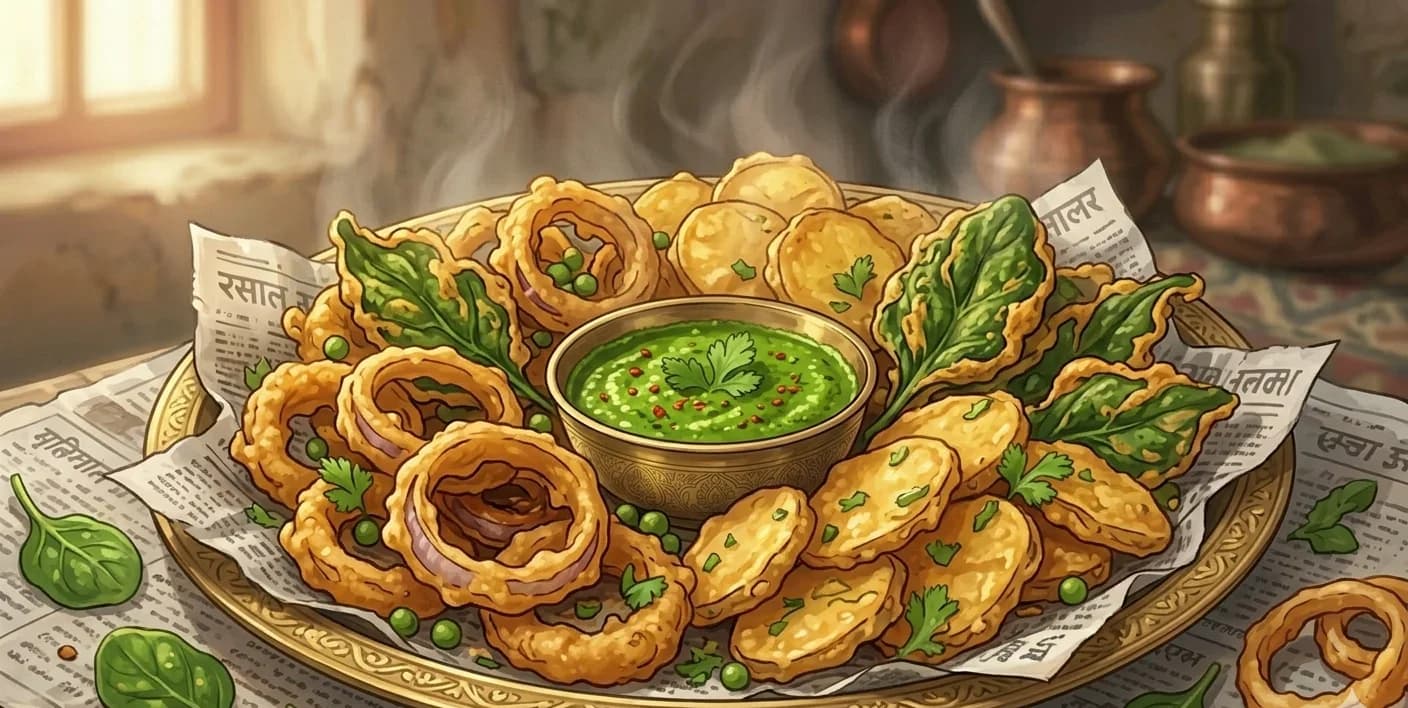
Pakora means fritter, loosely, and it encompasses an entire world: sliced onion, potato, spinach leaves, paneer, cauliflower, raw banana, green chillies stuffed with spiced potato, bread. Anything that can be coated in a thick chickpea batter and lowered into hot oil is a pakora candidate. But the great ones are the humble ones: onion, its petals separating in the batter and crisping individually; thin potato slices that cook through completely; whole spinach leaves coated thinly and fried until they shatter.
The batter is the thing. Besan (chickpea flour) gives it a distinctive nuttiness and a slight earthiness that wheat flour cannot replicate. The spicing is straightforward: cumin seeds for their warm, essential oil punch; ajwain for its thyme-like sharpness; red chilli powder for colour and heat. The batter should be thick enough to coat the back of a spoon without dripping off immediately. If it flows off too quickly, it will barely coat the vegetables and the fritter will be thin and greasy. If it's too thick, it will puff up into a doughy ball rather than a lacy, crisp fritter.
Temperature is the other variable. Oil that isn't hot enough produces pakoras that absorb fat before they can crisp. Oil that's too hot browns the outside before the interior cooks through. The sweet spot is around 175°C: pakoras sizzle immediately on contact and emerge deeply golden.
At a Glance
Yield
6–8 servings (approximately 30 pieces)
Prep
15 minutes
Cook
25 minutes
Total
40 minutes
Difficulty
Easy
Ingredients
- 3¼ cupchickpea flour (besan)
- 2⅓ tspcumin seeds
- 2 tspajwain / ajowan seeds
- 2¾ tspred chilli powder
- ⅞ tspsalt
- 1 cupcold water
- 7 ozonion (about 1–1½ onions), peeled and sliced into 5 mm rings
- 3½ ozpotato (about ½–1 potato), peeled and sliced into 3 mm rounds
- 1¾ ozfresh spinach leaves, washed and dried
- 3¼ tbspgreen chillies, halved lengthwise
- 1¾ tbspfresh ginger, finely grated (optional addition to the batter)
- 2 cupsneutral oil
Method
- 1
Make the batter. Sift the besan into a large bowl to remove any lumps. Add cumin seeds (1 tsp), ajwain (1 tsp), red chilli powder (1 tsp), salt (1 tsp), and grated ginger (10 g) if using. Add cold water gradually, whisking as you go, until the batter is smooth and thick. It should coat the back of a spoon and fall off in thick ribbons, not thin streams. Rest for 5 minutes; the besan will absorb the water slightly and the batter will thicken a little.
- 2
Prepare the vegetables. For onion (200 g) pakoras: separate the rings and toss through the batter, ensuring each ring is well coated. You want the batter to fill the rings somewhat so that the onion and batter fuse into a cohesive fritter rather than a battered ring. For potato (100 g) slices: pat dry with paper, then coat individually. For spinach (50 g): wash, dry completely (wet spinach will splatter violently in oil), and dip to coat.
- 3
Heat the oil. Pour oil into a deep pan or karahi to a depth of at least 5 cm. Heat over medium-high heat to approximately 175°C. To test without a thermometer: drop a small ball of batter into the oil. If it sinks, rises immediately to the surface, and begins sizzling vigorously, the oil is ready. If it sits on the bottom, the oil is too cold.
- 4
Fry in batches. Lower battered vegetables gently into the oil (use a spoon or your fingers carefully). Do not crowd the pan; overcrowding drops the oil temperature and leads to greasy, pale fritters. Fry for 3–4 minutes, turning once or twice, until deeply golden and crisp all over. Onion pakoras will darken quickly; potato rounds need the full time to cook through.
- 5
Drain and serve immediately. Remove with a slotted spoon and drain on paper for 30 seconds. Serve at once. Pakoras lose their crispness within minutes of leaving the oil.
Key Ingredient Benefits
Besan (chickpea flour) is nutritionally one of the most substantive flours used in Indian cooking. It contains significantly more protein than wheat flour (approximately 20% protein by weight), along with iron, magnesium, and B vitamins. Naturally gluten-free. That said, pakoras are best understood as an occasional pleasure rather than a health food.
Ajwain (carom seeds) contains thymol as its primary active compound, the same constituent that gives thyme its character. Traditionally used in Indian cooking as a carminative, and research supports its effectiveness as a digestive aid. This is probably why it appears so consistently in fried foods.
Cumin seeds provide earthy, warm depth. Their essential oils are released rapidly in hot fat. Research associates cumin with digestive enzyme stimulation, though the quantities in a batter are small.
Onion when fried becomes sweet and deeply savoury as its natural sugars caramelise. Contains quercetin and other flavonoid compounds associated with anti-inflammatory activity in research.
Spinach fried in a thin besan coat becomes intensely savoury, the leaves crisping to a translucent fragility. It contributes iron, folate, and vitamin K, and the fat-soluble vitamins in spinach are more bioavailable when consumed with fat.
Why This Works
Chickpea flour (besan) produces a distinctly different crust from wheat flour. Its protein structure behaves differently under heat, crisping more aggressively and with less tendency to become bready or doughy. Besan also contains natural emulsifying compounds that help the batter adhere to wet or oily vegetables without slipping off. Its nuttiness deepens as it fries, contributing to the characteristic pakora flavour that is as much the batter as the vegetable inside.
Cold water in the batter slows gluten development (besan has some gluten-like proteins) and keeps the batter lighter and crispier. Warm water produces a denser, heavier batter that absorbs more oil. The resting period allows the besan proteins to hydrate fully and the batter to reach a consistent viscosity before frying.
Ajwain is a deliberate digestive addition that appears in many fried Indian foods, but it also contributes a piercing, almost medicinal warmth that becomes mellow and complex in the hot oil. Combined with cumin seeds that pop and release their oils when they hit the oil, the spiced batter develops layers of aroma that the vegetables alone couldn't provide.
Substitutions & Variations
- Cauliflower pakora: Small florets coated and fried, one of the most popular versions. Blanch briefly first if the florets are thick, so the interior cooks through.
- Paneer pakora: Cubes of paneer dipped in batter and fried until the batter is golden while the paneer inside just softens. A richer, milkier version popular as an evening snack.
- Bread pakora: Slices of bread sandwiched around a potato filling, dipped in batter and fried. Found throughout North Indian cities.
- Cheese addition to batter: A pinch of chaat masala and ¼ tsp turmeric added to the batter gives a more vivid colour and extra complexity.
- Air-fryer version: Brush battered vegetables lightly with oil and air-fry at 200°C for 12–15 minutes, turning once. Less crisp than deep-fried, but substantially lighter.
Serving Suggestions
Pakoras are inseparable from chai. The combination of a strong, milky, ginger-spiced tea and a hot, salty, crisp fritter is one of the essential flavour pairings in Indian food culture. Serve with green coriander chutney and tamarind chutney alongside. A wedge of lemon on the side, squeezed over just before eating, lifts everything. The canonical serving is informal: a pile of pakoras in the center of the table, chutneys around them, people reaching in. Not plated. This is communal food, best eaten standing in the kitchen while the next batch finishes frying.
Storage & Reheating
Pakoras are fundamentally a serve-immediately food. They lose their crispness within 10–15 minutes of frying as steam from the interior softens the crust. That said, they reheat reasonably well in an oven at 200°C for 6–8 minutes or in an air fryer at 190°C for 4–5 minutes. Not as good as fresh, but acceptable. Do not microwave. Batter can be made up to 2 hours ahead (keep at room temperature; stir before using). Prepared but unfried battered pieces can be refrigerated for 30 minutes, though the batter tends to thin out as the vegetables release moisture.
Cultural Notes
Pakora (पकोड़ा, also called bhajia in western India) is the broad Indian category of deep-fried fritters made from a chickpea-flour batter spiked with chopped vegetables and Indian aromatics. The dish covers many specific preparations: onion pakora (sliced onions with the batter), spinach pakora (whole leaves dipped in batter), potato pakora (slices), cauliflower pakora (florets), and many others. The basic format is universal across the Indian subcontinent, with regional variations in the batter consistency, the dominant spice, and the dipping accompaniments.
The chickpea-flour batter is the technical foundation. Besan (chickpea flour) is whisked with water to a thick coating consistency, with the addition of salt, turmeric, kashmiri red chili powder, ground cumin or ajwain (carom seeds), chopped green chilies, chopped fresh cilantro, and sometimes a small amount of baking soda for additional puff. The batter's consistency matters: too thick produces heavy clumpy fritters, too thin produces a watery coating that slides off the vegetables. Some regional traditions add a small amount of rice flour to the chickpea flour for additional crispness.
The frying produces the crisp golden exterior. Sliced or whole vegetables are dipped in the batter, lifted with chopsticks or a fork to drain excess, and slid into oil heated to around 180°C. The pakoras fry for two to three minutes, turned periodically, until both sides develop a deep golden color and the batter has cooked through completely (raw chickpea flour has a bitter taste, so adequate cooking time is essential). The pakoras drain briefly on paper and are served immediately, while still crisp, with green chutney (cilantro and mint with green chili) or tamarind-date chutney for dipping. The dish appears at every Indian household during monsoon season (June through September across most of India), when the cool wet weather makes the warming fried snack feel seasonally right, and at countless tea-time gatherings across the year. Pakoras are also one of the standard accompaniments to evening chai at homes, at chai stalls, and at corner shops across India.
Nutrition Facts
Calories: 221kcal (11%)|Total Carbohydrates: 26.5g (10%)|Protein: 9.1g (18%)|Total Fat: 8.8g (11%)|Saturated Fat: 1.2g (6%)|Cholesterol: 0mg (0%)|Sodium: 651mg (28%)|Dietary Fiber: 4.9g (18%)|Total Sugars: 5.1g
You Might Also Like
Ratings & Comments
Ratings & Comments
Ratings
Share your thoughts on this recipe.
Sign in to rate and comment