Indian Cuisine
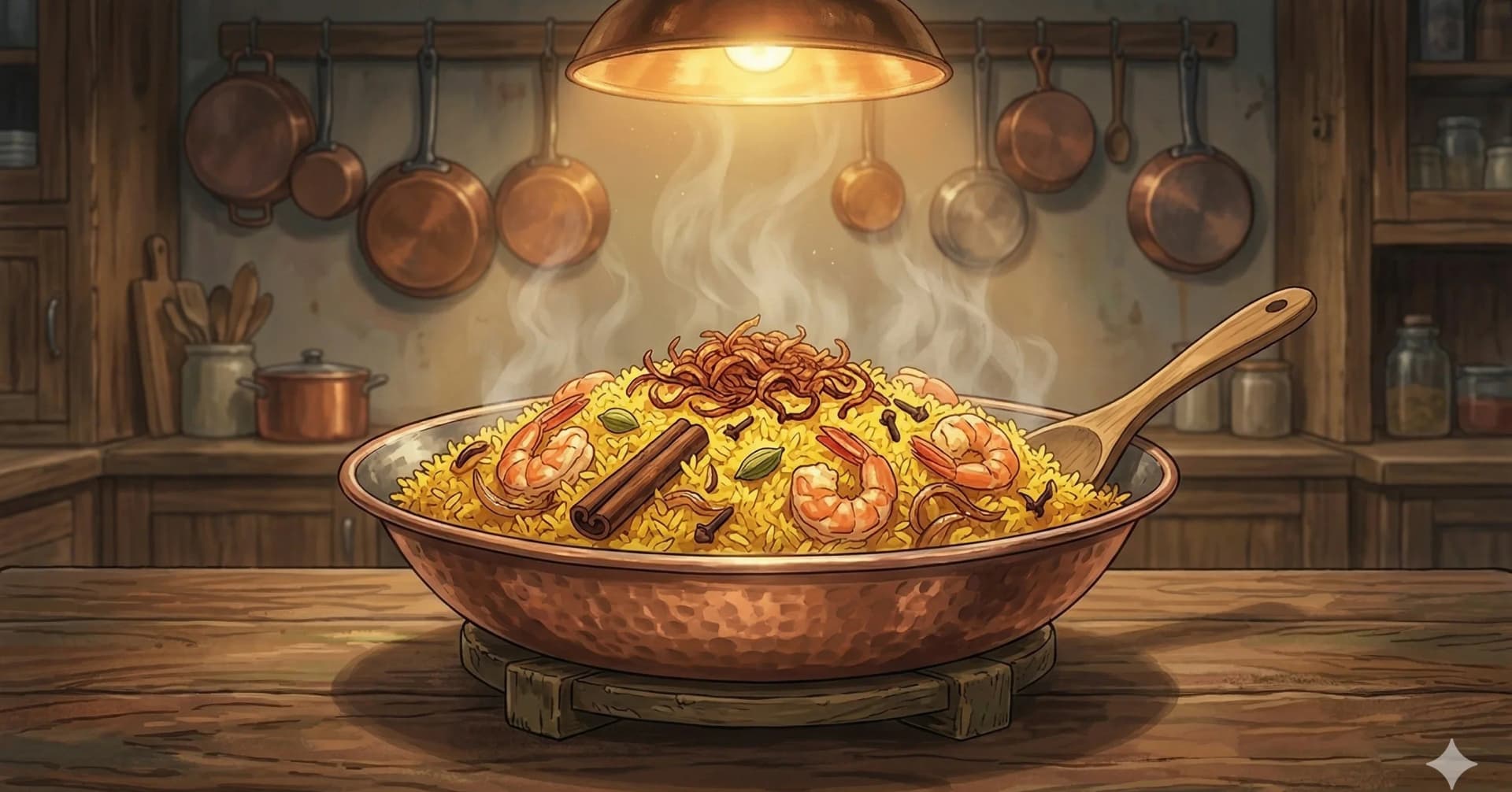
Prawn Pulao
Goan basmati rice cooked in prawn stock with tomato and whole spices
In Goa's seafood-rich cooking tradition, prawn pulao occupies a very different register from the spiced, heavily masala-forward rice preparations of the North Indian interior. The flavour here comes primarily from the stock (the liquid in which the rice cooks, made from prawn shells and heads and reduced to a deep, oceanic intensity) rather than from spice aromatics. The spices present (bay leaf, black pepper, cloves) are mild and background, providing a framework rather than a foreground.
Prawn stock is the ingredient that separates a genuinely good prawn pulao from a merely decent one. Prawn shells and heads contain a remarkable concentration of flavour: glutamates, minerals, and the unique sweet-savoury compounds of crustacean shells that, when simmered, produce a rich, deeply flavoured liquid that infuses the rice as it cooks. It is worth making the stock before everything else, even from a small quantity of shells. The difference is significant.
The technique is straightforward: ghee, whole spices, tomato, green chilli, rice fried briefly until the grains separate, then the prawn stock and fresh prawns added together. The prawns cook alongside the rice in the final stage, absorbing the stock's flavour while contributing their own. A small number of prawns are fried separately and arranged over the finished rice as a garnish. Their slightly crisp texture against the soft, fragrant rice provides the contrast that makes the dish as visually appealing as it tastes.
At a Glance
Yield
Serves 4–6
Prep
30 minutes (includes soaking and stock)
Cook
35 minutes
Total
1 hour 5 minutes
Difficulty
Medium
Ingredients
Stock Ingredients
- —Prawn shells and heads from 300 g fresh prawns (below)
- 2½ cupwater
- ⅓ tspwhole peppercorns
- 1bay leaf
Rice Ingredients
- 6 ozbasmati rice
- 1½ cupprawn stock (from above)
- ¾ lbfresh prawns, peeled and deveined (shells reserved for stock)
- 2 tspgreen chillies (about 2), slit lengthways
- 2¼ oztomatoes (about ½–1 tomato), finely chopped
- ¼ ozbay leaves (1–2 leaves)
- ½ tspwhole cloves (about 3)
- ⅓ tspwhole black peppercorns
- ⅛ tspsalt (about ¼ teaspoon, plus salt in stock)
- 3⅓ tbspghee, divided (35 g for cooking, 15 g for finishing prawns)
Method
- 1
Make the prawn stock (350 ml). Peel the prawns (300 g) and set the flesh aside in the refrigerator. Place the shells and heads in a small pot with 600 ml cold water (600 ml), the peppercorns (¼ teaspoon), and the bay (1 g) leaf (1). Bring to a boil, then simmer uncovered for 15–20 minutes until reduced by roughly a third. Strain and discard the solids. Season the stock lightly with salt (¼ teaspoon, plus salt in stock). You should have approximately 400 ml; measure out 350 ml for the pulao.
- 2
Soak the rice. Rinse the basmati in cold water until the water runs mostly clear. Cover with fresh cold water and soak for 30 minutes. Drain through a sieve.
- 3
Build the base. Heat 35 g of ghee (50 g) in a wide, heavy-based pot with a lid over medium heat. Add the bay leaves, whole peppercorns (¼ teaspoon), and cloves (3). Stir for 20 seconds. Add the chopped tomatoes (65 g) and slit green chillies (2). Cook for 3–4 minutes until the tomatoes soften.
- 4
Fry the rice. Add the drained soaked rice to the pot. Stir and fry, turning the rice in the ghee and tomato mixture, for 2–3 minutes until the grains are well coated and separated.
- 5
Add stock, prawns, and cook. Add the 350 ml of prawn stock and the salt. Stir once. Reserve 4–6 of the largest prawns for garnish. Add the remaining prawns to the pot. Bring to a boil over high heat, then reduce to the lowest simmer. Cover tightly and cook for 18–20 minutes until the rice has absorbed all the stock and is cooked through. The prawns will be cooked through by this point.
- 6
Fry the garnish prawns. While the rice cooks, heat the remaining 15 g of ghee in a small pan over high heat. Add the reserved large prawns with a pinch of salt. Fry for 1–2 minutes each side until pink, lightly golden, and cooked through. Set aside.
- 7
Serve. Gently fluff the pulao with a fork. Transfer to a serving platter and arrange the fried prawns over the top.
Key Ingredient Benefits
Prawns (Penaeus spp.) are one of the leanest animal proteins available: very low in fat, very high in protein per calorie, and a meaningful source of selenium, iodine, and vitamin B12. In Goan coastal cooking, they are as fundamental a protein as chicken or lamb is in the North Indian interior. Iodine in particular is important in coastal food systems where seafood has historically been the primary source; research confirms that seafood is among the most reliable dietary iodine sources.
Ghee here serves a different purpose than in heavier meat preparations. In a delicate prawn pulao, it is the carrier of the subtle whole-spice aromatics and the fat that keeps the rice grains separate and glossy. Its slightly nutty sweetness is compatible with the sweet, oceanic flavour of the prawn stock in a way that neutral oil is not.
Whole black peppercorns (Piper nigrum) are both flavour and functional in this recipe. Their heat compound, piperine, is strongly fat-soluble. Dissolved into the ghee during the initial blooming, it distributes throughout the rice with the fat. Piperine research is notable: it significantly enhances the bioavailability of numerous other compounds, including the curcumin in turmeric. Here, in a dish without turmeric, its role is primarily flavour, contributing warmth without the assertiveness of chilli.
Why This Works
Prawn stock is the functional heart of this recipe. When the rice cooks in prawn stock rather than plain water, the glutamates and mineral compounds from the stock permeate every grain. The result tastes definitively of the sea in a way that adding prawns alone to plain-water rice could not achieve. The prawns would flavour the gravy but not the grain. Cooking rice in a flavoured liquid is the fundamental principle of all pulao: the liquid is the flavour delivery system.
Frying the rice briefly in ghee before adding the liquid is the technique that ensures separate, non-sticky grains. The fat coats the starch on the grain's exterior and slows the rate at which water is absorbed, preventing the starch from over-hydrating and becoming gummy. This single step is what separates a well-made pulao from a pot of boiled rice with added ingredients.
Adding the prawns raw to the rice for the final cooking stage rather than cooking them separately is calculated: prawns cook very quickly (2–3 minutes), but in a covered pot on low heat with 20 minutes of residual steam, they cook gently and evenly without over-firming. Prawns cooked separately and added to the finished rice tend to become rubbery if they were pre-cooked and then sit in the hot rice.
Substitutions & Variations
No prawn stock: Use a good-quality fish or vegetable stock. The oceanic character will be less pronounced but the dish will still be fragrant.
Coconut milk: Replace half the prawn stock with coconut milk for a richer, Goan-style version that leans into the region's coconut cooking tradition.
Tiger prawns: Large tiger prawns, halved lengthways, cook in the same time as smaller prawns and make a more impressive dish for a special occasion.
Add tomato paste: 1 tablespoon of tomato paste dissolved in the stock deepens the colour and adds a slightly richer tomato note.
Serving Suggestions
Prawn pulao is a complete dish: substantial enough to serve as the centrepiece with only a green salad or a raita alongside. In Goan tradition, it might be accompanied by a coconut-based vegetable preparation or a fried fish. Serve immediately after finishing; rice dishes with seafood lose their best texture as they cool.
Storage & Reheating
Best eaten immediately. Can be refrigerated for 1 day — the prawns will firm slightly and the rice will absorb more moisture. Reheat covered with a splash of water over low heat. Does not freeze well — prawn texture deteriorates significantly on freezing and thawing.
Cultural Notes
Prawn pulao (झींगा पुलाव, jhinga pulao) is the coastal Indian rice preparation in which marinated prawns are cooked together with spiced basmati rice in a single pot, drawing on the seafood-rich culinary traditions of Bengal, Maharashtra, Goa, and Kerala. The dish has multiple regional forms: the Bengali version (chingri pulao) is on the sweeter side with a touch of sugar and ghee, the Maharashtrian version uses a deeper masala profile with coconut, the Goan version may include coconut milk and a Portuguese-influenced spice mix (recheado masala or cafreal paste), and the Malabari Kerala version uses coconut, curry leaves, and the broader South Indian spice palette.
The technical demand is timing. Prawns cook extremely fast (90 seconds to 2 minutes in hot oil or in the steam of a covered pot), so the dish has to be assembled in a way that lets the rice finish cooking without overcooking the prawns. The most common technique marinates the prawns briefly in turmeric, salt, and a small amount of lemon juice or yogurt, lightly sautés them in ghee or oil with whole spices (cumin, cardamom, cinnamon, bay leaf) until they just turn pink, then removes the prawns from the pot. Soaked basmati rice is added to the same pot, toasted briefly in the leftover oil and aromatics, then cooked with measured water or fish stock and the partially cooked prawns layered back on top for the last ten minutes of steam cooking.
The dish appears at coastal Indian family meals and at the seafood-focused restaurants of Mumbai, Kolkata, Goa, and Kerala. The Bengali bhadralok (cultured upper-class) home cooking tradition treats chingri pulao as the prestige preparation for visiting guests, often using the larger king prawns (called galda chingri) that Bengali fish-and-prawn cookery prizes highly. The Goan and Mangalorean versions appear at family lunches alongside sol kadi (a coconut-and-kokum drink) and a side of recheado-stuffed fried fish. Indian-Goan cookbook writer Maria Teresa Menezes and Bengali food writer Bhaswati Chakravorty have both documented regional variations in published cookbooks and online food columns.
Nutrition Facts
Calories: 223kcal (11%)|Total Carbohydrates: 23.6g (9%)|Protein: 12.1g (24%)|Total Fat: 8.8g (11%)|Saturated Fat: 5.2g (26%)|Cholesterol: 102mg (34%)|Sodium: 228mg (10%)|Dietary Fiber: 0.5g (2%)|Total Sugars: 0.3g
You Might Also Like
 Easy
EasyGoan · Indian Cuisine
Maharashtrian Tomato Soup (Tomato Saar)
30 minutes
 Medium
Goan · Indian Cuisine
Goan Sour-Spicy Curry (Ambotik)
50 minutes
 Involved
Indian Cuisine
Sesame-Crusted Rice Cookies (Anarsas)
3 days plus 5 hours active and rest
 Involved
Indian Cuisine
Honeycomb Milk Cake (Ghevar)
1 hour 30 minutes
Ratings & Comments
Ratings & Comments
Ratings
Share your thoughts on this recipe.
Sign in to rate and comment