Punjabi · Indian Cuisine
Punjabi Kadhi
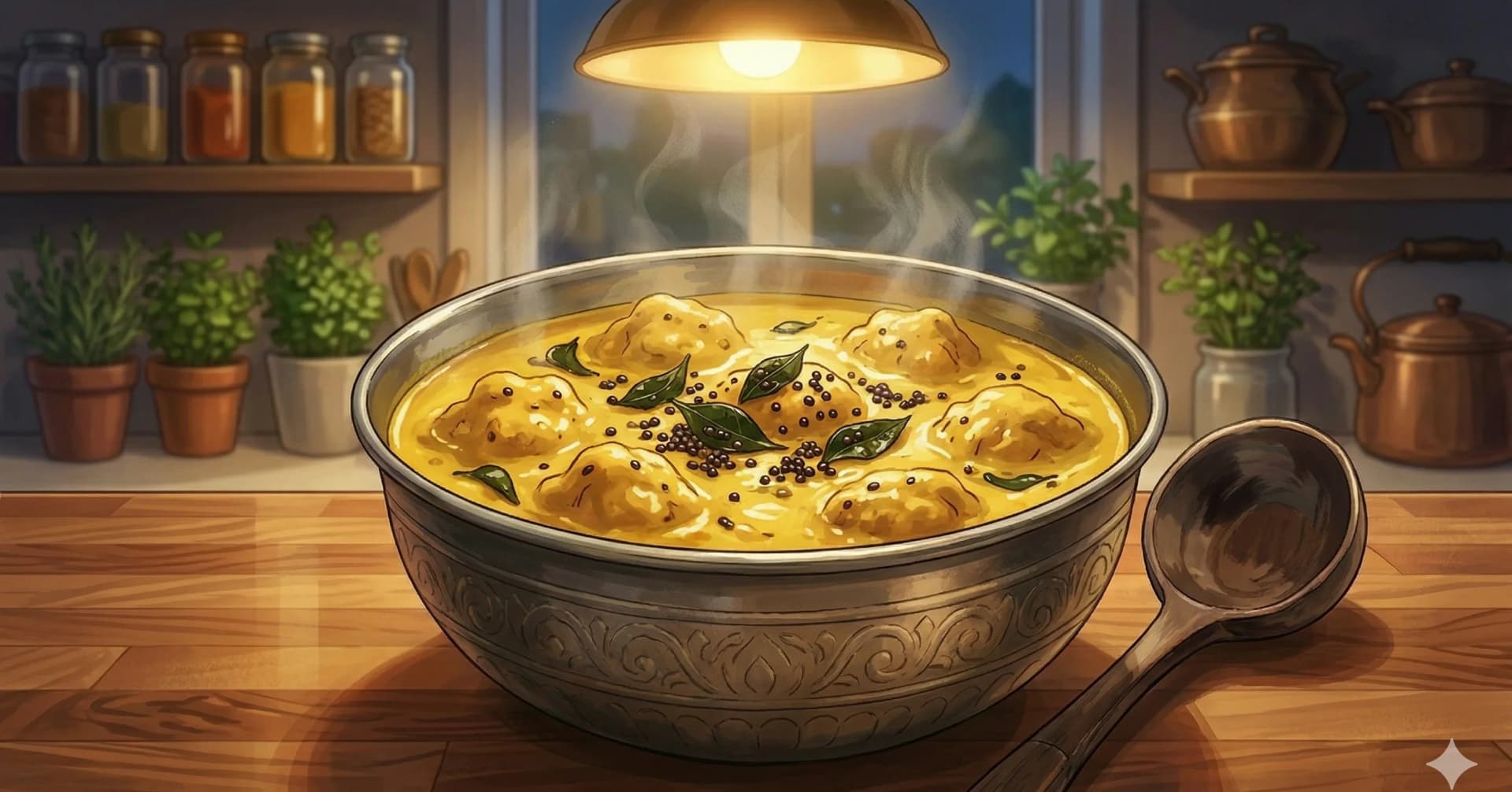
Tangy yoghurt and gram flour curry with spiced spinach pakodas
Kadhi has a character that is difficult to describe to someone who hasn't tasted it: sour, thick, deeply savoury, faintly spiced, with a cling that coats every grain of rice it meets. It is also, by traditional cooking standards, one of the more demanding weekday dishes. Not in technique, but in time. A good Punjabi kadhi simmers for an hour, minimum. During that time the raw besan slowly cooks out, the yoghurt's acidity mellows, and the whole mixture thickens from a pale yellow liquid into something that will hold its texture on a plate.
The Punjabi version is distinguished from its regional counterparts by its relative simplicity and its pakodas: soft dumplings of besan and spinach, deep-fried until crisp, then added to the simmering kadhi where they absorb the tangy gravy and soften to a yielding, almost custardy texture. The contrast between the outer surface of the pakoda (now softened from the long braise) and its denser interior is one of the pleasures of the dish.
The tempering at the end (whole red chillies bloomed in hot oil) is both practical and visual: it re-introduces heat and a hint of smokiness to the finished kadhi, and the red oil that pools over the yellow surface is how a finished Punjabi kadhi should look at the table.
This is a dish that rewards patience and suffers when rushed. Serve over plain boiled rice with a dry vegetable on the side.
At a Glance
Yield
Serves 4–6
Prep
25 minutes
Cook
1 hour 15 minutes
Total
1 hour 40 minutes
Difficulty
Medium
Ingredients
Kadhi Ingredients
- ½ cupbesan (gram/chickpea flour)
- 1 lbplain yoghurt, full-fat
- ¼ cupneutral oil
- 1⅓ tspcumin seeds
- 1⅛ tspcoriander seeds
- ¾ tspajwain / carom seeds
- 1 tspwhole dried red chillies (2 chillies), plus extra for tempering
- 1¼ ozonion, finely chopped
- ⅔ tspsalt
- 1⅛ tspred chilli powder
- ⅓ tspturmeric
- 1¼ tbspgreen chillies (about 3), finely chopped
- 1⅓ tspginger and garlic paste (combined)
Method
- 1
Beat the yoghurt (500 g). Place the yoghurt in a large bowl. Add the besan (50 g), turmeric (¼ teaspoon), red chilli (¼ teaspoon) powder (¼ teaspoon), and salt (¾ teaspoon). Whisk vigorously until completely smooth. No lumps of besan should remain. This mixture will look quite thin at first. Set aside.
- 2
Build the masala. Heat the oil in a large, wide, heavy-based pot over medium heat. Add the cumin (½ teaspoon) seeds (¾ teaspoon), coriander (2 teaspoons) seeds (½ teaspoon), and ajwain (½ teaspoon). When they splutter and darken, add the whole dried red chillies (2 g). Within 15 seconds, add the ginger-garlic paste and green chillies (3). Stir for 1 minute.
- 3
Add the onions. Add the chopped onions and stir-fry for 5–6 minutes until softened but not browned.
- 4
Add the yoghurt mixture. Pour the yoghurt-besan mixture slowly into the pot, stirring constantly. Bring to a boil over medium-high heat. This is important. Once it boils, reduce to a gentle simmer. Cook uncovered, stirring occasionally, for 1 hour. The kadhi will thicken, deepen in colour, and lose its raw besan (85 g) flavour. At the 30-minute mark, taste it. It should taste pleasantly sour and slightly thick. At the 60-minute mark it should be fully cohesive, with no raw flour note. Adjust salt (¾ teaspoon). **Make the pakodas:**
- 5
Make the batter. Combine the besan, sliced onion (35 g), chopped spinach (35 g), cumin powder, ginger (3 g), green chilli (1 g), salt, red chilli powder, and coriander powder in a bowl. Add just enough water, a tablespoon at a time, to form a thick batter that holds its shape when scooped. It should be thicker than pancake batter and should hold a rough shape when dropped from a spoon.
- 6
Fry the pakodas. Heat sufficient oil for deep-frying in a separate pot to 170°C (or until a small drop of batter sizzles and rises to the surface immediately). Drop rounded tablespoons of batter into the oil. Do not overcrowd. Fry for 3–4 minutes, turning, until deep golden all over. Remove with a slotted spoon and drain on kitchen paper.
- 7
Add pakodas to kadhi. When the kadhi has simmered for its full hour, add the fried pakodas to the pot. Bring back to a boil, then simmer for a further 5 minutes until the pakodas have absorbed some of the kadhi and swelled slightly.
- 8
Final tempering. In a small pan, heat 2 tablespoons of oil until very hot. Add 2–3 whole dried red chillies. Within 20 seconds they will darken and crisp. Pour this immediately over the finished kadhi. Serve at once.
Key Ingredient Benefits
Besan (chickpea / gram flour, Cicer arietinum) is one of the most protein-dense flours available in the Indian kitchen, significantly higher in protein than wheat flour, and naturally gluten-free. It is a source of B vitamins, particularly folate, and contains iron and magnesium. In both Ayurvedic and Unani traditions, chickpea preparations are considered strengthening and are associated with sustained energy without heaviness.
Ajwain / carom seeds (Trachyspermum ammi) have a sharp, slightly thyme-like flavour that comes from thymol, the same compound responsible for the aroma of thyme. In traditional medicine systems including Ayurveda and Unani, ajwain is widely used as a digestive aid, thought to ease flatulence and improve digestion of difficult-to-digest foods like legumes. Its appearance in a besan-yoghurt preparation is particularly deliberate.
Plain yoghurt (Lactobacillus bulgaricus culture) is the structural base of this dish. Its lactic acid provides the characteristic tanginess, and its proteins, once stabilised by the cooking besan, give the kadhi its body. Fermented dairy products like yoghurt are associated with gut microbiome diversity in research on fermented foods and digestive health.
Why This Works
Whisking the besan thoroughly into the yoghurt before cooking is not optional. Lumps of unwhisked besan will not break down during cooking and will produce an unpleasant, grainy texture. The fat in the yoghurt and the moisture together thin the besan enough to disperse it evenly.
Bringing the yoghurt-besan mixture to a boil before reducing to simmer is a critical step that novice cooks sometimes skip out of worry about the mixture splitting. The yoghurt does curdle slightly when first heated, which is why continuous stirring during the initial heating is important. As the besan cooks, its starch gelatinises and acts as a stabiliser, eventually preventing further separation and creating the smooth, thick finished kadhi.
The one-hour simmer is non-negotiable for the same reason besan appears in the ingredient list at all: raw chickpea flour tastes distinctly and unpleasantly floury. An hour of gentle simmering cooks the starch out completely. Rushing this process produces kadhi that tastes of raw flour regardless of the other flavours.
Substitutions & Variations
Pakoda variations: The pakodas can be made with just onion (no spinach), or with methi (fresh fenugreek leaves) instead of spinach for a more bitter, aromatic version that is particularly good.
No pakodas: Kadhi without pakodas is also eaten, particularly in summer when the lighter version is preferred. Just serve the simmered yoghurt base over rice as a thin, tangy gravy.
Sour yoghurt: Traditional kadhi ideally uses yoghurt that is slightly sour. Day-old yoghurt left at room temperature has a more pronounced acidity that is actually preferred in this dish. If your yoghurt is very fresh and mild, add a small squeeze of lemon juice to the yoghurt mixture before cooking.
Consistency: For a thinner kadhi, increase the water in the base to 750 ml total liquid. For a very thick, restaurant-style kadhi, use the proportions above but simmer uncovered for up to 90 minutes.
Serving Suggestions
Punjabi kadhi is traditionally served over plain steamed or boiled rice. That combination is one of the fundamental North Indian comfort meals. The rice absorbs the tangy gravy; the pakodas provide body and contrast. A dry sabzi on the side (aloo gobhi or any simply spiced vegetable) and pappadums complete a satisfying meal. Kadhi is filling and warming; this is cold-season food, and it has been made in Punjabi kitchens through every winter for generations.
Storage & Reheating
Kadhi keeps well in the refrigerator for up to 3 days and actually improves slightly on the second day as the flavours settle. The pakodas will be fully softened by then, which is a matter of preference. Some find this preferable; others add fresh pakodas when reheating. To reheat, warm over low heat, stirring, and add a splash of water if it has thickened too much. Does not freeze well. The yoghurt base tends to split on thawing.
Cultural Notes
Punjabi kadhi (पंजाबी कढ़ी) is the simpler base version of the broader kadhi-pakora family, served as a plain yogurt-and-chickpea-flour curry without the addition of fritters. The dish is the everyday Punjabi home version, appearing on home dinner tables across Punjab, Delhi, and the broader Punjabi diaspora as the lighter, faster, more economical alternative to the more elaborate kadhi pakora. Where kadhi pakora is treated as a slightly special preparation requiring the additional step of frying pakoras, plain Punjabi kadhi is the workday version that can be made in thirty minutes from pantry ingredients.
The dish belongs to the broader Indian kadhi family that exists across most of the regional cuisines: the sweet thin Gujarati kadhi, the chickpea-flour-dumpling Rajasthani gatte ki kadhi, the coconut Kerala moru curry, and various other regional yogurt-based curry traditions. The Punjabi version is distinguished by its thick consistency, the deep yellow color from generous turmeric, the heavy tempering of fenugreek seeds and dried red chilies, and the absence of the sweetness that characterizes the Gujarati and Rajasthani versions.
The technique is identical to kadhi pakora minus the fritters. Yogurt and chickpea flour are whisked smooth together, thinned with water, brought to a simmer with constant stirring, and cooked at low heat for thirty to forty minutes until the chickpea flour cooks through and the curry thickens. The Punjabi home version sometimes adds finely chopped onion, ginger, and slit green chilies to the simmering curry for additional flavor and texture, and a final tempering of ghee with cumin, mustard seeds, fenugreek seeds, dried red chilies, and asafoetida is poured over just before serving. The dish is most often served with plain steamed basmati rice, which absorbs the curry and provides the carbohydrate base of the meal, and the pairing of kadhi-chawal (kadhi over rice) is the standard Punjabi comfort food that home cooks teach to their children as one of the foundational vegetarian meals. The dish travels well as packed lunches and reheats easily, which has made it a staple of Punjabi office workers' tiffin lunches and college student dining for generations.
Nutrition Facts
Calories: 247kcal (12%)|Total Carbohydrates: 18.3g (7%)|Protein: 8.3g (17%)|Total Fat: 15.8g (20%)|Saturated Fat: 3.6g (18%)|Cholesterol: 11mg (4%)|Sodium: 1387mg (60%)|Dietary Fiber: 2.8g (10%)|Total Sugars: 6.8g
You Might Also Like
Ratings & Comments
Ratings & Comments
Ratings
Share your thoughts on this recipe.
Sign in to rate and comment