Indian Cuisine
Rasmalai
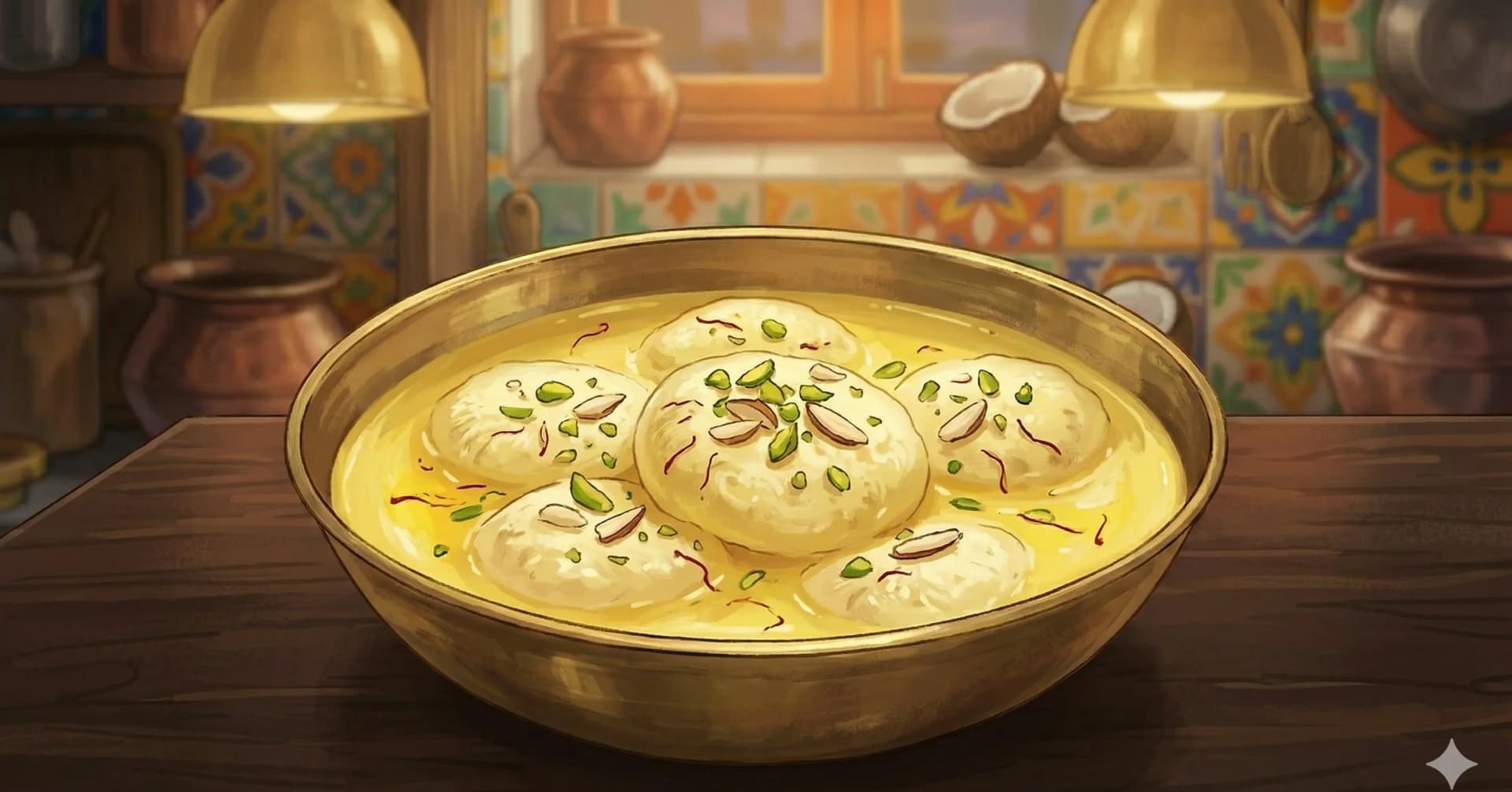
Soft chhena discs floating in saffron-scented, cardamom-spiced thickened milk
Rasmalai is roshogolla's more opulent cousin. Same foundation of soft, milky chhena, but dressed in something entirely different. Here the discs float in rabri: a slow-reduced, heavily perfumed thickened milk the colour of pale gold, scented with saffron and cardamom, scattered with slivers of pistachio and almond. Where roshogolla is clean and singular, rasmalai is layered and luxurious. Each spoonful contains both the yielding softness of the chhena and the rich, almost custardy density of the rabri. The contrast is the point.
The sweet originated in Bengal, where the chhena tradition runs deepest in Indian sweets-making, and has spread across the subcontinent to become one of the most beloved festive sweets at Eid, Diwali, and celebratory family meals. In Bengali sweet shops, it is often displayed in wide, shallow trays in cooling glass cases, the rabri fragrant and still warm, the discs barely visible beneath the surface.
Rasmalai is a two-component recipe, and both components require patience. The chhena discs are made and cooked in sugar syrup first, exactly as for roshogolla, but shaped into flat rounds rather than balls. The rabri is made separately by simmering full-fat milk in a wide, open pan over low heat, stirring frequently, until it thickens into a dense, cream-coloured sauce. This reduction takes time. Plan for 40 to 50 minutes. The flavour that develops, though, is irreplaceable.
One practical note that makes a real difference: gently squeeze the cooked chhena discs before adding them to the rabri. If left in syrup-soaked form, they will dilute the rabri and flatten its flavour. Once pressed and transferred, allow four hours of chilling time. The discs slowly absorb the rabri, and the result, when you finally taste it cold, is worth every hour of waiting.
At a Glance
Yield
10–12 pieces
Prep
40 minutes
Cook
1 hour
Total
2 hours + 4 hours chilling
Difficulty
Medium
Ingredients
- 1 qtfull-fat milk, for the chhena
- 3½ tbsplemon juice or white vinegar
- 1½ cupwhite sugar, for the syrup
- 2⅛ cupwater, for the syrup
- 1½ qtfull-fat milk, for the rabri
- ¾ cupsugar, for the rabri
- 2½ tspcardamom powder
- 10 strandssaffron, soaked in 2 tbsp warm milk for 15 minutes
- ¾ ozpistachios, thinly sliced
- ¾ ozalmonds, thinly slivered
Method
- 1
Curdle the milk for the chhena. Bring the 1 litre of milk to a full boil in a heavy pan, then take it off the heat and let it stand for a minute so it drops just below boiling. Add the lemon juice a little at a time, stirring gently after each addition. The milk will separate into soft white curds and thin, greenish whey. Stop adding acid the moment the whey runs clear. More acid than you need makes the chhena tough and sour.
- 2
Strain and rinse cold. Pour the curds into a muslin-lined sieve. Gather the cloth and hold the bundle under cold running water for 30 seconds, squeezing gently. The rinse washes out the lemon so the finished sweet does not taste sour, and the cold shock firms the protein slightly, which makes the next step easier. Twist the cloth to press out the water and hang the bundle for 30 minutes until it stops dripping.
- 3
Knead to a smooth matrix. Turn the drained chhena onto a clean surface and knead with the heel of your hand for 8 to 10 minutes, pushing it away and gathering it back. It starts grainy and gradually turns smooth, soft and faintly greasy under the palm. It is ready when you can roll a small piece between your fingers with no visible grain. Under-kneaded chhena gives hard, gritty centres, and there is no fixing it later.
- 4
Shape into discs. Divide the chhena into 10 to 12 portions and roll each into a smooth crack-free ball, then press it gently between your palms into a disc about 4 cm across and 1 cm thick. Discs rather than balls give more surface area for the rabri to soak into, which is the whole point of the dish.
- 5
Simmer in syrup. Combine the 300 g sugar and 500 ml water in a wide pan and bring to a rolling boil. Slide the discs in, cover, and boil hard for 12 to 15 minutes. They will swell to roughly double and turn slightly translucent at the edges. Keep the lid on: the trapped steam is what inflates them. Take the pan off the heat and let them cool in the syrup.
- 6
Reduce the milk for the rabri. While the discs cool, pour the 1.5 litres of milk into the widest heavy pan you own and simmer over medium heat, stirring often and scraping the sides back in, until it has reduced by about half. This takes 45 minutes to an hour. A wide pan evaporates faster and lets the milk sugars caramelise gently around the rim, which is where the rabri gets its depth.
- 7
Sweeten and perfume the rabri. Stir the 150 g sugar into the reduced milk until it dissolves, then add the cardamom powder and the saffron along with the warm milk it soaked in. The saffron will streak amber through the cream before it evens out. Simmer for 5 more minutes, then take it off the heat.
- 8
Squeeze and combine. Lift each disc from the syrup and press it gently between your palms to expel most of the syrup it absorbed. Do not skip this. A syrup-loaded disc will thin the rabri into something watery and flat. Lower the squeezed discs into the warm rabri and turn them once to coat.
- 9
Chill and serve. Cover and refrigerate for at least 4 hours, preferably overnight. The discs go on absorbing rabri the whole time and the flavour settles. Serve cold in shallow bowls with plenty of the milk, scattered with the sliced pistachios and slivered almonds.
Key Ingredient Benefits
Saffron (the dried stigmas of Crocus sativus) has been used in South Asian cooking for centuries, particularly in Mughal and royal Bengali kitchens. The compound safranal is responsible for its distinctive aroma. Research suggests it may have antioxidant properties, though the quantities used in cooking are small. In Ayurvedic practice, saffron is traditionally associated with warming the body and supporting digestion.
Cardamom has a long history of use in South Asian culinary and medicinal traditions. It is traditionally valued for aiding digestion after rich meals, a relevant quality when served as a dessert after a substantial feast. Research suggests it may have mild anti-inflammatory properties.
Full-fat milk provides the fat necessary for the rabri to develop its characteristic richness and body. As the milk reduces, milk solids (lactose, proteins, and fat) concentrate, creating a more nutritionally dense component than fresh milk.
Pistachios and almonds contribute tocopherols (vitamin E), magnesium, and healthy fats. They also provide textural contrast. Their slight crunch against the soft chhena and creamy rabri is a deliberate part of the dish's character.
Why This Works
Flattening into discs rather than balls increases the surface area of each piece, allowing the chhena to absorb the rabri more efficiently during chilling. The flat shape also presents more elegantly in a bowl.
Squeezing out the syrup before adding the discs to the rabri is essential. Syrup-saturated chhena will thin the rabri and create an insipid, watery sauce. The gentle press ensures the chhena is ready to absorb the rabri rather than diluting it.
Reducing milk in a wide pan allows more surface evaporation per unit of time, making the process faster and producing a more complexly flavoured result as the milk sugars gently caramelise around the edges of the pan.
Saffron bloomed in warm milk releases its colour and aromatic compounds more effectively than adding it directly to boiling liquid. The fat and warmth help extract the fragrance.
Substitutions & Variations
Rose water instead of or alongside saffron: A few drops of rose water added to the cooled rabri gives a different but equally traditional aromatic profile.
Kesar Rasmalai: Double the saffron quantity for a deeply golden, intensely perfumed rabri, a popular variation for special occasions.
Using store-bought ricotta: Ricotta can substitute for chhena in a pinch, though the texture will be slightly grainier. Drain it well through muslin before kneading.
Smaller portions: This recipe makes generous discs. For a lighter presentation, shape smaller, thinner discs and reduce syrup cooking time to 10 minutes.
Serving Suggestions
Serve rasmalai well chilled in individual shallow bowls or on a dessert plate with a generous ladle of rabri. The sweet is complete on its own but benefits from a few extra sliced pistachios for colour. It is traditionally served as the final course of a Bengali feast or festive meal.
Rasmalai also works beautifully at a sweets table alongside roshogolla and mishti doi. The three together represent the heart of the Bengali sweet tradition.
Storage & Reheating
Store rasmalai in an airtight container submerged in the rabri in the refrigerator for up to 3 days. The flavour deepens overnight as the chhena continues to absorb the saffron and cardamom.
Do not freeze. Both the chhena and the rabri lose their texture and become watery on thawing.
Rasmalai is served cold and does not require reheating.
Cultural Notes
Rasmalai (রসমালাই, "juice cream") is the Bengali sweet of small flat discs of chhena (fresh paneer-style curd cheese) soaked in cardamom-and-saffron-perfumed reduced milk (rabri), topped with crushed pistachios and slivered almonds, and served chilled in small bowls. The dish is one of the most internationally famous Bengali sweets after roshogolla and one of the foundational preparations of the chhena-based sweet tradition that defines Bengali confectionery. The dish has a documented Bengal origin and has been served at Bengali sweet shops for at least a century, with the modern form crystallizing in the late nineteenth and early twentieth centuries alongside the broader Bengali chhena revolution.
The technical foundation is the milk reduction. Whole milk is brought to a low simmer in a heavy-bottomed pot, then cooked at the lowest possible heat for ninety minutes to two hours, stirred periodically to prevent skin formation and to push the partially-formed skin (malai) back into the milk. The reduction concentrates the milk solids and develops a slightly caramelized character that distinguishes properly reduced rabri from simply sweetened condensed milk. Green cardamom pods and a small pinch of saffron are added during the reduction, and sugar is stirred in toward the end so it dissolves completely. The finished rabri is roughly half the original volume of milk and has a thick, almost custard-like consistency.
The chhena preparation parallels rosogolla but with a different shape. Fresh chhena is kneaded smooth, formed into small flat discs about an inch and a half across and half an inch thick (the disc shape distinguishes rasmalai from the round rosogolla), and cooked briefly in a thin sugar syrup until they swell and turn slightly translucent. The discs are then drained, gently squeezed to remove excess syrup, and transferred to the cooled rabri where they soak for at least four hours and ideally overnight, absorbing the milk and the perfumed flavors throughout. The dish is served chilled with a generous scatter of crushed pistachios, slivered almonds, and a few additional saffron threads on top. KC Das and Bhim Chandra Nag in Kolkata, along with the Mishti shops in major Bengali population centers, serve canonical reference versions.
Nutrition Facts
Calories: 208kcal (10%)|Total Carbohydrates: 30g (11%)|Protein: 5g (10%)|Total Fat: 8g (10%)|Saturated Fat: 4g (20%)|Cholesterol: 20mg (7%)|Sodium: 55mg (2%)|Dietary Fiber: 0.5g (2%)|Total Sugars: 28g
You Might Also Like
Ratings & Comments
Ratings & Comments
Ratings
Share your thoughts on this recipe.
Sign in to rate and comment