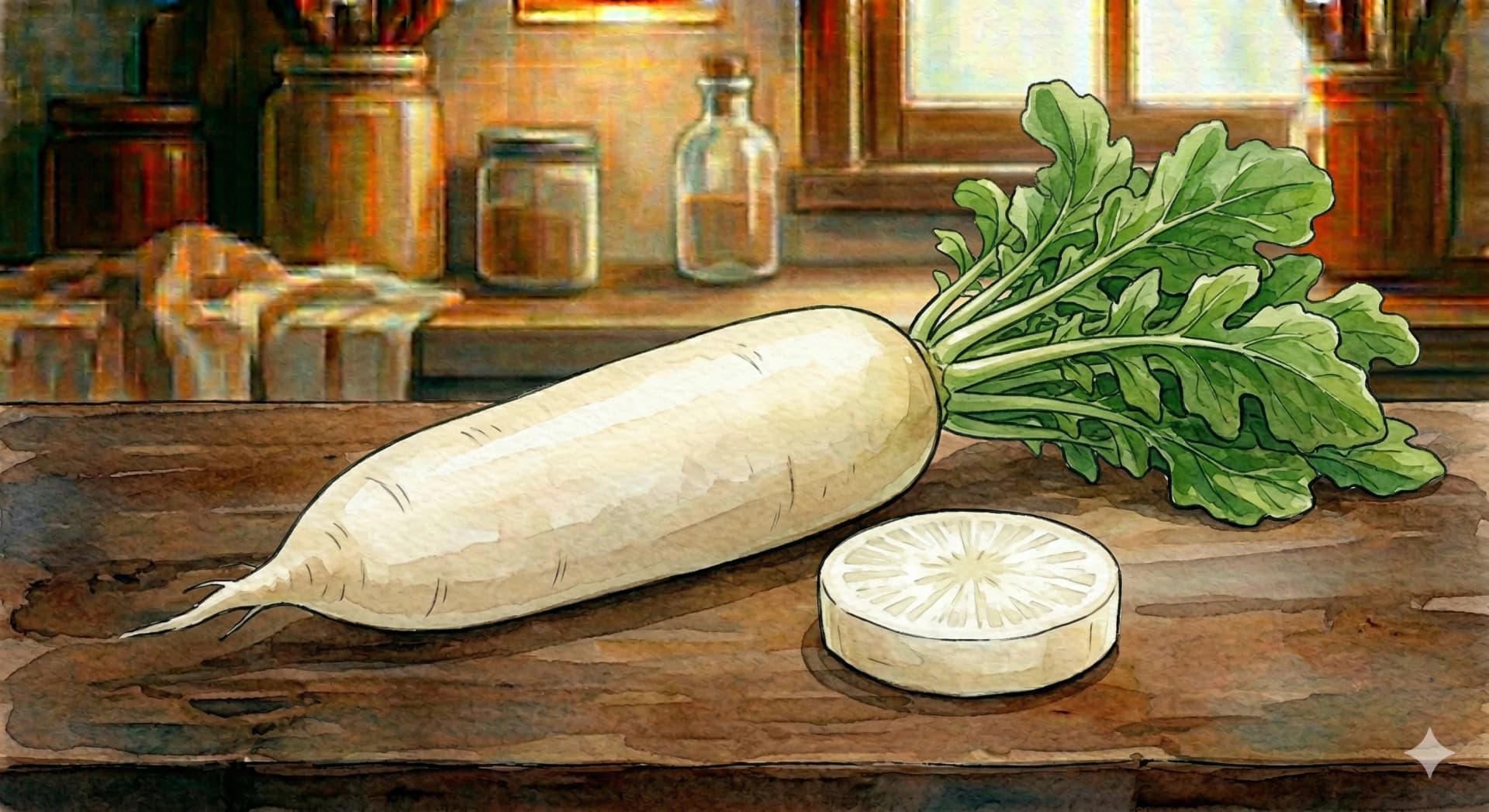
Daikon Radish
Also known as: Luo Bo, White Radish, Japanese Radish, Chinese Radish, Raphanus sativus var. longipinnatus
Daikon is a large, mild-flavored white radish that is one of the most versatile and beloved vegetables in East Asian cooking. Raw, it is crisp and mildly peppery with a clean, refreshing bite; cooked, it turns silky and sweet, absorbing the flavors of the broth or sauce around it with exceptional aptitude. A single daikon can weigh several kilograms and delivers extraordinary culinary range: it can be braised until tender as butter, shredded raw into a palate-cleansing salad, pickled into a condiment, pressed into rice flour cakes, or used as a garnish. In Chinese, Japanese, and Korean cooking, daikon is a cornerstone ingredient.
Key facts at a glance:
- Daikon is a large, mild-flavored white radish that — One of the most versatile and beloved vegetables in East Asian cooking.
- Raw, it is crisp and mildly peppery with a clean — Refreshing bite; cooked, it turns silky and sweet, absorbing the flavors of the broth or sauce around it with exceptional aptitude.
- In Chinese, Japanese, and Korean cooking, daikon — A cornerstone ingredient.
Flavor Profile
Origin
China, Japan, Korea, East Asia
Traditional Medicine Perspectives
Traditional Chinese Medicine
Daikon (Luo Bo) is classified as cool and acrid-sweet in TCM, associated with the Lung, Stomach, and Large Intestine meridians. It is one of the most important vegetables in TCM dietary medicine — used to resolve food stagnation, transform phlegm, clear Lung heat, relieve cough, and promote digestion. A Chinese proverb holds that 'a daikon a day keeps the doctor away,' reflecting centuries of belief in its digestive and respiratory benefits. It is prescribed for accumulation of food, phlegm-heat cough, and abdominal distension.
Modern Scientific Research
Daikon contains glucosinolates that break down to isothiocyanates, compounds with documented antimicrobial and potential cancer-preventive properties. It contains amylases, proteases, and esterases — digestive enzymes that survive in raw preparations and support the breakdown of starchy foods. Research shows daikon consumption may reduce the formation of N-nitroso compounds in the stomach. It is rich in vitamin C, folate, and potassium.
Cultural History
Daikon has been cultivated in China for over a thousand years and spread throughout East and Southeast Asia, becoming independently central to Chinese, Japanese, Korean, Vietnamese, and Indian cooking. In Japan, daikon is one of the most consumed vegetables — featured in simmered dishes (oden), grated as a condiment (oroshi daikon), and pickled as takuan.
In China, luo bo appears in soups, stir-fries, and as a major ingredient in the dim sum staple lo bak go (turnip cake, though daikon is not a turnip). In Korea, daikon is critical to kimchi and banchan culture. Daikon radish cakes have become a defining item of Cantonese dim sum worldwide.
Culinary Uses
Braise in dashi or master stock with soy sauce and mirin for a classic simmered preparation. Shred raw and use as a garnish with fish to cut through richness.
Grate raw (oroshi) and serve alongside grilled fish and tempura. Make daikon radish cake (lo bak go) with rice flour for dim sum.
Pickle in rice vinegar, sugar, and salt for a bright condiment. Add to hot pots and soups for sweetness and body.
Preparation Methods
Peel with a vegetable peeler — the skin is fibrous and should be removed for most applications. For braising, cut into thick rounds or half-moons.
For soups, cut into chunks. For raw preparations, julienne or grate.
Blanch daikon briefly before adding to simmered dishes to remove bitterness. Store in the refrigerator wrapped in damp paper towel.
Traditional Dishes
- Daikon and pork rib soup
- Braised daikon with soy sauce
- Daikon radish cake (lo bak go)
- Pickled daikon
- Japanese oroshi daikon with grilled fish
Comments
Share your thoughts on this ingredient.
Sign in to comment0 Comments