Japanese Cuisine
Saba Shioyaki (Salt-Grilled Mackerel)
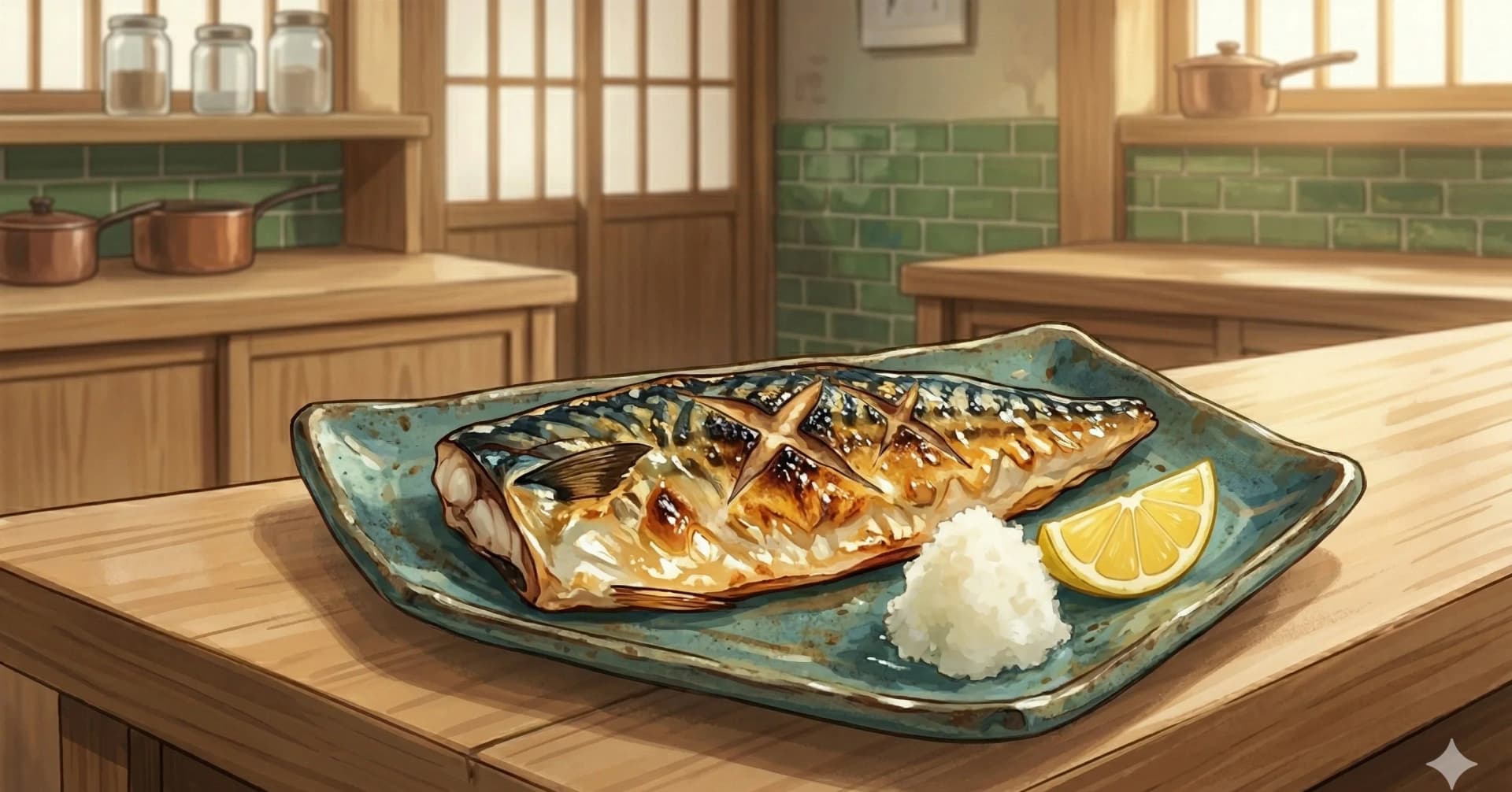
Whole mackerel fillets seasoned with nothing more than sake and salt, then grilled until the skin blisters and the rich flesh turns golden
There is something quietly radical about a dish that uses two seasonings and nothing else. Saba shioyaki sits at the heart of everyday Japanese home cooking, the kind of meal that appears on dinner tables across the country without ceremony or explanation. The name says everything you need to know: saba is mackerel, shio is salt, yaki is grilling. That is the entire recipe in three syllables.
What makes it worth learning is the technique behind the simplicity. A brief wash of sake before salting serves multiple purposes. It tenderizes the flesh, rounds out any sharpness in the fish's flavor, and helps the salt do its work evenly. The 20-minute rest after salting is not optional. During that window, the salt draws moisture from the surface of the fish, concentrating flavor and firming the flesh just enough so it holds together on the grill. Too little time and the fish tastes underseasoned. Too much and the texture tightens past the point of pleasure.
Archaeological evidence from the Jomon era (roughly 3000 BC) shows mackerel bones at coastal settlements, suggesting that the Japanese relationship with this fish stretches back thousands of years. Today, mackerel remains one of the most popular and affordable fish in Japanese markets, with a significant portion imported from Norway.
Saba shioyaki belongs in the same family of minimalist fish preparations as Ikan Bakar, the charcoal-grilled fish of Southeast Asia, and Turmeric Fried Fish, where a single spice transforms a simple protein. It is proof that restraint in seasoning, when the ingredient is good, is its own kind of mastery.
At a Glance
Yield
2 servings
Prep
5 minutes
Cook
20 minutes
Total
45 minutes (includes 20 minutes resting)
Difficulty
Easy
Ingredients
- ½ lbmackerel (saba) fillets (about 2 fillets), skin on
- 2 tbspsake (Japanese rice wine)
- ½ tspfine sea salt or kosher salt
- 2¾ ozdaikon radish (about ½–1 radish), peeled and finely grated
- 1lemon wedge, halved
- 1 tspsoy sauce
Method
- 1
Rinse the mackerel fillets briefly under cold running water and pat them dry with kitchen paper. Place the fillets in a shallow dish and pour the sake over the surface, turning the fish so both sides are coated. Let the sake sit on the fish for 1 to 2 minutes. This helps reduce any strong fishy aroma and begins to tenderize the flesh.
- 2
Pat the fillets dry again with fresh kitchen paper, discarding the sake. Transfer the fish to a baking sheet lined with parchment paper.
- 3
Sprinkle the salt evenly over both sides of each fillet, distributing it from a slight height so it falls in a thin, even layer rather than clumping. Let the salted fish rest at room temperature for exactly 20 minutes. You will see small beads of moisture forming on the surface as the salt draws liquid from the flesh.
- 4
While the fish rests, preheat your oven to 220C (425F) with a rack positioned in the center. If using a convection oven, reduce the temperature to 205C (400F).
- 5
After 20 minutes, gently pat the fillets dry one more time to remove the moisture the salt has drawn out. This step is important for achieving crisp, golden skin. Place the fish skin side down on the parchment paper.
- 6
Slide the baking sheet into the oven and bake for 15 to 20 minutes. The flesh should turn opaque and golden, and the thinnest edges will begin to caramelize. The skin on the underside will crisp against the parchment. If you prefer extra color on top, switch the oven to the grill or broiler setting for the final 2 minutes, watching closely to avoid burning.
- 7
While the fish bakes, grate the daikon radish using the finest holes of a box grater or a Japanese ceramic grater. Gather the grated daikon in your hand and gently squeeze out most of the liquid. The result should be a soft, slightly damp mound, not a wet puddle.
- 8
Transfer each fillet to a plate. Set a small mound of grated daikon alongside the fish and tuck a lemon wedge on the plate. Drizzle a few drops of soy sauce over the daikon. To eat, squeeze the lemon over the fish and take a bite of mackerel with a little of the seasoned daikon. The sharpness of the radish and the acidity of the lemon cut beautifully through the richness of the fish.
Key Ingredient Benefits
Mackerel (saba): One of the most nutritionally dense fish available, mackerel provides high-quality protein, omega-3 fatty acids (EPA and DHA), vitamin D, vitamin B12, and selenium. The omega-3 content is highest in autumn and winter when the fish build fat reserves. Japanese markets distinguish between ma-saba (chub mackerel, best in autumn through winter) and goma-saba (blue mackerel, best in summer through early autumn). Frozen fillets from Norway are widely available and work well for this recipe. See the Daikon Radish ingredient guide for notes on the accompaniment.
Sake: Pure rice sake (junmai-shu) is the best choice for cooking. It contains natural amino acids and organic acids that tenderize protein and round out flavors. Cooking sake (ryori-shu) contains added salt and is a workable substitute, though you may want to reduce the salt on the fish slightly if using it.
Daikon radish: Freshly grated daikon, called daikon-oroshi, is the traditional accompaniment to grilled fish across Japan. It contains the enzyme myrosinase, which produces compounds believed to aid digestion of oily foods. This is the reason it appears alongside virtually every grilled fish dish in Japanese cuisine.
Why This Works
Saba shioyaki relies on a principle central to Japanese cooking: drawing out the best qualities of a single ingredient rather than layering flavors on top of it.
The sake bath before salting is a technique called sake-buri. Sake contains amino acids and sugars that subtly enhance umami while its alcohol dissolves and carries away trimethylamine, the compound responsible for strong fishy odors. You discard the sake after a minute or two because the fish has already absorbed what it needs.
The timed salt rest, called furizake or shio-furi depending on the context, serves a dual purpose. Osmosis pulls water from the surface cells, concentrating the natural glutamates in the flesh and firming its texture. The extracted liquid carries with it any remaining off-flavors. Patting the fish dry after this rest is the step most home cooks skip, and it is the difference between skin that blisters and crisps versus skin that steams and stays flabby.
Mackerel is a fatty fish, roughly 12 to 15 percent fat depending on the season. That fat is largely composed of omega-3 fatty acids, which render during cooking and baste the flesh from within. The salt helps this fat render more evenly, which is why a well-salted fillet develops a more uniform golden color than an unsalted one.
Substitutions & Variations
Fish: Any skin-on oily fish fillet works with this technique. Salmon, yellowtail (hamachi), sardines, and Pacific saury (sanma) are all traditional shioyaki candidates. White fish like sea bream (tai) can be prepared the same way but will produce a leaner, more delicate result. For a Thai approach to steamed fish, see Pla Nueng Manao.
Cooking method: If you have a fish grill (sakana-yakiki) or broiler, preheat it on medium-high for 3 to 5 minutes. Grill the flesh side first for about 4 minutes, then flip and grill the skin side for 3 minutes until charred and crispy. You can also pan-fry the fillets skin side down in a dry or very lightly oiled skillet over medium-high heat for about 4 minutes per side. An air fryer at 200C (400F) for 10 to 12 minutes works as well, though you lose some of the smoky quality.
Salt type: Flaky sea salt, fine sea salt, and kosher salt all work. If using fine table salt, reduce the amount by about one-third, as it packs more densely. Some cooks use matcha salt or smoked salt as a variation.
Citrus: Sudachi, the small green Japanese citrus fruit, is the traditional pairing. Yuzu, kabosu, or lime all substitute nicely.
Score marks: For thicker fillets, make 2 to 3 shallow diagonal cuts through the skin before salting. This helps the salt penetrate evenly and allows the heat to reach the center of the fish.
Serving Suggestions
Saba shioyaki is at its best as the center of a traditional Japanese set meal (ichiju sansai, meaning one soup and three sides). Steamed short-grain rice is non-negotiable. A bowl of Miso Shiru completes the foundation. From there, add one or two small vegetable sides: Kinpira Gobo, with its sweet-savory braised burdock root, is a classic pairing, and Takikomi Gohan, seasoned mixed rice, can replace plain steamed rice when you want a more substantial meal. Pickled vegetables (tsukemono), a simple cucumber sunomono, or blanched spinach with sesame sauce (gomaae) round out the table. For a larger spread, a chilled tofu dish or a small portion of simmered vegetables provides contrast without competing with the fish.
Storage & Reheating
Refrigerator: Store leftover grilled mackerel in an airtight container for up to 2 days. The flavor holds well, but the skin will lose its crispness.
Freezing: While still warm, wrap each fillet tightly in plastic wrap, pressing out as much air as possible. Place the wrapped fillets in a freezer bag and freeze for up to 1 month. To reheat from frozen, unwrap the fish, sprinkle a few drops of water over the surface, and microwave at medium power for about 2 minutes per fillet. Alternatively, reheat in a 180C (350F) oven for 8 to 10 minutes to restore some of the skin's texture.
Grated daikon: Prepare fresh each time. Grated daikon oxidizes quickly and loses its bright, sharp flavor within an hour. It does not store well.
Cultural Notes
Saba shioyaki (鯖塩焼き), salt-grilled mackerel, is a foundation dish of Japanese home cooking. It shows up at countless Japanese breakfasts, school lunches, and family dinners. The dish belongs to the yakimono (焼き物) grilled category, a tradition built around using almost no seasoning and letting the natural flavor of the main ingredient lead. With fish, yakimono gets serious. Crispy salt-flecked skin on the outside, firm but not dried out inside, is a small test of timing and temperature, and Japanese cooks take it seriously.
Mackerel (saba, 鯖) has been one of the most important food fish in Japan for more than a thousand years. The fish migrates through Japanese waters in seasonal rhythms, and Japanese cooks track those rhythms closely. The "fall mackerel" (aki saba, 秋鯖) hits its peak fat content from September through November. The "winter mackerel" (kan saba, 寒鯖) reaches its fattest state from December through February. Top-end Japanese restaurants charge premium prices during peak fat seasons, but mackerel is also one of the cheapest reliable proteins on the Japanese market, which makes saba shioyaki something close to universal. Rich households eat it. So does everyone else.
A traditional Japanese breakfast is a small ceremony: rice, miso soup, pickled vegetables, a sheet of nori, and a piece of grilled fish. Saba shioyaki is the default fish. At many ryokan (traditional inns), the morning meal arrives with the fish grilled to order on a small individual hibachi brought right to your table, finishing as you sit down to eat. The smell of grilling mackerel, distinctive and rich and slightly smoky, is one of the most evocative scents of Japanese home life. A lot of older Japanese people associate it with childhood mornings at their grandparents' house.
Outside Japan, saba shioyaki has been working its way onto Japanese-American restaurant menus as an alternative to the more familiar salmon. Diners looking for something more genuinely Japanese than the Westernized standards tend to find it.
Nutrition Facts
Calories: 317kcal (16%)|Total Carbohydrates: 2g (1%)|Protein: 27g (54%)|Total Fat: 20g (26%)|Saturated Fat: 5g (25%)|Cholesterol: 80mg (27%)|Sodium: 680mg (30%)|Dietary Fiber: 0g (0%)|Total Sugars: 0g
You Might Also Like
Ratings & Comments
Ratings & Comments
Ratings
Share your thoughts on this recipe.
Sign in to rate and comment