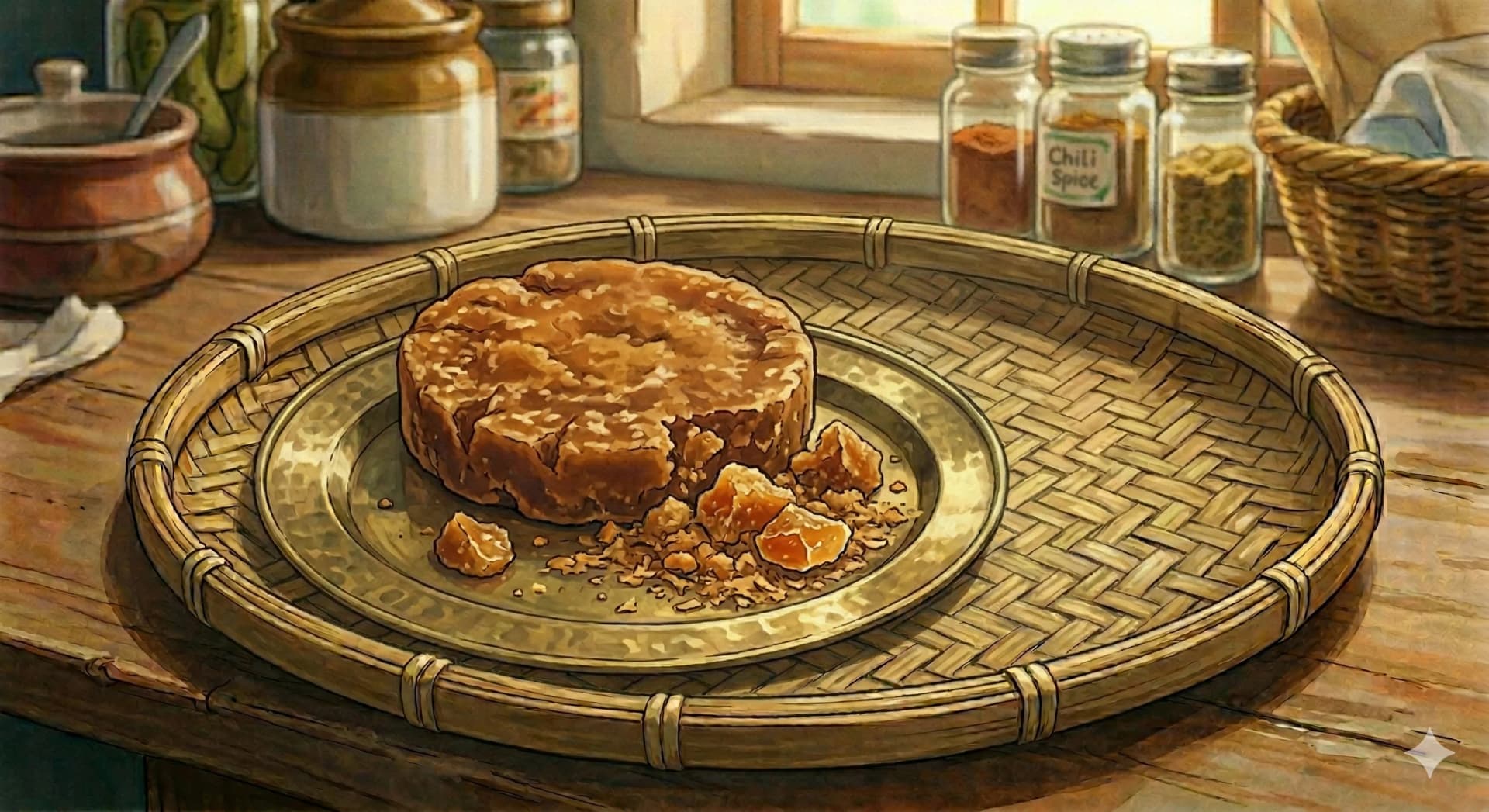
Jaggery
Also known as: Gur, Gud, Non-centrifugal Cane Sugar, Panela, Piloncillo
Jaggery is an unrefined sweetener produced by boiling down freshly extracted sugarcane juice until it thickens and sets into blocks, cakes, or granules. Unlike refined white sugar, jaggery never undergoes the centrifugation step that spins out the molasses fraction.
The molasses remains bound to the sugar crystals, giving jaggery its characteristic deep amber to dark brown color, its complex caramel-and-earth flavor, and its trace mineral content of iron, potassium, magnesium, and phosphorus that are entirely absent from refined sugar.
The flavor of jaggery is not simply sweetness. It carries a warmth and depth that white sugar and even light brown sugar cannot replicate. Tasting it plain reveals layers: first a straightforward sweetness, then a rich, almost smoky molasses note, then a faint earthy finish reminiscent of raw cane.
In cooking, these flavor compounds integrate into whatever dish jaggery sweetens, contributing character that refined sugar never could — this is why recipes built around jaggery taste distinctly incomplete if white sugar is substituted.
Jaggery's behavior in cooking also differs from refined sugar in ways that matter technically. It dissolves more slowly and unevenly, making it better suited to long-cooked preparations. It does not crystallize as readily as sucrose, which is why certain traditional sweets made with jaggery have a fudge-like, slightly granular texture.
Key facts at a glance:
- Unrefined sweetener — molasses fraction retained, unlike white sugar
- Complex flavor — layers of caramel, smoky molasses, and earthy finish
- Mineral content — iron, potassium, magnesium, and phosphorus
- Cooking behavior — dissolves slowly, resists crystallization
- Multiple forms — blocks, cakes, granules, and the prized nolen gur (date palm jaggery)
Flavor Profile
Origin
Indian Subcontinent, Southeast Asia, Africa
Traditional Medicine Perspectives
Ayurveda:
Jaggery (guda) has been used in Ayurvedic medicine for millennia, appearing in classical texts as both a food and a medicinal vehicle. It is classified as warm, heavy, and nutritive, with specific benefits attributed to its iron and mineral content. Old jaggery (purana guda), left to mature for at least a year, is considered superior to fresh jaggery in Ayurvedic medicine: it is thought to be lighter, less mucus-generating, and more beneficial for digestive health. Fresh jaggery, by contrast, is considered heavier and may increase Kapha and produce ama (undigested metabolic waste) if consumed in excess. Jaggery is frequently prescribed in Ayurvedic formulations as an anupana (carrier substance) to improve the palatability and absorption of bitter herbal medicines.
Modern Scientific Research
Jaggery contains approximately 65 to 85 percent sucrose, depending on the source and processing, along with fructose and glucose from the residual molasses.
Its mineral content is meaningfully higher than refined sugar: iron levels in jaggery have been studied as a potential dietary intervention for iron-deficiency anemia. However, absolute quantities per typical serving remain modest, and jaggery should not be considered a significant mineral supplement.
Research into the phenolic compounds retained in non-centrifugal sugar products like jaggery has identified antioxidant activity absent in refined sugar, attributable to flavonoids and phenolic acids that survive the boiling process.
Its glycemic index, while lower than refined white sugar in some studies, is still high enough that it should be consumed with the same moderation appropriate for any concentrated sweetener.
Cultural History
Sugarcane cultivation in the Indian subcontinent dates to at least 500 BCE, and the production of raw sugarcane products is even older. Sanskrit texts from the first millennium CE reference both liquid sugarcane juice (rasa) and solidified preparations (guda or gur), indicating jaggery has been in continuous production for over two thousand years.
The technology traveled outward: Arab traders carried the knowledge westward into Persia and North Africa, and eventually into the Americas, where Spanish colonizers established plantations giving rise to panela and piloncillo, the South American equivalents.
Within India, jaggery became the universal sweetener of the common population. Every region developed its own traditions. In Maharashtra, puran poli (flatbread stuffed with chana dal and jaggery) is tied to specific Hindu holidays. In South India, pongal marks the harvest festival of the same name. In Punjab, gur wali chai is a winter staple.
The most prized variety of jaggery in India is not made from sugarcane at all — nolen gur, or date palm jaggery, is harvested exclusively from the Khejur date palm in Bengal during the cool winter months, producing a dark jaggery with an extraordinarily complex flavor of deep caramel, faint smokiness, and floral sweetness.
The nolen gur harvest season is a cultural event in Bengal, and the jaggery is used to flavor winter sweets including nolen gurer sandesh and nolen gurer payesh (rice pudding).
Culinary Uses
In South Indian cooking, jaggery is used in chutneys (tamarind and jaggery chutney is a canonical pairing), in rice-based sweets like pongal and payasam, and in lentil and vegetable dishes where a small amount rounds out acidity.
In Maharashtrian cooking, it appears in puran poli, modak, and chivda. In North India, it sweetens winter foods: rewri (sesame brittle), chikki (peanut brittle), and til ladoo (sesame balls) are all jaggery-sweetened confections associated with Makar Sankranti.
Jaggery behaves differently depending on its form. Solid block jaggery must be grated or broken before use; it dissolves slowly and benefits from being melted with water to make a syrup first. Soft or granulated jaggery incorporates more easily. Powdered jaggery is the most convenient form but may contain anti-caking agents.
Preparation Methods
To make a jaggery syrup for use in sweets or drinks: roughly chop or grate 100 grams of solid jaggery and combine with 100 ml of water in a small saucepan. Heat over medium-low, stirring, until completely dissolved. Strain through a fine sieve to remove any impurities. The resulting syrup can be used immediately or refrigerated for up to two weeks.
For chikki (peanut brittle): dry-roast 200 grams of peanuts until fragrant and lightly colored. In a separate pan, heat 200 grams of jaggery with 2 tablespoons of water over medium heat without stirring until it reaches the hard crack stage (a small drop in cold water should shatter, approximately 150 degrees Celsius). Stir in the peanuts quickly, pour onto a greased surface, flatten with a greased spatula, and score into pieces while still warm. Allow to cool completely before breaking apart.
Traditional Dishes
- Pongal (Sweet)
- Til Ladoo
- Gur ki Roti
- Chikki
- Puran Poli
- Gur Wali Chai
- Tamarind Chutney
- Nolen Gurer Sandesh
- Nolen Gurer Payesh
- Modak
- Rewri
- Doda Burfi
- Chana Jor Garam
- Kozhukattai
Comments
Share your thoughts on this ingredient.
Sign in to comment0 Comments