Maharashtrian · Indian Cuisine
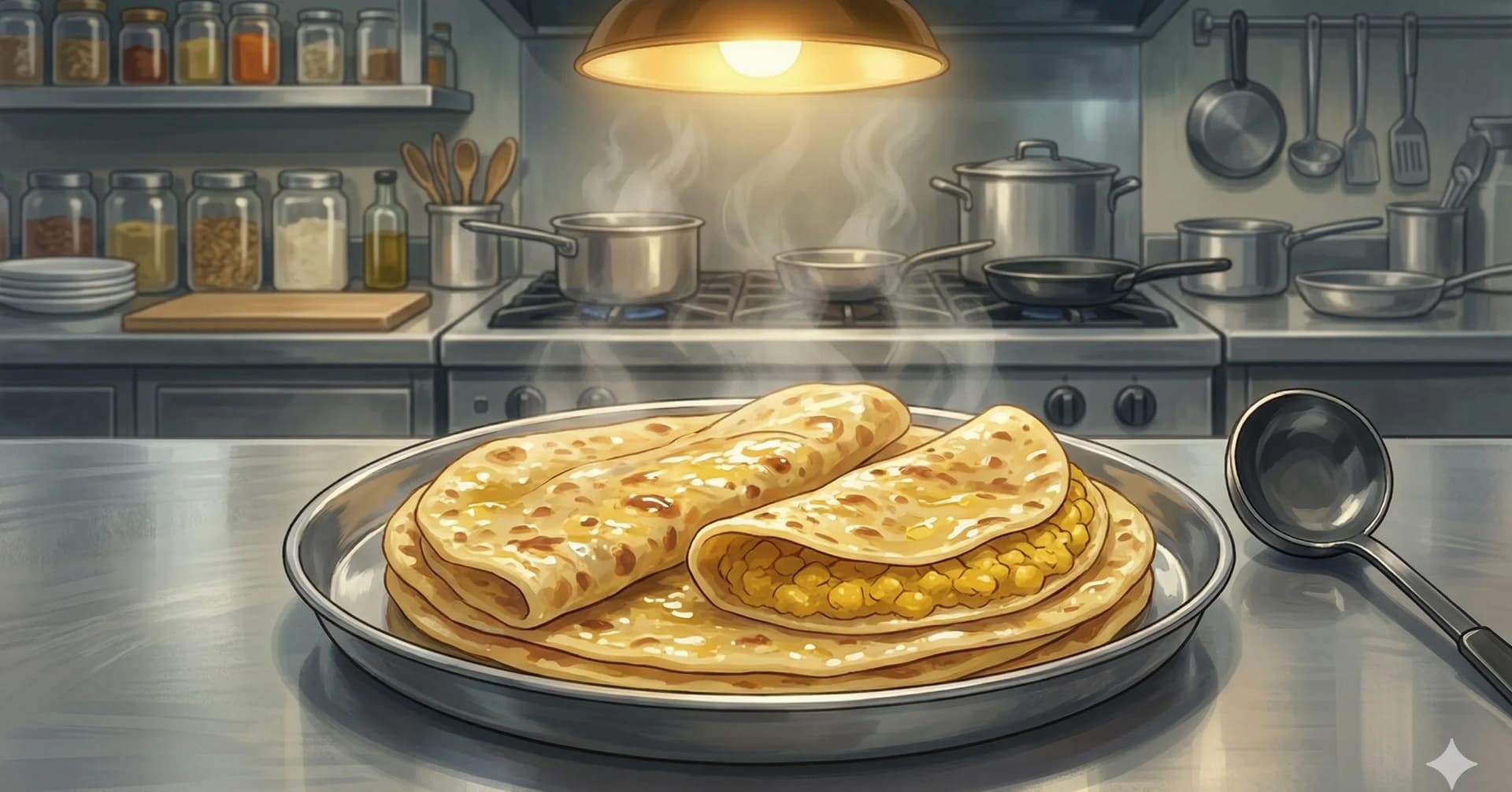
Sweet Lentil Stuffed Bread (Puran Poli)
Maharashtrian sweet flatbread filled with spiced chana dal and jaggery
When the smell of puran poli reaches you from the kitchen, you know it is a festival day. There is a particular sweetness that hangs in the air: the caramel of cooking jaggery, the warm breath of cardamom and nutmeg, the smoky-butter note of ghee on a hot tawa. It is a smell that belongs to Holi morning, to Gudi Padwa, to the first day of the Maharashtrian new year, to any day that the household decides deserves something made entirely with care.
Puran Poli is the most important sweet bread of Maharashtra, made from a soft, yielding dough wrapped around a filling called puran: a thick, silky paste of chana dal cooked until falling-soft, mashed with jaggery until they become one smooth, deeply amber confection, and lifted with cardamom and a hint of nutmeg. The poli (flatbread) is rolled thin, cooked on a tawa with a modest amount of ghee, and served immediately with a generous pour of melted ghee. At festivals, the ghee is considered as important as the poli itself.
This is not a quick recipe. The puran must be cooked long enough that it is completely dry. A wet filling makes the dough soggy and difficult to roll, and the poli tears. Patience at the stovetop during the filling stage determines the ease of everything that follows. The reward is a filling that holds its shape inside the dough and produces a flatbread with a clean, round cross-section when cut.
The practical insight for first-time makers: the dough should be soft almost to the point of stickiness, and the puran ball and dough ball should be approximately equal in size. Roll gently but confidently, turning the poli frequently to keep it round. If it tears, press the dough back over the filling and re-roll from that spot.
At a Glance
Yield
Makes 12–14 puran poli (serves 4)
Prep
45 minutes (plus 30 minutes rest)
Cook
45 minutes
Total
2 hours
Difficulty
Medium
Ingredients
Dough Ingredients
Filling Ingredients
To Finish
- —Ghee, generously, for cooking on the tawa and for serving
Method
- 1
Mix and knead. Combine the whole wheat flour (300 g) and maida (30 g) in a wide bowl. Add the oil or ghee, turmeric, and a pinch of salt. Rub the fat into the flour with your fingers until it resembles coarse breadcrumbs. Add water gradually, mixing with one hand while the other holds the bowl, until a soft, pliable dough forms. The dough should feel slightly softer than standard roti dough. Nearly tacky, but not sticking to your palms. Knead for 5 minutes until smooth.
- 2
Rest. Cover the dough with a damp cloth and rest for 30 minutes. The resting allows the gluten to relax, which makes the dough far easier to roll thin around the filling without springing back. **Make the puran filling**
- 3
Pressure cook the dal. Drain the soaked chana dal (300 g) and add to a pressure cooker with enough water to cover by 3 cm (about 500 ml). Pressure cook for 3–4 whistles on medium heat, until the dal is completely soft and easily mashed between two fingers, offering no resistance. Drain well in a sieve, pressing gently to remove excess water. A wet dal makes a wet puran; thorough draining matters.
- 4
Cook with jaggery (250 g). Transfer the drained dal to a wide, heavy-based pan. Add the grated jaggery. Cook over medium heat, stirring continuously. The jaggery will melt immediately and the mixture will become liquid and bubbly. Continue cooking and stirring, scraping the base of the pan to prevent sticking, as the mixture gradually thickens. After 15–20 minutes, the mixture should be quite thick: when you draw a spoon through it, the line should hold for a moment before closing. Mash any whole dal pieces as you stir.
- 5
Test and dry completely. The puran is ready when it pulls away cleanly from the sides of the pan and holds its shape when a portion is scooped onto a plate and allowed to cool for 30 seconds. If it spreads, continue cooking. Add the cardamom powder (1½ teaspoons) and nutmeg. Stir through. Remove from heat and allow to cool completely before shaping. Warm puran is sticky and difficult to work with.
- 6
Divide. Once cool, divide the puran into 12–14 equal balls, roughly the size of a large marble or a small golf ball. Set aside. **Assemble and cook**
- 7
Divide the dough. Divide the rested dough into the same number of equal portions as the puran balls. Keep covered with the damp cloth when not in use.
- 8
Wrap and seal. Working one at a time, flatten a dough portion between your palms into a small circle about 7–8 cm across. Place a puran ball in the center. Bring the edges of the dough up around the puran and pinch firmly to seal, like wrapping a dumpling. Press the sealed end gently downward so it sits flat. The puran should be entirely enclosed with no gaps.
- 9
Roll gently. On a lightly floured surface, place the sealed ball seam-side down. Using a rolling pin, roll it out gently into a disc about 15–16 cm in diameter. Apply even, light pressure. Do not press hard. Turn the poli frequently to keep it round and to check that it is not sticking. If the filling breaks through, press the dough back and continue rolling from a different direction. The finished poli should be thin but not translucent.
- 10
Cook on tawa. Heat a tawa or heavy griddle over medium heat. Place the poli on the tawa and cook until the underside shows small golden-brown spots, about 1–2 minutes. Flip, and add a small amount of ghee around the edges of the poli. It will sizzle. Press the poli gently with a flat spatula. Cook until the second side also shows golden spots and the poli feels dry and slightly puffed in places.
- 11
Serve with ghee. Remove from the tawa, place on a plate, and immediately drizzle with warm ghee. At festivals, the ghee is poured generously. There's a Maharashtrian saying that puran poli without ghee is incomplete, like a song without its final note. Serve immediately.
Key Ingredient Benefits
Chana dal (split Bengal gram) is one of the most nutritionally dense legumes used in Indian cooking, high in protein, dietary fibre, and slowly digested complex carbohydrates. Research suggests that the low glycaemic index of chana dal is associated with a slower post-meal blood glucose rise compared to refined grain preparations. It is the foundation of a balanced and sustaining filling.
Jaggery is unrefined cane sugar that retains some molasses, iron, and trace minerals that refined white sugar loses in processing. It has a more complex, slightly bitter-sweet flavor than white sugar, and its moisture content contributes to the fudge-like texture of the puran. Traditionally, the quality of jaggery used in puran poli is a point of pride; the best jaggery for this recipe is deep amber, not too soft, and smells of caramel.
Cardamom is used generously in Maharashtrian sweets. Traditionally used in Ayurvedic preparations to support digestion, and research has explored potential digestive and antioxidant properties of its compounds, though most clinical evidence remains limited. Its primary role here is aromatic. It lifts the deep sweetness of jaggery with a cool, perfumed top note.
Ghee (clarified butter) is the traditional finishing fat for puran poli. It has a very high smoke point and a rich, nutty flavour. Ghee is considered in both Ayurvedic tradition and Maharashtrian festival cooking to be both nourishing and auspicious. It is particularly associated with festival food and offerings.
Why This Works
The combination of chana dal and jaggery produces a uniquely stable filling. Chana dal has a relatively low moisture content after pressure cooking and draining, and its starch absorbs the melted jaggery as the mixture cooks down, creating a paste that is fudge-like in structure. It holds its shape without crumbling, wraps cleanly, and doesn't leak under the pressure of the rolling pin.
The addition of a small amount of maida (white flour) to the whole wheat dough is not decorative: it smooths the dough's texture and makes it more elastic and easier to roll thin without tearing. Traditional Maharashtrian recipes often use maida-only dough for maximum pliability; this blend offers both workability and the nuttier flavour of whole wheat.
Turmeric in the dough is a very old Maharashtrian practice that gives the finished poli its slight golden-yellow tint. The quantity is small enough to be undetectable in flavour, but contributes colour and, according to traditional belief, auspiciousness. Turmeric is associated with festive occasions across Maharashtra.
Substitutions & Variations
Jaggery to sugar: White or brown sugar can be substituted in equal weight. The flavor will be less complex and the color paler. Coconut jaggery (available in South Indian grocery stores) produces a darker, more caramel-forward filling.
Whole wheat to all-purpose flour: Using 100% maida produces a more pliable, smoother dough that is easier to roll thin. The resulting poli is more delicate but slightly less nutritious and flavourful.
Goda Masala variation: Some Maharashtrian home cooks add a small amount of goda masala to the puran instead of (or alongside) nutmeg. This produces a more savoury-sweet, layered filling.
Toor dal variation: Some communities, particularly in Konkan Maharashtra, make puran with toor dal (split pigeon pea) instead of chana dal. The result is slightly softer in texture and milder in flavor.
Serving Suggestions
Puran poli is the centerpiece of a Maharashtrian festival thali, served warm from the tawa with a generous pour of ghee. The traditional accompaniment is aamti, a thin, slightly tart Maharashtrian dal made with toor dal, tamarind, and jaggery. The sweet poli and the sour-spiced dal complement each other beautifully. A glass of cold milk is another traditional pairing, especially for children. At festive meals, puran poli may be followed by katachi amti (dal made from the cooking water of the chana dal) as a soup, completing a no-waste tradition.
Storage & Reheating
Puran poli keeps at room temperature (in cool weather) for 1–2 days, stored stacked in a container lined with paper. Refrigerate for up to 4 days; bring to room temperature before serving or warm briefly on a dry tawa over low heat for 30–40 seconds per side. The puran filling (uncooked in poli) keeps refrigerated for up to 5 days; the dough is best made fresh.
Cultural Notes
Puran poli (पुरण पोळी) is the Maharashtrian sweet flatbread of a wheat-flour dough wrapped around a sweet filling of cooked chana dal (split chickpea) and jaggery flavored with cardamom and nutmeg, then rolled flat and cooked on a hot griddle with ghee until both sides develop a golden surface. The dish is one of the most strongly Maharashtrian of all Maharashtrian preparations and the central festival sweet of multiple Maharashtrian holidays, including Holi (the festival of colors in March), Diwali (the festival of lights in October-November), and Ganesh Chaturthi (the elephant-god festival in August-September).
The filling is the technical and cultural heart. Chana dal is soaked, then cooked until completely tender, drained, and mixed with an equal weight of jaggery (the Maharashtrian preference is for Kolhapur jaggery). The mixture is cooked over moderate heat for fifteen to twenty minutes, stirred constantly, until it thickens into a stiff paste that can be rolled between the palms. Cardamom powder, a pinch of nutmeg, and sometimes a small amount of saffron are folded in at the end. The cooled filling has the consistency of thick cookie dough and a sweet earthy character that distinguishes it from the more aromatic fillings of the broader Indian sweet tradition.
The shaping demands skill. A small ball of wheat dough is flattened, an equal-sized ball of puran filling is placed in the center, and the dough is folded over the filling and pinched closed. The filled ball is then rolled gently between the palms to distribute the filling evenly, and rolled out on a floured surface to about six inches in diameter and a quarter inch thick. The rolling has to be even and patient: rolling too aggressively breaks the dough and exposes the filling; rolling unevenly produces a flatbread with thin spots that burn and thick spots that stay raw. The shaped poli cooks on a hot tava (flat griddle) for two to three minutes per side, with ghee brushed on both surfaces, until both sides develop a uniform golden color. The dish is served warm with a small puddle of melted ghee on top, sometimes with a side of amti (Maharashtrian dal) or katachi amti (a thin spicy dal made from the leftover chana dal cooking water). The pairing with the spicy amti is the traditional Maharashtrian way to balance the sweet poli with a savory counterpoint at festival meals.
Nutrition Facts
Calories: 530kcal (27%)|Total Carbohydrates: 94.7g (34%)|Protein: 14.8g (30%)|Total Fat: 11.9g (15%)|Saturated Fat: 4g (20%)|Cholesterol: 15mg (5%)|Sodium: 22mg (1%)|Dietary Fiber: 12.7g (45%)|Total Sugars: 34.8g
You Might Also Like
Ratings & Comments
Ratings & Comments
Ratings
Share your thoughts on this recipe.
Sign in to rate and comment