Kasuri Methi
Also known as: Dried Fenugreek Leaves, Kasoori Methi, Trigonella foenum-graecum (dried leaves)
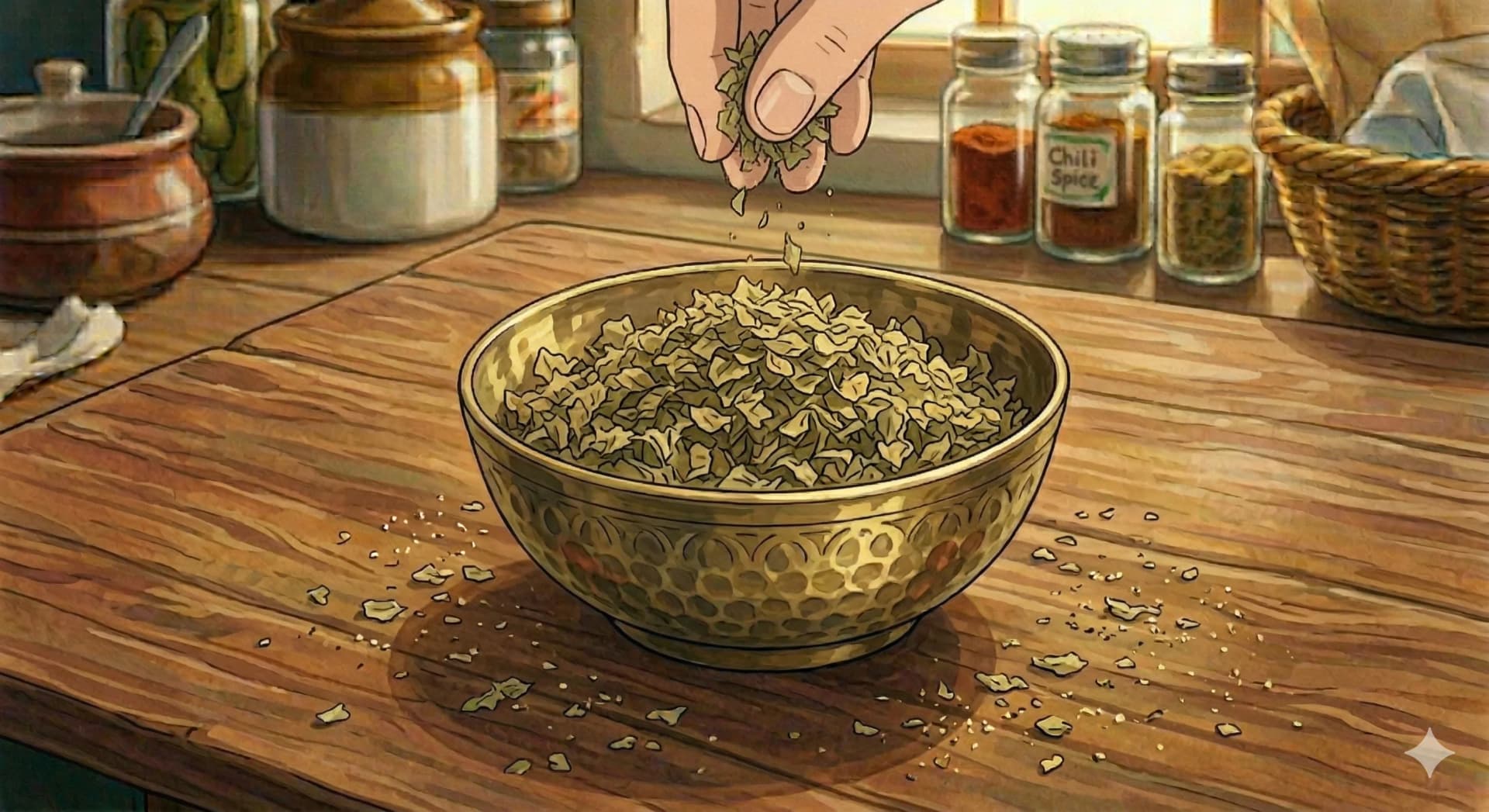
Kasuri methi is dried fenugreek leaf, and it is one of the most important finishing ingredients in North Indian cooking. It looks unremarkable: small, crumbled, pale olive-green dried leaves in a jar.
But the moment you crush a pinch between your palms and breathe in, the aroma is unmistakable — a bittersweet, hay-like, faintly maple-syrup warmth that is immediately recognizable to anyone who has eaten butter chicken or dal makhani in a serious restaurant. That characteristic flavor note comes specifically from kasuri methi added in the final moments of cooking.
The "kasuri" designation refers to the city of Kasur, located in the Punjab province of Pakistan near the Indian border. Kasur became associated with high-quality dried fenugreek leaves because the fenugreek grown in the region's soil and climate produced a leaf with a particularly balanced flavor. Over time, the name became a quality marker for dried fenugreek leaves in general, even as production spread to other regions.
Kasuri methi should not be confused with fresh methi (fresh fenugreek leaves used as a vegetable) or with methi dana (fenugreek seeds, which are much more bitter and used in entirely different ways).
Key facts at a glance:
- Dried fenugreek leaf — the finishing spice behind butter chicken and dal makhani
- Bittersweet aroma — hay-like, faintly maple-syrup warmth
- Named for Kasur — city in Punjab province of Pakistan, a quality marker
- Finishing spice — added in the final 2-3 minutes, never at the start
- Palm-crushing technique — must be crushed between palms to release volatile oils
Flavor Profile
Origin
Kasur, Punjab (Pakistan/India border region), South Asia
Traditional Medicine Perspectives
Ayurveda:
Fenugreek leaves are classified in Ayurveda as bitter (tikta) and slightly sweet (madhura) in taste, with a cooling virya in the case of the leaves specifically. This is an important distinction from the seeds, which are warming. The leaves are considered beneficial for the liver, digestive system, and blood. They are classified as a galactagogue, promoting breast milk production in nursing mothers, and fenugreek preparations for new mothers are a widespread traditional practice across South Asian cultures. The leaves are considered beneficial for blood sugar regulation, and fenugreek preparations have traditionally been used for conditions associated with excess sweetness in the body. As a digestive, the leaves are considered mildly stimulating and supportive of a healthy gut, without the strong heating effect of the seeds. Kasuri methi, being dried rather than fresh, retains these properties in a more concentrated form.
Modern Scientific Research
Fenugreek seeds contain diosgenin, a steroidal saponin investigated for its effects on testosterone levels and hormonal health. More clinically significant is the research on blood sugar regulation: multiple controlled trials have found that fenugreek seed supplementation reduces fasting blood glucose and postprandial glucose spikes in people with type 2 diabetes.
The leaves contain trigonelline, a compound also present in coffee that has demonstrated neuroprotective and antidiabetic activity in preclinical studies. The distinction between leaves and seeds is important: fiber content and most steroidal compounds are concentrated in the seeds, while the leaves carry different phytochemical profiles.
Research specifically on dried versus fresh fenugreek leaves is limited, but the bittersweet flavor comes partly from trigonelline and partly from volatile compounds produced during the drying process.
Cultural History
Fenugreek has been cultivated in the Indian subcontinent and the Middle East for millennia. Seeds found at Neolithic sites in Iraq have been dated to around 4000 BCE, and fenugreek appears in the Ebers Papyrus, an ancient Egyptian medical text.
The specific tradition of drying fenugreek leaves for use as a finishing herb appears to be a North Indian and Pakistani culinary development. In the Punjab, methi is a winter crop growing from October through March. Drying the leaves at peak harvest allowed year-round use, and the drying process itself transformed the flavor: some harsh green-leaf bitterness mellowed, and the characteristic sweet, hay-like quality became more pronounced.
Butter chicken (murgh makhani) was created in the mid-20th century in Delhi, attributed to Kundan Lal Gujral and Kundan Lal Jaggi of the Moti Mahal restaurant — its distinctive flavor depends substantially on kasuri methi as a finishing element.
When butter chicken spread globally, kasuri methi traveled with it as a quietly essential ingredient. Most diners who have eaten butter chicken thousands of times would not be able to name kasuri methi, but they would notice its absence immediately.
Culinary Uses
Kasuri methi's defining characteristic is its role as a finishing spice, added near the end of cooking or directly before serving. This is the opposite of most Indian spices, which are bloomed in oil at the beginning. Kasuri methi is fragile: high heat and long cooking will drive off its most delicate aromatic compounds and leave only bitterness.
The essential technique is to crush the dried leaves between your palms before adding — this physical crushing releases the volatile oils trapped in the leaf cells, activating the aroma.
Uncrushed dried leaves added whole will release flavor more slowly and unevenly. The quantity is typically small: one to two teaspoons of crushed kasuri methi per dish serving four.
Preparation Methods
As a finishing herb: Take the measured quantity of kasuri methi in both palms and rub briskly together, crushing the leaves. The aroma will intensify immediately. Add directly to the dish in the final 2 to 3 minutes of cooking, or stir in off the heat just before serving.
In marinades: Kasuri methi can be incorporated into yogurt-based marinades for paneer or chicken. It holds up well because the marinating time allows gradual flavor release. Crush before adding.
In doughs: For methi paratha, a combination of fresh fenugreek and kasuri methi gives the best flavor. Crush the dried leaves and mix into the dough.
In butter and cream dishes: Kasuri methi has a particular affinity for fat. In butter chicken, makhani sauce, or cream-based paneer dishes, the fat carries its volatile compounds through the entire dish more effectively than in water-based gravies.
Storage: Keep in an airtight jar away from heat and light. Kasuri methi loses its volatile aromatics more quickly than most dried spices. Buy in small quantities and replace every three to four months.
Traditional Dishes
- Butter chicken (murgh makhani)
- Dal makhani
- Aloo methi
- Palak paneer (some preparations)
- Methi malai paneer
- Qeema methi (minced meat with fenugreek)
- Methi paratha
- Kasuri methi naan
- Paneer makhani
- Methi murgh (fenugreek chicken)
Comments
Share your thoughts on this ingredient.
Sign in to comment0 Comments