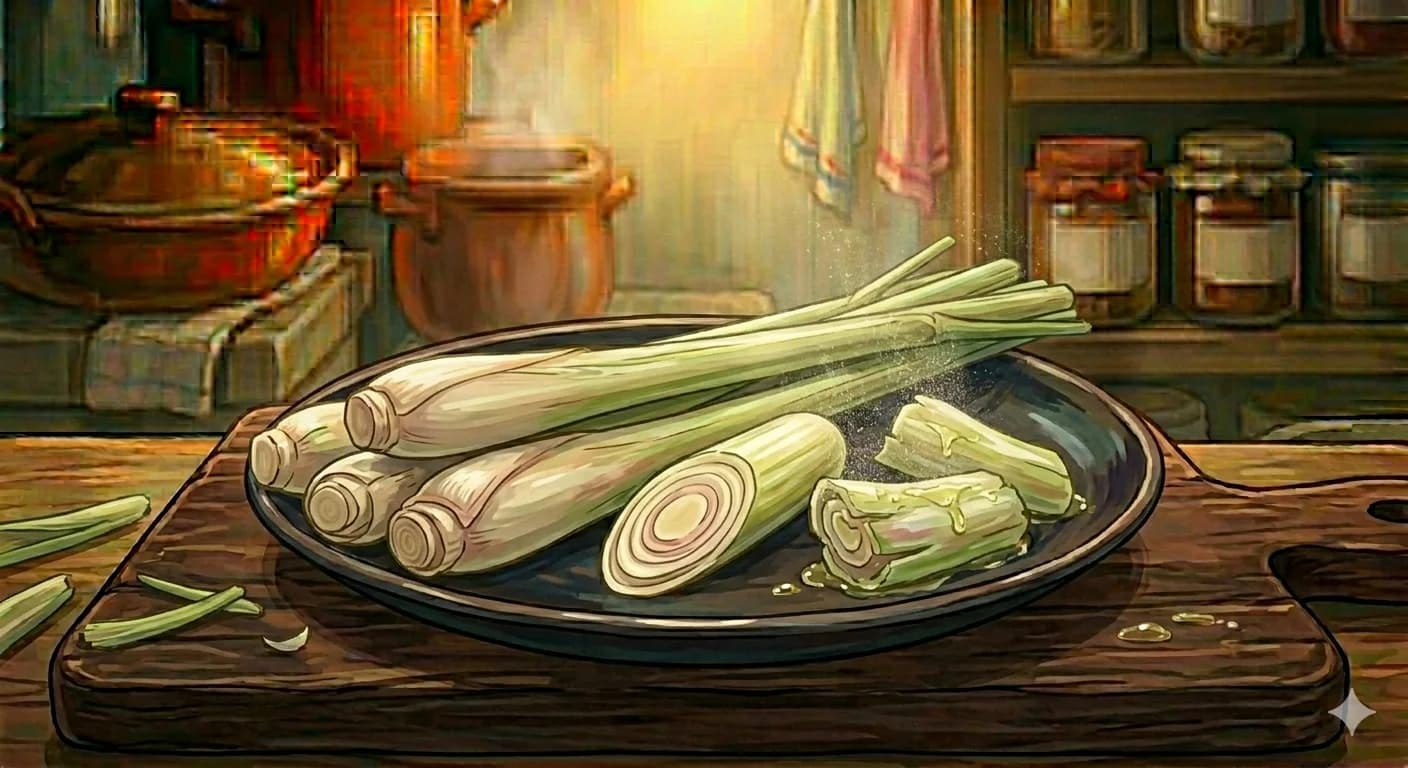
Lemongrass
Also known as: Takrai, Xa, Serai, Citronella Grass, Cymbopogon citratus, Tanglad
Lemongrass is a tall, fragrant tropical grass that imparts a bright, lemony-floral aroma to dishes across Southeast Asia. Unlike lemon itself, lemongrass brings citrus fragrance without sourness — instead, it delivers a clean, almost ethereal quality that lifts rich curries, soups, and grilled meats.
The flavor lives primarily in the lower 3 to 4 inches of the stalk — the pale, bulbous base where the layers are tightly packed and full of aromatic oils. This is where the essential compound citral is most concentrated, giving lemongrass its distinctive lemon-like scent along with subtle undertones of ginger, mint, and fresh green herbs.
Lemongrass is a defining ingredient in Thai, Vietnamese, Indonesian, and Malaysian cooking. It appears in the aromatic pastes that form the foundation of curries, in the herb-heavy salads and soups of Thailand and Vietnam, and in the spice mixtures that flavor satays and rendangs across the Malay Archipelago. Without lemongrass, these cuisines would lose one of their most distinctive aromatic signatures.
Key facts at a glance:
- Tropical grass in the Cymbopogon genus — related to citronella
- Citral — the primary compound responsible for its lemon-like aroma
- Lower stalk is the flavorful part — the pale, dense base, not the green tops
- Used fresh, dried, or as a paste — fresh is strongly preferred for most dishes
- Featured in 40 recipes on this site — from tom kha gai to rendang to bun bo hue
Flavor Profile
Origin
Thailand, Vietnam, Indonesia, Malaysia, India, Sri Lanka, Philippines
Traditional Medicine Perspectives
Ayurveda
Lemongrass is used in Ayurvedic practice as a digestive aid and fever reducer. It is classified as having a cooling energy despite its warming taste, and is associated with balancing kapha and vata doshas. Lemongrass tea is a common Ayurvedic home remedy for indigestion, bloating, and cold symptoms.
Traditional Thai Medicine
In Thai traditional medicine, lemongrass is valued for its carminative properties and is commonly brewed as a tea to soothe digestive discomfort and reduce flatulence. It is also used in traditional Thai herbal compresses (luk pra kob) applied to sore muscles and joints.
Traditional Chinese Medicine
Lemongrass is not a core TCM herb but is recognized in folk practice for its ability to release exterior conditions (wind-cold patterns). It is sometimes used to promote sweating during mild fevers and to relieve headaches associated with common colds.
Modern Scientific Research
Citral (a mixture of the isomers geranial and neral) is the primary bioactive compound in lemongrass, making up 60–80% of its essential oil. Research has demonstrated that citral possesses notable antimicrobial, antifungal, and anti-inflammatory properties in laboratory settings.
Studies on lemongrass tea consumption have shown potential anxiolytic (anxiety-reducing) effects in animal models, and preliminary human studies suggest it may help reduce anxiety and promote relaxation. Lemongrass extracts have also shown antioxidant activity in laboratory tests, attributed to compounds including chlorogenic acid, caffeic acid, and isoorientin.
Research into citral's effects on Helicobacter pylori (the bacterium associated with stomach ulcers) has shown inhibitory activity in vitro, though clinical applications remain under investigation. Lemongrass essential oil is also widely studied for its effectiveness as a natural insect repellent, with citronella-related compounds showing documented repellent activity against mosquitoes.
Cultural History
Lemongrass is native to South and Southeast Asia, where it has been cultivated for centuries as both a culinary herb and a practical plant. In tropical villages, lemongrass clumps were traditionally planted around homes — partly for cooking use, partly because the citronella compounds in the leaves repel mosquitoes.
In Thai cuisine, lemongrass (takrai) is one of the essential aromatics alongside galangal, kaffir lime leaves, and chilies. These ingredients form the aromatic backbone of soups like tom yum and tom kha, curry pastes, and the pounded salads called yam. In Vietnam, lemongrass (xa) is a key component in marinades for grilled meats and in the complex, spicy broth of bun bo hue.
Across the Malay Archipelago, lemongrass (serai) appears in rempah — the spice pastes that are the starting point for curries, rendangs, and laksa. Indonesian and Malaysian cooks bruise whole stalks and simmer them directly in coconut milk-based dishes, infusing the liquid with fragrance before removing them. The plant’s journey from Southeast Asian gardens to global kitchens accelerated in the late 20th century, and today lemongrass is grown commercially in tropical regions worldwide.
Culinary Uses
The first rule of lemongrass is knowing which part to use. The outer woody layers of the stalk should be peeled away, revealing the pale, tender inner core. Only the bottom 3–4 inches have significant flavor — the green upper stalks can be saved for tea or stock but lack the punch needed for cooking.
In Thai soups like tom yum and tom kha gai, lemongrass stalks are cut into 2-inch pieces, bruised with the back of a knife to release their oils, and simmered in the broth. These pieces are left in the bowl for fragrance but not eaten. For curry pastes, lemongrass is sliced very thin and then pounded in a mortar with other aromatics until a smooth paste forms — the fibrous structure breaks down completely when processed this way.
In Vietnamese cooking, lemongrass is minced finely and used in marinades for grilled pork (thit nuong), beef, and shrimp. The combination of lemongrass, garlic, shallots, and fish sauce is one of the fundamental Vietnamese marinades. In Indonesian and Malaysian dishes, whole bruised stalks are added to simmering rendang, laksa, and sayur, imparting aroma that deepens over long cooking.
Lemongrass also makes an excellent tea — simply steep sliced stalks in boiling water for 5–10 minutes. It pairs beautifully with ginger and a touch of honey for a soothing, aromatic drink.
Preparation Methods
Start by trimming away the root end and the top two-thirds of the stalk (the dry, green, grassy portion). Peel off 1–2 tough outer layers from the remaining base to reveal the pale, aromatic core. This inner stalk is where all the flavor lives.
For pastes and marinades, slice the tender core as thin as possible, then mince or pound in a mortar. The finer you cut it, the more flavor you release and the less fibrous texture remains in the finished dish. For a shortcut, freeze lemongrass stalks for an hour, then grate them on a Microplane — the frozen texture makes grating much easier.
For soups and braises, cut the trimmed stalk into 2–3 inch lengths and bruise them firmly with the flat of a knife or the handle of a pestle. This cracks the fibers and releases the aromatic oils without shredding the stalk, making it easy to remove before serving. Store fresh lemongrass wrapped in a damp paper towel in the refrigerator for up to 2 weeks, or freeze whole stalks for several months — they lose a little vibrancy but remain perfectly usable.
Traditional Dishes
Recipes Using Lemongrass
- Bubur Ayam (Indonesian Chicken Rice Porridge)
- Spicy Beef Noodle Soup (Bún Bò Huế)
- Gaeng Pa Gai (Thai Jungle Curry with Chicken)
- Opor Ayam (Javanese Chicken in Coconut Milk)
- Sayur Asem (Indonesian Tamarind Vegetable Soup)
- Black Nut Beef Soup (Rawon)
- Wedang Jahe (Indonesian Ginger Tea)
- Jakarta Creamy Beef Soup (Soto Betawi)
- Coconut Rice (Nasi Uduk)
Comments
Share your thoughts on this ingredient.
Sign in to comment0 Comments