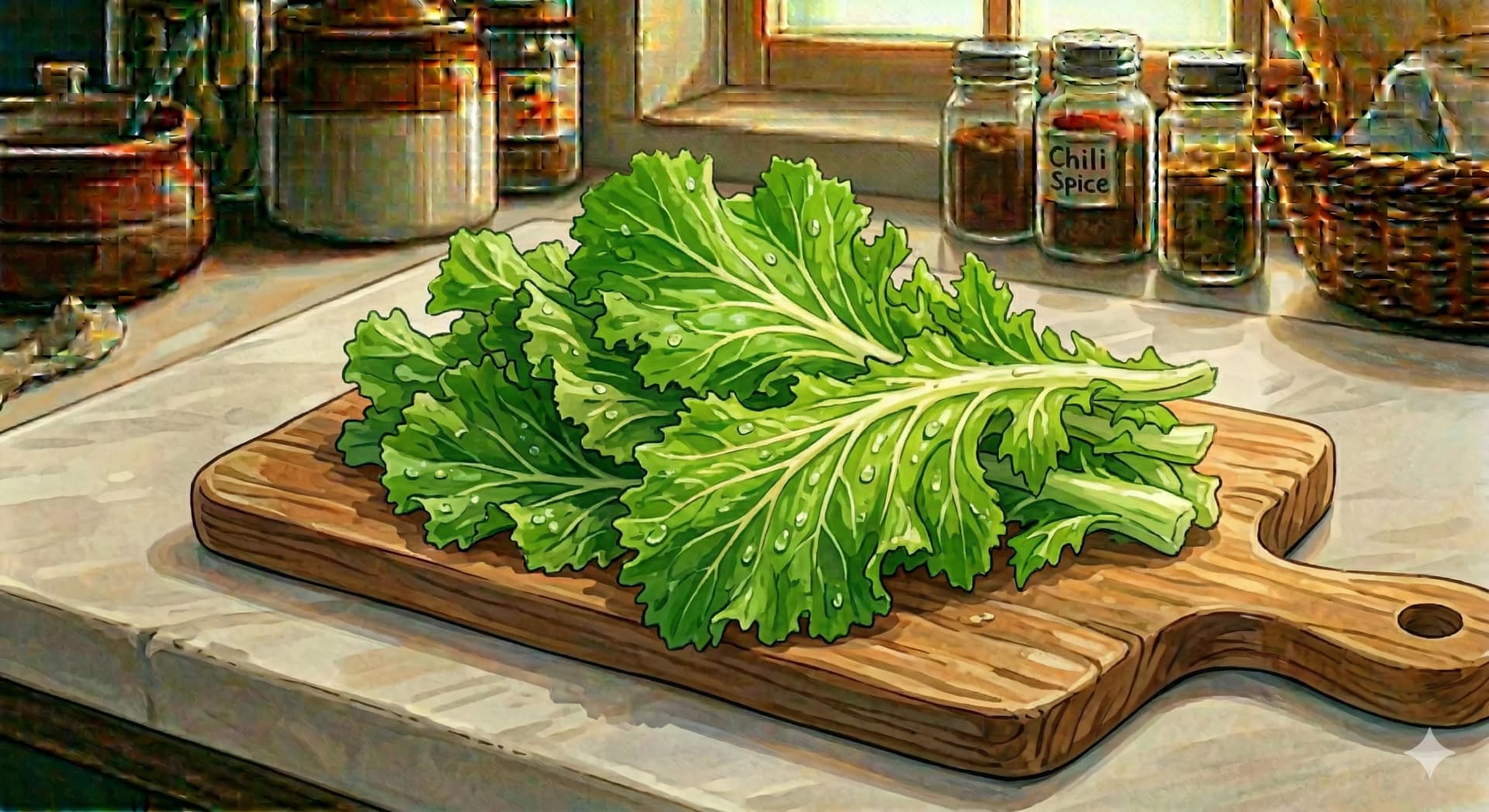
Mustard Greens
Also known as: Jie Cai, Chinese Mustard, Brassica juncea, Gai Choy, Xue Li Hong
Mustard greens are a peppery, slightly bitter brassica used fresh, pickled, and preserved across Chinese regional cuisines. The flavor is assertive — a sharp, pungent heat and bitterness that plays against rich meats and becomes mellow and complex through pickling and fermentation.
Fresh mustard greens are stir-fried quickly; preserved versions (suan cai in Sichuan, mei cai in Guangdong, xue cai in Shanghai) are some of the most important condiments in Chinese cooking.
Key facts at a glance:
- Peppery brassica — used fresh, pickled, and preserved across China
- Cultivated over 4,000 years — one of China's oldest food crops
- Rich in glucosinolates — including sinigrin, with antimicrobial properties
- Preserved forms are foundational — suan cai, mei cai, and xue cai define regional dishes
- High in vitamins A, C, and K — plus folate and calcium
Flavor Profile
Origin
China, South Asia (origin), Sichuan, Guangdong, Shanghai
Traditional Medicine Perspectives
Traditional Chinese Medicine
Mustard greens (Jie Cai) are classified as warm and acrid in TCM, associated with the Lung, Liver, and Kidney meridians. They are used to warm the Lung, transform phlegm, regulate Qi, and stimulate circulation. They are prescribed for cold-phlegm conditions, cough, and digestive stagnation. The pungent quality is considered activating and dispersing — cutting through accumulation and promoting movement.
Modern Scientific Research
Mustard greens contain glucosinolates including sinigrin, which converts to allyl isothiocyanate — the compound responsible for mustard's characteristic heat.
Research on mustard compounds shows antimicrobial, anti-inflammatory, and potential cancer-preventive properties. Mustard greens are rich in vitamins A, C, and K, folate, and calcium.
The fermentation of preserved mustard greens produces beneficial organic acids, probiotics, and increased bioavailability of nutrients.
Cultural History
Mustard greens have been cultivated in China for over four thousand years and have been used both as a food crop and as a source of mustard seeds for oil and condiments.
The preserved forms — perhaps more important than the fresh — represent some of China's oldest food preservation traditions. Sichuan suan cai (pickled mustard greens) are fundamental to Sichuan fish dishes. Mei cai (dried preserved mustard greens from Guangdong) enriches the braised pork that is synonymous with Hakka cooking. Xue cai (Ningbo preserved mustard) flavors Shanghai-style stir-fries and noodle soups.
Culinary Uses
Fresh: stir-fry with garlic, preserved meats, or chili. Pickle in salt and rice vinegar for suan cai.
Use preserved mei cai in braised pork belly (mei cai kou rou). Add xue cai to stir-fried rice cakes and noodle soups. Use pickled mustard greens in Sichuan fish soup for its characteristic sour-spicy note.
Preparation Methods
Fresh mustard greens: wash well, cut into bite-sized pieces, and stir-fry over high heat. Blanch briefly to reduce bitterness before using in mild preparations.
For quick pickling: salt, let sit 30 minutes, press out liquid, and dress with rice vinegar, sugar, and sesame oil.
Comments
Share your thoughts on this ingredient.
Sign in to comment0 Comments