Nigella Seeds
Also known as: Kalonji, Black Seed, Black Cumin (misnomer), Nigella sativa, Habbatus Sauda
Nigella seeds are small, triangular, matte black seeds with a faintly rough surface and no visible sheen. Their scent is polarizing and distinctive: a slightly resinous, onion-adjacent, faintly petrochemical quality that transforms in cooking into something simultaneously herbal and peppery.
They are one of three different plants commonly called "black cumin" or "black seed" in English-language spice markets, and the confusion between nigella seeds (Nigella sativa), true black cumin (Bunium persicum, also called Shah Jeera), and regular cumin that has darkened is one of the most persistent naming problems in the spice world. Nigella sativa belongs to the buttercup family (Ranunculaceae) and is botanically unrelated to cumin (Apiaceae). The only thing the three share is small dark seeds.
The flavor of nigella seeds is notably different raw versus cooked. Raw, they have a sharp, slightly harsh quality. When added to a hot griddle with bread dough, or scattered on flatbread before baking, or bloomed briefly in hot oil, the flavor opens up and mellows: the onion-like pungency softens, and a warm, oregano-adjacent herbal quality comes forward. This transformation is why nigella seeds are most often used as a bread topping or scattered into oil early in cooking rather than added at the end as a raw finish.
The geographic range of nigella seeds spans from North Africa through the Middle East, the Indian subcontinent, and into Central Asia. This broad distribution means the seeds carry different cultural identities in different cooking traditions: a bread topping in Turkey, a key ingredient in Egyptian spice blends, a component of the Bengali five-spice blend panch phoron in India, and a sacred medicinal plant across Islamic cultures worldwide.
Key facts at a glance:
- Triangular black seeds — from Nigella sativa, in the buttercup family
- Sacred in Islamic tradition — a hadith attributes near-universal healing properties
- Key component of panch phoron — the Bengali five-spice blend
- Thymoquinone — the primary bioactive compound with wide-ranging pharmacological activity
- Flavor transforms with heat — from sharp and harsh to warm and herbal
- Not related to cumin — despite being called "black cumin" in many markets
Flavor Profile
Origin
South Asia, Middle East, Eastern Mediterranean
Traditional Medicine Perspectives
Ayurveda
In Ayurvedic classification, nigella seeds are understood as warming, pungent, and digestive. They are considered Vata-pacifying due to their oily nature and warming quality, and useful for conditions involving cold, stagnation, and poor circulation. They are included in formulations for respiratory conditions, skin disorders, and low digestive fire. The seeds are used in some traditional hair and skin oil preparations, where their antimicrobial and anti-inflammatory properties are applied topically.
Islamic and Unani Medicine
The primary tradition in which nigella seeds have been most intensively used as medicine is Unani (Greco-Islamic) medicine, based on the humoral framework developed by Avicenna (Ibn Sina) and others. In this system, nigella seeds are classified as hot and dry in the second degree, appropriate for treating cold and moist conditions. The active compound thymoquinone, which accounts for approximately 30 to 50% of the seed's essential oil, is considered the primary medicinal agent. Nigella oil has been used internally for asthma, diabetes, hypertension, and immune support, and externally for skin conditions, headache, and joint pain.
Traditional Chinese Medicine
TCM references to nigella are limited, but the seeds appear in some Chinese materia medica under the name Lu Jiao Cao, used for warming the kidneys and dispersing cold.
Modern Scientific Research
Nigella sativa is one of the most intensively studied plants in traditional medicine research. The driving compound in most studies is thymoquinone (TQ), which constitutes the majority of the volatile oil fraction and has demonstrated a remarkable range of pharmacological activities in laboratory and animal studies. Documented activities of thymoquinone include antioxidant, anti-inflammatory, antifungal, antibacterial, antiviral, anticancer (in vitro and in animal models), and immunomodulatory effects. The breadth of these findings offers a partial scientific explanation for the traditional claim of near-universal therapeutic applicability.
Human clinical trials have focused on several specific applications with encouraging results. Multiple randomized controlled trials have found that nigella seed supplementation significantly reduces systolic and diastolic blood pressure in hypertensive adults. Studies on type 2 diabetes have found improvements in fasting blood glucose and HbA1c with nigella supplementation compared to placebo. Clinical evidence for asthma is also substantial: controlled trials have demonstrated improvements in pulmonary function and reductions in asthma symptoms with nigella oil supplementation.
Nigella sativa is frequently cited as one of the most researched traditional medicinal plants in contemporary pharmacognosy.
Cancer research has progressed through the in vitro and animal stages with multiple published studies on thymoquinone's apoptotic effects on various cancer cell lines, though human clinical oncology data remains limited.
Cultural History
No other culinary spice carries the religious significance of nigella seeds in the Islamic tradition. A hadith, a saying attributed to the Prophet Muhammad, states: "Use the black seed, for it contains a cure for every disease except death." This statement, recorded in multiple hadith collections including Sahih Bukhari and Sahih Muslim, elevated Nigella sativa from a culinary ingredient to a sacred medicine across the entire Muslim world. The Arabic name habbatus sauda (black grain) became synonymous with divine remedy, and nigella seeds appear in traditional Islamic medicine (Unani) in preparations for an enormous range of conditions.
This religious context meant that nigella seeds traveled widely with the spread of Islam, carried not just as a spice but as a medicine of religious significance. The Prophet's medicine tradition maintained that keeping nigella seed oil in the home was a form of preventive healthcare. From West Africa to Indonesia, wherever Islam spread, habbatus sauda went with it as a household remedy. The commercial trade in nigella seed oil today, which has expanded enormously following global interest in traditional medicine, is in part a direct descendant of this 1,400-year-old religious recommendation.
In Indian culinary culture, nigella seeds occupy a different but equally specific role through panch phoron, the Bengali and broader eastern Indian whole spice blend consisting of five seeds in roughly equal proportion: fenugreek seeds, nigella seeds, cumin seeds, black mustard seeds, and fennel seeds. The blend is used by blooming the whole seeds in oil or ghee before adding vegetables, fish, or lentils. The nigella seed's role in panch phoron is the onion-peppery note that bridges the blend's sweeter seeds (fennel) and its more pungent ones (mustard, fenugreek). This Bengali culinary tradition is entirely distinct from the Islamic medicinal tradition but reflects the seeds' long cultivation history in South Asia.
Culinary Uses
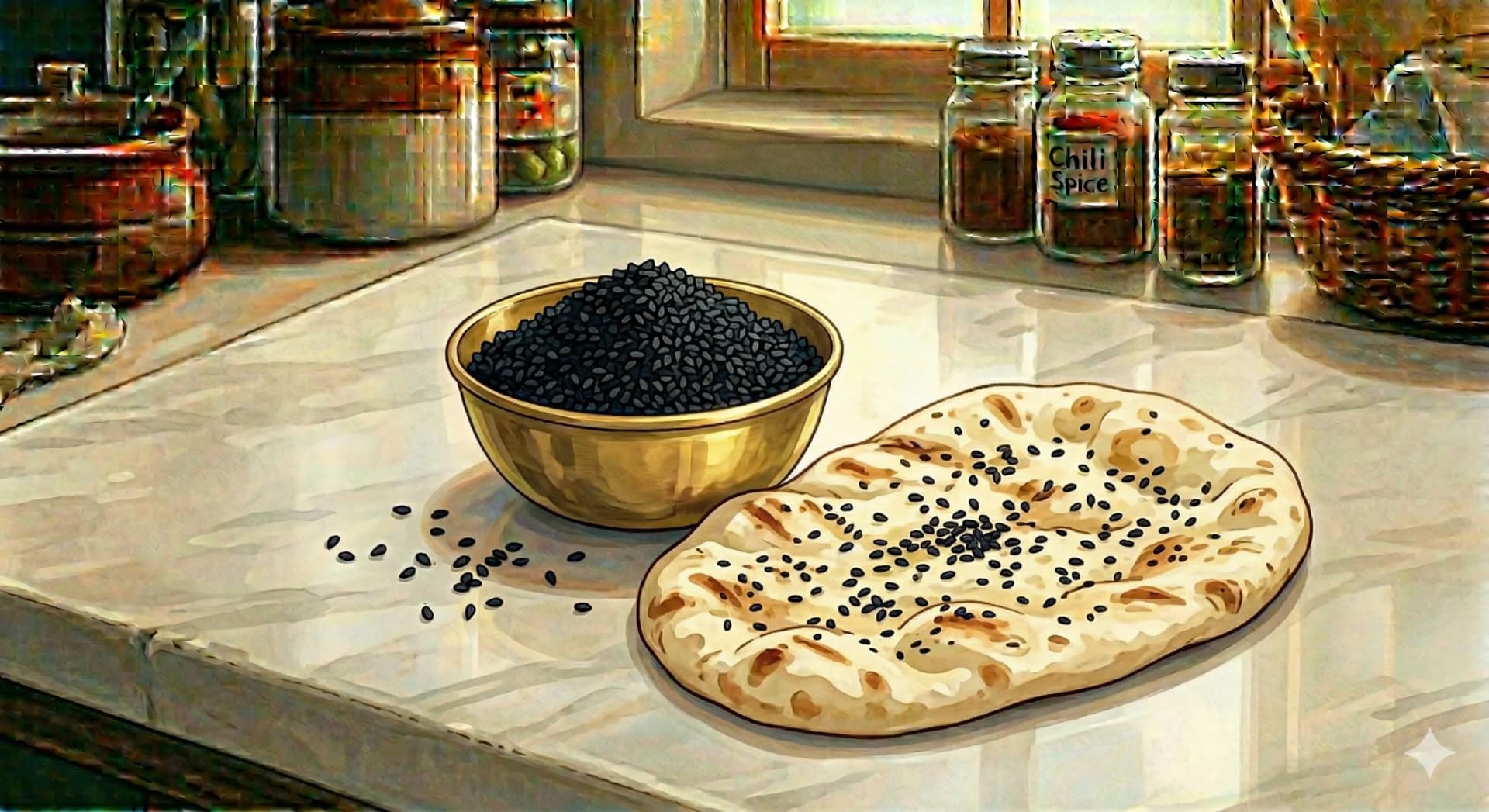
Nigella seeds are most naturally at home as a bread topping or scattered across flatbreads before cooking. The heat of the oven or griddle transforms their sharp raw quality into something warmer and more herbal, and their small triangular shape embeds into the dough's surface, providing both texture and flavor. On naan, they are a standard topping in South Asian bread traditions. On Turkish and Middle Eastern flatbreads, they appear alongside sesame seeds. On the soft rolls called pav in Mumbai, they are scattered on top before baking.
In Indian savory cooking beyond bread, nigella seeds are most prominent in the panch phoron tradition of Bengal and Odisha, where they are one of the five seeds bloomed whole in hot oil at the start of cooking. They appear in certain spiced pickle preparations (achar), where their antimicrobial properties are functionally relevant. They are less common in North Indian curries and rice dishes but are sometimes used in certain dal and vegetable preparations.
The seeds are almost never ground, as grinding produces an unpleasantly harsh, almost chemical quality that does not appear when they are cooked whole.
Preparation Methods
As bread topping: Scatter whole seeds generously over the surface of shaped dough just before baking or pressing onto a griddle. A tablespoon per naan or flatbread is typical. No pre-treatment needed.
In panch phoron: Combine equal parts whole fenugreek seeds, nigella seeds, cumin seeds, black mustard seeds, and fennel seeds. Store as a blend. Add one teaspoon to one and a half teaspoons of the blend to hot mustard oil or ghee before adding vegetables, fish, or lentils. The mustard seeds should pop and the nigella should sizzle and become fragrant within 30 to 45 seconds.
In achar (pickles): Add whole seeds directly to oil-based pickle preparations. Their antimicrobial properties and flavor are well-suited to the acidity and oil of preserved vegetables.
For oil extraction (traditional medicinal use): Cold-pressed nigella seed oil is commercially available and is the form used in most clinical research. One teaspoon taken directly or mixed into honey or warm water is the standard traditional dose. Not a culinary preparation but widely used as a supplement.
Traditional Dishes
- Naan
- Panch phoron spice blend
- Bengali fish curry (shorshe maach)
- Aloo panch phoron (potatoes with five spices)
- Pav (Mumbai soft rolls)
- Turkish simit (sesame bread rings)
- Egyptian aish baladi flatbread
- Begun bhaja (spiced fried eggplant)
- Mixed vegetable tarkari
- Various South Asian pickles and achar
Comments
Share your thoughts on this ingredient.
Sign in to comment0 Comments