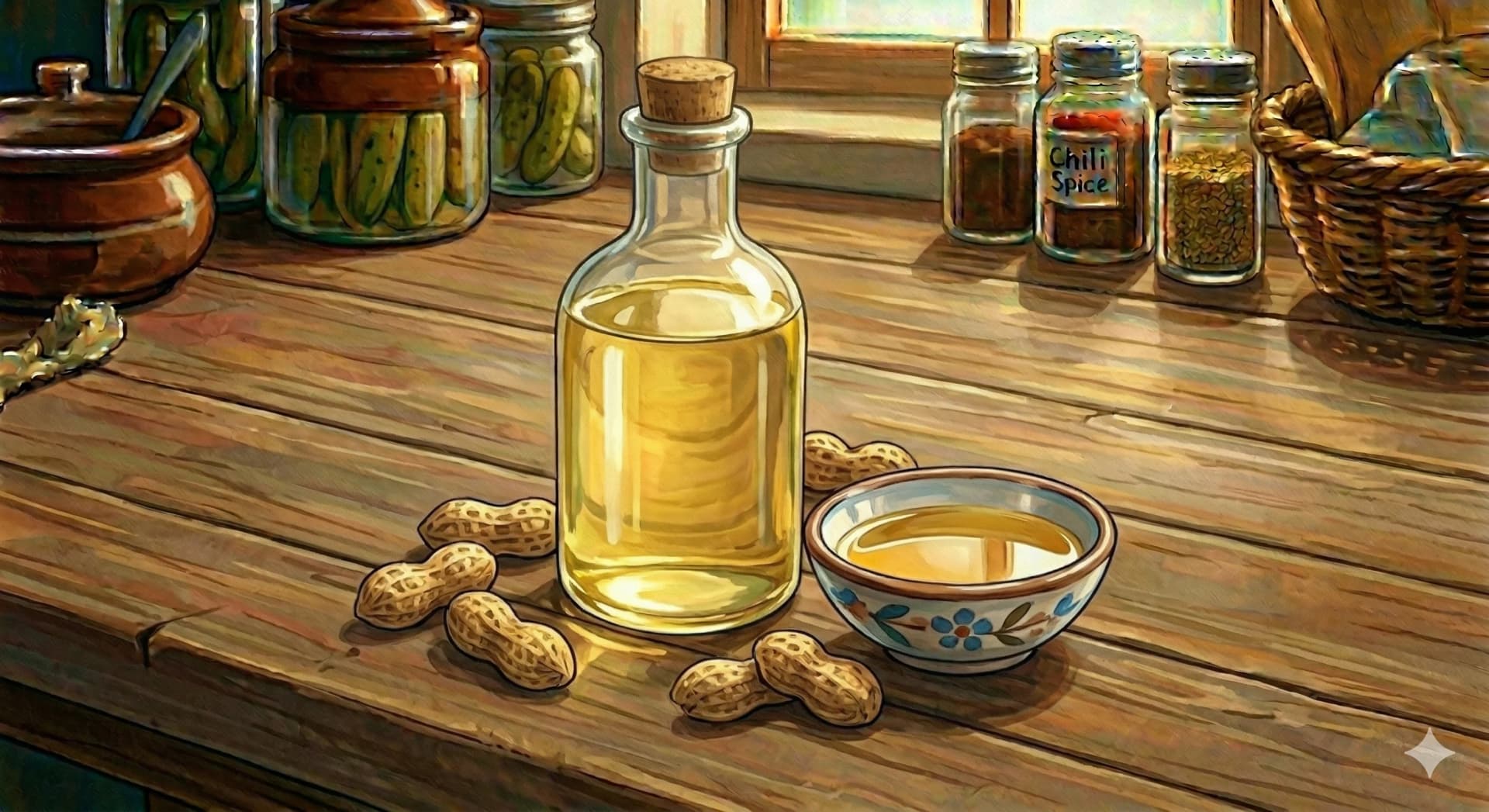
Peanut Oil
Also known as: Groundnut Oil, Arachis Oil, Hua Sheng You
Peanut oil is one of the most important cooking oils in Asian cuisines and beyond, prized above all for its exceptionally high smoke point of around 450°F (232°C) for refined varieties. This heat tolerance makes it the preferred fat for wok cooking, where oil must be pushed to extreme temperatures to create the wok hei — the smoky, seared quality — that defines great Chinese stir-fry. Without an oil that can sustain this heat cleanly, the Maillard reaction that produces deep browning and flavor complexity simply cannot happen at the speed required.
Its flavor is mild and subtly nutty, present enough to add character but restrained enough not to overpower the ingredients it cooks. Cold-pressed or unrefined peanut oil carries more pronounced nuttiness and retains naturally occurring vitamin E and trace compounds. Refined peanut oil is neutral and better suited to high-heat applications. Both types are liquid gold in a well-stocked pantry.
The peanut itself, Arachis hypogaea, is not a true nut but a legume — a fact relevant to allergy considerations. People with peanut allergies should treat peanut oil with caution: highly refined peanut oil has most allergenic proteins removed, but cold-pressed and unrefined versions may retain enough to trigger reactions.
Key facts at a glance:
- Smoke point ~450°F — ideal for wok cooking and deep frying
- Essential for wok hei — sustains the extreme heat needed for proper searing
- Favorable fatty acid profile — 46-49% oleic acid (monounsaturated)
- Originated in South America — brought to Asia by Portuguese traders in the 16th century
- Dominant cooking fat in Shandong — and foundational across many regional Chinese cuisines
- Allergy consideration — refined versions have most allergenic proteins removed
Flavor Profile
Origin
China, India, West Africa
Traditional Medicine Perspectives
Ayurveda:
In Ayurvedic thought, peanuts and their oil are considered warm in nature (ushna virya) and heavy (guru guna). They are said to increase Kapha when consumed in excess but nourish body tissues (dhatus) and support Vata. Peanut oil applied topically has been used in abhyanga (oil massage) formulations for its emollient properties. Internal use is generally considered appropriate in moderation for those with Vata imbalance, particularly in dry or cold conditions.
Traditional Chinese Medicine:
In TCM, peanuts (Hua Sheng) are associated with the Lung and Spleen meridians. They are considered sweet in flavor and neutral in temperature, with properties of moistening the Lungs, harmonizing the Stomach, and stopping bleeding. Peanut oil, derived from this foundation, is regarded as nourishing and lubricating. It is not a strongly medicinal substance in TCM but contributes to overall nourishment, particularly for those with Lung dryness or Spleen deficiency.
Modern Scientific Research
Peanut oil has a favorable fatty acid profile: approximately 46-49% oleic acid (monounsaturated), 30-33% linoleic acid (polyunsaturated), and modest saturated fat. Oleic acid has been associated with reduced LDL cholesterol and improved cardiovascular markers in multiple studies.
Unrefined peanut oil contains meaningful amounts of vitamin E (tocopherols), which function as antioxidants both in the oil and in the body. Some research has also identified resveratrol in cold-pressed peanut oil, the same stilbenoid found in red wine and associated with anti-inflammatory and cardioprotective effects.
Refined peanut oil is relatively resistant to oxidation at cooking temperatures due to its monounsaturated fat content, producing fewer harmful oxidation byproducts than oils higher in polyunsaturated fats when used at high heat.
Cultural History
The peanut originated in South America and was carried to West Africa and Asia by Portuguese traders in the 16th century. In China, it was adopted rapidly across Shandong, Guangdong, and other provinces, and peanut oil quickly became the dominant cooking fat in many regional cuisines. Shandong cooking in particular, considered the foundation of northern Chinese culinary tradition, relies on peanut oil for its iconic stir-fried and braised preparations.
In West Africa, groundnut oil became similarly central. It is the traditional fat for many Ghanaian and Nigerian stews, lending a gentle richness to groundnut soups that have sustained communities for centuries. Colonial-era trade routes brought peanut cultivation to the American South as well, where peanut oil became associated with deep-frying, particularly in Southern cooking and later popularized for frying turkeys.
In India, groundnut oil (moongphali ka tel) is a staple across Gujarat and Maharashtra — each regional tradition developed its own relationship with the oil, yet all converge on the same core quality: reliable high-heat performance and clean flavor.
Culinary Uses
In Chinese wok cooking, peanut oil is heated until it just begins to smoke before aromatics are added. This ensures the wok is hot enough for proper searing and prevents ingredients from steaming instead of frying. The oil's mild character lets garlic, ginger, and chili aromatics express themselves clearly without competing. It is equally valuable for deep frying: its high smoke point means food cooks quickly at the surface, resulting in a crisp exterior and less oil absorption.
Beyond high-heat applications, peanut oil works beautifully in dressings, cold noodle sauces, and marinades. Cold-pressed varieties contribute a gentle nuttiness to sesame-adjacent sauces and can partially replace sesame oil where a less intense but still rounded flavor is desired. In satay sauce and some dan dan noodle preparations, a small quantity of peanut oil unifies and enriches the sauce.
Preparation Methods
For wok cooking: heat the wok dry over highest heat until it begins to smoke slightly, then add peanut oil and swirl to coat. Add aromatics immediately and proceed with the stir-fry. This sequence is essential for wok hei.
For deep frying: maintain oil between 350-375°F (175-190°C); use a thermometer and fry in small batches to prevent temperature drop.
Store peanut oil in a cool, dark place; refined versions keep up to a year, cold-pressed varieties up to 6 months. Refrigeration is not necessary but extends shelf life in warm climates.
Traditional Dishes
- General Tso's Chicken
- Dan Dan Noodles
- Kung Pao Chicken
- Pad Thai
- Satay Sauce
- Shandong Stir-Fried Pork
- West African Groundnut Soup
- Southern Fried Chicken
- Cantonese Wok-Fried Vegetables
Comments
Share your thoughts on this ingredient.
Sign in to comment0 Comments