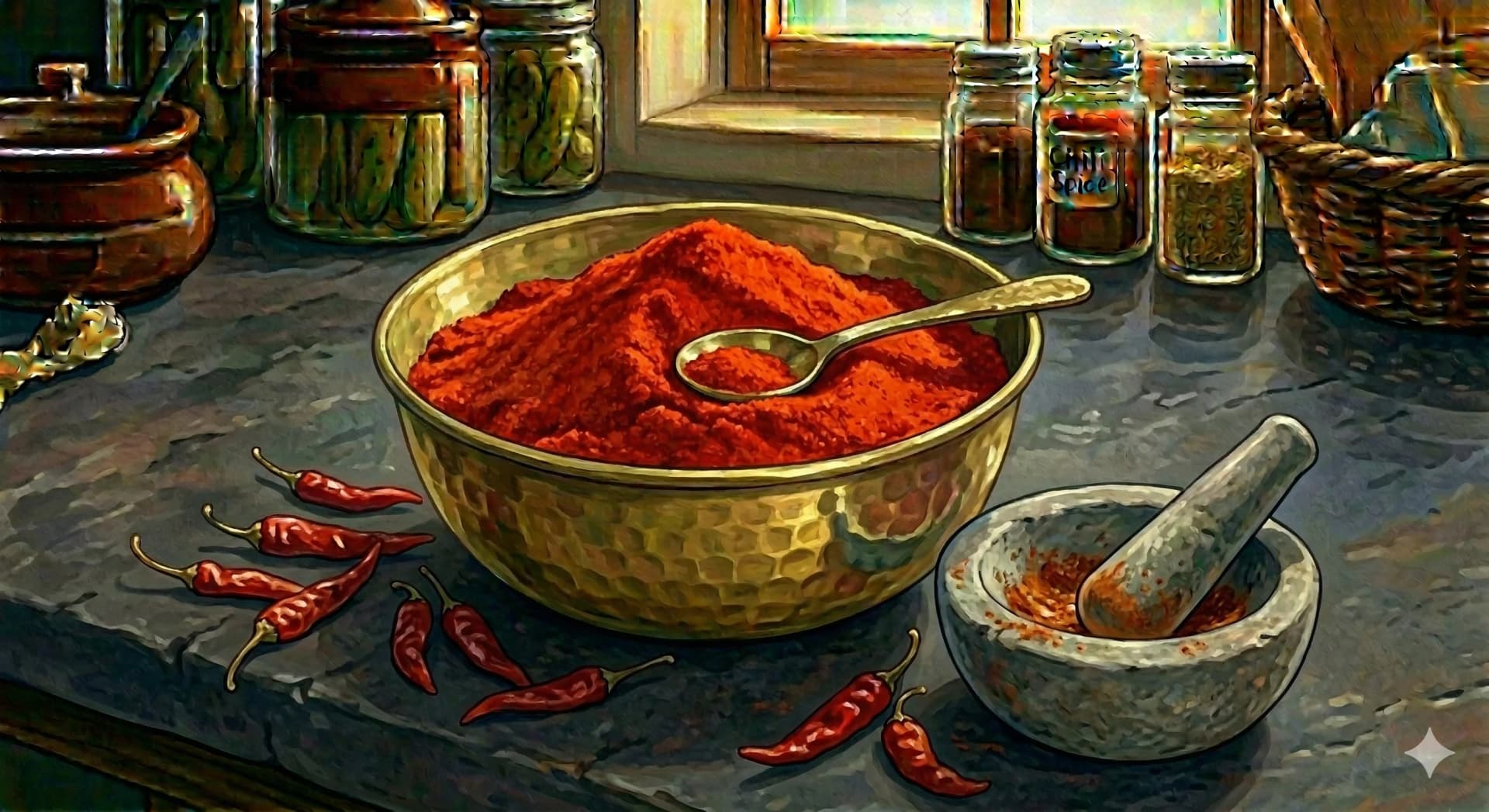
Red Chili Powder
Also known as: Lal Mirch, Cayenne Powder, Indian Chili Powder, Pisi Lal Mirch
Red chili powder as used in Indian cooking is typically pure ground dried red chilies, a fundamentally different product from the American spice-blend product called "chili powder" (which contains cumin, garlic powder, and other spices mixed in). Indian lal mirch is a single-ingredient spice: dried red chilies ground to a fine or coarse powder, with nothing added. The heat level varies considerably based on which chili variety is used, and the choice of chili powder is one of the most meaningful variables a cook controls when building an Indian dish.
The flavor of red chili powder is more than heat. A good-quality Indian chili powder has a fruity, almost sweet undertone beneath the pungency, a slightly smoky background note, and a color-contributing quality that gives Indian curries their characteristic red-orange appearance. Cheaply produced chili powder that has been stored too long becomes flat and dull, providing heat without depth.
The most prized varieties, such as Kashmiri chili and Byadagi, are specifically valued for their color-giving ability rather than their heat, allowing cooks to achieve a rich, vivid red appearance without making a dish unbearably spicy.
Chili arrived in India from the Americas, carried by Portuguese traders in the early 1500s, and its adoption was one of the fastest and most complete flavor revolutions in culinary history. Within roughly 200 years, red chili had become so embedded in Indian cooking across nearly every region that it is almost impossible for most people today to imagine the flavor of pre-chili Indian food.
Key facts at a glance:
- Pure ground dried chilies — not the American spice blend called "chili powder"
- Arrived via Portuguese traders — in the early 1500s, adopted within 200 years
- Kashmiri chili — mild, paprika-like, prized for brilliant red color
- Guntur chili — one of India's hottest, defines Andhra and Telangana cooking
- Capsaicin binds TRPV1 receptors — producing heat sensation through pain receptor activation
- Two-chili technique — Kashmiri for color, cayenne for heat, controlling each independently
Flavor Profile
Origin
Americas (origin), India (adoption), Mexico
Traditional Medicine Perspectives
Ayurveda:
Red chili is considered the most intensely heating (ushna) spice in Ayurvedic practice, significantly more warming than black pepper, ginger, or mustard. It strongly increases Pitta and reduces Kapha, with a more nuanced relationship to Vata (warming in small amounts, aggravating in excess). In Ayurvedic cooking, chili is used therapeutically in very small amounts to stimulate digestive fire (agni), clear Kapha-type congestion and cold conditions, and improve circulation. For Pitta constitutions or individuals with inflammatory conditions, excess stomach acid, skin conditions, or fever, chili is used minimally or avoided. The classical Ayurvedic texts predate chili's arrival from the Americas, so much Ayurvedic chili wisdom is more recent adaptation rather than ancient codification.
Traditional Chinese Medicine:
In TCM, hot peppers (Jiao) are classified as acrid and hot, entering the heart and spleen meridians. They are used to dispel cold, dry dampness, and warm the middle. TCM applications overlap significantly with Ayurvedic ones: chili is useful in cold-type digestive weakness, cold-damp conditions, and Yang deficiency patterns. Like in Ayurveda, it is contraindicated in heat patterns, yin deficiency with heat signs, and inflammatory conditions. External capsaicin application is noted in TCM-informed practice for relieving cold-type joint and muscle pain.
Modern Scientific Research
Capsaicin, the primary active compound in hot chilies, is one of the best-studied phytochemicals in food science. Its mechanism of action is now well understood: capsaicin binds to the TRPV1 receptor (Transient Receptor Potential Vanilloid 1), a pain and heat receptor, activating it in the same way that genuinely high temperatures do. This produces the burning sensation of hot food and, over time with repeated exposure, causes desensitization of TRPV1 receptors, which is the basis for the use of topical capsaicin preparations in pain medicine for conditions including post-herpetic neuralgia, diabetic neuropathy, and arthritis.
Capsaicin has been the subject of extensive research in cancer biology, with numerous in-vitro and animal studies demonstrating pro-apoptotic effects in cancer cells. Human clinical evidence remains limited, though epidemiological data from populations with high chili consumption has been examined.
Research on capsaicin and metabolism shows a modest but measurable increase in metabolic rate and fat oxidation following consumption, which has attracted interest in weight management research.
Cardiovascular research suggests that regular low-level chili consumption may be associated with reduced cardiovascular mortality, with studies from China and Italy showing associations between frequent chili consumption and reduced risk of death from cardiac and cerebrovascular causes.
Cultural History
Chili peppers are native to the Americas, where Capsicum species have been cultivated for at least 6,000 years in Mexico and Central America. When the Portuguese established trading posts along the Indian coastline in the early 1500s following Vasco da Gama's 1498 voyage, they brought with them Capsicum annuum and related species from their ports in Brazil and the Caribbean. The port of Goa became one of the primary entry points for chili into the Indian subcontinent, and it is not coincidental that Goan cooking today remains one of the most intensely chili-forward cuisines in India.
The speed of chili adoption across South Asia is remarkable and not fully explained. Chilies spread from the Portuguese coastal ports to the interior of India within decades, and by the 17th century were already being documented as common market goods across much of the subcontinent. Several theories have been proposed for this rapid adoption: chilies produced a similar pungency to long pepper (Piper longum), which was already familiar and valued, and they grew prolifically in the Indian climate.
Chilies may have been adopted enthusiastically by populations who could not afford black pepper and found in chilies a freely-grown alternative for adding heat.
The regional differentiation of chili use in India developed over these centuries into a sophisticated system. Kashmiri chili (Kashmiri mirch) is a mild, paprika-like variety grown in the Kashmir valley, prized almost exclusively for its brilliant red color and mild, slightly sweet flavor. Guntur chili from Andhra Pradesh is one of the hottest commercially grown chilies in India and defines the extraordinary heat levels of Andhra and Telangana cooking. Byadagi chili from Karnataka is wrinkled, dark red, and color-forward rather than heat-forward, essential to the appearance of many South Indian dishes. Sannam chili is the most widely exported Indian variety and provides the medium-hot baseline of much commercial chili powder.
Culinary Uses
The most important technique for using red chili powder in Indian cooking is bhuna: cooking the spice in hot oil or ghee until it darkens slightly, blooms in color, and loses its raw, harsh edge. This process transforms raw-tasting chili powder into a deep, rounded base. In a curry, after tempering aromatics, the tomatoes or onion paste are added, then once some liquid has evaporated, chili powder goes in along with other ground spices and is cooked in the oil-and-liquid mix for several minutes, stirring constantly to prevent burning. This cooking stage, when done correctly, produces the rich red-orange color and deep flavor that defines a well-built Indian curry.
Many experienced Indian cooks use two types simultaneously: a large quantity of Kashmiri chili for color with mild heat, and a smaller quantity of a hot variety like cayenne for the actual heat component.
The choice of chili powder variety is itself a culinary decision. This two-chili technique allows precise control over appearance and pungency independently. A dish can be made visually striking with a deep red color without being made painfully hot, or a moderate amount of hot chili can be added to a mild base when depth of color is less important.
Preparation Methods
Bhuna (blooming in oil): Add ground red chili powder to hot oil or a sauce base. Cook over medium heat, stirring constantly for 2-4 minutes, until the oil takes on a red-orange color and the chili loses its raw smell. Never add chili directly to a dry hot pan without liquid or fat, as it will burn within seconds.
Two-chili technique for color and heat: Use Kashmiri chili for color (1-2 teaspoons) and a small amount of cayenne or hot Indian chili for heat (1/4-1/2 teaspoon). Adjust ratios to reach the desired balance.
Tadka chili: Whole dried red chilies in hot oil contribute a different, more roasted flavor than ground powder. Combine both in a dish for layered chili complexity.
Tandoori marinade: Mix red chili powder with yogurt, ginger-garlic paste, and other spices. The yogurt moderates the heat while the chili contributes its deep color and flavor to the marinating protein.
Storage: Keep in an airtight container away from light and heat. Chili powder fades in color and loses intensity relatively quickly compared to whole spices. Replace within 1-2 years for best results.
Traditional Dishes
- Dal Tadka
- Sambar
- Tandoori Chicken
- Butter Chicken
- Rogan Josh
- Chole
- Vindaloo
- Chaat Masala
- Curry Base
- Achaar
- Shrimp Masala
- Egg Curry
Comments
Share your thoughts on this ingredient.
Sign in to comment0 Comments