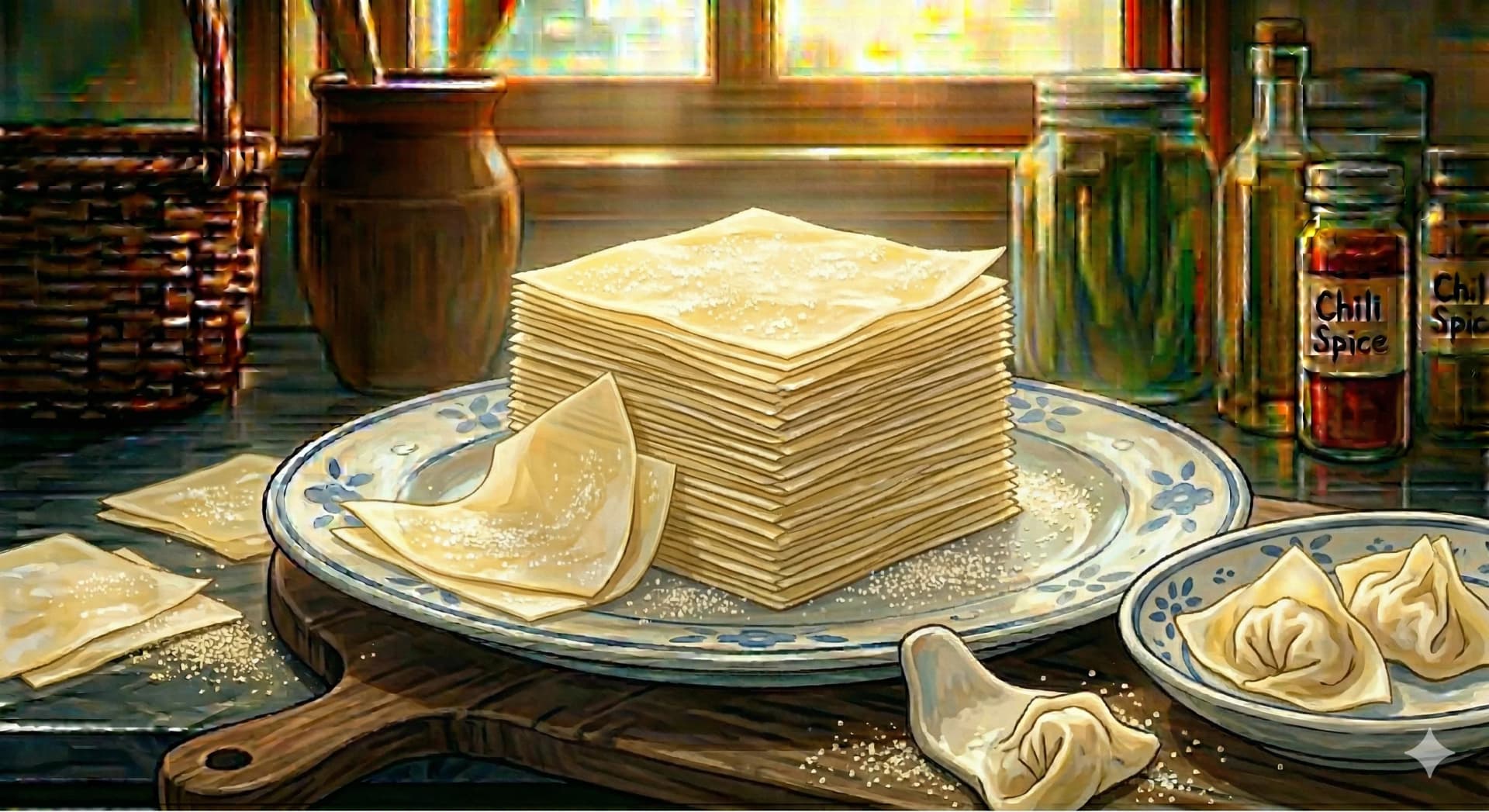
Wonton Wrappers
Also known as: Hun Tun Pi, Wonton Skin, Yun Tun Pi
Wonton wrappers are thin, yellow squares of egg-and-wheat dough — typically about 3 inches square and paper-thin — designed to be filled, folded into their characteristic shape, and either simmered in soup or deep-fried.
The egg in the dough gives them a characteristic golden-yellow color and a silky, slippery texture when cooked in broth that is one of the distinguishing pleasures of wonton soup.
Thinner than dumpling wrappers and square rather than round, they are a distinct product suited to the delicate, soup-based preparations of Cantonese cooking.
Key facts at a glance:
- Thin, yellow squares of egg-and-wheat dough — typically 3 inches square, paper-thin
- Egg gives golden-yellow color — and a silky, slippery texture in broth
- Distinct from dumpling wrappers — thinner and square rather than round
- Over a thousand years of history — the Cantonese version is one of the most refined expressions
- Traveled globally with Chinese diaspora — among the first Chinese foods widely encountered worldwide
Flavor Profile
Origin
China, Cantonese cuisine, Guangdong
Traditional Medicine Perspectives
Traditional Chinese Medicine
Wonton wrappers, as a wheat and egg product, are classified as warm and sweet in TCM, associated with the Spleen and Stomach. They tonify Qi and support the middle burner. The combination of wheat (Qi-tonifying) and egg (Blood and Yin-nourishing) creates a balanced, fortifying food. Soup-cooked preparations are considered more digestible than fried versions.
Modern Scientific Research
Wonton wrappers provide primarily carbohydrates from wheat flour and some protein from egg content.
The thin, delicate nature means they contribute relatively little nutritionally compared to the filling.
The egg provides choline, B vitamins, and protein.
Cultural History
Wontons have been eaten in China for over a thousand years, with the Cantonese version — filled with pork and shrimp, served in a clear broth, paired with springy egg noodles — representing one of the most refined expressions of the form.
A perfectly made wonton is a point of craft pride in Cantonese food culture. The Sichuan version (chao shou) differs — served in chili oil rather than clear soup, folded differently.
Wontons traveled with Chinese diaspora communities globally and became one of the first Chinese foods widely encountered by non-Chinese communities worldwide.
Culinary Uses
Fill with seasoned pork and shrimp (the classic Cantonese filling) and fold into the traditional wonton shape.
Cook in boiling water for 3–4 minutes until the wrapper turns translucent. Serve in chicken or pork bone broth.
Deep-fry filled wontons for crispy appetizers. Make Sichuan chao shou by folding differently and serving in chili oil.
Preparation Methods
Keep wonton wrappers covered with a damp cloth while working to prevent drying.
Place filling in the center (about 1 teaspoon). Fold into desired shape and seal edges with a dab of water.
Cook immediately or freeze on a tray before transferring to bags.
Traditional Dishes
- Wonton noodle soup (Cantonese)
- Sichuan chao shou in chili oil
- Deep-fried wontons
- Wonton soup
- Hong Kong shrimp and pork wontons
Comments
Share your thoughts on this ingredient.
Sign in to comment0 Comments