Punjabi · Indian Cuisine
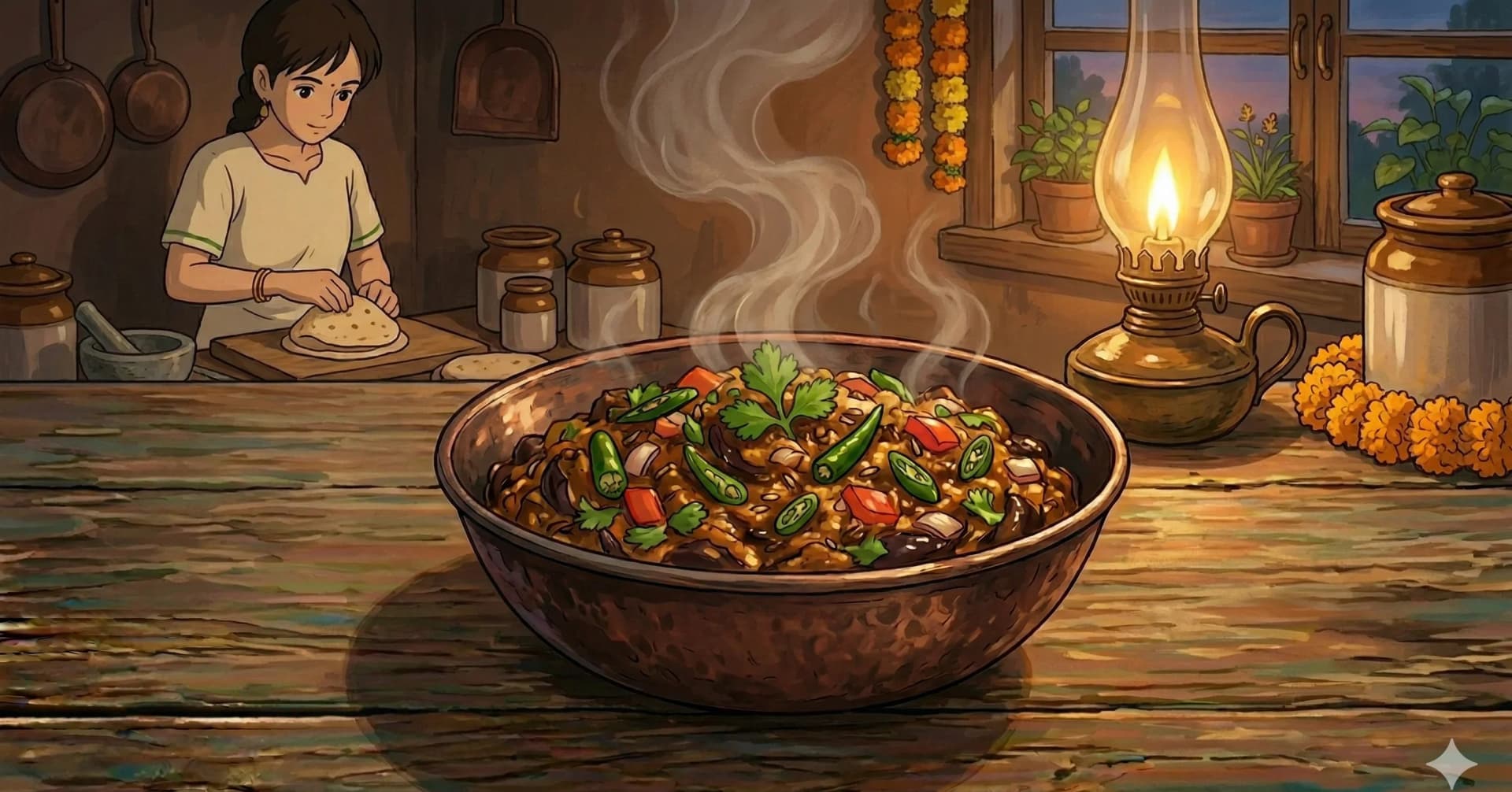
Smoky Mashed Eggplant (Baingan Ka Bhartha)
Tandoor-roasted aubergine mashed with spiced tomato and onion
The word bhartha means "mashed," but the technique that precedes it is what gives this dish its character. Before any spice or pan enters the picture, the whole aubergine is placed directly over a live flame, or into the intense radiant heat of a tandoor, until the skin chars black and the interior collapses entirely. This collapse is not damage; it is the recipe. The smoke penetrates the flesh as it softens, producing a flavour that no amount of cooking in a pan can replicate.
In Punjabi homes and dhabas, the bhartha method is applied to large globe aubergines (baingan) that have the surface area to char well and the thick flesh to develop real depth. The roasted aubergine is peeled while still warm (the charred skin lifting easily from the smoky mash beneath) then folded into a simple masala of fried onions, tomatoes, and spices. The dish is finished with a handful of raw diced onion, which provides textural and flavour contrast to the cooked mash.
What arrives at the table is something between a side dish and a condiment: smoky, deeply savoury, slightly acidic from the tomatoes, with the fresh coriander and green chilli cutting through the richness. Baingan ka bhartha is one of the most elemental Punjabi vegetable dishes: few ingredients, minimal technique, but that irreplaceable quality of smoke from the fire.
If you do not have a gas hob or tandoor, a very hot oven grill will char the aubergine reasonably well. See Substitutions below.
At a Glance
Yield
Serves 4–6
Prep
10 minutes
Cook
30 minutes
Total
40 minutes
Difficulty
Easy
Ingredients
- 1½ lblarge globe aubergine (about 2 medium)
- 1¼ cupsneutral oil
- 1⅓ tspcumin seeds
- 2½ ozonion, finely sliced
- 1⅔ tspred chilli powder
- 1 tbspginger and garlic paste (combined)
- 1⅔ tspcoriander powder
- 3½ oztomatoes (about ½–1 tomato), finely chopped
- 1 tspgaram masala powder
- ¼ ozgreen coriander, roughly chopped
- ⅔ tspsalt
- 1½ tspgreen chillies (about 1–2 small), finely chopped
- ¾ ozonion, finely diced (for garnish/texture)
Method
- 1
Roast the aubergine. Place the whole aubergines directly over the open flame of a gas hob on medium-high heat. Turn every 2–3 minutes with tongs until the skin is completely blackened and the aubergine feels soft and collapsed throughout; this takes 12–18 minutes depending on size. The aubergine should feel very soft when pressed gently and may leak juice. Transfer to a plate and allow to cool until handleable.
- 2
Peel and mash. Peel away and discard the charred skin; it should come off easily in large pieces. Remove and discard the stem. Place the roasted flesh in a bowl and mash coarsely with a fork. Do not over-process; a slightly textured mash is more interesting than a smooth purée.
- 3
Build the masala. Heat the oil in a wide kadhai over medium heat. Add the cumin seeds (¾ teaspoon); when they splutter and darken, add the sliced onions. Fry, stirring regularly, until the onions are light golden brown, about 8 minutes. Add the ginger-garlic paste and stir for 1 minute until fragrant. Add the red chilli powder (½ teaspoon) and coriander (8 g) powder (1 teaspoon), stir for 30 seconds.
- 4
Add tomatoes (100 g). Add the chopped tomatoes to the pan and cook, mashing them down with the back of the spoon, for 5–6 minutes until the tomatoes are completely broken down and the oil begins to separate and pool at the edges of the masala. This is the sign the masala is properly cooked.
- 5
Fold in the aubergine. Add the mashed roasted aubergine and the salt (¾ teaspoon) to the masala. Mix well, pressing and folding, until thoroughly combined. Cook for a further 3–4 minutes on medium heat, stirring regularly.
- 6
Finish. Add the garam masala (½ teaspoon) and stir through. Taste and adjust salt. Turn the heat off.
- 7
Serve. Transfer to a serving dish. Scatter the diced raw onion (70 g) over the top, followed by the green chillies (1–2 small) and fresh coriander. Serve immediately.
Key Ingredient Benefits
Aubergine / Baingan (Solanum melongena) is one of the most widely cultivated vegetables in South Asia. It is low in calories and a source of dietary fibre and several B vitamins. In Ayurvedic tradition, aubergine is considered to stimulate digestion and is used to support liver function when cooked with appropriate warming spices. The charring process creates new compounds on the surface through the Maillard reaction, adding complexity without significantly altering the nutritional profile of the flesh.
Garam masala (the finishing spice blend) is not a single ingredient but a blend of warming whole spices, typically including cardamom, cloves, cinnamon, cumin, coriander, and black pepper. In Ayurvedic cooking, these warming spices are added at the end of cooking to avoid prolonged heat that diminishes their more volatile aromatic compounds. The term garam means "warm," a reference not to heat-spice but to the Ayurvedic property of warming the body.
Cumin seeds (Cuminum cyminum), bloomed in hot oil as the first step, release their volatile oils into the cooking fat which then distributes them through the whole dish. In Unani medicine, cumin is traditionally used as a carminative, thought to aid digestion and reduce flatulence. Relevant here given the aubergine's fibre content.
Why This Works
The entire flavour foundation of bhartha is the Maillard reaction between fire and aubergine skin. The char creates aromatic compounds that permeate the flesh during roasting. This is not surface flavour; it penetrates throughout the pulp. Because the skin also acts as a container holding the steaming interior, the aubergine essentially smokes itself from the inside as it collapses.
Adding diced raw onion at the end serves a specific purpose: the cooked masala and roasted aubergine are rich and rounded in flavour, and the raw onion's sharp, slightly pungent bite creates contrast and freshness that the finished dish would otherwise lack. This is deliberate textural and flavour layering common in Punjabi cooking. The same ingredient (onion) used twice in the same dish to do two different jobs.
Substitutions & Variations
No gas flame: Place the whole aubergines on a foil-lined tray directly under a very hot grill, as close to the element as possible. Turn every 5 minutes. The skin will char but less evenly; the interior will soften but the smoke flavour will be more subtle. Some cooks add a small drop of liquid smoke to compensate.
Green peas: 60 g of cooked green peas folded in with the aubergine adds colour and a mild sweetness that balances the smoky depth.
No tomatoes: A version without tomatoes, using only onion and spices, is also traditional; slightly drier and more smoky in character.
Yoghurt finish: A tablespoon of thick plain yoghurt stirred in at the end adds a slight tang and makes the texture slightly creamier.
Serving Suggestions
Baingan ka bhartha is most at home with hot chapati or missi roti, where the bread can scoop up the smoky mash. It also works alongside a simple dal and rice for a complete vegetarian meal. The smokiness makes it a natural companion to richer, creamier dishes. The contrast between a bhartha and a makhni dal or paneer butter masala on the same table is a classic Punjabi combination. Serve immediately after finishing; the warm mash with the raw onion and coriander scattered over is at its best fresh from the pan.
Storage & Reheating
Refrigerate in a covered container for up to 2 days. The smoky flavour deepens slightly overnight, which some find even more appealing. Reheat in a pan over medium heat with a small splash of water, stirring well. Does not freeze well.
Cultural Notes
Baingan ka bhartha (बैंगन का भर्ता, "smashed eggplant") is the Punjabi preparation of a whole eggplant roasted over an open flame until the skin chars and the interior softens, then peeled, mashed, and cooked with onions, tomatoes, ginger-garlic, green chilies, cumin, and garam masala. The dish is one of the foundational Punjabi vegetable preparations and one of the most strongly textured of the North Indian vegetable dishes, with the rough hand-mashed texture and the deep smoky flavor from the open-flame roast distinguishing it from the smoother, more uniformly cooked Indian vegetable curries.
The fire-roasting is the technical heart. The eggplant (the large round purple variety, sometimes called Italian or globe eggplant) is washed, lightly oiled, and pierced in a few places to release steam. The whole vegetable goes directly onto an open gas flame, a wood fire, or under a hot broiler, and is rotated every two or three minutes for fifteen to twenty minutes total until the skin is uniformly blackened and blistered and the interior has collapsed to a soft creamy texture. The blackened skin is peeled away (some cooks intentionally leave a few small bits of char in the flesh for additional smoky flavor), and the soft interior is roughly mashed with a fork or the back of a spoon, keeping the texture chunky rather than puréed.
The cooking finishes the dish. A base of cumin seeds tempered in ghee or mustard oil, then sliced onions cooked to deep golden brown, then ginger-garlic paste, then chopped tomatoes cooked down until they break apart. The mashed eggplant is added with turmeric, kashmiri red chili powder, salt, and garam masala, and the whole mixture is stirred over moderate heat for ten to fifteen minutes until the flavors meld and the dish takes on a uniform texture. A final scatter of chopped fresh cilantro and slit green chilies on top completes the dish. The pairing with roti or naan and a yogurt-based side (raita or plain yogurt) is the standard Punjabi home serving format. The dish is also one of the staple winter preparations across Punjab, when eggplants are at their largest and most flavorful from the cool-season harvest.
Nutrition Facts
Calories: 404kcal (20%)|Total Carbohydrates: 16g (6%)|Protein: 3g (6%)|Total Fat: 38g (49%)|Saturated Fat: 5.4g (27%)|Cholesterol: 0mg (0%)|Sodium: 397mg (17%)|Dietary Fiber: 6.8g (24%)|Total Sugars: 7.9g
You Might Also Like
Ratings & Comments
Ratings & Comments
Ratings
Share your thoughts on this recipe.
Sign in to rate and comment