Indian Cuisine
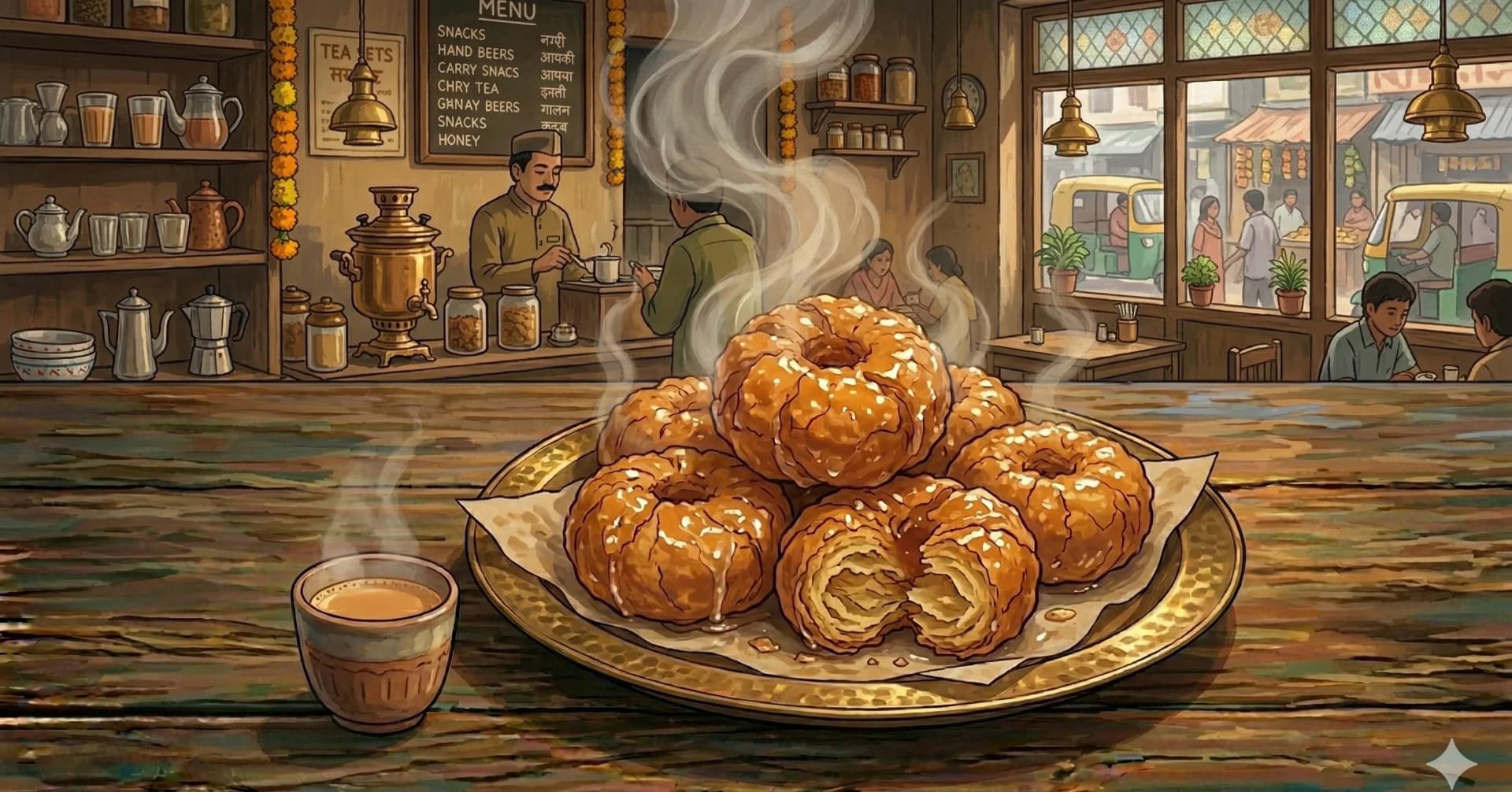
Flaky Fried Pastry (Balushahi)
North Indian Flaky Glazed Pastry Sweet
Balushahi is a sweet that rewards a light hand. The dough (flour, ghee, thick curd, and a small measure of leavening) must be mixed gently, almost carelessly, just enough for everything to come together without the gluten developing into an elastic network. Overwork it and the pastry becomes dense and biscuit-like; handle it with restraint and it emerges from the ghee as a puffed, layered disc that shatters at the edges and flakes inward, carrying its rich ghee flavour through every stratum.
North India's mithai shops have been making balushahi for centuries, and it sits in a category of its own among Indian sweets. Where gulab jamun is yielding and syrup-soaked to its centre, balushahi is drier and crisper, the sugar syrup absorbed mostly at the surface, leaving a glazed exterior over a still-distinct interior crumb. Where jalebi is chewy and syrup-heavy, balushahi is flaky and restrained. The sweetness is real but measured. This is not a sweet that overwhelms, which is precisely why it is eaten in pairs and triples rather than stopped at one.
The technique requires patience in two places. First, the dough must rest for a full hour after mixing. This allows the ghee to set firm again and the small amount of leavening to work quietly. Second, the frying must begin off the heat: the balushahis go into hot ghee removed from the flame, which sets a very gentle initial temperature and prevents the exterior from browning before the interior has begun to cook. They go back on the flame at low heat, and the bloating happens slowly. You watch each disc swell and puff over several minutes.
The resulting sweet, glazed in two-string syrup and left to set, is one of North India's finest and least-heralded confections.
At a Glance
Yield
18–20 pieces
Prep
20 minutes (plus 1 hour rest)
Cook
45 minutes
Total
2 hours
Difficulty
Medium
Ingredients
Method
- 1
Make the dough. Sieve the flour and baking soda together into a large bowl. In a separate bowl, whisk the curd and room-temperature ghee together until creamy and smooth. Add the curd-ghee mixture to the flour and bring together gently, using your fingertips rather than kneading, folding and pressing rather than pushing. Add the ammonia bicarbonate and incorporate with the lightest possible hand. The dough should come together just enough to hold shape; it will look slightly rough and uneven. This is correct. Do not knead vigorously.
- 2
Rest. Cover the dough and leave to rest for 1 hour at room temperature. Do not refrigerate.
- 3
Make the syrup. Combine the sugar with approximately 750 ml of water in a pan. Bring to a boil over medium heat, stirring until the sugar dissolves. Continue boiling without stirring until the syrup reaches two-string consistency: when a drop is placed between your thumb and forefinger and pulled apart, two distinct threads form. Keep the syrup warm over the lowest possible flame while you fry.
- 4
Shape the balushahis. After resting, knead the dough very briefly, just 30 seconds, to bring it together. Divide into lime-sized balls (approximately 18–20 pieces). Roll each into a smooth ball, then press gently between your palms to flatten slightly into a thick disc. Make a shallow indentation in the centre of each disc with your thumb. This helps them cook more evenly.
- 5
Heat the ghee and remove from flame. Pour ghee into a deep, wide pan to a depth of at least 8 cm. Heat over medium-high heat until the ghee is visibly hot. Remove the pan from the flame entirely. Allow the ghee to cool for 2–3 minutes off the heat. It should still be hot but no longer scorching.
- 6
Fry - first phase. Lower 6 balushahis at a time into the removed-from-heat ghee. Return the pan to the lowest possible flame. The balushahis will begin to sizzle gently and puff slowly over the next 8–10 minutes. Do not increase the heat. Turn them carefully once or twice.
- 7
Fry - second phase. Once the balushahis have puffed and begun to colour, increase the heat slightly to medium-low. Continue frying, turning occasionally, until they are a deep, even golden-brown. Darker than you might expect. Around 12–15 minutes total. They should feel light and hollow when lifted.
- 8
Drain and soak. Remove the fried balushahis with a slotted spoon, allowing excess ghee to drip back into the pan. Transfer immediately into the warm sugar syrup. Stir very gently to coat. Leave to soak for 5–10 minutes, turning once or twice.
- 9
Remove and cool. Lift out with a slotted spoon and arrange on a tray. The sugar syrup will coat each balushahi and begin to set as it cools. Leave undisturbed until completely cool. The glaze will become matte and slightly cloudy.
Key Ingredient Benefits
Ghee serves three roles here: as a shortening agent in the dough (inhibiting gluten development), as the frying medium (its high smoke point making it stable for the extended low-temperature fry), and as the primary flavour. The quality of the ghee matters significantly in a preparation this simple. Use pure, good-quality ghee.
Ammonia bicarbonate (ammonium bicarbonate) is a traditional leavening agent used across North Indian baking. It decomposes completely into ammonia gas and carbon dioxide during heating, leaving no residual alkaline taste, unlike baking soda, which can leave a soapy note if not completely neutralised by acid. The trace smell of ammonia during frying dissipates entirely by the time the balushahi is eaten. Available at Indian and Middle Eastern grocery stores.
Thick curd contributes mild acidity (activating the baking soda), fat, and moisture. The curd's proteins also contribute to the tender crumb. Hung curd or Greek-style yogurt is ideal. Thinner yogurt will make the dough too slack.
Why This Works
The very light kneading is the foundation of the recipe. All-purpose flour contains gluten proteins that, when developed through vigorous kneading and moisture, form an elastic network. In bread, this is desirable. In balushahi, it is the enemy. A developed gluten network prevents the pastry from separating into layers during frying and produces a dense, chewy result. The minimal kneading and the presence of ghee (which coats flour proteins and inhibits gluten development) ensure the dough remains short and crumbly.
Ammonia bicarbonate (baker's ammonia) is a traditional leavening agent that decomposes completely into gas during frying, leaving no residual flavour. It produces a more complete, thorough lift than baking soda alone, which is why traditional balushahi uses both. The baking soda provides initial lift and the ammonia provides a secondary expansion that creates the characteristic airy interior.
Starting the fry off the heat prevents the exterior from immediately hardening at too high a temperature, which would trap the interior before it has had time to expand. The slow, low-temperature fry allows the leavening gases to expand gradually, pushing layers apart and creating the flaky interior.
Substitutions & Variations
- Without ammonia bicarbonate: Increase baking soda to 2 g. The result is slightly less airy but still flaky.
- With kewra water: Add 1 tsp of kewra (screwpine) water to the dough for the floral note used in some regional versions.
- Stuffed balushahi: Press a pinch of crumbled khoya and crushed nuts into the centre before shaping, seal, and proceed. The filling heats through during the slow fry.
- Cardamom syrup: Add ½ tsp of cardamom powder to the sugar syrup for additional fragrance in the glaze.
Serving Suggestions
Balushahi is served at room temperature, one or two per person, as a mithai at festivals, weddings, and celebrations. It is associated with North Indian wedding sweets and the autumn festival season. No accompaniment is traditional or necessary. In sweet shops it is sold by weight, wrapped in food-grade paper. At home, arrange on a wide plate and allow the glaze to set fully before serving.
Storage & Reheating
Store in an airtight container at room temperature for up to 5 days. The glaze will remain matte and the interior will stay flaky. Do not refrigerate. The moisture in the refrigerator softens the glaze and makes the interior gummy. Do not reheat. Balushahi is a cold sweet, and its flakiness is best appreciated at room temperature.
Cultural Notes
Balushahi (बालूशाही) is the North Indian sweet of a flaky donut-shaped pastry made from refined flour (maida), ghee, yogurt, and a small amount of baking soda, deep-fried slowly in ghee until the exterior turns golden and the interior develops a flaky layered crumb, then dipped in sugar syrup until the syrup soaks into the porous interior. The dish belongs to the broader Punjabi-UP wedding sweets tradition and appears at Hindu and Muslim weddings, Diwali sweet boxes, and the halwai (traditional sweet-maker) shops of the north Indian belt. The dish is closely related to the Persian zoolbia and the Middle Eastern zalabia, with the regional Indian variant developed over centuries of culinary exchange across the Persian-Indian corridor.
The dish's flaky texture distinguishes it from the dense gulab-jamun and the syrupy jalebi that anchor the broader North Indian sweet tradition. Where gulab jamun is dense and uniform in texture and jalebi is crisp and brittle, balushahi sits between the two with a flaky shortbread-like interior that absorbs the sugar syrup without losing its layered structure. The key to the layered texture is the combination of two physical techniques: cold ghee rubbed into the flour at the mixing stage (producing pockets of fat that flake during frying, similar to the puff pastry technique), and a slow long fry at moderate heat that lets the interior cook through and develop the layers without the exterior burning.
The technique builds the layered structure carefully. Refined flour is sifted with a small pinch of baking soda. Cold ghee is rubbed into the flour with the fingertips until the mixture resembles coarse breadcrumbs (this is the key step for the flakiness). Yogurt is added gradually and worked in to form a soft sticky dough, which is rested for thirty minutes. The dough is divided into small balls (about an inch and a half across) and shaped into thick donuts with a small indentation in the center (no actual hole, just a deep dimple). The donuts are slid into ghee heated to only about 130-140°C (much cooler than typical frying temperatures, which is the secret to the flaky interior). The donuts fry slowly for about fifteen minutes per side, the temperature kept low so the interiors cook through without the exteriors browning too fast. When the surface turns deep golden, the donuts are removed and dropped directly into warm sugar syrup (cooked to a one-string consistency with cardamom and a few strands of saffron) and soaked for ten minutes. The dish is served at room temperature.
Nutrition Facts
Calories: 655kcal (33%)|Total Carbohydrates: 127g (46%)|Protein: 8g (16%)|Total Fat: 13g (17%)|Saturated Fat: 5.8g (29%)|Cholesterol: 22mg (7%)|Sodium: 133mg (6%)|Dietary Fiber: 1.9g (7%)|Total Sugars: 73g
You Might Also Like
Ratings & Comments
Ratings & Comments
Ratings
Share your thoughts on this recipe.
Sign in to rate and comment