Dum · Indian Cuisine
Slow-Cooked Okra (Dum Bhindi)
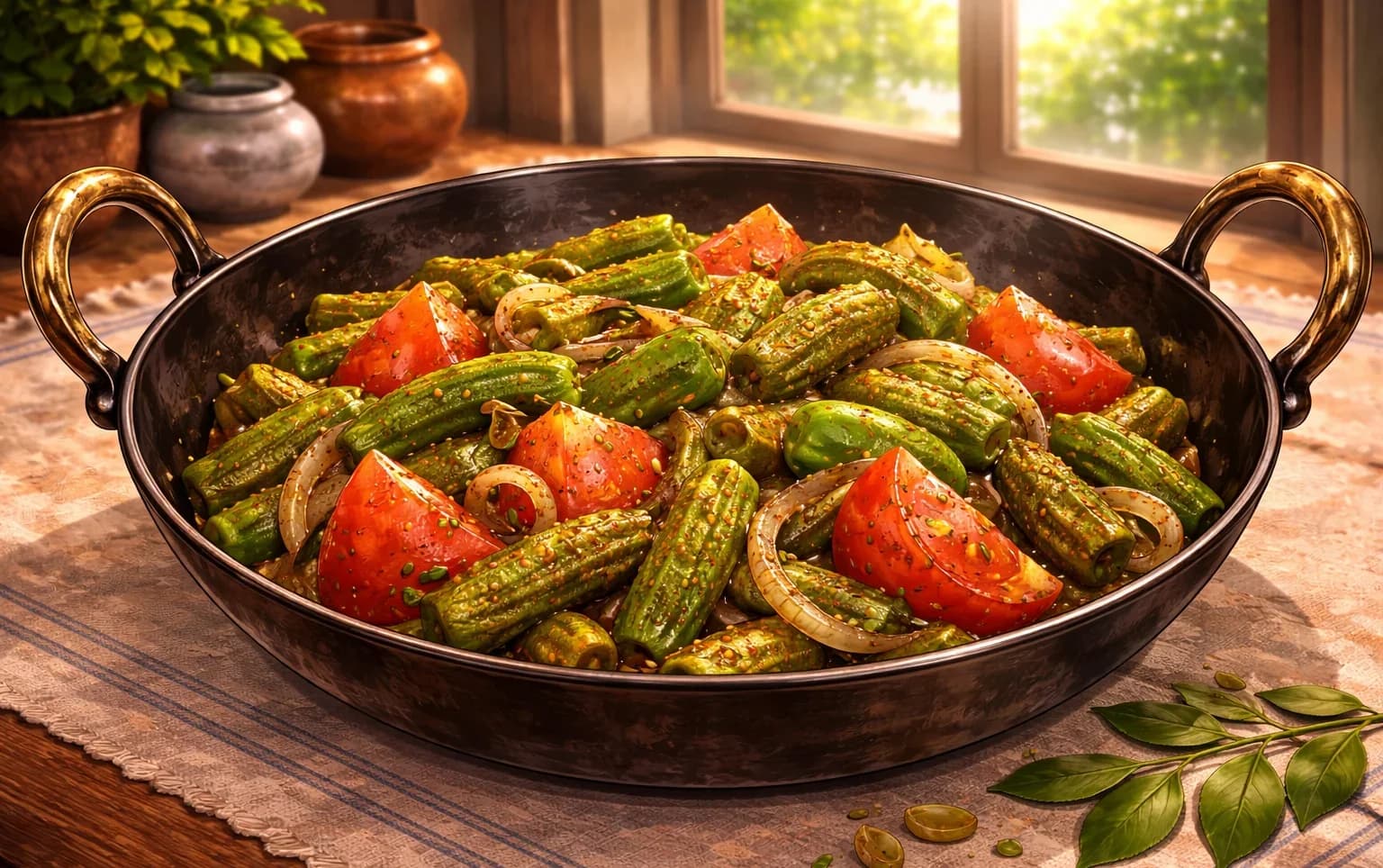
Okra with capsicum and tomato, sealed and slow-cooked with live coal
There is a moment, just before you lift the lid, when the kitchen smells like somewhere older. The coal on top has been sitting for fifteen minutes, radiating heat downward through the lid, and the mustard oil inside has been doing its quiet, pungent work. When the seal breaks, the steam carries something green and smoky and earthy all at once — the signature of dum.
Bhindi, or lady finger, is a vegetable that rewards patience. Rushed in too much oil at once, it becomes slick and chewy. Fried in small batches over confident heat, it firms at the edges, builds a dry, slightly blistered skin, and loses the sliminess that can make people distrust it. That first frying step is the foundation of this dish. Everything that follows — the tomatoes collapsing into sauce, the capsicum softening without losing its faint sweetness, the red chilli powder blooming in hot oil — depends on having bhindi that can hold its shape.
Dum as a technique was never just about slow cooking. It was about containment. The sealed vessel traps every molecule of moisture and fragrance. In a dish as simple as this one (no cream, no elaborate masala, just five core vegetables and two spices) that containment is everything. The bhindi doesn't stew. It finishes in its own steam, absorbing the spiced oil and the sweetness of cooked tomato through the skin.
The mustard oil here is not optional. Its sharpness, which mellows with heat but never fully disappears, gives dum bhindi its character. This is village cooking elevated by a palace technique: direct, confident flavors brought to their peak through the patient application of sealed heat.
At a Glance
Yield
4 servings
Prep
20 minutes
Cook
35 minutes
Total
55 minutes
Difficulty
Easy
Ingredients
- 1 lblady finger (bhindi / okra), washed and thoroughly dried
- 5½ ozcapsicum (about 1 pepper), coarsely chopped
- ½ lbtomatoes (about 2–2½ tomatoes), coarsely chopped
- 5½ ozonions (about 1 onion), coarsely chopped
- 2¾ tspred chilli powder
- ¾ tspturmeric powder
- ⅔ cupmustard oil
- ⅞ tspsalt
- 1small piece of natural charcoal (wood or coconut shell)
- —Long-handled tongs for handling the coal
Method
- 1
Wash the bhindi thoroughly and spread on a clean cloth. Pat completely dry. Any moisture will cause splattering and steaming in the oil. Trim the top stem and the tail tip from each piece. Leave whole, or cut into large sections if very long.
- 2
Heat the mustard oil (150 ml) in a wide, heavy pan over high heat until it smokes lightly and the raw smell fades. This tempers the oil and mellows its bite. Reduce to medium-high. Fry the bhindi in small batches, without crowding, until the skin blisters and they're about half cooked, 4 to 5 minutes per batch. The pieces should feel firm with a slight give. Drain on paper and set aside.
- 3
In the same oil (add a little more if needed), add the onions (150 g). Sauté over medium heat just until they soften and turn lightly translucent at the edges. Not golden, not caramelized. About 3 minutes.
- 4
Add the tomatoes (250 g) and capsicum (150 g). Cook, stirring occasionally, for 4 to 5 minutes until the tomatoes begin to break down and release their liquid.
- 5
Return the fried bhindi to the pan. Add salt (5 g), red chilli powder (5 g), and turmeric (2 g). Toss gently to coat, being careful not to break the pieces.
- 6
Place the lid firmly on the pan. Light a piece of natural charcoal (1) directly on the gas flame using tongs, and when it glows red and begins to ash at the edges, set it carefully on top of the lid.
- 7
Reduce the heat under the pan to its lowest setting. Cook undisturbed for 15 minutes. The coal provides radiant top heat while the low flame below maintains a gentle cooking environment. The two together create the dum effect.
- 8
Remove the coal carefully using tongs. Lift the lid away from you so the steam escapes safely. The bhindi should be fully tender, glossy with oil and collapsed tomato, fragrant with coal-smoke. Taste and adjust salt.
- 9
Serve immediately with chapattis.
Key Ingredient Benefits
Bhindi (okra): The mucilage in okra — the slippery quality — comes from a polysaccharide called okra pectin. Heat and direct oil contact break it down. Research suggests okra's soluble fiber may support blood sugar regulation, though most studies are preliminary. Traditional Ayurvedic use rates it as cooling and grounding (heavy quality, or guru).
Mustard oil: Cold-pressed mustard oil contains erucic acid, which is why it is officially restricted for culinary use in some Western countries. In India, it has been used for millennia, and current research does not support the degree of risk initially attributed to erucic acid from food sources. It is rich in monounsaturated fats and has antimicrobial properties. It is used here both for flavor and as the primary cooking medium.
Turmeric: Curcumin, turmeric's active compound, is fat-soluble. Cooking it in oil (as done here) increases its absorption compared to water-based preparations. Its anti-inflammatory properties are well-documented in laboratory studies; clinical human evidence is still developing.
Red chilli powder: Contains capsaicin, which has documented effects on circulation and metabolism. Heat destroys very little of the capsaicin, so the cooked powder retains its active compounds.
Why This Works
Frying the bhindi in batches before the dum is the step that separates this dish from a simple sauté. High heat and uncrowded oil drive out the internal moisture quickly, sealing the surface and eliminating the characteristic slipperiness. The bhindi enters the dum stage already structurally sound, which means it finishes in the sealed vessel without dissolving.
Mustard oil does two things in this dish that refined oil cannot replicate. First, its inherent pungency acts as a background flavor note — present but not harsh once cooked through — that grounds the brightness of tomato and capsicum. Second, its relatively high smoke point means you can get the pan genuinely hot for frying without the oil breaking down.
The live coal on the lid is not theatrical. It creates a top-down heat source that gently dries and concentrates the surface of the dish while the steam circulates below the lid. The result is a texture that is simultaneously moist and slightly crisped — something an oven or a plain covered pan cannot achieve.
Coarsely chopping the vegetables rather than fine-dicing them ensures they retain some presence after the dum. The tomatoes collapse into a loose sauce; the capsicum softens but keeps a faint chew; the onion becomes almost silky. These different textures give the dish interest without complexity.
Substitutions & Variations
- No charcoal available: Place a small piece of foil over the lid and weight it down. The dish will still be good, but the subtle smoky note from the coal will be absent.
- Refined oil: Can replace mustard oil for a milder flavor. The dish will taste cleaner but less distinctly itself.
- Additional spice: A pinch of cumin seeds added to the oil before the onions adds an earthy undertone that works well here.
- Onion and tomato balance: If your tomatoes are quite acidic, reduce slightly and add a pinch of sugar to balance.
- Capsicum color: Green capsicum is traditional here. Red or yellow capsicum will add sweetness.
Serving Suggestions
Serve dum bhindi directly from the pan onto fresh chapattis. The soft bhindi and oily, spiced sauce soak into the bread naturally. A simple dal alongside makes a complete vegetarian meal. Raw sliced onion dressed with lemon juice and salt makes a clean counterpoint to the richness of the mustard oil. Yogurt on the side cools any heat from the chilli powder.
Storage & Reheating
Store in a sealed container in the refrigerator for up to 2 days. The bhindi will soften further on storage. Reheat gently in a pan over low heat with a splash of water to loosen, covered, for 5 minutes. Do not microwave — it makes the bhindi chewy. The dish does not freeze well.
Cultural Notes
Dum bhindi (दम भिंडी, "okra cooked dum") is the Awadhi vegetarian preparation of whole okra pods slow-cooked in a sealed pot with yogurt, fried onion paste, ginger-garlic, and the Awadhi spice mix of green cardamom, fennel, and a small amount of Kashmiri red chili. The dish applies the dum technique (sealed pot, slow heat from above and below) to okra, allowing the pods to cook in their own steam and the gravy to thicken without breaking. The dish belongs to the Awadhi vegetarian banquet repertoire and appears at Hindu festival meals, vegetarian wedding menus, and home cooking across the Lucknow region and the broader Awadhi-influenced kitchens of Uttar Pradesh.
The dish's distinctive quality is how it handles okra's natural mucilage. Okra (called bhindi in Hindi, lady's finger in Indian English) releases a viscous mucilage when cut and cooked, which is the textural element that defines successful okra cooking: too much mucilage produces a slimy dish, too little produces dry mealy pods. The Awadhi dum technique keeps the pods whole (only the stem cap trimmed off) so the mucilage stays inside the pod rather than leaching into the gravy, and the sealed slow cook lets the pods cook through gently without breaking. The yogurt-based gravy with its fried onion sweetness and gentle spicing provides a luxurious counterpoint to the fresh vegetal flavor of the whole okra.
The technique is simpler than the meat dum preparations. Whole okra pods (small to medium size, picked fresh and patted thoroughly dry) are gently slit lengthwise on one side and stuffed with a spice mix of ground coriander, cumin, fennel, dried mango powder (amchur), Kashmiri red chili, and salt. Onions are sliced thinly and fried until golden, then ground with whisked yogurt, ginger-garlic, and a small amount of water into a smooth gravy base. Ghee is heated in a heavy handi, the stuffed okra is added in a single layer, and the yogurt-onion gravy is poured over. The handi is sealed with a dough closure and cooked over low heat for twenty-five to thirty minutes until the okra is tender. The dish is served with rumali roti or rice and a small side of plain yogurt.
Nutrition Facts
Calories: 281kcal (14%)|Total Carbohydrates: 18g (7%)|Protein: 4g (8%)|Total Fat: 23g (29%)|Saturated Fat: 2.8g (14%)|Cholesterol: 0mg (0%)|Sodium: 500mg (22%)|Dietary Fiber: 6.7g (24%)|Total Sugars: 6.3g
You Might Also Like




Ratings & Comments
Ratings & Comments
Ratings
Share your thoughts on this recipe.
Sign in to rate and comment