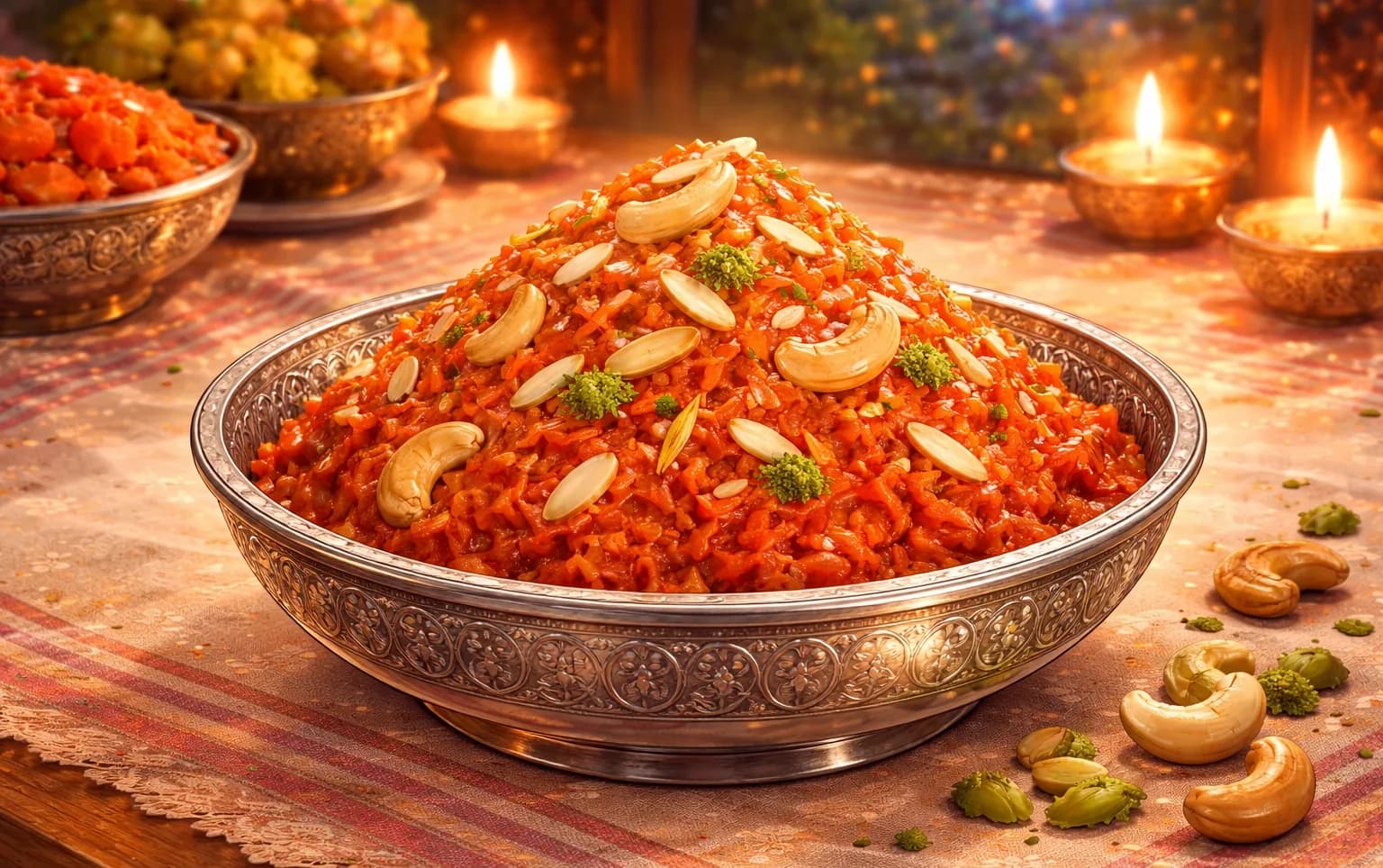
Indian Cuisine
Carrot Pudding (Gajar Ka Halwa)
Slow-Cooked Carrot Halwa with Ghee, Cardamom, and Nuts
Gajar ka halwa has a season, and that season is winter. In North India (particularly in Delhi, Punjab, and Uttar Pradesh) it belongs to the cold months when the red Delhi gajar floods the markets: a carrot that is smaller, denser, and more intensely sweet than the orange varieties grown elsewhere. When you grate these carrots and let them cook in ghee, the kitchen fills with a smell that is somewhere between caramel and earth, sweet and faintly vegetal, the kind of smell that stays in the walls of a house and comes back to you years later.
The dish is thought to have become widely popular in the Mughal period, when halwa (from the Arabic hulw, meaning sweet) was an established category of North Indian sweet-making. Today it is served at weddings and festivals, but more than that, it is the sweet that home cooks make on a cold Sunday when there is time to stand at the stove. It is a domestic sweet in the truest sense.
What gajar ka halwa delivers is a warmth that is almost architectural: layered, built up over an hour of patient cooking. The carrots lose their raw sharpness and become something almost jammy, deeply coloured, with the ghee separating out at the edges of the pan by the end. That is the sign the halwa is done.
The practical insight: the moisture in the carrots must be cooked out fully before the milk is added, and the milk must then be absorbed completely before the sugar goes in. Moving too fast between stages makes the halwa watery and pale. Give each stage its full time.
At a Glance
Yield
4 servings
Prep
20 minutes
Cook
70 minutes
Total
90 minutes
Difficulty
Medium
Ingredients
- 2¼ lbcarrots (about 15–15½ carrots), peeled and coarsely grated (red Delhi carrots preferred when in season; orange carrots work year-round)
- 3⅛ cupfull-fat whole milk
- 1 cupwhite sugar (adjust to taste; red carrots are sweeter and may need less)
- ½ cupghee (clarified butter)
- 2½ tspgreen cardamom powder
- 1¾ ozkhoya (mawa / dried whole milk solids), crumbled (optional but recommended)
- 1 ozraw cashews, halved
- 1 ozblanched almonds, slivered or roughly chopped
Method
- 1
Prepare the carrots. Peel and coarsely grate the carrots using a box grater or food processor. Set aside.
- 2
Cook the carrots in ghee - stage one. Melt the ghee in a wide, heavy-bottomed pan or karahi over medium heat. Add the grated carrots and stir to coat them in the ghee. Cook, stirring frequently, over medium heat for 20 to 25 minutes. The carrots will first release a significant amount of liquid, which will gradually evaporate. Continue cooking until all moisture has evaporated: the carrots will begin to look dry, pull away slightly from the sides of the pan, and change colour from bright orange to a deeper, more amber-toned hue. They will smell sweet, nutty, and faintly caramelised. This stage is not to be rushed.
- 3
Add the milk. Pour the full-fat milk over the cooked carrots and stir well. Bring to a boil, then reduce to medium-low heat. Cook, stirring frequently, for 25 to 30 minutes until the milk has been fully absorbed into the carrots. Stir every few minutes to prevent the mixture from sticking to the base of the pan. The mixture should look damp but not liquid.
- 4
Add the sugar. Add the sugar to the carrot mixture and stir well. The sugar will draw out some residual moisture and the mixture will loosen slightly. Continue cooking over medium heat, stirring regularly, for 8 to 10 minutes until this moisture is again absorbed and the halwa is thick and cohesive.
- 5
Add khoya and spices. If using khoya, crumble it into the pan and stir well, cooking for 3 to 4 minutes until it is fully incorporated and the mixture is glossy. Add the cardamom powder and stir through.
- 6
Add the nuts and finish. Add the cashews and slivered almonds. Stir to combine. Continue cooking until you can see the ghee beginning to separate from the mixture at the sides and base of the pan. This is the traditional sign that the halwa is ready. It typically takes a further 5 minutes. The halwa should hold its shape when you press the back of a spoon against it, and should look glossy and deeply coloured.
- 7
Serve warm. Transfer to a serving dish or individual bowls. Garnish with a few extra slivered almonds or cashews. Gajar ka halwa is best served warm.
Key Ingredient Benefits
Carrots: Red Delhi gajar, when available from October to February, are the traditional choice. They are less fibrous, naturally sweeter, and produce a more tender, deeply coloured halwa. Standard orange carrots produce excellent results year-round. Carrots are high in beta-carotene, an antioxidant precursor to vitamin A; the ghee in this recipe is a fat-soluble carrier, which research suggests enhances beta-carotene absorption.
Ghee: Made by cooking butter until all milk solids and water are removed, leaving pure clarified butterfat. Traditionally used in Ayurveda as a nourishing and digestive fat. Ghee has a high smoke point (around 250°C), making it ideal for the extended dry-cooking of carrots in this recipe. It contributes the characteristic richness and sheen of a good halwa.
Khoya (mawa): Fresh or block khoya is dried whole milk that has been simmered until nearly all moisture is removed. It adds concentrated dairy richness and binds the halwa. Available fresh from Indian sweet shops (mithai wallahs) or in block form from Indian grocery stores. If unavailable, substitute 3 tablespoons of full-fat milk powder stirred in with a small amount of milk to form a paste.
Cardamom: Traditionally used in Ayurvedic cooking as a digestive and to balance the richness of dairy- and ghee-heavy sweets. It adds a clean, aromatic lift that prevents the halwa from becoming cloying.
Sugar: The 200g specified here produces a traditionally sweet halwa. If using red Delhi carrots, which are inherently sweeter, start with 150g and taste before adding more.
Why This Works
Cooking the carrots in ghee before adding liquid is the structural foundation of this dish. The ghee conducts dry heat, which drives off the carrots' water content and begins concentrating their sugars. This is what produces the deep amber colour and caramelised flavour that distinguish a well-made gajar halwa from a merely adequate one. Adding milk after this stage means the milk solids cook into the dry, sugar-concentrated carrots and integrate fully, rather than sitting on top as an unconcentrated liquid. The sequence of sugar after milk absorption is equally deliberate: sugar added too early would inhibit milk absorption and keep the halwa loose. Khoya (concentrated milk solids) adds a richness and faint dairy-caramel note that whole milk alone cannot achieve.
Substitutions & Variations
- Condensed milk shortcut: Replace the 750ml whole milk with one 400ml tin of sweetened condensed milk, and reduce or omit the sugar. This cuts cook time by 15 minutes but produces a slightly different, more sticky-sweet result.
- Without khoya: Simply omit it. The halwa will be slightly less rich but still very good. Add an extra tablespoon of ghee at the end if you want more sheen.
- Milk powder substitute for khoya: Mix 4 tablespoons of full-fat milk powder with 2 tablespoons of whole milk to form a thick paste. Add in place of khoya at step 5.
- Vegan version: Replace ghee with refined coconut oil (the flavour will change), substitute full-fat coconut milk for dairy milk, and omit khoya. The result is a lighter, less traditional halwa with tropical notes.
- Beetroot halwa (Chukandar ka halwa): Replace carrots with grated raw beetroot for a deep crimson halwa with an earthy sweetness. Method is identical.
Serving Suggestions
Gajar ka halwa is served warm in small bowls. A small scoop of vanilla ice cream or a spoonful of thick cream set alongside the warm halwa is a popular contemporary pairing and a beautiful contrast of temperatures.
In traditional North Indian households, it is served as the final course of a winter feast, after a full meal of dal, sabzi, and roti. It also appears at weddings as part of the dessert spread. At festivals and celebrations, it is often offered as prasad.
Garnish generously: a scatter of toasted slivered almonds, a few extra cashew halves, a light pinch of cardamom powder, and a small pinch of saffron threads for special occasions.
Storage & Reheating
Refrigerator: Store in an airtight container for up to 5 days. The halwa will firm up considerably when cold.
To reheat: Warm in a small pan over low heat with a tablespoon of milk or a small knob of ghee, stirring to loosen. Alternatively, warm in a microwave in 30-second bursts, stirring between each. Serve immediately once warm. It firms up again quickly.
Freezing: Gajar ka halwa freezes well for up to 2 months. Thaw overnight in the refrigerator and reheat as above.
Cultural Notes
Gajar ka halwa (गाजर का हलवा, "carrot halwa") is the North Indian winter sweet of grated red carrots slowly cooked in whole milk and ghee until the milk reduces and concentrates, the carrots soften and caramelize, and the mixture takes on a deep reddish-orange color from the carrots and a thick fudgy texture from the reduced milk solids. The dish is sweetened with sugar and scented with green cardamom, finished with a topping of chopped almonds, cashews, and pistachios, and a generous drizzle of ghee. The dish is the central North Indian winter dessert and appears at Hindu festival meals, Diwali sweet boxes, wedding banquet menus, and home kitchens across UP, Delhi, Punjab, and the broader north Indian belt from November through February.
The seasonal context defines the dish's character. The specific red carrot variety used (the desi or Indian red carrot available in North Indian markets from November to February) has a deeper red color, higher sugar content, and softer fiber than the orange supermarket carrot, and the halwa made from this variety produces the characteristic deep red color and intense sweetness that the orange-carrot substitute cannot fully match. The Mughal-era documentation of carrot halwa suggests that the dish entered the North Indian sweet repertoire through the Persian-Central Asian tradition of vegetable halwas (the broader halwa family includes wheat halwa, semolina halwa, lentil halwa, and several vegetable variants), with the carrot version developing in north India where the cool winters produce the right red carrot variety and the dairy tradition supports the milk-and-ghee-heavy cooking style.
The technique requires patience for the long slow milk reduction. Red carrots (about a pound) are peeled and grated finely. Whole milk (about four cups) is brought to a simmer in a wide heavy pot with the grated carrots added directly. The mixture is cooked over medium-low heat for about an hour, with frequent stirring, while the milk slowly reduces and the carrots cook through. As the mixture thickens (after about forty-five minutes), a generous knob of ghee is added and the heat raised slightly to start the caramelization stage. The mixture is stirred more continuously now to prevent sticking, as the remaining milk solids cling to the carrots and begin to caramelize. Sugar is added when the mixture is mostly dry (sugar added earlier would slow the milk reduction by releasing water from the carrots). The sweetened mixture cooks for another fifteen minutes, with more ghee added if needed, until the halwa pulls away from the sides of the pot and forms a thick fudgy mass. Crushed green cardamom is added off the heat. The dish is topped with chopped almonds, cashews, pistachios, and a final drizzle of warm ghee, and served warm with a small scoop of vanilla ice cream (the modern restaurant pairing) or by itself in small bowls.
Nutrition Facts
Calories: 463kcal (23%)|Total Carbohydrates: 43.5g (16%)|Protein: 12.1g (24%)|Total Fat: 29.2g (37%)|Saturated Fat: 14g (70%)|Cholesterol: 66mg (22%)|Sodium: 294mg (13%)|Dietary Fiber: 9.6g (34%)|Total Sugars: 24.9g
You Might Also Like


Ratings & Comments
Ratings & Comments
Ratings
Share your thoughts on this recipe.
Sign in to rate and comment