Goan · Indian Cuisine
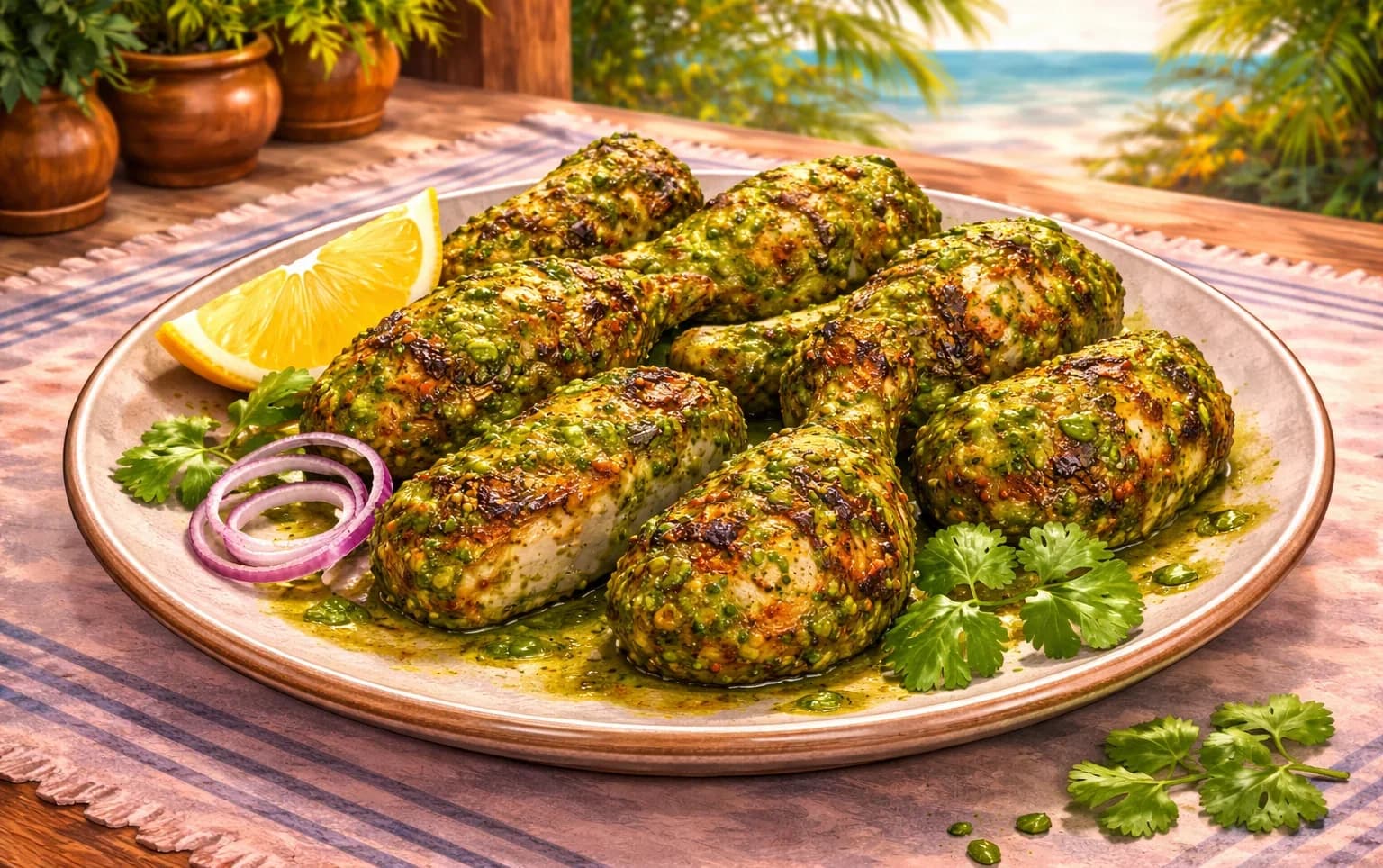
Goan Green-Spiced Chicken (Galinha Cafreal)
Goa's vivid green spatchcock — a dish from the African coast via Portugal
The name alone carries history. Cafreal is derived from Kafir (a term used by Portuguese colonisers to describe African peoples) and refers to the dish's origins in Portuguese East Africa, particularly Mozambique, where a similar preparation of chicken in green spices and citrus was common. When the Portuguese brought Goan Catholics to Africa as administrators and traders, and when they returned, they brought the preparation back with them. Cafreal became absorbed into Goan Catholic cooking and over generations became as distinctly Goan as a vindaloo, despite its entirely different geographical origin.
What makes cafreal extraordinary is the simplicity of the green paste and the intensity of the result. Fresh coriander leaves (a full 100 g, far more than most recipes use) are ground with ginger, garlic, green chillies, turmeric, garam masala, and lemon juice into a vibrant, deeply fragrant paste. The chicken is marinated in this paste overnight: not merely coated, but saturated. By the next day, the paste has penetrated the meat and the chicken has turned a deep, almost military green.
The cooking method is a grill or a hot pan. High heat, direct contact, until the exterior chars and caramelises while the interior remains moist and the green paste darkens to a deep olive. The char is not an accident or a failure of technique. It is the point. The slight bitterness of the charred paste edges balances the herbaceous brightness of the uncharred paste, and together they produce something irreducibly delicious.
There is no complicated sauce here, no thickening, no reduction. The paste is the sauce. When the chicken rests after cooking, its juices mix with the cooked paste on the surface, creating a natural, simple coating that is exactly as complex as it needs to be.
Marinate overnight, at minimum four hours. The coriander's volatile aromatics penetrate surprisingly deep into the meat during a long marinade, and the lemon juice begins to work on the surface proteins, giving the eventual cooked chicken a tenderness that a shorter marinating time cannot produce.
At a Glance
Yield
Serves 4
Prep
20 minutes (plus 4–12 hours marinating)
Cook
30 minutes
Total
50 minutes active (plus marinating)
Difficulty
Medium
Ingredients
Spice Paste Ingredients
- 5¼ cupfresh coriander leaves and soft stems (about 1 large bunch)
- ⅓ cupfresh ginger, peeled and roughly chopped
- ¼ cupgarlic cloves (about 8–10 cloves), peeled
- 3¼ tbspgreen chillies (about 4 chillies), roughly chopped
- 1⅞ tspturmeric
- 1 tspgaram masala
- 1¼ tbsplemon juice
- 1⅔ tspfine salt
- 2–3 tbspwater, as needed for blending
Chicken Ingredients
- 2¼ lbchicken, jointed into 8 pieces (thighs, drumsticks, wings, breast pieces) or a whole spatchcocked chicken
- 3⅓ tbspneutral oil (groundnut, sunflower, or coconut)
- —Lemon wedges, to serve
Method
- 1
Make the cafreal paste. Combine the coriander, ginger (30 g), garlic, green chillies (4 chillies), turmeric (1 teaspoon), garam masala (¾ teaspoon), lemon juice (1½ tablespoons), and salt (2 teaspoons) in a blender. Add 2–3 tablespoons of water — just enough to help the blades catch the mixture. Blend to a completely smooth, vibrant green paste. The paste should be thick and deeply fragrant. You should be able to smell the coriander and raw garlic together, sharp and herbal, before you've even opened the blender lid. Taste the paste: it should be well-seasoned, bright with lemon, and noticeably hot from the green chillies.
- 2
Score and marinate the chicken (1 kg). Using a sharp knife, make 3–4 deep diagonal scores through the skin and into the flesh on each chicken piece. This allows the paste to penetrate past the surface into the meat. Coat the chicken thoroughly with the green paste, working it into the scored cuts and under the skin where possible. Place in a covered container and refrigerate for at least 4 hours, ideally overnight. The chicken will turn a deep, vibrant green.
- 3
Bring to temperature. Remove the chicken from the refrigerator 30 minutes before cooking. Cold chicken placed directly in a hot pan dramatically extends cooking time and produces uneven results, with the exterior overcooked before the interior reaches temperature.
- 4
Cook — grill method. Heat a grill pan or barbecue grill to high. Brush or spray the grill with a little oil. Place the chicken pieces skin-side down. Cook without moving for 6–8 minutes until the first side is deeply charred with visible grill marks and the paste has caramelised. Turn and cook for a further 6–8 minutes. For thicker pieces (whole thighs, drumsticks), reduce heat to medium after charring and continue cooking, turning occasionally, until cooked through. The juices should run clear when the thickest part is pierced.
- 4
Cook — pan-fry method. Heat the oil in a large, heavy frying pan or cast-iron skillet over medium-high heat. When the oil shimmers and begins to smoke very slightly, add the chicken pieces skin-side down. Do not crowd the pan. Work in two batches if necessary. Cook for 6–8 minutes without moving until a deep, dark crust forms. Turn and cook for 6–8 minutes on the other side. Reduce heat to medium, cover with a lid, and cook for a further 8–10 minutes until fully cooked through.
- 5
Rest and serve. Allow the chicken to rest for 5 minutes before serving. This allows the juices to redistribute and the paste coating to settle slightly. Serve with lemon wedges and chilli sauce alongside.
Key Ingredient Benefits
Fresh coriander (Coriandrum sativum, dhania) is the defining ingredient of this paste. Its leaves contain linalool and other terpene compounds that give it its distinctive aroma, the same compounds that some people perceive as soapy due to a specific genetic variation in olfactory receptors. In Ayurveda, coriander is considered tridoshic (balancing for all constitutions) and cooling, traditionally associated with reducing internal heat and supporting digestion. Research suggests coriander contains compounds with mild antimicrobial properties.
Turmeric contributes both colour and warmth to the paste. Its curcumin content is better absorbed in the presence of fat, and the oil used for cooking provides that context. In Ayurveda, turmeric is used as an antiseptic and tonic; in traditional Goan Catholic cooking it appears across meat marinades as a standard base note, having been thoroughly adopted from the Hindu culinary tradition.
Ginger contains gingerol compounds, which research suggests are associated with anti-inflammatory activity and digestive support. In both Ayurveda and Unani medicine, ginger is considered warming and stimulating. Its culinary function here is to provide a sharp, forward heat alongside the green chilli. The two together produce a complex, layered heat that penetrates into the marinated meat.
Garlic contains allicin and related sulfur compounds, released when garlic is crushed or chopped. Research associates garlic with cardiovascular support in observational studies, and it is used across Ayurvedic and Unani traditions as a circulatory and immune-supporting food. In this paste, raw garlic's pungency mellows and deepens during the overnight marination and then caramelises slightly under the high heat of cooking.
Why This Works
The high coriander-to-other-ingredient ratio is deliberate and load-bearing. Coriander leaves are roughly 90% water. Grinding 100 g of leaves releases that moisture into the paste, which becomes the basting liquid during cooking. As the water in the paste evaporates under high heat, the coriander's volatile aromatic compounds concentrate on the surface of the meat, and the sugars in the paste begin to caramelise. The result is the characteristic deep green-to-olive-to-charred-edge gradient that makes cafreal visually distinctive.
Scoring the meat is not merely cosmetic. The scored channels break through the relatively impermeable skin barrier and allow the acidic, aromatic paste to make direct contact with the muscle meat below. After an overnight marinade, the lemon juice's citric acid has penetrated the muscle fibres through these channels, gently denaturing the surface proteins and producing a noticeably more tender texture in the cooked chicken.
The garam masala in the paste is used sparingly. Its role is structural rather than dominant. The small quantity of warming spice provides a background note that bridges the herbal brightness of the coriander and the heat of the green chilli, preventing the paste from tasting one-dimensional. More garam masala would shift the dish toward an Indian spice character; the current quantity keeps it in the zone of fresh herb and heat where cafreal belongs.
Substitutions & Variations
Whole spatchcocked chicken: Butterfly a whole chicken by removing the backbone with shears, pressing flat, and scoring deeply through both sides. Marinate as above. Grill over medium-high heat for 20–25 minutes per side, or roast at 220°C (425°F) for 35–40 minutes, finishing under the grill for the last 5 minutes to achieve the char.
Chilli heat: The recipe as written is medium-hot. Increase green chillies to 6–8 for a fiercer result; reduce to 2 for a milder version.
No lemon — use lime: Goa's coast is lined with lime trees; lime juice is an authentic alternative that adds a slightly sweeter, more tropical acidity.
Vegan option: The same paste applied to thick slices of firm tofu, paneer, or portobello mushrooms, then grilled, produces a compelling vegetarian version. Reduce cooking time significantly.
Serving Suggestions
Serve cafreal on a large plate with lemon wedges and a small bowl of Goa's vinegared green chilli sauce for dipping. Alongside: fried rice, plain steamed rice, or soft bread rolls to mop up the juices. A crisp green salad (shredded cabbage with lemon and olive oil) cuts through the richness of the charred chicken. In Goa, cafreal is the quintessential beach shack dish: eaten at rough-hewn tables facing the sea, with cold Kingfisher beer and nothing else needed. That spirit is worth carrying to the table wherever you serve it.
Storage & Reheating
Cooked cafreal keeps in the refrigerator for up to 3 days. The flavour continues to develop, and the second day is often notably better than the first. To reheat, place pieces in a covered pan over medium-low heat with a tablespoon of water, warming gently for 8–10 minutes. Alternatively, reheat in a 180°C (350°F) oven, loosely covered with foil, for 15 minutes, then uncover for the final 3–4 minutes to re-crisp the surface. Raw marinated chicken (before cooking) can be frozen for up to 1 month; defrost thoroughly in the refrigerator and cook as above.
Cultural Notes
Galinha cafreal (also called chicken cafreal) is the Goan grilled chicken preparation in which whole or cut chicken pieces are marinated in a bright green paste of fresh cilantro, mint, green chilies, ginger, garlic, cumin, peppercorns, cinnamon, cloves, palm vinegar, and lime juice, then either grilled, pan-fried, or roasted until cooked through. The dish has a documented African colonial origin: the technique traveled to Goa from the Portuguese African colonies of Mozambique, Angola, and Guinea-Bissau through the Portuguese soldiers and sailors who circulated across the Portuguese Indian Ocean empire from the sixteenth through twentieth centuries, and the name cafreal derives from the Portuguese word for African or sub-Saharan (cafre).
The Portuguese-African-Goan triangular history is documented in Goan and Portuguese culinary scholarship. Portuguese soldiers stationed in the African colonies developed spiced grilled chicken preparations using local African aromatics (the predecessor to what is now Mozambican frango piri-piri), then carried these preparations to Goa during the centuries of intercolonial trade and military rotation. The Goan adaptation replaced the African piri-piri chili with kashmiri red chili and added Indian aromatics like cumin, ginger, and curry leaves, producing a preparation that is recognizably related to its African ancestor but distinctly Goan in its flavor profile.
The technique relies on the green marinade and the high-heat cooking. The marinade is ground from a generous bunch of fresh cilantro, fresh mint leaves, green chilies, ginger, garlic, cumin seeds, black peppercorns, a small piece of cinnamon, two or three cloves, palm vinegar (or apple cider vinegar as a substitute), lime juice, and salt. The chicken (typically a whole bird butterflied flat, or bone-in pieces) is slashed with shallow cuts so the marinade penetrates the flesh, rubbed thickly with the green paste on both sides, and marinated for at least four hours and ideally overnight. The marinated chicken is grilled over charcoal, pan-fried in a hot skillet, or roasted in a hot oven until the surface develops a charred green-brown crust and the interior is just cooked through. The dish is served with sliced raw onion, lime wedges, and either fresh pao bread rolls or rice. The dish appears at Goan family meals, at the small Goan Christian restaurants, and at the broader Indo-Portuguese restaurant tradition in Mumbai and Bangalore.
Nutrition Facts
Calories: 547kcal (27%)|Total Carbohydrates: 3.8g (1%)|Protein: 48.1g (96%)|Total Fat: 36.3g (47%)|Saturated Fat: 9.6g (48%)|Cholesterol: 188mg (63%)|Sodium: 365mg (16%)|Dietary Fiber: 0.3g (1%)|Total Sugars: 0.2g
You Might Also Like
 Easy
EasyGoan · Indian Cuisine
Maharashtrian Tomato Soup (Tomato Saar)
30 minutes
 Medium
Goan · Indian Cuisine
Goan Sour-Spicy Curry (Ambotik)
50 minutes
 Medium
Tamil Nadu · Indian Cuisine
Chicken Chettinad
1 hour 15 minutes
 Medium
Punjabi · Indian Cuisine
Butter Chicken (Murgh Makhni)
1 hour 15 minutes (plus marinating)
Ratings & Comments
Ratings & Comments
Ratings
Share your thoughts on this recipe.
Sign in to rate and comment