Indian Cuisine
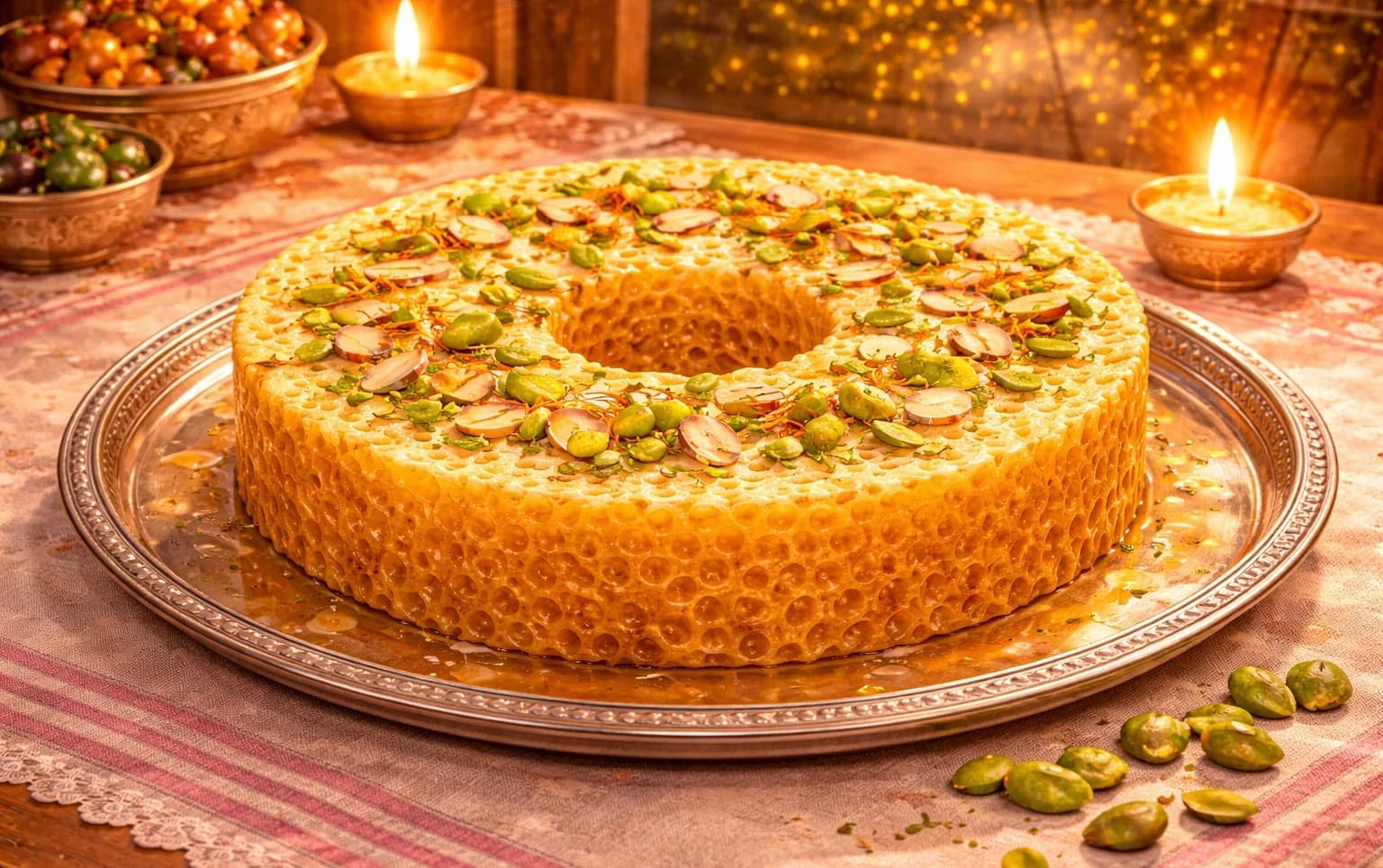
Honeycomb Milk Cake (Ghevar)
Rajasthani Lacy Disc Sweet with Rabdi and Nuts
Ghevar is Rajasthan's most dramatic sweet, and its making is an act of controlled theatrics. A thin batter of refined flour, beaten with ghee and cold water to a smooth, airy consistency, is poured from height into a deep vessel of smoking-hot ghee. Not poured all at once, but in a thin, continuous stream held 10–12 inches above the surface. The batter hits the hot ghee with a fierce sizzle and immediately begins to form, the strands of batter cooking as they fall and binding together at the surface of the ghee to create the characteristic lacy, honeycomb-textured disc.
This is the sweet of Teej and Sawan, the monsoon festival months of July and August in Rajasthan, when women gather to celebrate in yellow and green, when swings are hung from trees, and when ghevar, piled high in gleaming stacks at every halwai shop, marks the season as nothing else does. The same halwai who makes ghevar all year knows that during Sawan his supply will not keep pace with demand. Ghevar is not a simple or forgiving preparation, but it is irreplaceable.
The finished disc, crisp and golden, is first bathed in hot, three-thread sugar syrup that soaks into the lacy network from the top. Then come the garnishes: a layer of rabdi (reduced milk cream thickened with saffron and cardamom) spread across the top, and then the nuts (sliced blanched almonds, pistachio slivers) scattered generously. The result is a sweet of remarkable textural complexity: the crisp, open latticework of the base, the dense, fragrant cream above it, the crunch of toasted nuts at the surface.
Some ghevar is made without rabdi, simply syrup-soaked and nut-scattered. Both are correct. But the version with rabdi is the festive one, the occasion sweet, the one worth making when time allows.
At a Glance
Yield
6–8 medium ghevar discs
Prep
30 minutes
Cook
1 hour
Total
1 hour 30 minutes
Difficulty
Involved
Ingredients
- 6⅓ cuprefined flour (maida)
- 1 cupghee, melted and cooled
- 3 cupcold water
- ⅛ tspsalt (a pinch)
- ¼ ozsaffron, dissolved in a small amount of the batter (optional, for half the discs)
- —Sugar (approximately 400 g)
- —Water (enough to make syrup, approximately 300 ml)
- ¾ lbblanched almonds, sliced
- 1 ozpistachio, sliced
- 1½ tspcardamom powder
Method
- 1
Make the sugar syrup. Combine sugar and approximately 300 ml of water in a pan. Boil until the syrup reaches three-thread consistency: when a drop is pulled between thumb and forefinger it forms three distinct, clean threads. Add cardamom powder and set aside, keeping warm.
- 2
Sift the flour. Sift the flour with the pinch of salt into a wide bowl.
- 3
Rub in ghee. Pour the cooled melted ghee over the flour and rub in well with your fingertips until the flour resembles wet sand and no dry patches remain. This fat-coating of the flour is what produces the lacy structure during frying.
- 4
Make the batter. Gradually add the cold water to the ghee-flour mixture, mixing steadily with a wooden spoon in a single circular direction until you have a thin, smooth, pourable batter. Beat vigorously in the same direction for 3–5 minutes until the batter is light and slightly aerated. It should be thinner than pancake batter, very pourable, almost like a thin cream. Divide the batter into two portions if making saffron ghevar; dissolve the saffron in a few tablespoons of one portion.
- 5
Prepare the vessel and heat the ghee. Use a tall, cylindrical vessel approximately 10 cm in diameter and at least 15 cm deep. Fill half with ghee. Place on high heat. When the ghee is very hot (almost at the point of smoking), reduce to medium heat.
- 6
Pour the ghevar. Hold a ladle or jug of batter about 30 cm (10–12 inches) above the centre of the ghee. Pour the batter in a thin, steady stream, directly into the centre. The batter will splatter and sizzle fiercely. Maintain the stream, holding it centred. After 2–3 tablespoons of batter have been poured, pause. The first layer will have set at the surface. Pour more batter over the same spot in a thin stream. Continue, layer by layer, until the ghevar disc is approximately 2–3 cm thick and 10 cm in diameter. The disc builds up naturally as each pour of batter cooks and the next poured layer bonds to it.
- 7
Cook through. Once the ghevar has built up to the desired thickness, allow it to fry undisturbed for 2–3 minutes until the underside is golden. Lift carefully from the ghee with a slotted spoon or a bent wire lifter. Place on a rack.
- 8
Apply syrup. While the ghevar is still hot, pour very hot three-thread syrup over the top generously. The syrup will penetrate the lacy structure and the ghevar will hiss and steam. Allow to soak for 2–3 minutes.
- 9
Garnish. Scatter sliced almonds and pistachios generously over the top. For the rabdi version, spread a layer of cooled rabdi over the ghevar before scattering the nuts.
Key Ingredient Benefits
Refined flour (maida) produces the necessary thin, extensible batter. Wholemeal flour is too heavy and would not form the lacy structure. The fat-to-flour ratio is high by most pastry standards. This is what produces the characteristic crispness and richness.
Cold water is specified deliberately. Cold water inhibits gluten development, producing a thinner, more extensible batter that flows in narrow streams when poured from height. Room temperature or warm water would produce a slightly thicker, more elastic batter that would not pour as cleanly.
Saffron is included in some ghevar discs for colour and fragrance. It is the traditional marker of a festive preparation in North Indian sweets. Dissolved in the batter before pouring, it distributes through the structure during frying and produces a golden-amber colour distinct from the plain version.
Blanched almonds are a festival garnish with particular status in North Indian sweet-making. The blanching and slicing is not merely aesthetic. Sliced almonds expose more surface area and toast more evenly and more quickly under heat or pressure.
Why This Works
The lacy structure of ghevar is produced by one mechanism: thin batter poured in a stream hits very hot ghee and cooks instantly as it falls, creating irregular, branching strands that bind at the surface. The key variables are batter viscosity (thin enough to fall in narrow streams), ghee temperature (hot enough to set the batter immediately on contact), and pour technique (centred and steady, so layers build up uniformly).
Rubbing ghee into the flour before adding water does two things: it coats the flour particles with fat, which inhibits gluten development and ensures the batter remains fluid and non-elastic; and it introduces fat into every part of the batter, which produces the rich, slightly crisp quality of the fried ghevar rather than the chewy quality of a pure starch-and-water structure.
Three-thread syrup is used rather than the lighter one-thread or two-thread syrups used in other sweets because ghevar needs a syrup thick enough to stay on the surface of the open, lacy structure rather than draining straight through.
Substitutions & Variations
- Plain ghevar (without rabdi): Skip the rabdi and simply apply syrup and nuts. This is the simpler, more common everyday version and is excellent in its own right.
- Mawa ghevar: Spread a layer of sweetened, crumbled khoya (mawa) over the top rather than rabdi. Richer and denser than rabdi topping.
- Smaller discs: Use a smaller vessel (6–7 cm diameter) to make individual ghevar appropriate for plating at a dinner.
Serving Suggestions
Ghevar is served at room temperature as a festival sweet, typically in generous portions with rabdi spread thickly over the top. During Teej and Sawan, it is gifted in elaborately wrapped boxes between families. At sweet shops it is displayed in large stacks, plain or topped, sold by piece or weight. At home it is most meaningful served the day it is made, when the lacy structure is still at its crispest before the syrup softens it further. Offer with masala chai. The sweet and the spiced tea are natural companions.
Storage & Reheating
Ghevar without rabdi keeps well in an airtight container at room temperature for up to 5 days. The syrup acts as a preservative. Once topped with rabdi, store in the refrigerator and consume within 2 days. Bring to room temperature before eating. The lacy structure softens over time as it absorbs syrup; freshly made ghevar within 24 hours has the best textural contrast. Reheating is not appropriate for this sweet.
Cultural Notes
Ghevar (घेवर) is the Rajasthani disc-shaped sweet of refined flour, milk, and ghee batter drizzled into hot ghee in thin streams, where the batter cooks immediately into a lacy lattice pattern that hardens into a porous golden disc. The disc is removed, soaked briefly in sugar syrup, and topped with a layer of rabri (thickened reduced milk), chopped pistachios, almonds, and silver leaf for the festive presentation. The dish is the central sweet of the Rajasthani-Marwari women's festival of Teej (the monsoon festival held in the Hindu month of Shravan, July-August) and appears at every Rajasthani Teej celebration, wedding feast, and at the famous Jaipur halwai shops in the run-up to the festival season.
The technique of forming the lattice disc is the dish's defining feature. The batter (a thin smooth pourable mixture of refined flour, milk, melted ghee, and water) is held in a small bowl with a pouring spout. Ghee is heated in a tall narrow cylindrical vessel (the ghevar bhanda used specifically for ghevar) to about 200°C, and the batter is drizzled in a thin steady stream from a height of about a foot above the hot ghee. The batter cooks the instant it hits the hot fat, forming thin lacy strands that interlock into a porous disc shape. Successive drizzles build up the disc from below until it reaches the desired thickness (about an inch). The disc is removed with two slotted spoons, drained briefly, and dropped into a one-string sugar syrup flavored with cardamom and a few drops of edible rose water. The syrup soaks into the porous structure in seconds.
The Teej cultural setting frames the dish. Teej is the Rajasthani women's monsoon festival in which married women fast for the long life of their husbands, dress in green and gold finery, swing on flower-decorated swings, and exchange ghevar as the canonical festival sweet. The exchange of ghevar between married women and their natal families is a Teej ritual: a married woman's father sends ghevar to her marital home as a sign of continued natal connection and care. The Jaipur halwai tradition produces several Teej-specific variants: plain ghevar, malai ghevar (topped with thick clotted cream), and the elaborate mawa ghevar (topped with reduced milk solids). The dish has spread from Rajasthan through migration to Delhi, Mumbai, and the broader north Indian diaspora.
Nutrition Facts
Calories: 900kcal (45%)|Total Carbohydrates: 85.1g (31%)|Protein: 18.7g (37%)|Total Fat: 55.2g (71%)|Saturated Fat: 15.6g (78%)|Cholesterol: 48mg (16%)|Sodium: 2mg (0%)|Dietary Fiber: 7.8g (28%)|Total Sugars: 2.2g
You Might Also Like
Ratings & Comments
Ratings & Comments
Ratings
Share your thoughts on this recipe.
Sign in to rate and comment