Goan · Indian Cuisine
Goan Fish Curry
Tangy coconut and red chilli — the daily table of coastal Goa
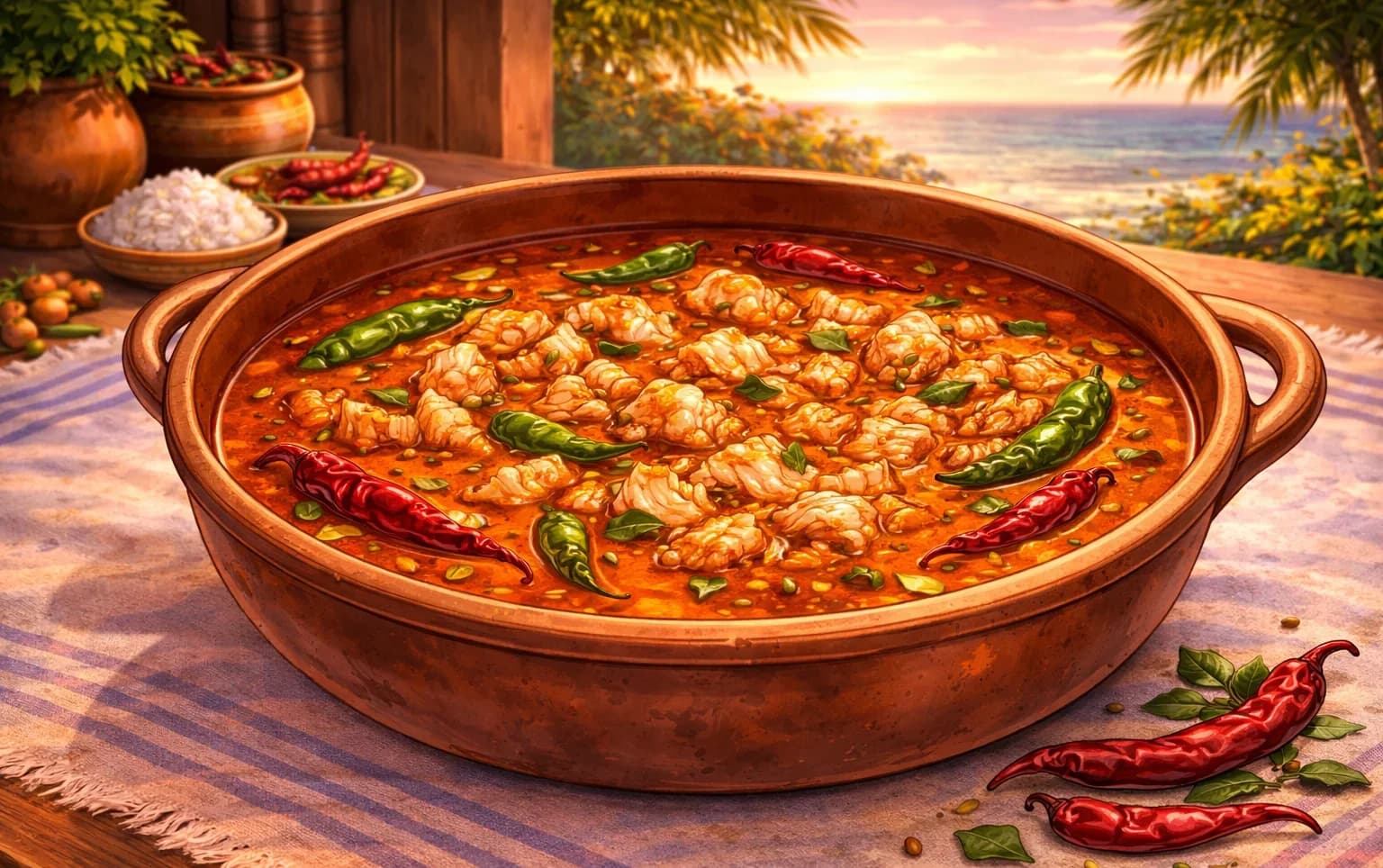
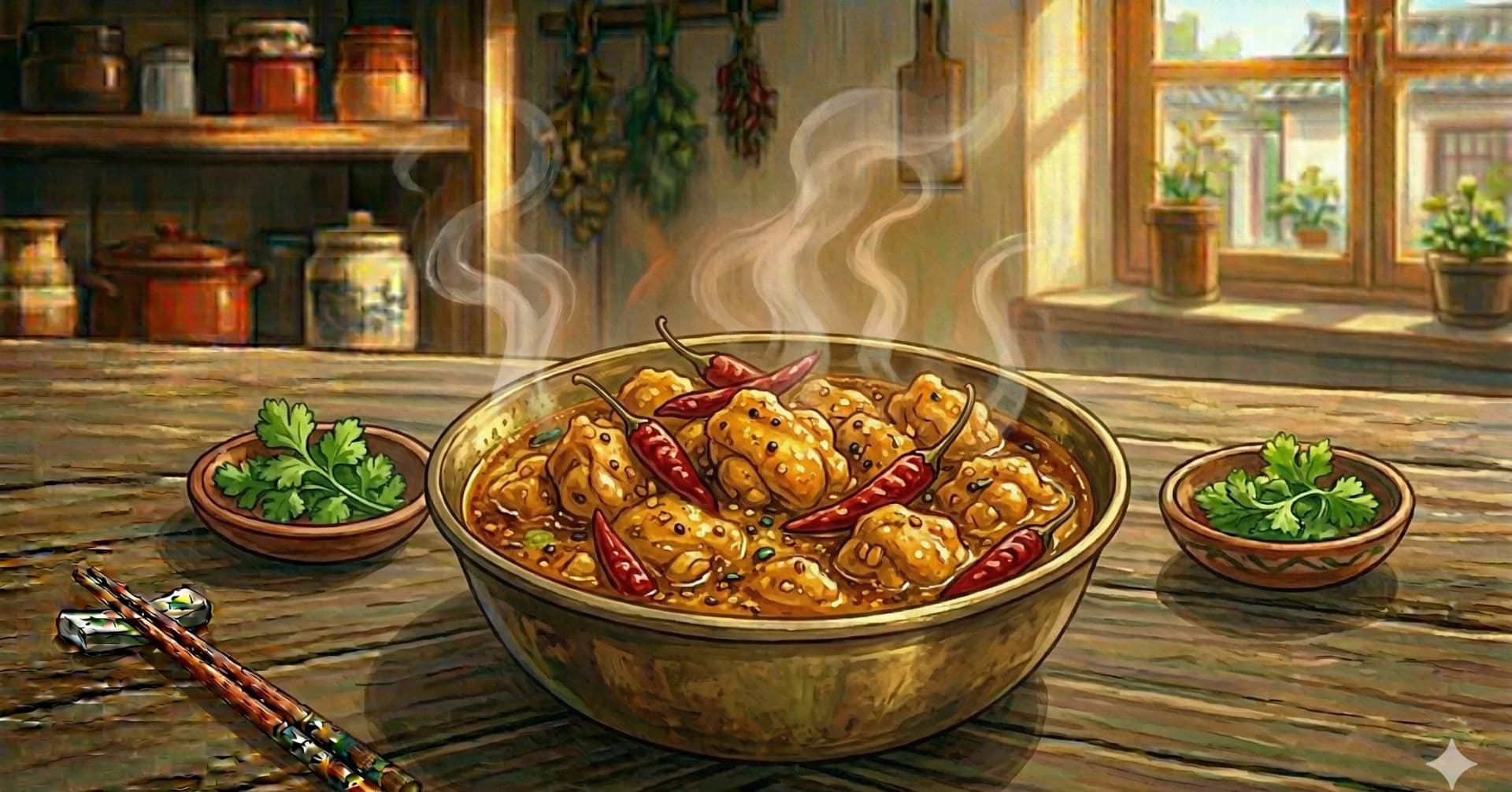
Stand in a Goan kitchen near the sea at lunch and you will smell this curry before you see it: the fragrance of toasted red chilli and coconut hitting warm oil, the sharp, dark note of tamarind pulling through the steam. Goan fish curry is not elaborate. It is the taste of a place: the equatorial heat of dried red Kashmiri chillies balanced by the cool sweetness of freshly grated coconut, the tamarind's bright acidity keeping everything light and forward, the green chillies giving a different kind of heat — grassier, more immediate — alongside the dried chilli's slower depth.
Goa sits at the confluence of several food traditions. Its Hindu fishing communities, its Catholic families descended from Portuguese colonial-era converts, and its Muslim traders each brought different techniques and preferences. This particular curry — built on a ground coconut paste with dried red chilli and tamarind — belongs to the Hindu fishing tradition of the Koli and Goan Catholic kitchens alike, predating the Portuguese influence that shaped other Goan preparations. It is simply what Goan coastal cooking looks like when it is not performing for tourists: straightforward, very good, and built around whatever fish the morning's catch brought.
The coconut paste is the foundation. Freshly grated coconut, dried Kashmiri red chillies (chosen for colour as much as heat), coriander seeds, cumin, and tamarind are ground together into a smooth, rust-coloured paste. When this paste hits the pan with the fried onion and cooks for a few minutes, the raw coconut becomes fragrant and slightly golden, the tamarind darkens and concentrates, and the whole house smells like a Goan tiffin box opening.
Pomfret (paplet) is the prestige choice: firm, flat, sweet-fleshed, and supremely well-suited to a tangy coconut curry. Kingfish is a worthwhile alternative, with a denser, more assertive flavour. Both hold their shape through the gentle simmering without falling apart.
At a Glance
Yield
Serves 4
Prep
25 minutes
Cook
25 minutes
Total
50 minutes
Difficulty
Easy
Ingredients
Fish Ingredients
Curry Paste Ingredients
- 7 ozfresh coconut, grated
- 3¼ tbspdried red Kashmiri chillies (about 8–10 chillies), soaked in warm water 20 minutes
- 1¾ tbspcoriander seeds, lightly toasted
- 2⅓ tspcumin seeds, lightly toasted
- 1¼ tspblack pepper, whole
- 1⅞ tspturmeric
- 1 oztamarind pulp (about 2 tablespoons, from a block or paste)
Curry Ingredients
- 1¾ ozonion (about 1 small onion), finely sliced
- 3¼ tbspgreen chillies (about 4 chillies), slit
- 3⅓ tbspcoconut oil or neutral oil
- 1⅔ tspfine salt (total for dish, adjusted to taste)
Method
- 1
Marinate the fish. Pat the fish steaks dry and rub with turmeric (1 teaspoon) and salt (1 teaspoon) on all surfaces. Set aside while you make the paste.
- 2
Make the coconut (2 cups) paste. Drain the soaked dried red chillies (4 chillies). In a blender or wet grinder, combine the grated coconut, soaked red chillies, toasted coriander seeds (1½ teaspoons), toasted cumin (1 teaspoon), black pepper (½ teaspoon), turmeric (1 teaspoon), and tamarind pulp (2 tablespoons, from a block or paste). Add 4–5 tablespoons of water and grind to a smooth, thick paste. This takes 3–4 minutes of blending, stopping to scrape down the sides. The paste should be rust-red, fragrant, and smooth rather than granular. Taste it — it should be sharp, hot, and distinctly tangy. Add a little more tamarind if it seems flat.
- 3
Fry the onions. Heat the oil in a wide, heavy pan over medium heat. Add the sliced onion (1 small onion) and cook, stirring regularly, for 8–10 minutes until soft and just beginning to turn golden at the edges. Do not rush this step — properly softened onions give body to the sauce that raw or merely wilted onions cannot.
- 4
Cook the paste. Add the coconut paste to the softened onions. Stir continuously over medium heat for 4–5 minutes. The paste will become fragrant and deepen slightly in colour as the coconut toasts and the tamarind concentrates. You want the raw coconut smell to cook off completely before adding water.
- 5
Build the curry. Add 300–350 ml of water to the paste and stir well to incorporate. The sauce should be roughly the consistency of a thin soup at this stage — it will thicken as it simmers. Add the slit green chillies and remaining salt (10 g). Bring to a boil, then reduce to a steady simmer. Cook for 5 minutes, tasting and adjusting for salt, heat, and acidity.
- 6
Cook the fish. Gently slide the marinated fish steaks into the simmering curry. Tilt the pan slightly to ensure the sauce covers the fish. Cover with a lid and simmer gently for 8–10 minutes — the fish should be cooked through when a piece flakes easily at the thickest part. Do not stir aggressively; the fish is delicate.
- 7
Taste and serve. Adjust the salt and add a small squeeze of lime or extra tamarind if more acidity is needed. Serve from the pan directly into bowls over rice.
Key Ingredient Benefits
Coconut (Cocos nucifera) is used fresh and grated here, providing both fat and fibre to the paste. Its medium-chain triglycerides (MCTs) are metabolised differently from most dietary fats. In Ayurveda, coconut is considered cooling and building. The fresh coconut used in Goan cooking is a very different flavour profile from desiccated coconut: sweeter, more milky, and cleaner. If fresh is unavailable, finely desiccated coconut moistened with a little water is the best substitute.
Tamarind (Imli, Tamarindus indica) is the souring agent of tropical India, used across Goan, Tamil, Andhra, and Maharashtrian cooking wherever kokum or amchur would be unfamiliar. It contains tartaric acid and malic acid, which give it its characteristic tangy depth. Research suggests tartaric acid may have antioxidant properties. In Ayurveda, tamarind is considered stimulating to digestion and cooling in its effects despite its sharp flavour.
Dried Kashmiri red chillies are chosen for both colour and flavour. They are large, moderately hot, and intensely coloured; their deep red, when ground with coconut, produces the characteristic rust-orange colour of Goan curry. They are milder than Guntur or bird's eye chillies, which means you can use enough for colour without making the dish unreasonably fiery.
Coriander seeds are the dominant spice here and contribute an earthy, slightly citrusy warmth. In Ayurveda, coriander is considered tridoshic (suitable for all constitutions) and mildly cooling, traditionally associated with digestion and reducing internal heat. Research suggests coriander seeds contain linalool and other terpene compounds with mild antimicrobial activity.
Why This Works
Grinding coconut with the spices and tamarind rather than adding them separately is the foundational technique here. When coconut and red chilli are ground together, the coconut's fat breaks down the chilli's capsaicin compounds, creating a more evenly distributed, rounded heat than simply adding chilli powder to liquid would produce. The tamarind, ground in with the other ingredients, is dispersed through the paste uniformly so its acidity comes through in every mouthful rather than pooling.
Lightly toasting the coriander and cumin seeds before grinding is a small step with meaningful impact. The dry heat drives off surface moisture and begins the Maillard reaction on the surface of the seeds, deepening their flavour from raw and green to warm and nutty. This toasting also makes the seeds easier to grind smoothly.
Adding the fish only after the sauce has fully developed — and then cooking it gently, covered — prevents two common failures: adding fish too early to an underdeveloped sauce, where the fish overcooks before the paste has had a chance to cook out; and adding fish to a vigorously boiling sauce, where the turbulence breaks the steaks apart. A covered, gently simmering sauce creates a steam environment around the fish as well as a liquid one, cooking it more evenly and gently.
Substitutions & Variations
Pomfret to mackerel or sardines: Excellent and more affordable. Reduce cooking time to 6–8 minutes as smaller, oilier fish cook faster. The stronger flavour of mackerel pairs beautifully with the assertive paste.
Fresh coconut to desiccated: Soak 150 g of unsweetened desiccated coconut in 200 ml of warm water for 10 minutes, then drain and blend. Use as you would fresh coconut.
Tamarind paste (ready-made): Use 1 tablespoon of concentrated tamarind paste dissolved in 3 tablespoons of warm water. Start with less and add to taste — concentrated paste is significantly more potent than block tamarind.
Kokum variation: In some parts of Goa and coastal Maharashtra, kokum (dried mangosteen rind) replaces tamarind entirely. Add 4–5 pieces of dry kokum to the curry at the sauce stage rather than grinding it into the paste.
Serving Suggestions
Serve over steamed white rice. Goan ukde tandul (parboiled rice) is traditional, with a slightly sticky, firm texture that holds up to the tangy sauce. Plain long-grain white rice is equally correct. Alongside, a simple vegetable preparation (Goan beans, fannas, stir-fried with coconut, or a plate of fried okra) and a wedge of lime. Goan fish curry is not a dish that benefits from elaborate accompaniment. It is at its best when it is the simple, direct, main event at a mid-week lunch, with rice, a cool drink, and the smell of the sea coming through the window.
Storage & Reheating
Goan fish curry keeps in the refrigerator for up to 2 days, though the texture of the fish will soften. Store in a sealed container — the tamarind and chilli in the sauce keep it from spoiling quickly. Reheat gently in a covered pan over low heat, as vigorous boiling will cause the fish to break apart and the coconut paste to separate. Add a splash of water if the sauce has thickened too much in the refrigerator. The curry does not freeze well.
Cultural Notes
Goan fish curry (also called xitti kodi or fish caldine depending on the specific preparation) is the everyday Goan home dish of white-fleshed fish (mackerel, kingfish, pomfret, or local catches) cooked in a tangy coconut-based gravy spiced with kashmiri red chili, coriander, cumin, turmeric, ginger-garlic, kokum or tamarind for sourness, and finished with curry leaves. The dish is the central everyday non-vegetarian preparation of Goan home cooking and one of the most recognizable expressions of Goan cuisine, which reflects more than four centuries of Portuguese colonial influence layered onto the older Konkani Hindu and Christian foundations of the region.
The Goan culinary identity is uniquely layered. The Konkan coast region had its own pre-Portuguese cooking traditions rooted in coconut, rice, and the seafood of the Arabian Sea. The Portuguese arrival in 1510 (when Afonso de Albuquerque captured Goa for the Portuguese crown) brought New World ingredients (chilies, tomatoes, potatoes, cashews) and Portuguese culinary techniques (vinegar-based marinades, the use of pork, sausage-making, baking traditions). The four hundred and fifty years of Portuguese rule that followed (until 1961 when Goa was incorporated into independent India) produced a hybrid cuisine that is distinctly Goan rather than either purely Indian or purely Portuguese.
The technique builds the curry on a freshly ground spice paste. Kashmiri red chilies (soaked briefly to soften), coriander seeds, cumin seeds, peppercorns, turmeric, ginger, garlic, and fresh grated coconut are ground together with a small amount of water to form a thick spice paste. The paste is sautéed briefly in oil with chopped onions until the raw spice flavor dissipates. Thin coconut milk is added with kokum (the Goan souring agent, the dried fruit of Garcinia indica) or tamarind extract, the curry is brought to a simmer, and the fish is added for the final ten minutes so it cooks gently without breaking apart. The dish is finished with thick coconut milk added off the heat and a final scatter of fresh curry leaves. The pairing with plain rice is the standard Goan household serving format, and the dish appears at every Goan home (Hindu, Catholic, and Muslim) and at the small xacuti and fish curry restaurants of Panjim, Margao, Vasco da Gama, and the coastal villages.
Nutrition Facts
Calories: 494kcal (25%)|Total Carbohydrates: 13.4g (5%)|Protein: 52g (104%)|Total Fat: 27.3g (35%)|Saturated Fat: 21g (105%)|Cholesterol: 125mg (42%)|Sodium: 238mg (10%)|Dietary Fiber: 5.1g (18%)|Total Sugars: 6.5g
You Might Also Like
Ratings & Comments
Ratings & Comments
Ratings
Share your thoughts on this recipe.
Sign in to rate and comment