Chinese Cuisine
Re Gan Mian (Hot Dry Noodles)
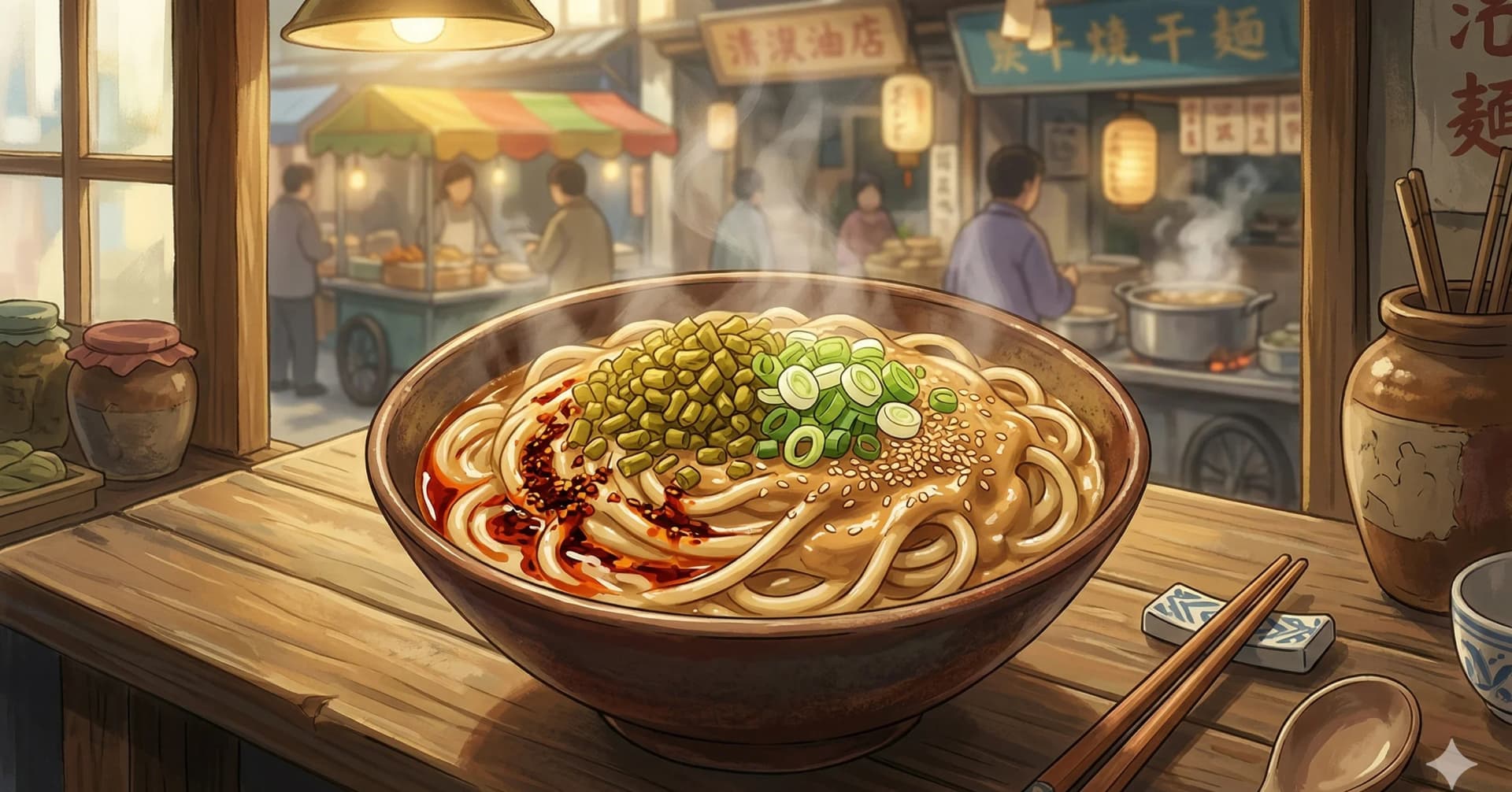
Wuhan's signature noodles tossed in sesame paste, soy sauce, pickled beans, and chili oil
In Wuhan, the day begins with re gan mian. Walk through any neighborhood before eight in the morning and you will find people standing at plastic tables on the sidewalk, heads bowed over small bowls of these noodles, mixing them quickly with chopsticks. The noodles arrive dry, which is the point: there is no broth, no soupy sauce, just a thick, fragrant coating of toasted sesame paste, soy sauce, and chili oil that clings to each springy, alkaline strand. The toppings, a scattering of chopped pickled long beans, scallion greens, and sometimes a dusting of ground Sichuan peppercorn, add texture and brightness to the rich, nutty base.
Re gan mian literally means "hot dry noodles," distinguishing it from the broth noodles and cold tossed noodles that are the other two pillars of Chinese noodle culture. The dish is inseparable from Wuhan, the sweltering capital of Hubei province, where it was born in the 1930s. It has since spread across China but remains most closely associated with the Wuhan breakfast routine. Locals eat it fast, often in under five minutes, standing or walking.
The practical key is the noodle preparation. Traditional re gan mian noodles are alkaline wheat noodles that are first boiled until just short of done, then tossed with sesame oil and spread out to cool. This par-cooking creates a firm, springy texture that holds up to the heavy sesame paste without becoming mushy. A quick dip in boiling water just before serving reheats them without further softening.
At a Glance
Yield
4 servings
Prep
10 minutes
Cook
10 minutes
Total
20 minutes
Difficulty
Easy
Ingredients
Noodle Ingredients
- 1 lbfresh alkaline noodles (or dried alkaline ramen noodles)
- 2 tspsesame oil (for tossing)
Sauce Ingredients
- 1 ozChinese sesame paste (zhi ma jiang), stirred well
- 2 tsplight soy sauce
- 1 tspdark soy sauce
- 1 tspchili oil (with sediment)
- ⅔ tsprice vinegar
- ½ tspsugar
- 1 tbspwarm water (to thin the paste)
To Finish
- 1½ ozpickled long beans (suan dou jiao), finely chopped
- 3scallions, finely sliced
- —Ground Sichuan peppercorn, to taste (optional)
- —Toasted white sesame seeds
Method
- 1
If using fresh alkaline noodles, bring a large pot of water to a rolling boil. Cook the noodles for about 2 minutes less than you would for eating, until they are flexible and nearly cooked but still have a firm, slightly chewy core. If using dried noodles, adjust according to package directions, pulling them 1 to 2 minutes early.
- 2
Drain the noodles immediately and toss them with the sesame oil to prevent sticking. Spread them out on a sheet pan or large plate and let them cool to room temperature. You can fan them or place them in front of a fan to speed this up. This step firms up the noodle texture.
- 3
While the noodles cool, prepare the sauce. In each serving bowl, place the sesame paste, light soy sauce, dark soy sauce, chili oil, rice vinegar, and sugar. Add the warm water and stir vigorously until the sauce is smooth and creamy. The consistency should be like a thin peanut sauce, fluid enough to coat noodles easily.
- 4
Prepare the toppings: chop the pickled long beans finely, slice the scallions, and have the Sichuan peppercorn and sesame seeds ready.
- 5
Bring a fresh pot of water to a boil (or reboil the original pot). Place the cooled, oiled noodles in a strainer or wire basket and dip them into the boiling water for 10 to 15 seconds, just long enough to reheat them without further cooking. The noodles should be hot and springy.
- 6
Shake off the excess water thoroughly. Wet noodles will dilute the sauce.
- 7
Add the hot noodles to the prepared bowls, on top of the sauce.
- 8
Top each bowl with a generous spoonful of chopped pickled long beans, sliced scallions, a pinch of ground Sichuan peppercorn, and a sprinkle of toasted sesame seeds.
- 9
Do not add any additional liquid. The dish is meant to be dry, with the sauce coating the noodles rather than pooling at the bottom.
- 10
Serve immediately. Each person should use chopsticks to toss the noodles vigorously with the sauce and toppings, lifting and turning until every strand is coated.
- 11
Taste after mixing. If the sauce is too thick, a tiny splash of warm water will help. If it needs more salt, add a drop of soy sauce. If it needs more heat, add more chili oil.
- 12
Eat quickly, while the noodles are warm and the sesame paste is fragrant. These noodles do not wait well.
Key Ingredient Benefits
Sesame paste is calorie-dense and rich in healthy unsaturated fats. Sesame seeds are one of the oldest oilseed crops, and research suggests that regular consumption is associated with improved cholesterol profiles and antioxidant status.
Alkaline noodles get their characteristic yellow color and springy texture from the addition of kansui (lye water) to the dough. The alkalinity raises the pH, which strengthens the gluten network and alters the flavor of the wheat.
Pickled long beans are a fermented condiment traditionally used in Wuhan cuisine. Like other lacto-fermented vegetables, they may contain beneficial lactic acid bacteria, though their primary role here is flavor and texture.
Why This Works
The par-cooking and cooling step is borrowed from a technique used in professional noodle kitchens across China. Partially cooking the noodles, then cooling them, allows the starch on the surface to retrograde (recrystallize), which gives the noodles a firmer, more elastic texture when they are briefly reheated. This is why re gan mian noodles feel distinctly springier and chewier than standard boiled noodles.
Chinese sesame paste is made from toasted sesame seeds, which gives it a much deeper, nuttier flavor than tahini (which is made from raw or lightly toasted seeds). The toasting activates hundreds of Maillard reaction products in the sesame seeds, producing a complexity of flavor that raw sesame paste cannot match.
The pickled long beans are not merely a garnish. Their acidity and crunch provide essential contrast to the rich, heavy sesame paste. Without them, the noodles would feel monotonous and cloying.
Substitutions & Variations
- Sesame paste: Chinese sesame paste (zhi ma jiang) is ideal. Tahini can substitute in a pinch but lacks the toasted depth. You can bridge the gap by toasting the tahini briefly in a dry pan.
- Noodles: Fresh alkaline noodles are preferred. If unavailable, dried ramen noodles (the straight kind without seasoning packets) are a good substitute. Avoid egg noodles, which are too soft.
- Pickled long beans: If unavailable, chopped pickled mustard greens (zha cai) or pickled radish provide a similar salty-tangy crunch.
- Peanut butter version: Some modern recipes add a tablespoon of peanut butter to the sesame paste for a richer sauce. This is not traditional but is quite popular.
- Spicier version: Increase the chili oil and add a teaspoon of doubanjiang to the sauce for more heat.
Serving Suggestions
Re gan mian is a complete one-bowl meal, traditionally eaten for breakfast in Wuhan. It does not require side dishes, though a cup of hot soy milk or a bowl of rice porridge alongside it is a classic pairing. For a fuller meal, serve with a simple soup and a side of marinated cucumber. These noodles work equally well for lunch or a quick dinner.
Storage & Reheating
The par-cooked, oiled noodles can be prepared up to 1 day in advance and stored in the refrigerator, covered. The sauce can be prepared in advance and stored in a sealed jar in the refrigerator for up to 1 week. Assemble fresh each time: reheat the noodles with a quick dip in boiling water, sauce the bowls, and add toppings. Fully assembled re gan mian does not store well, as the noodles absorb the sauce and become sticky.
Cultural Notes
Re gan mian (熱乾麵, "hot dry noodles") is the breakfast noodle dish of Wuhan, the capital of Hubei province on the Yangtze River in central China. The dish is the defining everyday food of Wuhan, eaten by the city's residents from streetside stalls and small breakfast counters at a rate that makes it one of the most consumed noodle dishes in any Chinese city. Wuhan locals call the dish simply re gan mian and treat it as the obligatory morning food in the way that congee is for Cantonese diners or buns and soy milk for Beijing residents.
The technique is fast and specific. Fresh thick alkaline wheat noodles (the alkaline water gives them the springy, slightly yellow character that defines Wuhan-style noodles) are blanched briefly in boiling water, drained, and immediately tossed in sesame oil to coat each strand and prevent sticking. The pre-cooked, oil-tossed noodles are then spread on a tray to cool slightly, which is the "dry" part of the dish name: the noodles are not served in broth. When a customer orders, a portion is dropped into a small bowl with a generous spoonful of zhi ma jiang (Chinese sesame paste, similar to Middle Eastern tahini but with a distinctly toasty Chinese character), light soy sauce, Chinese black vinegar, chili oil, chopped pickled long beans, chopped pickled mustard greens, and chopped scallion. The customer mixes everything together at the table, and the sesame paste coats the noodles in a creamy savory-sweet-spicy sauce.
The dish's status in Wuhan is hard to overstate. Local food scholars and travel writers have documented the city's morning ritual of carrying takeaway bowls of re gan mian to work, eaten on the go from a paper bowl with chopsticks. The vendor Cai Lin Ji (蔡林記), founded in 1928, is widely credited with codifying the modern form and remains one of the city's reference points for the dish. The dish became internationally visible during the COVID-19 lockdown in early 2020, when Wuhan residents posted videos and photos of re gan mian as a symbol of the city's identity and resilience, with the dish appearing in news coverage and social media as a culinary stand-in for Wuhan itself.
Nutrition Facts
Calories: 428kcal (21%)|Total Carbohydrates: 69.6g (25%)|Protein: 11.9g (24%)|Total Fat: 10.5g (13%)|Saturated Fat: 1.4g (7%)|Cholesterol: 20mg (7%)|Sodium: 514mg (22%)|Dietary Fiber: 2.8g (10%)|Total Sugars: 2.2g
You Might Also Like
 Medium
Chinese Cuisine
Niu Rou Yang Cong Jiaozi (Beef and Onion Dumplings)
60 minutes
 Medium
Chinese Cuisine
Bai Qie Ji (White Cut Chicken)
4 hours 30 minutes
 Easy
EasyTraditional Chinese Medicine · China
Bok Choy in Ginger Sauce (姜汁白菜)
6 minutes
 Medium
Chinese Cuisine
Char Siu (Chinese BBQ Pork)
9 hours (including marinating)
Ratings & Comments
Ratings & Comments
Ratings
Share your thoughts on this recipe.
Sign in to rate and comment