Indian Cuisine
Green Mango Chutney (Kancha Gola)
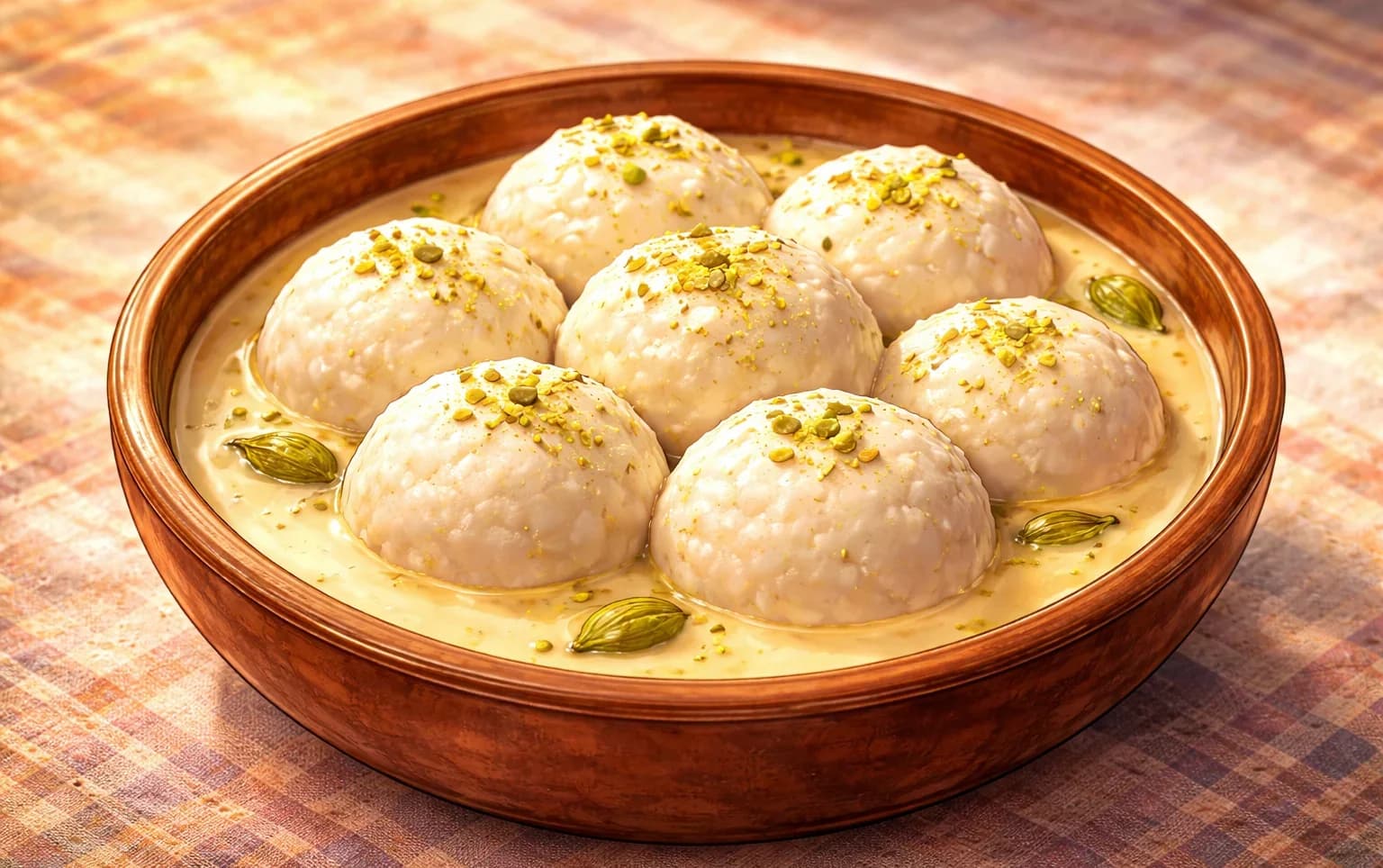
Bengali Fresh Chenna Sandesh with Condensed Milk and Cardamom
Kancha gola occupies a particular place in the Bengali sweet tradition. It is sandesh in its most immediate, unrefined form. Where classic sandesh is kneaded until the chenna becomes smooth as putty and pressed into moulds for a clean, uniform result, kancha gola embraces its granular texture. The name says it directly: kancha means raw or fresh, gola means ball. What you make here is soft, slightly grainy, barely set, shaped into balls by hand while still warm enough to hold the impression of your palms.
The method begins not with fresh market chenna but with milk curdled at home using curd. This is a gentler, more gradual process than the sharp vinegar or lime juice method, which produces a harder, more tightly knit curd. The milk is first boiled, then cooled, then seeded with curd and allowed to curdle when the mixture is brought back to a boil. The curd separates the milk into solid and whey, but the process is slower and the resulting chenna retains more moisture and a softer, more yielding grain.
Condensed milk enters at the precise moment the curd begins to form. It doesn't just sweeten. Its thickened, concentrated dairy nature merges with the curdling chenna and creates a stickiness that holds the granules together as the mixture reduces. Stir continuously from this point. The water evaporates, the mixture tightens, and you're watching for the moment it pulls away from the pan and holds together when you press a small piece between your fingers.
Cardamom goes in at the end, off the heat, perfuming the warm mixture. When it has cooled enough to handle, roll into balls with your palms. The texture will be granular, and this is exactly right.
At a Glance
Yield
15–18 balls
Prep
10 minutes
Cook
30–35 minutes
Total
45 minutes (plus 15 minutes cooling)
Difficulty
Easy
Ingredients
Method
- 1
Boil the milk. Pour the milk into a heavy-bottomed pan and bring to a full boil over medium heat, stirring occasionally to prevent scorching at the base.
- 2
Cool slightly and add curd. Remove from heat and allow to cool for 2–3 minutes. The milk should still be quite hot but no longer boiling. Add the curd and stir gently to incorporate.
- 3
Return to heat and curdle. Return the pan to medium heat and bring the mixture back to a boil. Watch carefully. The milk will begin to curdle, separating into soft white curds and thin pale whey. If the milk is reluctant to separate after 2–3 minutes at a boil, add a few drops of lime juice to encourage curdling.
- 4
Add condensed milk. As soon as you see the milk beginning to separate, add the condensed milk and begin stirring continuously with a wooden spoon or flat spatula. Do not stop stirring from this point.
- 5
Reduce until sticky. Continue stirring over medium heat as the whey evaporates and the mixture becomes progressively thicker and stickier. This takes approximately 15–20 minutes. The mixture is ready when it has come together into a cohesive, sticky mass that pulls away from the sides and base of the pan when you stir.
- 6
Finish with cardamom. Remove from heat. Sprinkle the cardamom powder over the mixture and stir well to distribute.
- 7
Cool and shape. Allow the mixture to cool until warm enough to handle, about 10–15 minutes. It will still be slightly tacky. With slightly moistened or lightly oiled palms, take small portions (about 1 tablespoon each) and roll into balls between your palms. Work quickly while the mixture is warm and pliable.
- 8
Serve at room temperature, or cool completely before plating.
Key Ingredient Benefits
Whole milk provides the dairy protein (casein) that, when denatured by heat and acidified by the curd, forms the chenna. Full-fat milk is important. Lower-fat milk produces a leaner, drier chenna with less body and a less satisfying texture.
Fresh curd used as the curdling agent must be genuinely fresh and not overly sour. Sour curd (older, more acidic) will curdle the milk too aggressively and too quickly, producing smaller, tighter granules and a drier result. Day-fresh curd, still mild, allows the gradual, gentle separation the recipe requires.
Condensed milk is simply whole milk reduced and sweetened. It provides both sweetness and the sticky, binding quality of concentrated milk solids. Homemade condensed milk (whole milk simmered with sugar for 45 minutes) works identically.
Green cardamom is added off the heat to preserve its volatile aromatic compounds, which are delicate enough to dissipate significantly during prolonged cooking. The heat of the warm mixture is sufficient to bloom the fragrance without evaporating it.
Why This Works
Using curd rather than vinegar or lime juice to curdle the milk produces a fundamentally different chenna. Acid curdling agents work quickly and completely, producing a tight, firm curd ideal for smooth sandesh and rasgolla. Curd (yogurt) acts more gently. Its lactic acid causes the milk proteins to aggregate more slowly and more loosely, producing a softer, more moisture-retentive curd with larger, more visible granules.
Adding condensed milk at the moment of curdling is the key technique here. The condensed milk is essentially pre-concentrated dairy with significant sugar. It binds with the forming chenna granules as the whey cooks off, coating each granule with sweetened milk solids and creating the sticky-but-granular texture that defines kancha gola. If sugar were added instead at the end (as in the variation), it wouldn't bind the granules in the same way and the result would be drier and less cohesive.
Continuous stirring from the point of condensed milk addition is essential to prevent the sugar from burning on the base of the pan, and to ensure even reduction.
Substitutions & Variations
- Sugar instead of condensed milk: Substitute 150 g of sugar, adding it once the whey has evaporated and the mixture is dry and beginning to stick. The texture will be slightly drier and more granular than the condensed milk version.
- Jaggery: Replace sugar with 120 g of jaggery for a more complex, caramel-toned sweetness and a slightly darker colour.
- Rose water: Add 1 teaspoon of rose water at the same time as the cardamom for a more Mughal-inflected fragrance.
- Pistachio topping: Press a sliver of pistachio into each ball just before it sets for a traditional garnish.
Serving Suggestions
Kancha gola is served at room temperature as a dessert or afternoon sweet. In Bengali tradition, fresh sandesh is eaten the same day it is made. The granular texture and soft yield are at their most appealing when fresh and still slightly warm. Arrange on a small plate lined with parchment or a banana leaf. No accompaniment is needed; the sweetness is restrained enough and the cardamom fragrance complete enough that these balls are entirely self-sufficient.
Storage & Reheating
Store in an airtight container in the refrigerator for up to 2 days. Bring to room temperature before eating. Cold kancha gola loses much of its softness and the cardamom fragrance is muted. Do not reheat. These are best made and eaten the same day; the granular texture begins to harden slightly by the second day, though the flavour remains pleasant.
Cultural Notes
Kancha gola (কাঁচা গোল্লা, "raw ball") is the Bengali chhena-based sweet in which freshly made chhena is kneaded with a small amount of sugar and shaped into smooth round balls, served without cooking or syrup soaking. The dish is the most strongly "raw" or "fresh" of the Bengali chhena sweets. Where roshogolla, rasmalai, and most other Bengali sweets cook the chhena in some form, kancha gola preserves the chhena in close to its just-made state, with only enough sugar to balance the natural milky tang and only enough shaping to produce a recognizable sweet form.
The dish is associated specifically with the Murshidabad region of West Bengal, especially the city of Murshidabad itself which served as the capital of the Bengal Nawabs in the eighteenth century. The town's most famous version is the Murshidabadi kancha gola, produced by a small number of heritage shops in the old city that have maintained the same recipe for generations. The dish has GI (geographical indication) protection through India's geographical indication system, formally recognizing Murshidabad as the originating region and limiting the legal use of the name to producers in the designated area.
The technique relies entirely on the quality of the chhena. Fresh chhena is made from whole milk curdled with lemon juice, drained briefly (the drain should leave the chhena slightly moist rather than dry), and immediately kneaded with powdered sugar (the sugar should be very fine so it dissolves completely into the chhena without leaving a grainy texture). The kneading continues for fifteen to twenty minutes until the chhena and sugar form a smooth uniform paste, with periodic checks for sweetness adjustment. The paste is then divided into portions of about one ounce each and rolled smooth between the palms into round balls about an inch and a half across. The finished balls are served immediately or refrigerated for up to a day, with longer storage causing the chhena to lose its fresh character. A small piece of edible silver leaf (chandi ka varak) is often pressed onto the top of each ball before serving for ceremonial presentation.
Nutrition Facts
Calories: 148kcal (7%)|Total Carbohydrates: 18g (7%)|Protein: 5.8g (12%)|Total Fat: 6g (8%)|Saturated Fat: 3.6g (18%)|Cholesterol: 25mg (8%)|Sodium: 88mg (4%)|Dietary Fiber: 0g (0%)|Total Sugars: 18.2g
You Might Also Like
Ratings & Comments
Ratings & Comments
Ratings
Share your thoughts on this recipe.
Sign in to rate and comment