Indian Cuisine
Khichdi
The Ancient One-Pot Meal of Rice and Lentils
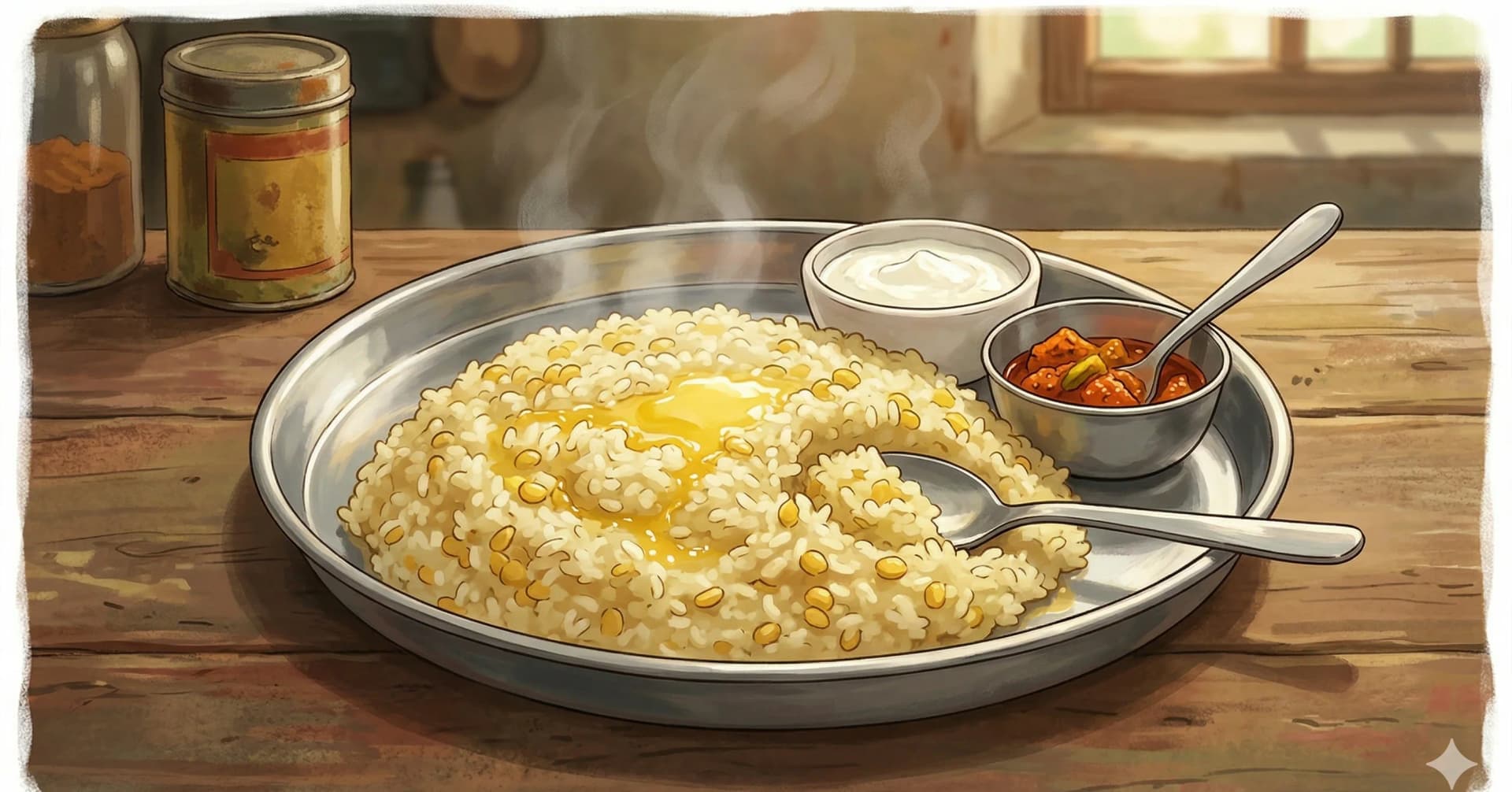
There is a particular comfort in the smell of cumin seeds hitting hot ghee, the way the kitchen shifts from ordinary to something older and more settled. Khichdi carries that quality from the very first step. It is a golden, porridge-like dish, soft and yielding, with the faint earthiness of turmeric and the whisper of asafoetida threading through each spoonful.
Few dishes can claim as long and well-documented a history. Khichdi appears in the Mahabharata, one of the oldest texts in the world. Mughal Emperor Akbar was said to eat it regularly. The Moroccan traveller Ibn Battuta wrote about it in the 14th century. Ayurvedic physicians have prescribed it for centuries as the ideal complete meal: a single dish that provides both protein and carbohydrate in a form the body can process with the least effort. In Ayurveda, it is called a tridoshic food, meaning it is considered appropriate for all body types and conditions.
What this dish delivers is deeply simple: a thick, cohesive, almost creamy pot of rice and lentils that have cooked together until they are indistinguishable from each other. It is not fluffy rice. It is not a soup. It is something between the two, soft enough to be a vehicle for ghee, substantial enough to be a complete meal.
One practical thing worth holding onto: the ratio of water is high and the heat must stay low. Khichdi wants to absorb and swell without rushing. Stir it occasionally, add water if it thickens too quickly, and pull it from the heat when it is thick but still flows slowly from a spoon.
At a Glance
Yield
4 servings
Prep
25 minutes (including soaking)
Cook
35 minutes
Total
1 hour
Difficulty
Easy
Ingredients
- 7 ozwhite basmati rice
- 3½ ozyellow moong dal (split, hulled)
- 1⅓ tbspghee
- 2⅓ tspcumin seeds
- 1⅛ tspasafoetida / hing
- 1⅞ tspground turmeric
- —1.2–1.5 litres water (start with 1.2L, add more as needed)
- —Salt to taste
- —Additional ghee for drizzling
- —Plain yogurt
- —Indian pickle (mango or lime achaar)
Method
- 1
Soak the rice and dal. Combine the rice and moong dal in a bowl. Rinse in several changes of cold water until the water runs mostly clear. Cover with fresh cold water and soak for 20 minutes. Drain well.
- 2
Build the tadka. In a medium-to-large heavy-bottomed pot, warm the ghee over medium heat until it shimmers. Add the cumin seeds and let them sizzle for 30–45 seconds, until fragrant and beginning to colour. Add the asafoetida and stir once. Add the turmeric — it will bloom immediately in the ghee.
- 3
Coat the rice and dal. Add the drained rice and dal to the pot. Stir to coat everything in the spiced ghee. Toast gently for 1–2 minutes — you want each grain touched by the golden fat.
- 4
Add water and salt. Pour in 1.2 litres of water. Add salt generously — khichdi needs seasoning. Stir once and bring to a gentle boil over medium heat.
- 5
Slow cook, covered. Once it reaches a boil, reduce heat to low. Cover and cook for 25–30 minutes, stirring every 8–10 minutes to prevent the base from catching. As the rice and dal break down and swell, the mixture will thicken considerably. If it becomes very thick before the grains are fully soft, add water in 100ml increments and continue cooking.
- 6
Check consistency and finish. Khichdi is ready when the rice and dal are completely soft, merged together, and the texture is thick but pourable. It should flow slowly off a spoon. Adjust salt. Remove from heat and rest, covered, for 5 minutes before serving.
- 7
Serve. Ladle into deep bowls. Make a small well in the centre of each portion and pour in a teaspoon of ghee. Serve with yogurt and pickle alongside.
Key Ingredient Benefits
Yellow moong dal: Split and hulled mung beans. Among the most digestible legumes available: the hull has been removed, which takes with it much of the fibre that can cause digestive stress. Research suggests mung beans have a relatively low glycemic index and contain significant protein, folate, and magnesium. Traditionally used in Ayurveda as a cleansing food and recommended for the elderly, unwell, and those recovering from illness.
Ghee: Clarified butter with the milk solids removed. Contains butyric acid, a short-chain fatty acid that has been studied for its potential role in gut health. Traditionally used in Ayurvedic cooking as a carrier that improves absorption of fat-soluble spices such as turmeric. Suitable for those sensitive to lactose, as the milk solids have been removed.
Turmeric: Contains curcumin, which has been extensively studied for anti-inflammatory properties. Research suggests curcumin has low bioavailability on its own; fat (as in the ghee here) meaningfully increases absorption. Traditionally used to support digestion and as an anti-inflammatory agent in Ayurvedic and Unani medicine.
Asafoetida (hing): A dried resin from the Ferula plant, used in minute quantities. Traditionally used to reduce gas and bloating associated with legume consumption. Has a strong, sulphurous raw smell that transforms to a mild, savoury quality once cooked.
Why This Works
Soaking the rice and dal together before cooking allows them to begin absorbing water evenly, which helps them soften at roughly the same rate during cooking. Moong dal is already quick to cook, but soaking ensures it breaks down fully into the mixture rather than remaining in distinct pieces.
The asafoetida (hing) is functional, not just aromatic. Traditionally used with legumes, it is believed in Ayurvedic cooking to reduce the gas-producing compounds in dal. It also adds a low, umami-adjacent depth to the base.
Cooking at low heat with a lid lets the steam do the work. The rice and dal stew gently in their own released starch, which is what produces the thick, cohesive texture. High heat would evaporate the water too quickly and produce unevenly cooked grains.
The final rest off the heat allows the pot to finish cooking through residual heat and for the starches to fully hydrate and settle.
Substitutions & Variations
Rice: White basmati is traditional, but short-grain rice or even sona masoori works. Brown basmati can be used — increase water and cooking time significantly, and the texture will be slightly more rustic.
Dal: Yellow moong is the most traditional choice for its digestibility and mild flavour. Masoor dal (red lentil) also works well and cooks at a similar speed. Chana dal produces a more textured, less smooth khichdi.
Ghee: If unavailable, use a neutral oil such as sunflower or coconut oil. The dish will taste less rich but remains completely authentic in technique.
Vegetables: A common variation is to add diced seasonal vegetables (carrot, cauliflower, peas) stirred in after the tadka. This makes the dish more substantial and is particularly common in Maharashtra and Gujarat.
Spice level: This recipe is deliberately gentle. For more warmth, add a slit green chilli in the tadka, or a small piece of ginger, grated.
Masala khichdi: A bolder variation layers in garam masala, red chilli powder, onion, and tomato. Nourishing but no longer the soft, restorative classic.
Serving Suggestions
Khichdi is a complete meal in itself. The traditional accompaniment is simple and deliberate:
- A generous pour of warm ghee over the top — this is not optional for the full experience
- A bowl of cold plain yogurt, which provides contrast in temperature and a cooling creaminess
- Indian pickle (mango keri nu achaar, or lime) for sharp, spiced counterpoint
- A side of fried or roasted papad for texture
In many households, khichdi is served on rainy evenings, during illness recovery, on days of religious fasting (in adjusted forms), and as the final meal before a fast. It is the dish that says the house is calm.
Storage & Reheating
Refrigerator: Cool completely before storing. Khichdi thickens significantly as it cools and will become nearly solid in the fridge. Store in an airtight container for up to 3 days.
Reheating: Transfer to a pot and add water (start with 100–150ml per serving) and reheat gently over low heat, stirring frequently, until it returns to its soft, pourable consistency. It often tastes better the next day once the flavours have settled. Adjust salt after reheating.
Freezer: Khichdi freezes well. Portion into freezer containers and freeze for up to 2 months. Defrost overnight in the fridge and reheat as above with additional water.
Cultural Notes
Khichdi (खिचड़ी, also spelled khichuri in Bengali and khichadi in Gujarati) is the pan-Indian rice-and-lentil dish in which rice and split lentils (typically moong dal or split toor dal) are cooked together with turmeric, salt, ghee, and minimal additional spicing into a soft porridge-like consistency. The dish is among the oldest documented preparations of the Indian subcontinent: it appears in references in Greek, Persian, and Arabic travelers' accounts of medieval India, and it is mentioned in classical Sanskrit and Tamil literature as kṛsara (Sanskrit) and kūṭṭu (Tamil) along with other early names for the rice-lentil combination.
The dish's universality and antiquity make it one of the foundational dishes of Indian cooking. Khichdi appears in nearly every regional Indian cuisine in its own regional version: the Gujarati moong-dal khichdi with whole spices and ghee, the Bengali bhuna khichuri with browned aromatics and rich spicing, the Maharashtrian masala khichdi with vegetables and goda masala, the Tamil pongal (which is a khichdi variant elevated into a festival rice-lentil dish), the Punjabi khichri with garlic and ghee. The dish is also the canonical bimar ka khana (the food given to sick people) across most Indian households, valued for being gentle on digestion, easy to chew and swallow, and complete in protein-carbohydrate balance. The Ayurvedic tradition treats khichdi as a tridoshic preparation (balanced for all three Ayurvedic constitutional types) and recommends it for convalescence, cleansing, and during seasonal transitions.
The technique is forgiving and adapts to whatever rice-and-lentil ratio the household prefers. The simplest version combines one cup of rice with a half-cup of split moong dal (washed together until the water runs clear), and cooks them with three to four cups of water, a teaspoon of turmeric, and salt in a heavy pot or pressure cooker until both grains soften and break down partially into a soft thick porridge. A small tempering of ghee with cumin seeds, asafoetida, and crushed black pepper is poured over the cooked khichdi for the basic version. Regional variants add fresh ginger, slit green chili, sliced onion, chopped vegetables (cauliflower, peas, carrots, potatoes), curry leaves, mustard seeds, and various regional spice blends. The dish is served hot with a small bowl of plain yogurt, a wedge of pickle, and a generous drizzle of additional ghee on top. The dish appears at sick beds, post-festival cleansing meals, and as the everyday comfort food across the subcontinent.
Nutrition Facts
Calories: 288kcal (14%)|Total Carbohydrates: 54.8g (20%)|Protein: 9.6g (19%)|Total Fat: 3.6g (5%)|Saturated Fat: 2g (10%)|Cholesterol: 8mg (3%)|Sodium: 4mg (0%)|Dietary Fiber: 4.2g (15%)|Total Sugars: 0.1g
You Might Also Like
Ratings & Comments
Ratings & Comments
Ratings
Share your thoughts on this recipe.
Sign in to rate and comment