Ayurveda · Wellness
Masala Chai
Aromatic spiced tea simmered with milk and sweetened to taste
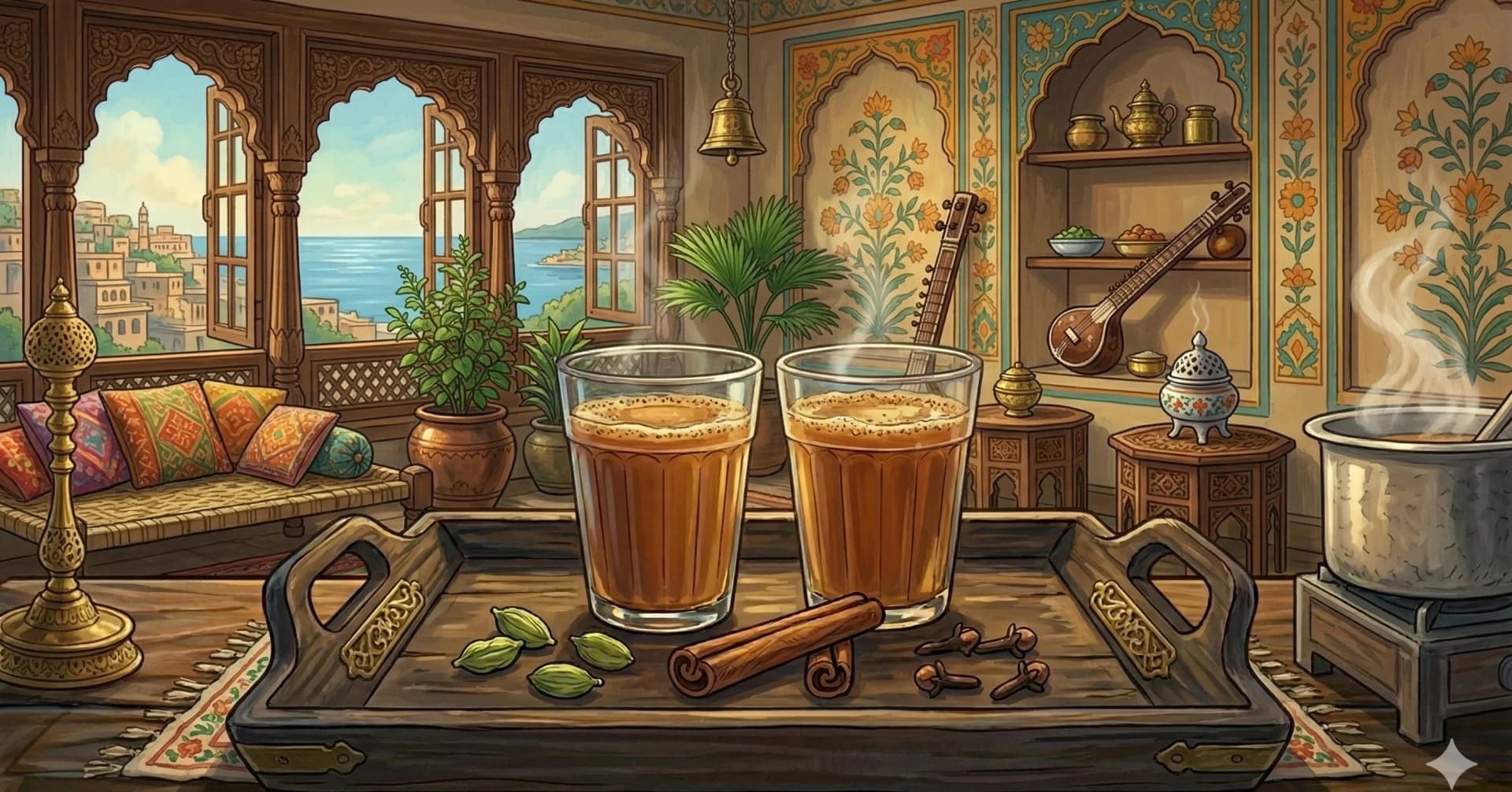
The sound comes first. Water bubbling in a small saucepan, the sharp crack of cardamom pods under the flat of a knife, the rasp of ginger against a grater. Then the smell: ginger hitting the hot water, releasing its bright, peppery steam, followed by the warmer, rounder fragrance of cardamom, cinnamon, and cloves unfurling as the spices simmer. By the time the tea leaves go in and the milk is added, the kitchen smells like something ancient and certain.
Masala chai is not "chai tea" in the redundant Western sense. Chai simply means tea, and masala means spice blend. What the rest of the world has adopted and often commercialized as a flavored latte is, in India, simply the default way tea is made in most households. The specific blend of spices varies by family, region, season, and mood. Some households use only ginger and cardamom. Others add black pepper for a Ayurvedic kick, or fennel for sweetness, or star anise for a deeper warmth. No two kitchens make exactly the same chai.
The technique is fundamental: water and spices are simmered together first, allowing the volatile oils and flavor compounds to extract into the water before the tea leaves are added. The milk goes in last, and the whole mixture is brought to a rolling boil, which concentrates the flavors and produces the slightly thick, creamy consistency that distinguishes proper chai from tea with a splash of milk.
The practical insight that makes the difference is this: crush the spices. Whole cardamom, cinnamon, and cloves added intact to the water will release very little of their flavor in a 10-minute simmer. Crushing them opens the cellular structure and exposes the essential oils to the hot liquid, producing a chai that is genuinely aromatic rather than merely spice-adjacent.
At a Glance
Yield
Serves 2
Prep
5 minutes
Cook
10 minutes
Total
15 minutes
Difficulty
Easy
Ingredients
- 1 cupwater
- ⅞ cupwhole milk (full-fat)
- 1¾ tbspfresh ginger (about 2 cm), peeled and roughly crushed or grated
- 4green cardamom pods, lightly crushed to crack open
- 1small cinnamon stick (about 3 cm), broken into pieces
- 3cloves
- 3 wholeblack peppercorns (optional)
- ¼ ozloose black tea leaves (Assam CTC is traditional, about 2 heaped teaspoons)
- 15to 25 g sugar, to taste, or jaggery
Method
- 1
Crush the spices. Place the cardamom pods (4) on a cutting board and press firmly with the flat of a knife to crack them open, exposing the small black seeds inside. Break the cinnamon stick (1) into 2 to 3 pieces. Lightly crush the cloves (3) and peppercorns (3, if using) with the side of a knife or in a mortar. The spices do not need to be finely ground, just cracked enough to release their oils.
- 2
Crush the ginger. Peel the ginger (10 g) and either grate it on a coarse grater or crush it with the flat of a knife until it is bruised and fibrous. Grated ginger produces a stronger, more pungent chai. Crushed ginger produces a gentler, more rounded flavor. Choose based on your preference.
- 3
Simmer the spices in water. Pour the water (250 ml) into a small saucepan and add the crushed ginger, cardamom, cinnamon, cloves, and peppercorns. Place over medium heat and bring to a simmer. Let the spices simmer in the water for 3 to 4 minutes. The water will turn slightly golden and the kitchen will fill with the warm, complex fragrance of the spices. This extraction step is crucial; it allows the fat-soluble and water-soluble flavor compounds in the spices to dissolve into the liquid before the tea and milk are added.
- 4
Add the tea leaves. Add the black tea leaves (10 g) to the simmering spiced water. Stir once. Let the tea steep and simmer for 2 minutes. The liquid will turn a deep reddish-brown. Assam CTC tea, with its small, rolled granules, releases its color and tannins quickly, which is why it is the preferred variety for chai. Leaf tea can be used but will produce a lighter, less robust brew.
- 5
Add the milk. Pour in the whole milk (200 ml). Stir gently to combine. Increase heat to medium-high and bring the chai to a full, rolling boil. Watch the pan closely as the milk will foam up rapidly once it reaches boiling point. When the chai rises in the pan, reduce heat immediately and let it settle. Bring it to a boil once more. This double boil concentrates the flavors and produces a slightly thicker, more cohesive chai. Some cooks repeat this boiling 3 to 4 times for an even more intense flavor.
- 6
Add sugar. Add the sugar (15 to 25 g) or jaggery and stir until dissolved. The sweetness should balance the bitterness of the tea and the spiciness of the ginger. Taste and adjust. Traditional Indian chai is typically sweeter than Western expectations, but this is entirely a matter of personal preference.
- 7
Simmer briefly. Let the chai simmer over low heat for 1 to 2 minutes more. The color should be a deep, warm amber-brown, and the surface should have a slight sheen from the milk fat. The aroma should be complex: ginger forward, with cardamom, cinnamon, and a hint of pepper underneath.
- 8
Strain and serve. Place a fine strainer over two cups or glasses. Pour the chai through the strainer, pressing lightly on the spices and tea leaves to extract the last of the flavor. Discard the solids. Serve immediately while hot.
Key Ingredient Benefits
Black tea (Assam CTC) contains caffeine, L-theanine, and polyphenols. The combination of caffeine and L-theanine has attracted research interest for its potential to promote alert relaxation, a state of calm focus. Research suggests that regular tea consumption is associated with cardiovascular and cognitive health benefits, though the evidence is observational and context-dependent. In Ayurvedic terms, tea is considered stimulating and is traditionally balanced with warming spices and milk to reduce its astringent, drying qualities.
Ginger (Zingiber officinale) contains gingerol and shogaol, compounds that research suggests may have anti-nausea, anti-inflammatory, and digestive properties. In Ayurvedic medicine, ginger is one of the most important herbs, known as "the universal remedy," traditionally used to kindle agni (digestive fire) and counter respiratory congestion. Its inclusion in chai is both a flavor choice and a health-oriented tradition.
Cardamom (Elettaria cardamomum) is traditionally regarded as one of the most important spices in Ayurvedic medicine, used as a digestive, breath freshener, and cooling agent despite its warm flavor profile. Research has explored cardamom's potential effects on blood pressure and digestive comfort, with some preliminary studies suggesting modest benefits.
Cinnamon (Cinnamomum verum or C. cassia) contains cinnamaldehyde and has attracted significant research attention for potential effects on blood sugar regulation. In Ayurvedic tradition, cinnamon is considered warming and is used to support circulation and digestion. Note that cassia cinnamon (the more common variety) contains higher levels of coumarin than true (Ceylon) cinnamon.
Black pepper contains piperine, which research suggests enhances the bioavailability of many compounds, including the curcumin in turmeric and the catechins in tea. Its traditional inclusion in chai is aligned with the Ayurvedic principle of synergistic spice combinations.
Why This Works
Simmering the spices in water before adding the tea and milk is the foundational technique. The essential oils in cardamom (primarily 1,8-cineole and alpha-terpinyl acetate), cinnamon (cinnamaldehyde), cloves (eugenol), and ginger (gingerol and shogaol) are released most effectively into hot water through sustained heat. Adding these spices after the milk is in the pan would coat them in fat, which slows the extraction of water-soluble compounds. The staggered addition, with water and spices first, then tea, then milk, ensures maximum flavor extraction from each component.
The rolling boil after adding milk serves multiple purposes. It concentrates the chai by evaporating some water content, intensifying the flavor. It also emulsifies the milk fat into the tea, producing the slightly creamy, unified texture that distinguishes simmered chai from tea with milk added separately. The repeated boiling, allowed to rise and settle 2 to 3 times, further concentrates and emulsifies.
Using CTC (Crush, Tear, Curl) Assam tea rather than whole-leaf tea is deliberate. CTC tea has a much larger surface area relative to its mass, which means it releases its tannins, caffeine, and color much more quickly. In a preparation where the tea is simmered for only a few minutes, this rapid extraction is essential. Whole-leaf tea simmered for the same duration would produce a weaker, less characterful brew.
Substitutions & Variations
Stronger ginger chai (adrak chai): Double the ginger and omit the other spices for a simpler, more pungent version that is a common cold-weather remedy across India.
Tulsi chai: Add 8 to 10 fresh tulsi (holy basil) leaves along with the spices. Tulsi chai is a popular Ayurvedic variation, particularly during cold and flu season.
Elaichi chai: Use only cardamom (6 pods, well-crushed) and omit the other spices for the simplest, most elegant variation, common in many households.
Without milk (black masala tea): Omit the milk entirely and increase the water to 400 ml. Add a squeeze of lemon at the end. This produces a lighter, more astringent drink common in some South Indian and Kashmiri traditions.
Jaggery instead of sugar: Jaggery (gur) adds a deeper, more complex sweetness with notes of caramel and molasses. It is considered preferable to refined sugar in Ayurvedic dietary practice.
Vegan version: Replace dairy milk with oat milk, which froths and simmers most similarly to whole milk. Coconut milk also works but shifts the flavor profile noticeably.
Serving Suggestions
Masala chai is served throughout the day in India, but it is most strongly associated with morning and late afternoon. It accompanies biscuits, rusks, samosas, pakoras, or simply a quiet moment. In many households, the morning chai is prepared by one designated family member and is a ritual that marks the start of the day. In offices, construction sites, and markets across India, chai is brewed and sold by chaiwallas (tea vendors) from small stalls, often served in small glass cups or disposable clay kulhads. It is as much a social ritual as it is a drink.
Storage & Reheating
Masala chai should be made fresh and consumed immediately. Reheated chai loses its aromatic complexity and the milk can develop a slightly stale taste. If you must reheat, warm gently over low heat without boiling. The spice mixture can be pre-ground in a larger batch and stored in an airtight jar for up to 2 months: grind together cardamom seeds, cinnamon, cloves, and peppercorns, and use about 3 g (½ teaspoon) per cup. This saves preparation time without significant flavor loss, though freshly crushed spices will always produce a more vibrant chai.
Cultural Notes
Masala chai, "spiced tea" in Hindi, has one of the more fascinating recent cultural histories in global beverages. Indians have been drinking spiced milk-and-herb decoctions for thousands of years (the Ayurvedic tradition includes many such preparations), but the version we now call masala chai is surprisingly modern. Black tea itself was not a significant part of Indian daily life until the early 20th century. The British East India Company's tea plantations in Assam and Darjeeling, established to break China's monopoly on tea production, began producing tea in volumes far greater than the British colonial population could consume.
The British colonial Indian Tea Association launched aggressive marketing campaigns in the 1920s and 1930s to encourage tea drinking among Indians, including free samples distributed at railway stations and tea breaks mandated in industrial workplaces. Indian tea vendors, called chai wallahs, adapted the British style by adding milk, sugar, and traditional Indian spice combinations (cardamom, ginger, cloves, cinnamon, black pepper) to create what became the modern masala chai. The result was a drink that suited Indian palates and economic realities far better than plain British black tea. Within a generation it had become embedded in Indian daily life across all classes and regions.
Today, chai wallah stalls are a defining institution of Indian urban and rural life, serving small glass tumblers of sweet, intensely spiced tea to office workers in the morning, to commuters at railway stations, to construction workers throughout the day, to anyone who passes by. The traditional small clay cup (kulhar), made from terracotta and discarded after one use, remains an iconic vessel for chai in many Indian cities, though disposable paper and plastic have mostly replaced it. The global rise of "chai tea" in Western coffee shops in the 2000s and 2010s is a recent secondary development. The actual Indian masala chai tradition is more heavily spiced, far hotter, far sweeter, and inseparable from the rituals of Indian daily life.
Nutrition Facts
Calories: 95kcal (5%)|Total Carbohydrates: 13g (5%)|Protein: 3g (6%)|Total Fat: 3g (4%)|Saturated Fat: 2g (10%)|Cholesterol: 10mg (3%)|Sodium: 45mg (2%)|Dietary Fiber: 0g (0%)|Total Sugars: 12g
You Might Also Like

Ratings & Comments
Ratings & Comments
Ratings
Share your thoughts on this recipe.
Sign in to rate and comment