Indian Cuisine
Stuffed Egg Paratha (Moglai Paratha)
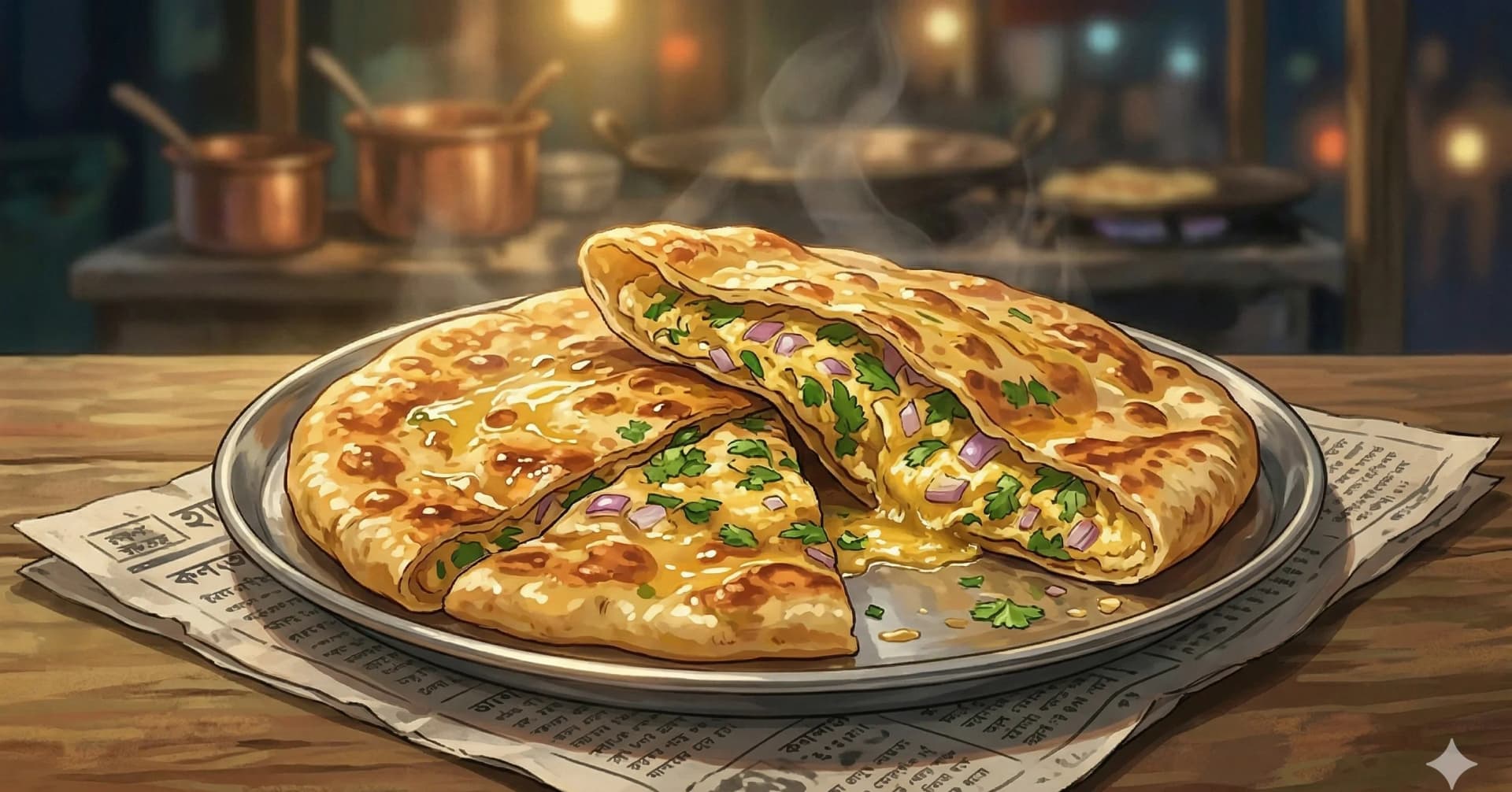
Kolkata's folded egg paratha — crisp, golden, and molten in the middle
Walk through any Kolkata neighbourhood in the late morning and you will find it: a large iron tawa over high flame, a pool of oil shimmering at the edges, a man pressing a folded dough parcel with a flat spatula until it blisters and crisps and exhales a gust of steam. The moglai paratha is Kolkata's answer to the stuffed flatbread, and it is one of the more quietly spectacular things the city makes.
The name gestures at the Mughal culinary tradition (Moglai is a Kolkata spelling of Mughal), and indeed the dish has roots in the Muslim communities of northern Kolkata, where egg-enriched breads and layered flatbreads have long been part of the cooking. But it is now entirely the city's own: sold from small stalls alongside biriyani shops, eaten for breakfast with a small dish of sharp mustard-chilli sauce, wrapped in newspaper and carried off through crowded morning streets.
The technique is what makes it: you roll the dough thin, almost as thin as a crepe, lay a beaten egg mixture across the surface, then fold the dough over itself to enclose the egg completely. In the hot oil, the dough forms a crisp, almost flaky shell while the egg inside cooks to a soft, just-set texture, fragrant with onion, green chilli, coriander, and a hit of cumin. Cutting it open at the table releases a curl of steam.
The key is heat management. Too low and the paratha absorbs oil without crisping. Too high and the outside burns before the egg inside can set. A medium-high flame, generous oil, and a patient hand with the spatula are all that stand between you and something excellent.
At a Glance
Yield
6–8 parathas
Prep
30 minutes (including 20-minute dough rest)
Cook
25 minutes
Total
55 minutes
Difficulty
Medium
Ingredients
Dough Ingredients
- 4 cupplain flour (maida)
- 1 tspsalt
- 1 tspoil
- 1⅛ cupwarm water
Filling Ingredients
- 1–2eggs (about 100 g egg in total for all the parathas)
- 1¾ ozonion, very finely chopped
- 3¼ tbspgreen chillies (2–3 chillies; adjust to the heat you like), finely chopped
- 1 cupfresh coriander, finely chopped
- 1¼ tbspfresh ginger paste
- ⅞ tspsalt
- 2⅛ tspblack pepper, freshly ground
- 1½ tbspcumin powder
For Frying
- ½ cupneutral oil (or a mix of oil and ghee for a richer flavour)
Method
- 1
Make the dough. Combine flour (500 g), salt (1 tsp), and oil (1 tsp) in a large bowl. Add warm water gradually, mixing until a smooth, soft dough forms. Softer than bread dough, almost as soft as an earlobe. Knead for 5–6 minutes. Cover with a damp cloth and rest for 20 minutes.
- 2
Prepare the egg mixture. In a bowl, beat the eggs. Add the finely chopped onion (50 g), green chillies (20 g), coriander (20 g), ginger paste (20 g), salt (5 g), black pepper (5 g), and cumin powder (10 g). Mix well and set aside. The mixture should be quite thick with aromatics.
- 3
Roll the paratha. Divide the dough into 6–8 equal balls. On a lightly oiled or floured surface, roll each ball as thin as possible. Aim for 2–3 mm, roughly the size of a small dinner plate, 25–28 cm across. Thin rolling is critical for the flaky texture.
- 4
Add the filling. Spoon 2–3 tablespoons of the egg mixture onto the center of the rolled dough, spreading it lightly but leaving a 2 cm border. Do not spread all the way to the edge or sealing will be difficult.
- 5
Fold and seal. Fold the bottom third of the dough up over the filling, then fold the top third down, like a letter. Then fold the left and right sides in to create a rectangular parcel with the egg enclosed completely. Press the edges firmly to seal.
- 6
Fry. Heat a large tawa or heavy frying pan over medium-high heat. Add enough oil to generously coat the surface, about 2 tablespoons per paratha. Carefully lay the folded paratha in the oil, sealed side down first to seal the edges with heat. Cook for 3–4 minutes until the underside is deeply golden, pressing gently with the spatula to ensure even contact. Flip and cook the other side for another 3–4 minutes. The paratha is ready when both sides are a rich amber-gold and the paratha feels light and slightly puffed.
- 7
Drain and serve. Remove to a wire rack or paper-lined plate briefly. Serve immediately. The contrast between crisp exterior and soft egg interior is greatest in the first few minutes.
Key Ingredient Benefits
Maida (plain flour) is a refined wheat flour with the bran and germ removed: white, low-fibre, with strong extensible gluten. It's used across Indian street food for its textural properties, for the same reason French baguettes and Italian pasta use refined flour. Nutritionally it offers carbohydrates and some protein; it lacks the fibre of whole wheat.
Eggs are the structural and flavour heart of the filling. The yolk's fat and lecithin keep the filling rich and cohesive; the white sets into a soft, yielding texture. Eggs are among the most complete dietary protein sources available, providing all essential amino acids alongside fat-soluble vitamins A, D, E, and K2.
Green chillies contribute bright, sharp heat, distinct from the earthier heat of red chilli powder. The capsaicin content is high. Traditionally used as a digestive stimulant across Indian cuisines, and research suggests capsaicin may be associated with metabolic and appetite effects.
Ginger paste provides warm, resinous heat that mellows as it cooks into the egg. Gingerols (the active compounds in fresh ginger) are associated with anti-inflammatory activity in research, though the quantities in a paratha are modest.
Coriander brings freshness and a slight citrus edge that cuts through the richness of egg and oil. The herb is rich in volatile oils that degrade quickly with heat, which is why it is mixed into the raw filling rather than cooked separately.
Why This Works
Maida is specified deliberately. It's finely milled plain flour with less fibre than whole wheat, and its smooth, extensible gluten network rolls thinner without tearing, creating the papery-thin dough sheets that produce the characteristic slightly layered, flaky texture when fried. Atta would add texture and nutrition but produces a coarser, more bread-like result that doesn't develop the same crispness.
The egg mixture is added raw to the raw dough, which means egg and dough cook together in the hot oil. The fat-rich egg yolk transfers heat quickly, cooking the interior from within while the oil does its work on the outside. The trick is that the folded paratha acts like a sealed packet. Steam from the cooking egg builds pressure inside, puffing the paratha slightly and cooking the egg through even as the outside crisps.
The aromatics (onion, green chilli, coriander, ginger) need to be finely chopped rather than chunky. Large pieces of onion or chilli create points of weakness in the dough where the egg mixture may leak into the oil during frying. Fine chopping means the aromatics integrate into the egg, creating a cohesive filling that stays put.
Substitutions & Variations
- Keema moglai paratha: Add 2–3 tablespoons of cooked spiced minced meat (chicken or mutton keema) to the egg mixture before filling. A richer, more substantial version, popular in Old Kolkata.
- Vegetarian version: Omit the egg and fill with a mixture of finely mashed potato, spices, and paneer. It becomes more of a standard stuffed paratha, but the same folding technique applies.
- Ghee frying: Substituting half the neutral oil with ghee dramatically enriches the flavour. The paratha turns more golden and develops a slightly nutty aroma at the edges.
- Spice adjustment: The standard Kolkata version is moderately hot. For milder versions, reduce green chillies by half and add ¼ tsp turmeric to the egg mixture for colour.
Serving Suggestions
Moglai paratha is traditionally served with kasundi (Bengal's thin, pungent fermented mustard sauce) and sliced raw onion with a squeeze of lemon. A simple green chutney of coriander and green chilli works well too. In Kolkata it's often eaten as a standalone morning or midday meal. For a more complete spread, serve alongside dal or a light curry for dipping. Cut the paratha in half at the table to reveal the egg. The steam that escapes is part of the experience.
Storage & Reheating
Moglai paratha is best made and eaten immediately. The crispness fades within 20 minutes as the steam from the egg interior softens the shell. Leftover parathas can be refrigerated and reheated in a dry pan over medium heat (not a microwave, which will make them rubbery), pressing lightly until the outside re-crisps. They will not fully recover their fresh texture but remain good eating. Do not freeze assembled parathas; the egg filling changes texture unpleasantly. Uncooked filled and folded parathas can be refrigerated (not frozen) for up to 4 hours before frying.
Cultural Notes
Moglai paratha (also Mughlai paratha, मोगलाई पराठा) is the Bengali Muslim street-food preparation of a large thin paratha (made from refined flour, maida) stuffed with beaten egg and minced lamb or chicken, folded into a square parcel, and deep-fried in oil until the exterior crisps to a golden brown and the egg and meat filling cooks through. The dish is a Calcutta (Kolkata) street-food classic with a documented history at Anadi Cabin (founded 1923) and Nizam's (founded 1932), the two restaurants most associated with the moglai paratha's spread across the city and beyond.
The dish's name and history reflect the Bengali Muslim cuisine of Calcutta, which is distinct from both the broader Mughlai tradition and from Hindu Bengali home cooking. Despite the "Mughlai" name, the dish is a Bengali Muslim invention that draws on Mughlai stuffed-paratha techniques but applies them in a Bengali street-food register: larger sizes, more aggressive frying, and the substitution of the Bengali staple egg as a binding element with the minced meat. The dish became one of the defining street foods of Calcutta in the early twentieth century, sold from corner stalls and small restaurants across the city and exported through Bengali migration to other Indian cities and to the Bangladeshi diaspora restaurants of the United Kingdom and the Middle East.
The technique requires a thin paratha that can hold the wet filling without tearing. Refined flour dough is rested for an hour, then rolled into very thin large rounds (about ten inches across). A filling is prepared from minced lamb or chicken cooked briefly with chopped onion, ginger-garlic, green chili, and ground spices, then mixed with beaten eggs (the egg binds the filling and adds richness). The thin paratha round is placed flat on the work surface, the meat-and-egg filling is spread over the center in a square shape leaving a two-inch border, and the four sides of the paratha are folded inward over the filling to make a closed square parcel. The parcel is shallow-deep-fried in hot oil in a heavy kadai, flipped once when the bottom turns golden, and removed when both sides are crisp and golden brown and the filling is cooked through. The dish is cut into four squares and served hot with a sliced raw onion salad, green chutney, and a few wedges of lime.
Nutrition Facts
Calories: 620kcal (31%)|Total Carbohydrates: 97.2g (35%)|Protein: 14.3g (29%)|Total Fat: 18.1g (23%)|Saturated Fat: 10g (50%)|Cholesterol: 85mg (28%)|Sodium: 84mg (4%)|Dietary Fiber: 3.7g (13%)|Total Sugars: 1g
You Might Also Like
Ratings & Comments
Ratings & Comments
Ratings
Share your thoughts on this recipe.
Sign in to rate and comment