Indian Cuisine
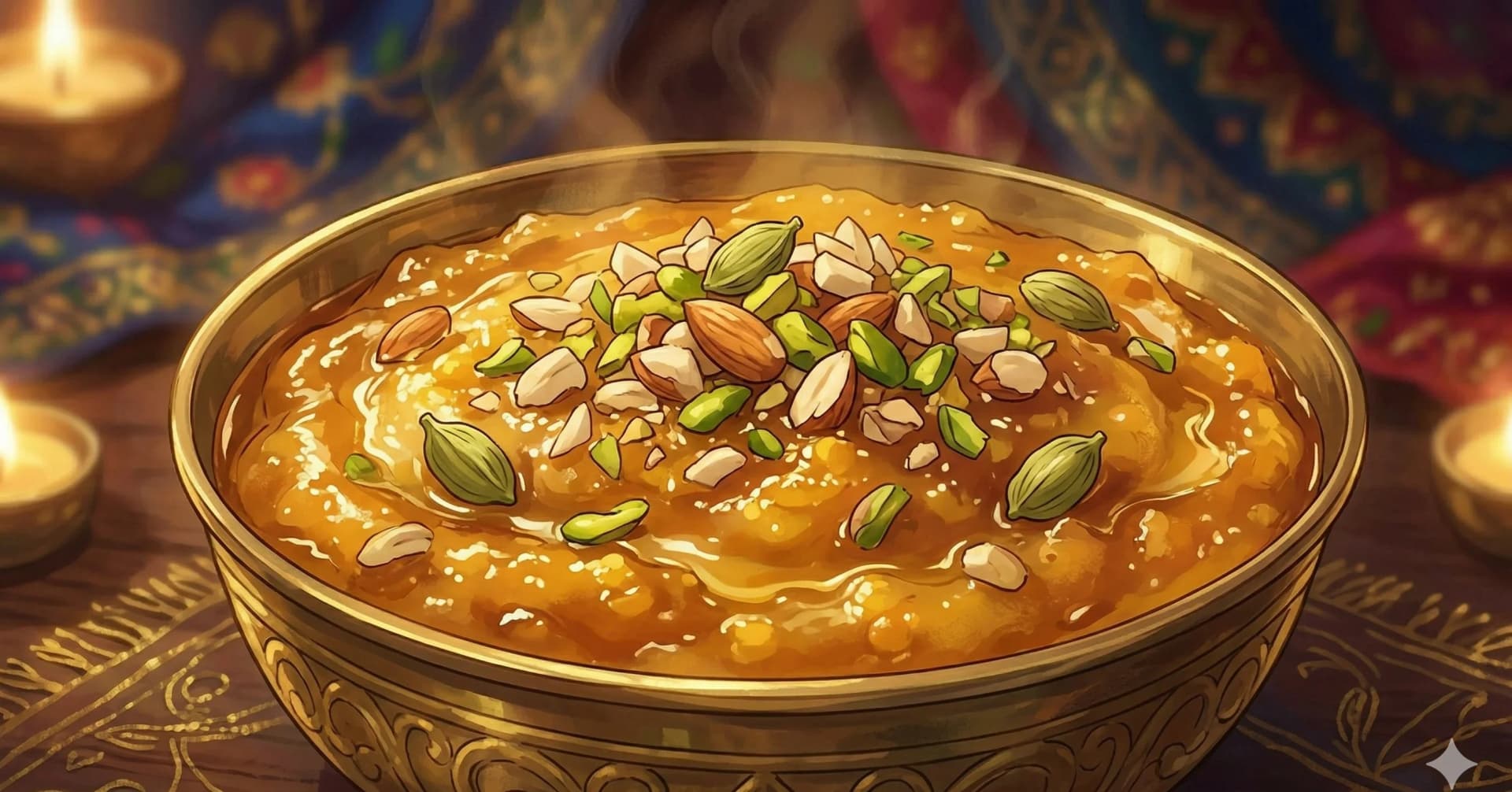
Lentil Flour Pudding (Moong Dal Halwa)
Rajasthani Winter Halwa of Slow-Roasted Ground Moong Dal
Moong dal halwa is winter food in the truest sense: a preparation that requires both cold weather justification and patient hands. In Rajasthan, it appears at weddings between November and February, at the celebration of Holi, and at the festival of Makar Sankranti. It is also made simply because it is cold and the body wants something rich, slow-cooked, and genuinely warming.
The technique is uncompromising. Soaked moong dal is ground to a coarse paste and then cooked in ghee, a generous amount of ghee, for a long time. Forty minutes at minimum, an hour is not uncommon. The paste hisses and spatters in the ghee as its water content evaporates, clumping and breaking, clumping and breaking, the colour shifting from pale yellow to a deep amber gold as the raw dal smell transforms first to toasted, then to nutty, then to something approaching caramelised. You stir almost continuously. Your arm aches. The kitchen smells extraordinary.
This extended frying of the dal paste in fat is the Maillard reaction at work on a grand scale, the same chemical process that browns bread and caramelises meat. The amino acids in the moong dal and the natural sugars present undergo hundreds of simultaneous reactions in the hot ghee, producing the dozens of aromatic compounds that give well-made moong dal halwa its complexity. No sugar syrup added to an underdone dal paste can substitute for this.
When the ghee separates from the dal and the paste is deep gold and fragrant, the sugar syrup and nuts go in, and the whole thing reduces together until it begins to leave the sides of the pan. The cardamom goes in last. The halwa is served hot, while it is still liquid enough to pour into bowls.
At a Glance
Yield
Serves 6–8
Prep
20 minutes (plus minimum 3 hours soaking)
Cook
50–60 minutes
Total
4+ hours (mostly passive soaking)
Difficulty
Medium
Ingredients
Method
- 1
Soak the dal. Wash the moong dal in several changes of water. Cover with cold water and soak for at least 3 hours. Up to overnight is also fine.
- 2
Grind to a coarse paste. Drain the soaked moong dal thoroughly. Transfer to a blender and grind to a coarse paste, adding as little water as possible, just enough to keep the blades moving. The paste should be thick and grainy, not smooth. A slight coarseness is desirable; it contributes to the final texture of the halwa. Do not over-grind to a smooth puree.
- 3
Heat ghee in a lagan (wide, heavy pan). Choose the widest, heaviest pan you have, a lagan or a wide kadhai. The wider the pan, the more surface area for the paste to cook, and the faster the water evaporates. Heat all the ghee over medium heat until it is hot and shimmering.
- 4
Add the dal paste and begin frying. Add the moong dal paste to the hot ghee. The paste will sputter and spit immediately. Step back and use a long spoon. Stir constantly. The paste will initially be wet and loose, then will begin to clump and separate from the ghee.
- 5
Fry until deep amber and fragrant. Continue stirring and frying over medium heat for 40–60 minutes. The paste will go through several stages: wet and clumping, then drier and beginning to colour, then golden, then deep amber-gold and nutty-smelling. The ghee will separate from the dal and be visible at the sides and base of the pan. At this point the dal should smell deeply roasted and nutty with no raw legume smell. Do not rush this stage.
- 6
Make and add the sugar syrup. While the dal is frying, combine the sugar with approximately 200–250 ml of water in a small pan. Bring to a boil, stirring until dissolved. Keep warm.
- 7
Add nuts, then syrup. When the dal is properly roasted and fragrant, add the chopped almonds and pistachios. Stir through for 1–2 minutes. Then carefully pour in the warm sugar syrup. It will spatter fiercely when it hits the hot ghee-dal mixture. Stir continuously as the syrup is absorbed.
- 8
Cook until the halwa leaves the sides. Continue cooking and stirring over medium heat as the syrup reduces and is absorbed into the dal. The halwa is ready when it has come together into a cohesive mass that begins to pull away from the sides and base of the pan, and you can see ghee at the edges.
- 9
Add cardamom. Remove from heat. Add the cardamom powder and stir well to distribute.
- 10
Serve immediately, hot, in small bowls.
Key Ingredient Benefits
Yellow moong dal is the hulled, split form of green mung beans, lighter, more easily digestible, and more quickly soaked than the whole bean. In Ayurvedic tradition, moong dal is classified as one of the most beneficial legumes, easily assimilated and considered suitable for all constitutions. The extended ghee-roasting transforms its nutritional profile somewhat. The high heat creates new compounds while driving off the volatile, potentially digestive-disruptive substances in raw legumes.
Ghee is present in substantial quantity and is load-bearing here, not just for flavour but as the cooking medium for a process that requires sustained high heat without burning. Its smoke point of approximately 250°C is significantly higher than butter or most vegetable oils, making it stable through the extended roasting period. Ghee contributes fat-soluble vitamins and butyric acid, a short-chain fatty acid associated in research with gut health.
Almonds and pistachio provide contrasting colours (pale gold against vivid green) and textural variation within the smooth halwa. They are added after the dal is fully roasted to preserve their texture. Added earlier, they would soften into the paste and lose their distinct presence.
Green cardamom added off the heat preserves its most delicate volatile aromatic compounds, which would largely evaporate in the continuing heat of an active flame.
Why This Works
The extended roasting of the moong dal paste in ghee is not just flavour development, it is water removal. Fresh-ground dal paste contains significant moisture. All of that moisture must be driven off before the paste can begin to brown, because water in a pan keeps the temperature at 100°C (the boiling point of water) regardless of the flame beneath it. Only once all the water has evaporated can the temperature of the dal rise above 100°C and the Maillard reactions that produce the deep, complex flavour begin.
This is why the first 20–30 minutes of frying seem unproductive. The paste is simply drying out. Only in the second half does the colour change accelerate and the fragrance emerge. Patience through the wet stage is what separates excellent moong dal halwa from adequate.
Adding the sugar syrup rather than dry sugar is deliberate. Dry sugar added to the hot ghee-dal mixture would be difficult to distribute evenly and could caramelise unevenly or burn in contact with the very hot ghee before it dissolves. Warm syrup distributes immediately and evenly.
Substitutions & Variations
- With more nuts: Double the almonds and pistachio, and add a handful of raisins, for a more textured, richer halwa. This is the wedding version.
- Less ghee: The quantity can be reduced slightly, to 120 g, but anything below this will cause the dal to stick and burn during the long roasting period.
- With saffron: Dissolve a generous pinch of saffron in the warm sugar syrup before adding to the roasted dal for a golden-hued, fragrant variation.
- Condensed milk shortcut: Some contemporary versions add 200 ml of condensed milk in place of sugar syrup, producing a richer, more fudge-like result. The extended roasting step remains unchanged.
Serving Suggestions
Moong dal halwa is served hot, in small bowls or in small mounds on a plate. It is winter food: rich, warming, deeply satisfying. At Rajasthani weddings it is often served as part of a dal baati churma meal as the final sweet. At Holi celebrations it appears alongside thandai. At home, it is simply winter warmth, served after a meal when the fire is going. Garnish with a few extra pistachio slivers pressed into the top and serve immediately.
Storage & Reheating
Moong dal halwa keeps well, refrigerated, for up to 1 week. It firms up considerably when cold. The ghee solidifies around the dal. To reheat: place a portion in a pan over low heat with a tablespoon of water or milk, stirring constantly until it loosens and warms through. Or microwave in 30-second bursts, stirring between each. Add a few drops of water if it seems dry. Serve hot.
Cultural Notes
Moong dal halwa (मूंग दाल हलवा) is the Rajasthani and broader North Indian sweet of ground moong dal cooked slowly in ghee and milk with sugar, cardamom, and saffron, finished with chopped almonds and pistachios. The dish is one of the most luxurious of the Indian halwas (sweet pudding-like preparations) and one of the most heavily ghee-laden, with the cooking process consuming sometimes a full cup of ghee for every cup of cooked dal. The dish is the centerpiece sweet of Rajasthani winter cooking and a fixture of Rajasthani wedding feasts, where it appears as one of the showcase sweets alongside ghevar, balushahi, and other elaborate festival preparations.
The technique demands patience for the long slow cook. Split skinned moong dal is soaked for at least four hours, drained, and ground to a coarse paste (the grind should be coarse rather than smooth, since too fine produces a gummy texture). The paste is cooked in a heavy pot over low heat with the full amount of ghee, stirred continuously for forty-five minutes to an hour, during which the dal passes through several visual stages: first pale yellow and grainy, then deeper golden as the Maillard reactions develop, then dark amber-brown with a pronounced toasted aroma that signals the dal is ready. The cooking is the single most important variable: under-cooked dal produces a raw vegetal flavor; properly cooked dal has a deep nutty caramel character that distinguishes a well-made halwa.
The finishing builds on the cooked dal base. Hot milk and water are added gradually to the cooked dal with continued stirring until the mixture forms a thick smooth paste. Sugar is added (the ratio is typically equal weight to dal, or slightly less for a less sweet version) and stirred until completely dissolved. Cardamom powder, saffron-infused milk, and chopped almonds and pistachios are folded in at the end. The dish is served warm in small bowls, sometimes with an additional drizzle of ghee on top and a scatter of edible silver leaf (chandi ka varak) for formal occasions. The pairing with hot masala chai is the traditional Rajasthani serving format. The dish appears at Rajasthani family meals during winter (when the heavily ghee-laden character feels seasonally right), at Rajasthani weddings, and at the prestigious sweet shops of Jaipur, Jodhpur, and Udaipur.
Nutrition Facts
Calories: 497kcal (25%)|Total Carbohydrates: 53.9g (20%)|Protein: 16.7g (33%)|Total Fat: 25.5g (33%)|Saturated Fat: 13.4g (67%)|Cholesterol: 53mg (18%)|Sodium: 9mg (0%)|Dietary Fiber: 11.2g (40%)|Total Sugars: 17.2g
You Might Also Like
Ratings & Comments
Ratings & Comments
Ratings
Share your thoughts on this recipe.
Sign in to rate and comment