Indian Cuisine
Spiced Lentil Fritters (Mysore Bonda)
South Karnataka's Pillowy Urad Dal Dumplings
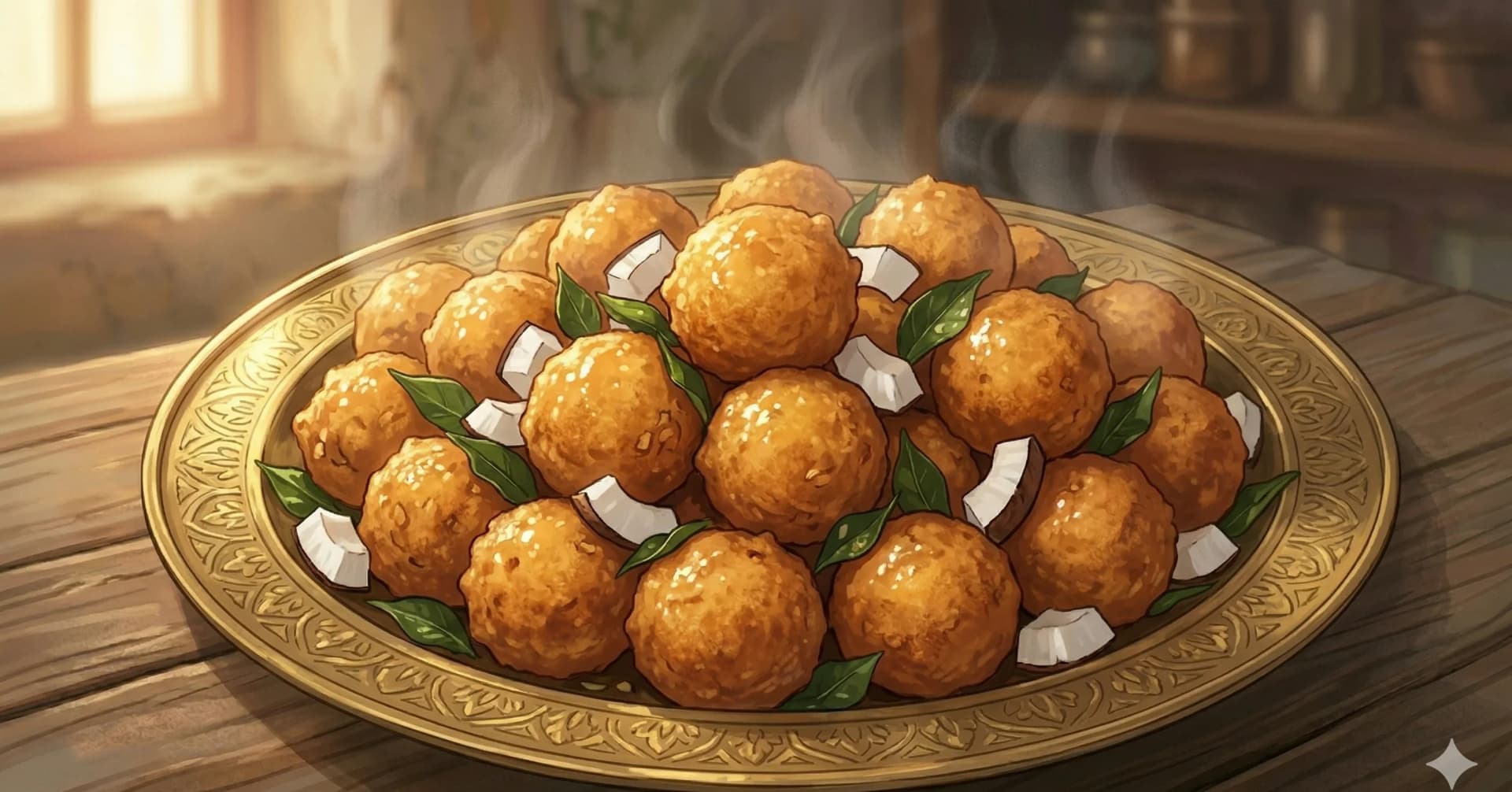
In the old coffee houses of Mysore, the ones with marble-topped tables and ceiling fans turning slowly overhead, a plate of bondas arrives without ceremony alongside your filter coffee. They come piled on a steel plate, six or eight at a time, roughly spherical, each one blistered and deeply golden. You pick one up while it is still too hot to hold for long, pull it apart, and the interior yields immediately: soft, airy, almost cloud-like, with the gentle warmth of black pepper and the faint coconut sweetness threading through every bite.
Mysore bonda is simpler than medu vada. There is no ring-shaping, no floating test anxiety, no geometry to master. The batter is ground, seasoned, and then dropped in rough balls from a wet palm into hot oil, where each one puffs on contact and turns an even gold. The skill lies in the batter's consistency and in temperature management during frying. The batter must be thick enough to hold a shape when dropped but aerated enough to puff; the oil must be hot enough to set the exterior quickly but not so hot that it colours before the interior has cooked through.
The technique has one essential rule: add as little water as possible when grinding. Less water means more protein per unit volume, which means the exterior sets faster when the ball hits the oil. Faster setting means a more complete pressure vessel for the steam expanding inside, and steam pressure is what makes the bonda puff. Use too much water and the batter spreads in the oil, producing flat, dense discs.
The Mysore version is clean and direct: coconut, whole black pepper, curry leaves, green chilli, and rice flour for the faintest extra crispness. Nothing that distracts from the deep, yielding interior.
At a Glance
Yield
18–22 bondas
Prep
15 minutes (plus 1 hour soaking)
Cook
30 minutes
Total
1 hour 45 minutes
Difficulty
Easy
Ingredients
- ¾ lburad dal (split black gram, hulled)
- 1¾ tbspgreen chillies (1–2 chillies), finely chopped
- ⅓ tspsalt
- ⅓ tspasafoetida
- 1 ozfresh coconut pieces, roughly chopped
- ⅔ tspwhole black peppercorns
- ¼ ozrice flour
- ¾ cupfresh curry leaves (about 1 sprig)
- —Oil, for deep frying
Method
- 1
Soak the dal. Wash the urad dal in several changes of water until the water runs clear. Cover with cold water and soak for 1 hour. Drain very thoroughly; shake the colander and press to remove as much surface water as possible.
- 2
Grind the aromatics first. Transfer the green chillies, salt, and asafoetida to a blender. Grind briefly until the chillies are broken down. This ensures even distribution through the batter.
- 3
Grind the batter. Add the soaked and drained urad dal to the same blender jar. Grind to a very tight, thick paste. Add water only if absolutely necessary to keep the blades moving, and even then, add only a few teaspoons at a time. The batter must never be slack or pourable. It should be dense enough to hold a shape when you scoop it with your hand.
- 4
Add remaining ingredients. Transfer the ground batter to a mixing bowl. Add the rice flour, whole black peppercorns, coconut pieces, and curry leaves (1 sprig). Mix well with your hand until everything is evenly distributed. Taste and adjust salt.
- 5
Beat the batter. Beat the batter vigorously with your hand for 1–2 minutes to incorporate additional air. A well-beaten batter produces lighter, more puffed bondas.
- 6
Heat the oil. Pour oil into a kadhai to a depth of at least 8 cm. Heat over medium-high flame until it reaches approximately 175°C. A small drop of batter should sizzle immediately and rise to the surface.
- 7
Shape and fry. Wet both palms with water. Scoop a generous tablespoon of batter and roll loosely into a rough ball between your palms. It does not need to be perfectly round. The natural irregularity creates the blistered surface characteristic of good bondas. Drop carefully into the oil. Fry 4–5 at a time, turning gently every minute or so with a slotted spoon, for 4–5 minutes until deeply golden-brown on all sides.
- 8
Test for doneness. Lift one bonda and tap it; it should sound slightly hollow. The finished colour should be a deep, even golden-brown.
- 9
Drain and serve. Remove with a slotted spoon and drain briefly on paper. Serve immediately with coconut chutney.
Key Ingredient Benefits
Urad dal is functionally irreplaceable in this recipe. Its high glutelin content creates the cohesive, air-trapping batter that produces the puffed, yielding interior. Nutritionally it is significant: approximately 26% protein by dry weight, with meaningful iron and calcium content.
Coconut pieces (not grated, but rough chunks) contribute fat, texture, and a mild sweetness. They remain distinct within the soft interior, providing occasional pockets of chew and coconut fragrance.
Whole black peppercorns provide bursts of sharp, dry heat within the bonda's soft interior. Piperine, black pepper's primary alkaloid, holds its character through frying without becoming harsh or bitter.
Curry leaves crisp slightly during frying, adding textural contrast within the soft interior. Their carbazole alkaloids are volatile and fragrant, giving an unmistakably South Indian character to each bite.
Asafoetida serves both flavour and tradition here. In Ayurvedic cooking it is considered a digestive aid for legume-heavy dishes, and its savoury depth enriches the otherwise mild urad dal batter.
Why This Works
The hollowness of a well-made bonda is produced by rapid steam expansion inside the frying shell. When the batter hits hot oil, the exterior, rich in urad dal protein, sets almost immediately into a sealed skin. Inside, the water content of the batter turns to steam under heat and has nowhere to go. It expands, pushing against the setting shell from within, and the bonda puffs visibly in the first thirty seconds of frying. This is the same principle that makes a puff pastry expand or a popover balloon in the oven: trapped steam creating internal pressure against a setting outer structure.
Grinding the chillies, salt, and asafoetida first before adding the dal ensures these flavours distribute evenly through the batter rather than existing as isolated pockets.
Rice flour adds to the exterior crispness without affecting the puffing behaviour. It provides additional starch at the surface that gelatinises rapidly in hot oil and produces a more shattering outer shell.
Substitutions & Variations
- Without coconut: Omit the coconut pieces for a plainer, more austere bonda. The puffing behaviour is unaffected.
- More pepper-forward: Double the whole black peppercorns and reduce or omit the fresh chilli. Produces a sharply spiced, warming bonda.
- Extra crisp shell: Increase the rice flour to 20 g. The shell will be noticeably more shattering.
- Sambar bonda: Make the bondas slightly smaller and serve submerged in hot, thin sambar. The bondas absorb the sambar and become fragrant and spongy, similar to sambar vada but with the bonda's distinct yielding interior.
Serving Suggestions
Mysore bonda is canonical breakfast and tea-time food. The traditional serving is a plate of bondas with thin coconut chutney, thinner and more liquid than the thick chutney served with idli, working as a dipping sauce so the bonda's crust stays crisp longer. In Mysore coffee houses, a small side of thin sambar may come alongside. These are best eaten within minutes of frying, while hot.
Storage & Reheating
Mysore bondas are at their best immediately from the oil. The interior softens and the puffed structure begins to deflate within 20–30 minutes of frying. To reheat, use an oven at 200°C for 6–8 minutes or an air fryer at 190°C for 4–5 minutes; the exterior will recover significant crispness. Do not microwave. Batter can be stored refrigerated for up to 24 hours; slight overnight fermentation improves flavour slightly. Bring to room temperature and beat briefly before frying.
Cultural Notes
Mysore bonda (ಮೈಸೂರು ಬೋಂಡ) is the Karnataka deep-fried tea-time snack of fermented batter made from urad dal flour or maida combined with yogurt, rice flour, asafoetida, ginger, green chili, and curry leaves, dropped by spoonfuls into hot oil and fried until golden and puffy. The dish is named for the city of Mysore (Mysuru), the former capital of the Wodeyar dynasty of the Kingdom of Mysore and a longstanding center of Karnataka culinary tradition. The bonda appears at every Karnataka tiffin restaurant, coffee house, and home tea-time as the standard fried tea companion alongside the masala dose and idli.
The Karnataka tiffin tradition shapes the dish's character. The Mysore-Bangalore tiffin restaurant culture developed in the early twentieth century around small clean vegetarian eateries that served standardized rice-based and urad-dal-based preparations through the day. Establishments like Mavalli Tiffin Rooms (MTR, founded 1924 in Bangalore) codified the tiffin format that pairs idli, vada, dose, upma, bonda, and bath preparations with coffee or buttermilk in small portion sizes for breakfast or evening tea. Mysore bonda fits into this tradition as the lighter, puffier alternative to the denser medu vada, with the fermented batter producing a crisp shell and a soft airy interior that takes the coconut chutney coating well.
The technique relies on the batter consistency and the frying temperature. A batter is prepared from urad dal flour (or a mix of urad and rice flour), yogurt, asafoetida, ginger paste, chopped green chili, chopped curry leaves, crushed black pepper, and salt, whisked smooth to a thick dropping consistency. The batter is rested for thirty minutes for the asafoetida to bloom and the flour to hydrate. Oil is heated in a deep kadai to about 175°C (medium-hot, not smoking), and the batter is dropped by tablespoonfuls (one bonda per spoonful, slid in carefully so the shape stays round). The bondas are fried for three to four minutes, flipped once, and removed when both sides are deep golden and the interiors have puffed up. The bonda is served immediately with coconut chutney and a small bowl of sambar for dipping, alongside a small steel tumbler of South Indian filter coffee.
Nutrition Facts
Calories: 422kcal (21%)|Total Carbohydrates: 56.1g (20%)|Protein: 23.1g (46%)|Total Fat: 13g (17%)|Saturated Fat: 3.6g (18%)|Cholesterol: 0mg (0%)|Sodium: 534mg (23%)|Dietary Fiber: 17.1g (61%)|Total Sugars: 0.5g
You Might Also Like
Ratings & Comments
Ratings & Comments
Ratings
Share your thoughts on this recipe.
Sign in to rate and comment