Indian Cuisine
Chickpea Flour Fudge (Mysore Pak)
The Royal Sweet of Karnataka. Three Ingredients, One Legendary Texture
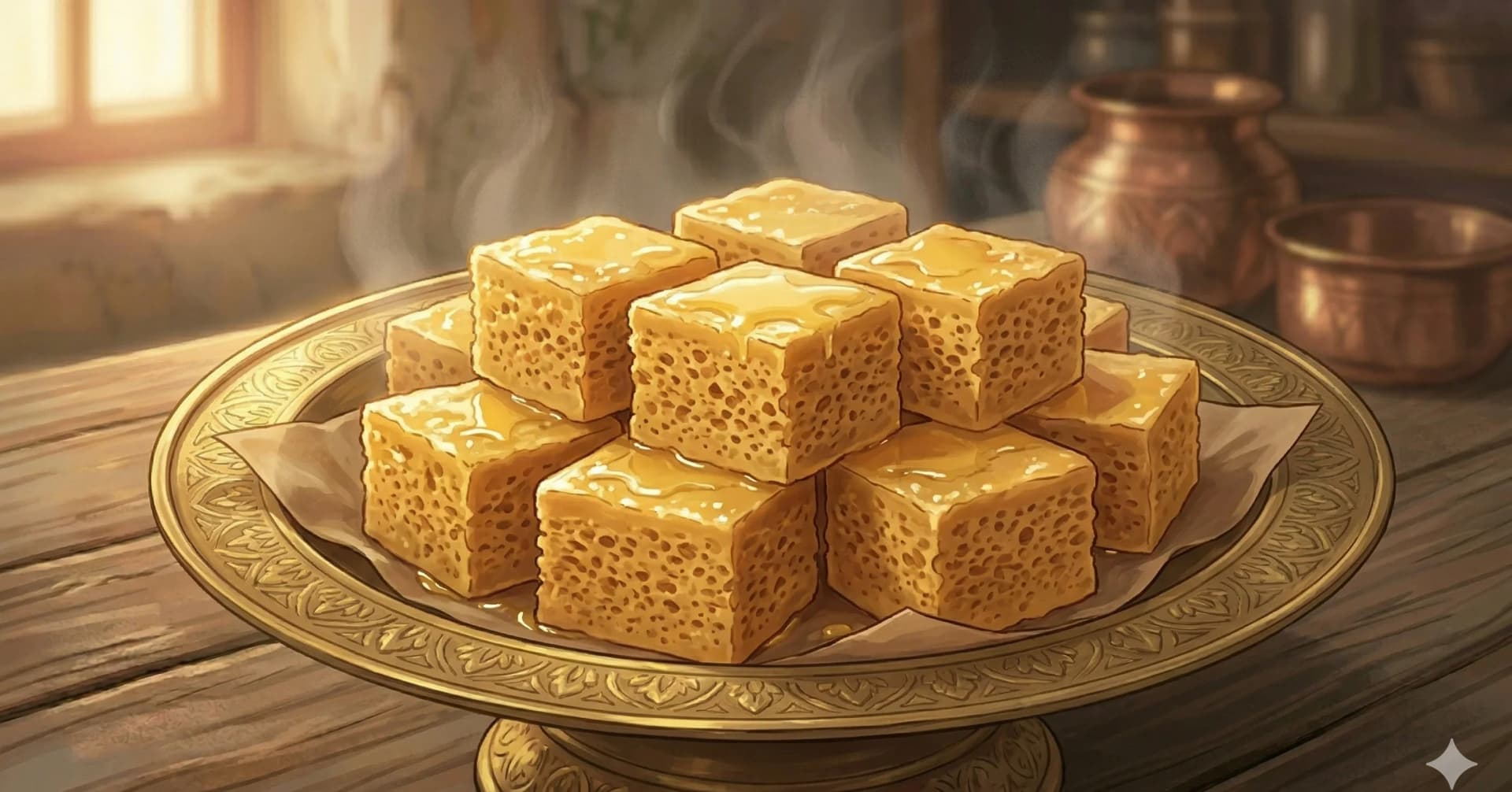
There is a particular satisfaction to biting into a piece of Mysore Pak: the way it yields in the first moment, then crumbles apart in soft, porous layers that melt before you've finished chewing. It is buttery without being greasy, sweet without being cloying, and deeply, warmly fragrant with roasted chickpea flour and ghee. Nothing about it announces itself loudly. It simply delivers.
The story goes that this sweet was invented in the Mysore Palace kitchen in the early 20th century by a royal cook named Kakasura Madappa, who was asked to prepare something new for Maharaja Krishnaraja Wadiyar IV. What he produced with three pantry staples (chickpea flour, sugar, and ghee) became one of India's most recognizable sweets and gave the city of Mysore one of its most lasting culinary legacies. The royal kitchens of Karnataka's Wodeyar dynasty were known for their refinement, and Mysore Pak stands as quiet proof that refinement doesn't require complexity.
What you get from this recipe is a sweet that rewards attention. The texture (crumbly, slightly porous, not dense) depends on two things: how well you roast the besan, and how steadily you add the hot ghee. Rush either step and you end up with something fudgy and heavy rather than the airy, melt-in-the-mouth result you're after. The ghee goes in gradually, tablespoon by tablespoon, while the mixture foams and hisses and slowly transforms.
The practical insight that matters most: have your ghee hot and your tray greased before you begin. Once the mixture is ready, it sets fast.
At a Glance
Yield
16–20 pieces
Prep
10 minutes
Cook
25 minutes
Total
35 minutes (plus 1 hour setting)
Difficulty
Medium
Ingredients
Method
- 1
Prepare your tray and ghee. Grease a 20x20cm tray (or similar) generously with ghee or neutral oil. Set aside. Heat all 200g of ghee in a small saucepan until it is quite hot but not smoking. Keep it warm on low heat throughout the process. The ghee must be hot when added to the mixture.
- 2
Roast the besan. In a heavy-bottomed kadai or wide pan, heat 2 tablespoons of ghee over medium-low heat. Add the sifted besan (200 g) and roast, stirring constantly with a flat spatula, for 8–10 minutes until it turns a shade deeper, smells nutty and fragrant, and feels slightly heavier in the pan. Do not rush this. Raw besan has a bitter taste that only roasting removes. Set the roasted besan aside in a bowl.
- 3
Make the sugar syrup. In a large, wide, heavy-bottomed pan, combine the sugar (300 g) and 150ml water. Bring to a boil over medium heat, stirring until the sugar dissolves. Continue cooking without stirring until you reach a one-string consistency: when you take a small drop between your thumb and forefinger and pull apart, it forms a single clean thread. This is the right stage. Do not cook further.
- 4
Add the besan. Reduce heat to medium-low. Add the roasted besan to the syrup all at once, stirring vigorously and continuously to prevent lumps. The mixture will be thick and sticky. Keep stirring.
- 5
Add ghee gradually. Begin adding the hot ghee, one tablespoon at a time, stirring continuously after each addition. The mixture will foam and bubble dramatically each time ghee is added. That is correct. Keep stirring and keep adding ghee, one tablespoon every 30–45 seconds. The mixture will slowly become porous and aerated as it absorbs the fat.
- 6
Watch for the ready sign. Continue until the mixture stops absorbing ghee, begins to leave the sides of the pan cleanly, and has a slightly grainy, porous appearance. The color deepens to a golden amber. The whole process of adding ghee takes approximately 10–12 minutes. Do not overwork once it reaches this stage.
- 7
Pour and cut. Immediately pour the mixture into your prepared tray. Working quickly, use a greased flat spatula or the back of a greased spoon to level the surface lightly. Do not press down hard. Allow to cool for 10–12 minutes until just firm but still warm. Cut into squares or diamonds using a sharp greased knife. Do not wait until it is fully cold or it will crack unevenly.
- 8
Set completely. Leave the cut pieces in the tray until completely cool, about 45–60 minutes. The pieces will firm up further and develop their characteristic crumbly texture as they cool.
Key Ingredient Benefits
Besan (chickpea flour, gram flour): Made from ground chana dal (split chickpeas). The defining ingredient of this sweet. Besan provides plant-based protein (about 20 g per 100 g), is naturally gluten-free, and has a low glycemic index. The roasting step is what transforms besan from a simple binder into the rich, nutty foundation of the sweet — properly roasted besan develops Maillard browning that contributes the distinctive aroma.
Ghee (clarified butter): The other defining ingredient. Pure clarified butter with the milk solids removed, ghee has a high smoke point and shelf-stable nature that suits long-cooking sweets. Traditional Mysore Pak uses a generous amount — sometimes equal parts ghee and besan by weight. Ghee contains fat-soluble vitamins A, D, E, and K, and traditional Ayurvedic texts describe ghee as nourishing and grounding.
Sugar: Standard granulated sugar. The technique of cooking sugar to a single-thread consistency (105-110°C / 220-230°F) before adding the besan-ghee mixture is what gives Mysore Pak its characteristic crystalline, porous texture.
Cardamom (optional traditional addition): A small pinch of ground cardamom in the final mixture adds aromatic complexity, though purist versions omit it. The cardamom should be very subtle — Mysore Pak's character is the besan-ghee combination, not the spice.
The simplicity of three ingredients (besan, ghee, sugar) is the heart of Mysore Pak. The sweet contains no eggs, no dairy beyond ghee, no leavening agents, and no flavoring beyond optional cardamom. The "miracle" of Mysore Pak is that three pantry staples, prepared with proper technique, produce a uniquely delicious result.
Why This Works
Roasting the besan first is the technique that separates great Mysore Pak from mediocre. Raw besan has a slightly bitter, beany flavor that disappears with proper roasting. Roast on low heat for 8 to 10 minutes, stirring constantly, until the besan turns a shade darker (light golden-brown) and releases a distinctly nutty, almost popcorn-like aroma. Skipping this step produces sweet with a "raw besan" off-flavor.
The sugar syrup must reach the single-thread consistency (about 110°C / 230°F) before the besan-ghee mixture is added. Test by dipping a metal spoon into the syrup, allowing it to cool briefly, and pressing a drop between thumb and forefinger — when separated, a single thread should form. Too thin a syrup produces fudgy, dense Mysore Pak; too thick produces dry, crumbly sweet that doesn't bind properly.
The gradual addition of hot ghee is the technique that produces the signature porous, crumbly texture. Hot ghee is added tablespoon by tablespoon while the mixture is on heat, with constant stirring. The mixture will foam, hiss, and gradually transform from a thick paste into a frothy, almost lava-like consistency. The porosity comes from tiny pockets of trapped ghee that solidify in the final sweet — without sufficient ghee and without gradual addition, those pockets do not form.
The mixture must be poured into the greased tray immediately when it reaches the right consistency. Properly cooked Mysore Pak goes from "still mixing" to "set in the pot" within 30 to 60 seconds at the critical moment. Hesitation produces a hardened block that cannot be poured. Restaurant kitchens often have two people working — one stirring, one watching the consistency, one ready to pour the moment it's right.
Cutting must happen while still warm. Once Mysore Pak fully cools, it becomes brittle and shatters when cut rather than producing clean squares. The traditional pattern is to cut into 1.5-inch diamonds or squares while the sweet is still warm and slightly soft, then let it finish setting in the cut form.
Substitutions & Variations
Besan: No good substitute. Coarsely-ground besan (some Indian groceries label it "Mysore Pak besan") produces a coarser, more rustic texture. Fine besan produces a smoother, more refined sweet. Both are traditional.
Ghee: Cannot be substituted without losing the essential character. Butter does not work — the water content produces the wrong texture. Vegetable oil is not traditional and produces a fundamentally different result (sometimes called vanaspati Mysore Pak, considered a cheaper version).
Sugar: Granulated white sugar is traditional. Jaggery (gud) can substitute but produces a darker, denser sweet with a different flavor profile — sometimes called gud Mysore Pak. Some artisan versions use palm sugar.
Cardamom: Optional. Traditional Mysore Palace recipes do not include cardamom. Modern home versions often add it for aroma. Use sparingly — a pinch is enough.
Saffron variation: Some festive versions include a few threads of saffron added to the hot ghee. Produces kesar Mysore Pak, a special-occasion variation.
Nuts: Modern variations include chopped pistachios, almonds, or cashews mixed into the final batter or as a garnish. Not traditional but increasingly common.
Different textures: Soft Mysore Pak (more ghee, less roasting) produces a fudgier, more chocolate-like texture. Hard/crumbly Mysore Pak (less ghee, more roasting) produces the traditional porous, crystalline texture. Most South Indian sweet shops sell both versions side-by-side.
Bombay-style Mysore Pak: Uses much more ghee than the traditional version, producing a denser, more buttery result. Not authentic to Mysore but widely sold under the name.
Serving Suggestions
Mysore Pak is a festival sweet, traditionally served at major South Indian celebrations including Diwali, Ugadi (Karnataka New Year), weddings, and religious offerings. The sweet appears as one of several items on a thali (large round platter) of mithai, alongside other Karnataka classics.
For festive occasions, pair with Mysore-style coffee, a strong filter coffee that complements the rich sweet beautifully. The bitter, slightly aromatic coffee cuts through the ghee richness.
For a complete South Indian sweet spread, serve alongside obbattu (sweet stuffed flatbread), kheer, and laddoo. Each provides different textures and flavor profiles.
In Karnataka, Mysore Pak is also a traditional gift during festivals — small boxes are presented to friends, neighbors, and family members during Diwali and other occasions. The sweet's long shelf life (1 to 2 weeks at room temperature) suits this gift-giving tradition.
Serve in small portions — Mysore Pak is rich and dense. A single 1.5-inch square is typically enough for one person. Larger pieces become overwhelming.
The sweet is also a temple offering (prasadam) at major Karnataka temples, particularly those associated with the Mysore royal family. The Chamundeshwari temple at Mysore is famous for its Mysore Pak offerings.
For modern presentation, dust with edible silver leaf (varak) for special occasions. A small grain of saffron or a slivered pistachio on top adds visual elegance.
Storage & Reheating
Room temperature: Stores excellently at room temperature in an airtight container for 1 to 2 weeks. The high sugar and ghee content acts as a natural preservative. Refrigeration is not needed and actually changes the texture (hardens the sweet).
Climate considerations: In very humid climates (monsoon season), the porous texture can absorb moisture and become slightly tacky. Store with a small packet of silica gel or in an extra-tight container. In dry climates, no special precautions are needed.
Make-ahead: Designed to be made ahead. Most South Indian families make Mysore Pak 2 to 3 days before Diwali and other festivals. Fresh-made Mysore Pak is slightly softer than aged; both are excellent.
Freezing: Not necessary or recommended. The sweet's natural shelf life is long enough that freezing serves no purpose.
Texture changes over time: Fresh Mysore Pak (day 1) is slightly soft and yielding. After 2 to 3 days, it firms slightly and the texture becomes more "classic" porous and crumbly. After a week, it may become slightly drier. All stages are correct.
Reviving slightly dry Mysore Pak: Microwave for 5 to 8 seconds, just enough to soften slightly without melting. Or place in a slightly warm oven (90°C / 200°F) for 1 to 2 minutes.
Restaurant trick: Many Karnataka sweet shops make massive batches of Mysore Pak and store in glass-fronted display cases. The sweet's natural beauty (golden color, crumbly texture, glossy surface) is part of the appeal, and proper storage maintains the visual appeal.
Cultural Notes
Mysore Pak is one of the most celebrated sweets of Karnataka and a defining preparation of South Indian dessert tradition. The sweet originated in the royal kitchens of the Mysore Palace in the early 20th century. The most widely-told origin story attributes the invention to Kakasura Madappa, a royal cook who served Maharaja Krishnaraja Wadiyar IV (1894-1940). Madappa was reportedly asked to create something new for the Maharaja's table and produced this combination of besan, ghee, and sugar.
The Mysore royal kitchens (under the Wodeyar dynasty) were known for their refinement and innovation. The kitchen produced many of Karnataka's signature dishes, and Mysore Pak became one of the most enduring legacies of that culinary tradition. The Guttu sweet shop in Mysore, founded by descendants of Madappa, is widely considered the gold standard for traditional Mysore Pak and remains in operation today.
The name Mysore Pak (literally "Mysore sweet preparation") is sometimes a source of confusion. Pak in this context derives from the Sanskrit paka, meaning "cooking" or "preparation," not the Hindi pak meaning "ripe." The sweet's name simply reflects its origin in Mysore.
The cultural significance of Mysore Pak extends beyond Karnataka. The sweet is now widely produced and sold across South India and increasingly in North Indian sweet shops as well. It appears at South Indian Brahmin weddings, religious festivals, temple offerings, and family celebrations. The Mysore royal family continues to commission special batches for state occasions.
The sweet's economic significance is also notable. Mysore Pak is one of Karnataka's most-exported sweets, and the city of Mysore has built a small industry around its production. Multiple sweet shops in Mysore are famous specifically for their Mysore Pak, and tourists frequently include sweet-shop visits in their itinerary.
In modern Indian sweet shop culture, Mysore Pak appears in two distinct styles. The traditional "hard" or crumbly style (closer to the Mysore Palace original) has a porous, crystalline texture and a more pronounced besan flavor. The modern "soft" or "Bombay" style uses much more ghee and produces a denser, fudgier texture. Both are widely available; purists prefer the hard style.
The sweet has also become a cultural marker of Karnataka identity. In recent years, Karnataka has applied for Geographical Indication (GI) status for Mysore Pak, similar to the GI protection given to other regional Indian foods. The application reflects the sweet's cultural and economic importance to the state.
Nutrition Facts
Calories: 181kcal (9%)|Total Carbohydrates: 23g (8%)|Protein: 3g (6%)|Total Fat: 9g (12%)|Saturated Fat: 5.5g (28%)|Cholesterol: 22mg (7%)|Sodium: 10mg (0%)|Dietary Fiber: 1g (4%)|Total Sugars: 16g
You Might Also Like
Ratings & Comments
Ratings & Comments
Ratings
Share your thoughts on this recipe.
Sign in to rate and comment