Indian Cuisine
Kheer
Slow-Simmered Rice Pudding with Saffron and Rose
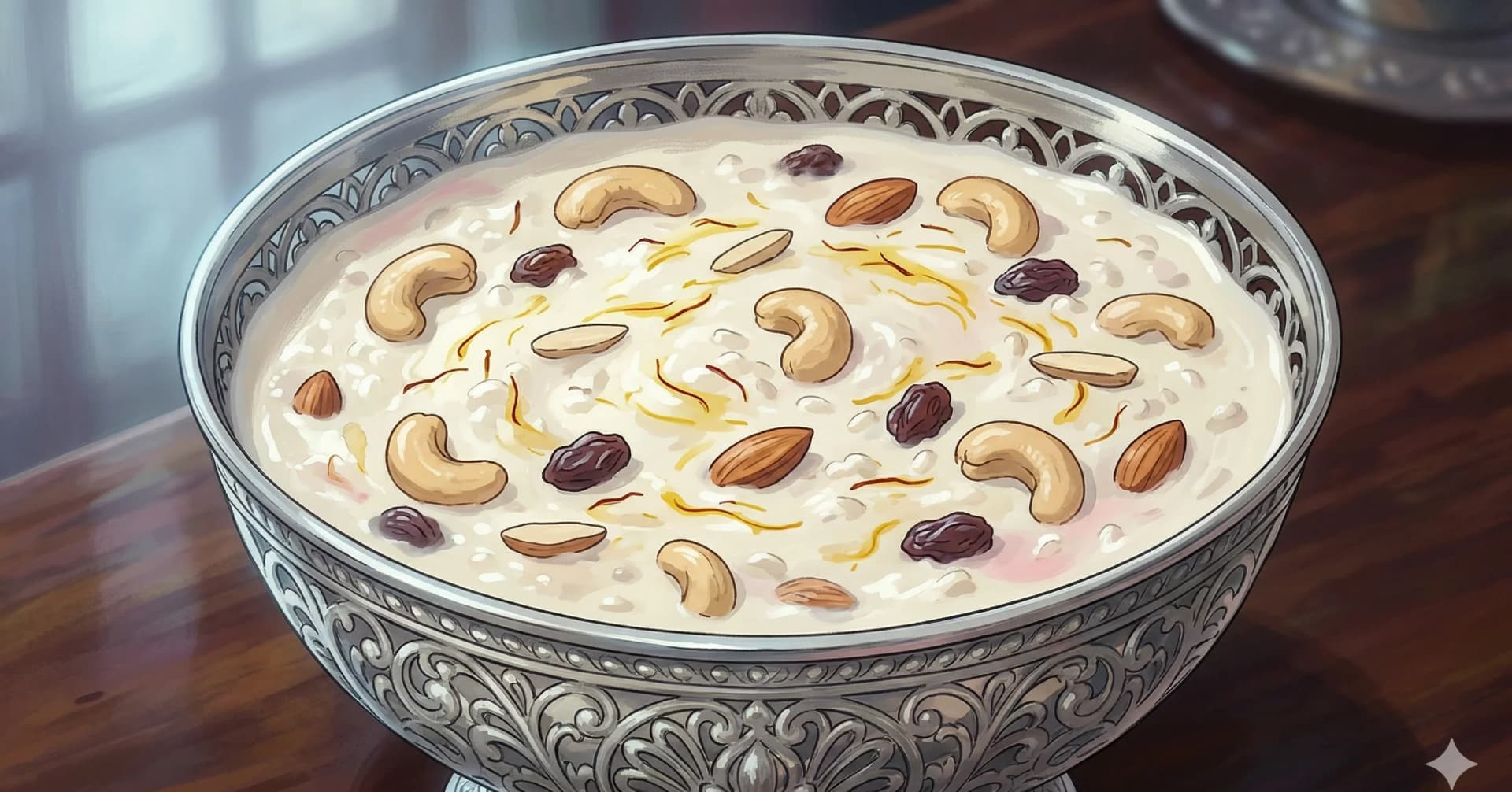
There is a particular stillness that settles over a kitchen when kheer is on the stove. The milk moves slowly in the pan, breathing steam, and you stay close, stirring, watching, the wooden spoon tracing the same slow arc again and again. The smell shifts over the hour: first hot dairy, then something almost caramelised, then the cardamom added near the end, and finally the faint perfume of rose water dropped in at the last moment before the heat goes off.
Kheer is one of India's oldest recorded desserts. The ancient Sanskrit text Charaka Samhita describes a preparation of rice cooked in milk and sweetened with honey. It appears in temple offerings across the subcontinent: prasad at Jagannath Temple in Puri, naivedyam in South Indian rituals, a fixture at every North Indian festival from Diwali to Holi to the birth of a child. It is a dish so embedded in devotional life that eating it carries a quiet weight beyond the bowl itself.
What kheer delivers is comfort at its most refined, the kind of sweetness that doesn't announce itself but settles slowly. The milk reduces to a silky, faintly thick base; the rice softens until the grains are almost dissolved, lending their starch to the whole; saffron turns everything a pale gold and adds a honeyed, slightly mineral depth; rose water lifts it at the finish.
The practical insight: do not rush the milk reduction over high heat. The sugars in milk scorch easily, and any browned layer on the bottom will make the whole pot taste slightly bitter. Keep the flame low, stir often, and scrape the sides of the pan where the milk solids want to cling. The time is the technique.
At a Glance
Yield
4 servings
Prep
25 minutes (includes soaking)
Cook
60 minutes
Total
85 minutes
Difficulty
Easy
Ingredients
- 1½ qtfull-fat whole milk
- 2 ozbasmati rice, rinsed and soaked in cold water for 20 minutes
- ½ cupwhite sugar (adjust to taste)
- 2½ tspgreen cardamom powder
- —A generous pinch of saffron threads (about 20–25 threads), soaked in 2 tbsp warm milk for 15 minutes
- ¼ ozrose water
- ¾ ozraw cashews, halved or roughly chopped
- ¾ ozblanched almonds, slivered
- ¾ ozraisins
Method
- 1
Soak the rice. Rinse the basmati rice under cold water until the water runs clear. Cover with fresh cold water and soak for 20 minutes. Drain and set aside.
- 2
Begin reducing the milk. Pour the milk into a heavy-bottomed pan. Stainless steel or a traditional karahi works well. Bring to a boil over medium heat, stirring occasionally. Once it boils, reduce the heat to low.
- 3
Add the rice and simmer. Drain the soaked rice and add it to the hot milk. Stir well to prevent the rice from settling and sticking to the bottom. Cook on low heat, stirring frequently (every 2 to 3 minutes) for approximately 40 to 45 minutes, until the rice grains are very soft and have begun to break apart slightly, and the milk has reduced by roughly half. Scrape the sides of the pan periodically to incorporate the thickening milk solids back into the mixture.
- 4
Add the sugar. Add the sugar to the reduced milk and rice. Stir well until fully dissolved. The mixture will loosen slightly; this is expected.
- 5
Add saffron, cardamom, nuts, and raisins. Pour in the saffron-infused milk along with all the saffron threads. Add the cardamom powder, cashews, slivered almonds, and raisins. Stir to combine. Continue cooking on low heat for a further 5 minutes, stirring gently.
- 6
Finish with rose water. Turn off the heat. Stir in the rose water. The fragrance will bloom in the residual heat of the pan.
- 7
Serve warm or chilled. Kheer can be ladled into bowls and served immediately while warm, or transferred to a serving dish, cooled to room temperature, then refrigerated for 2 to 3 hours and served cold. It thickens as it cools. This is correct and desirable.
Key Ingredient Benefits
Full-fat milk: The fat content is not optional here. It carries flavour, gives the finished kheer its silky body, and provides the milk solids that caramelise during reduction. Low-fat milk will produce a thin, watery result.
Basmati rice: The long-grain structure and low starch content of basmati means it softens fully without turning the kheer gluey. Short-grain rice would make the pudding overly thick and starchy.
Saffron: Traditionally used in Ayurvedic practice as a warming, nourishing tonic. Research suggests saffron contains compounds such as safranal and crocin that may have antioxidant and mild mood-supporting properties. It also contributes a distinctive honeyed, slightly floral depth that no other ingredient replicates.
Cardamom: Traditionally used in Indian cooking to support digestion and to balance the heaviness of dairy-based sweets. It adds a clean, eucalyptus-bright note that prevents the pudding from feeling cloying.
Rose water: Distilled from Damask rose petals. A few drops add floral lift without sweetness. Use food-grade rose water and add it off the heat to preserve the fragrance.
Sugar: 100g across 4 servings yields a moderately sweet pudding. Reduce to 70–80g if you prefer a more restrained sweetness that lets the saffron and rose come forward.
Why This Works
The long, slow reduction of whole milk concentrates its natural sugars and milk solids, producing a body and sweetness that no amount of added cream or cornflour can replicate. Soaking the rice shortens the in-pot cooking time and allows the grains to absorb the flavoured milk more evenly. Adding sugar only after the rice is soft prevents the sugar from creating a syrupy environment that would slow the rice from fully cooking through. Rose water is added off the heat because its volatile aromatic compounds dissipate rapidly at high temperature. A few seconds too long on the flame and most of the fragrance is lost.
Substitutions & Variations
- Vermicelli kheer (Seviyan): Replace rice with thin vermicelli (seviyan), lightly toasted in a dry pan before adding to the milk. Cook time reduces to 15–20 minutes.
- Jaggery: Substitute white sugar with unrefined jaggery for a deeper, molasses-like sweetness. Add it in small pieces and stir until fully dissolved.
- Condensed milk shortcut: Replace 300ml of the whole milk with one tin of sweetened condensed milk and omit added sugar. This shortens cook time but produces a richer, denser result.
- Vegan version: Substitute full-fat coconut milk (2 x 400ml tins, diluted with water to reach 1.5L) for dairy milk. The flavour profile changes significantly, more tropical, but the method remains the same.
- Nut-free: Omit nuts and raisins. A scattering of dried edible rose petals makes a beautiful garnish.
- Pistachio kheer: Replace cashews and almonds with 40g finely chopped unsalted pistachios for a distinctive green-flecked, slightly savoury finish.
Serving Suggestions
Kheer is best served in small bowls. It is rich, and a modest portion satisfies. Garnish with a few extra saffron threads, a light scatter of crushed pistachios or slivered almonds, and optionally a dried edible rose petal or two.
Serve warm in winter, chilled in summer. In North Indian homes, kheer is typically offered as the dessert following a full meal, or as prasad at a puja. It also works beautifully as a standalone afternoon offering with a cup of masala chai.
For a more formal presentation, serve chilled in small clay matkas (terracotta cups), which add an earthy minerality to the aroma.
Storage & Reheating
Refrigerator: Store in an airtight container for up to 3 days. The kheer will thicken considerably as it chills. This is normal. Stir before serving.
To reheat: Warm gently in a small saucepan over low heat, stirring frequently. Add a splash of warm milk to loosen to your preferred consistency. Do not boil; this can cause the mixture to separate.
Freezing: Not recommended. Dairy-based puddings tend to become grainy and separated upon thawing.
Cultural Notes
Kheer (खीर) is the Indian rice pudding made from rice slowly simmered in milk with sugar, cardamom, and saffron, garnished with chopped pistachios, almonds, and raisins. The dish is the pan-Indian version of the broader rice-and-milk pudding tradition that exists across most of South Asia, with regional variations including Bengali payesh, Tamil payasam, and Marathi khir. The dish has been documented in Indian cooking texts since at least the medieval period, with references in Sanskrit texts and in the Manasollasa (a twelfth-century cookery manuscript from the Western Chalukya court), and may date back much further as the milk-and-grain pudding form has been common across South Asian cooking for much of the documented historical record.
The technique demands patience for the milk reduction. Long-grain rice (typically basmati for kheer in north India; gobindobhog for the Bengali payesh; raw broken rice for the South Indian payasam) is washed thoroughly and added to whole milk at a roughly 1:8 ratio. The mixture is brought to a low simmer and cooked at the lowest possible heat for ninety minutes to two hours, with periodic stirring to prevent sticking and to push the partially-formed milk skin (malai) back into the pot. The milk reduces to roughly half its original volume during cooking, the rice softens completely and begins to break apart, and the mixture takes on a thick creamy consistency.
The flavoring varies but standardly includes green cardamom (pods bruised and added during the simmer, or powder added at the end), a small pinch of saffron, and sugar adjusted to taste. The dish is finished with a scatter of crushed pistachios, slivered almonds, raisins, and sometimes a few cashews. Kheer is served warm in winter and chilled in summer, in small bowls as the sweet course at the end of a meal or as a standalone dish during festivals (Eid, Diwali, Holi, Janmashtami). The dish has religious significance in Hindu temple cooking, where it is prepared as a prasadam (sacred food offering) and distributed to devotees, and in Sufi Muslim cooking, where it appears at the urs (annual death anniversary) celebrations of major Sufi saints across South Asia. The dish has spread globally through the Indian diaspora and is now one of the most familiar Indian desserts at restaurants in North America, the United Kingdom, and the Gulf.
Nutrition Facts
Calories: 450kcal (23%)|Total Carbohydrates: 61.2g (22%)|Protein: 15.2g (30%)|Total Fat: 17.2g (22%)|Saturated Fat: 7.7g (39%)|Cholesterol: 53mg (18%)|Sodium: 163mg (7%)|Dietary Fiber: 1g (4%)|Total Sugars: 47.2g
You Might Also Like

Ratings & Comments
Ratings & Comments
Ratings
Share your thoughts on this recipe.
Sign in to rate and comment