Indian Cuisine
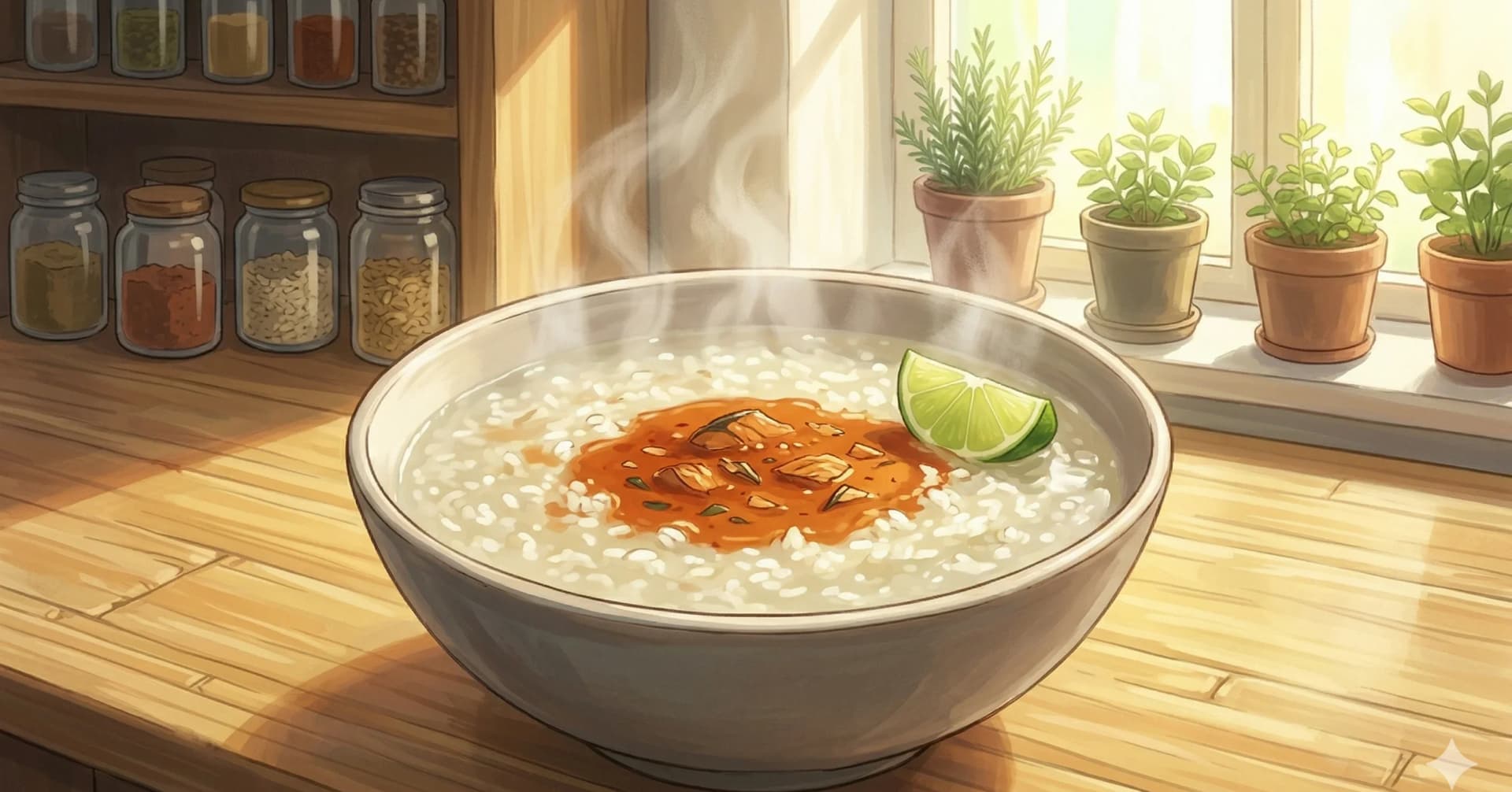
Goan Rice Porridge (Pez-Conji)
Goan rice congee with spiced coconut, cashew, and tamarind
Pez is the Konkani word for rice gruel or porridge: the kind of simple, water-cooked rice that forms the base of restorative cooking across South and Southeast Asian food traditions. This Goan version, however, is not the plain, soothing gruel of illness recovery. It is a substantive, complex preparation. The cooked rice porridge is combined with a roasted spice-coconut paste, enriched with cashews, and finished with a sweet-sour balance of tamarind and jaggery. The result sits somewhere between a congee and a thick dal in character: comforting but with real depth.
The spice paste at the centre of the recipe is made from roasted coriander seeds, methi (fenugreek) seeds, and red chillies ground with fresh grated coconut and marble-sized tamarind. This is a classic Goan technique: dry-roasting whole spices in a small amount of oil until fragrant, then grinding them with coconut into a wet paste that forms the flavour foundation. The methi seeds (used in small quantity) contribute a bitter, slightly sweet note that is distinctive to Goan and South Indian cooking and gives the finished pez-conji its characteristic complex depth.
The final tempering (mustard seeds and asafoetida bloomed in oil and poured crackling over the finished dish) is the South Indian pantry's signature finish: a sharp, pungent punctuation against what is otherwise a deep, rounded preparation.
Pez-conji is comfort food of a specifically Goan character: humble in its base ingredient, sophisticated in its layering.
At a Glance
Yield
Serves 4–6
Prep
20 minutes
Cook
40 minutes
Total
1 hour
Difficulty
Easy
Ingredients
Spice Paste Ingredients
Porridge Ingredients
Tempering Ingredients
- ½ tbspneutral oil
- ⅓ tspmustard seeds
- —A pinch of asafoetida / hing
Method
- 1
Cook the cashews. Place the chopped cashews in a small pot with enough cold water (700 ml) to cover and a small pinch of salt (¾ teaspoon). Bring to a boil and simmer for 10 minutes until softened. Drain and set aside.
- 2
Make the spice paste. Heat 1 teaspoon of oil in a small pan over medium heat. Add the coriander seeds (¼ teaspoon) and fenugreek (¼ teaspoon) seeds. Stir for 1–2 minutes until fragrant and slightly darkened. Add the dried red chillies (2 small) and stir for 30 seconds. Tip onto a plate to cool. Once cool, transfer to a blender with the grated coconut and the soaked tamarind (including the soaking water). Blend to a smooth, thick paste, adding a tablespoon of water if needed to get the blender moving.
- 3
Cook the rice (175 g). Place the rice in a medium pot with 700 ml of water and the salt. Bring to a boil, then reduce to a steady simmer. Cook uncovered, stirring occasionally, for 20–25 minutes until the rice is completely soft and breaking apart. This is rice cooked well beyond the al dente stage, into a porridge consistency. The mixture should be thick and almost spoonable rather than pourable.
- 4
Combine. Add the coconut-spice paste to the cooked rice porridge. Stir well to combine. Add the cooked cashews. Stir through. Add the jaggery (7 g) and mix. Taste: the flavour should be complex, slightly sweet from the coconut and jaggery, slightly sour from the tamarind (3 g), warm from the spices. Adjust jaggery or tamarind to balance to your taste.
- 5
Temper. Heat the oil in a very small pan over high heat. When very hot, add the mustard seeds (¼ teaspoon) — they should pop within seconds. Add the asafoetida immediately and pour the whole temper, still sizzling, over the pez-conji. Stir through and serve immediately.
Key Ingredient Benefits
Fenugreek seeds (Trigonella foenum-graecum) are one of the most researched ingredients in traditional Indian medicine. They contain a soluble fibre (galactomannan) that research suggests may help moderate blood glucose levels by slowing sugar absorption. In Ayurvedic and Unani traditions, fenugreek is used for digestive support and is considered a warming, slightly strengthening spice. Their bitterness, which diminishes with roasting, is primarily due to saponins — compounds that also contribute to their medicinal properties.
Tamarind (Tamarindus indica) is one of the primary souring agents in South Indian and Goan cooking, providing tartaric acid (distinct from the citric acid of lemon or the acetic acid of vinegar). It is a source of B vitamins and minerals, particularly iron and magnesium, and in traditional medicine is considered cooling, used in hot climates to refresh and restore. The sweet-sour balance it creates with jaggery in this recipe is a classic Goan flavour pairing.
Asafoetida / hing (Ferula assa-foetida) resin is one of the most pungent spices in the pantry: an intensely sulphurous, onion-garlic-like flavour that, paradoxically, rounds and harmonises dishes it is added to rather than dominating them when used in traditional quantities (a pinch, not a teaspoon). In Ayurvedic tradition it is strongly carminative, one of the primary spices used to ease flatulence and digestive discomfort, particularly from legume or grain preparations.
Why This Works
Cooking rice well beyond doneness (into a porridge state where the grains have broken down and the starch has gelled with the cooking water) is the defining technique of congee and pez. The broken-down starch creates a thick, self-gelling consistency that no amount of cooked whole-grain rice can achieve. This porridge base absorbs and holds the coconut-spice paste differently from cooked rice: the paste distributes throughout the gel rather than sitting between grains, creating a unified flavour in every spoonful.
The methi (fenugreek) seeds are used in tiny quantity but provide a disproportionate flavour contribution. Fenugreek has a bitter, slightly maple-adjacent flavour that in large amounts is overpowering but in small amounts adds exactly the kind of complexity that prevents the sweetness of coconut and jaggery from becoming cloying. It is the balancing element in the flavour architecture.
Asafoetida in the final temper is another balancing element: its sharp, pungent (almost sulphurous) character creates contrast against the sweet-sour base of the pez-conji. It is one of the most immediately identifiable flavours in South Indian and Goan cooking. A small amount has a large flavour presence that wakes up the whole preparation.
Substitutions & Variations
Desiccated coconut: Soak in warm water for 10 minutes, drain partially, and use. The flavour will be slightly less fresh but the paste will be good.
More or less tamarind: Adjust based on your sourness preference. Some versions of pez-conji are quite sour, others barely so.
Add cooked chickpeas: 50 g of cooked chickpeas or black-eyed peas stirred in with the cashews makes this more substantial and adds textural interest.
Type of rice: Short-grain rice or regular long-grain (not basmati) works best here. The higher starch content produces a better porridge consistency than aged basmati, which tends to stay more separate.
Serving Suggestions
Pez-conji is Goan comfort food: served in bowls, eaten with a spoon, requiring nothing alongside. It is a meal in itself. The rice provides carbohydrate, the cashews and coconut provide fat and some protein, the spices and tamarind provide the depth. At a Goan meal it might appear as a first course before more elaborate preparations. It is also traditionally eaten as a light evening meal, particularly in summer when something cooling is wanted. The sweet-sour-spiced combination works at any temperature, warm or at room temperature.
Storage & Reheating
Pez-conji thickens considerably as it cools. Refrigerate for up to 2 days. Add water when reheating — the ratio will need adjustment as the starch continues to absorb liquid overnight. Reheat over low heat, stirring frequently. The temper (mustard-asafoetida) fades; a fresh small tempering poured over when serving on subsequent days restores the character of the dish.
Cultural Notes
Pez (पेज, also called peja or conji in Goan Catholic Konkani) is the Goan rice porridge that sits at the simplest end of the Goan rice tradition, made from rice cooked with much more water than usual until the grains soften and break apart into a thick gruel. The dish is the Goan version of the broader pan-Asian rice porridge tradition that includes Chinese congee, Filipino arroz caldo, and South Indian kanji, and it occupies similar cultural niches: gentle food for the sick, the elderly, the very young, and convalescents recovering from illness.
The dish reflects both indigenous Konkani rice cooking and the Portuguese-colonial influence on Goan food language. The basic technique (slowly cooking rice in excess water until it breaks apart) is universal across rice-growing Asia and predates the Portuguese arrival in Goa by centuries. The Portuguese contribution is partly the name (conji derives from Portuguese-Anglo-Indian usage of the Indian word kanji, ultimately Tamil) and partly the cultural framing of the dish as a sick-room food rather than as a daily staple, reflecting the Portuguese convalescent food traditions that the colonial-era hospitals and household kitchens transmitted to Goan Catholic households.
The technique is forgiving and uses minimal ingredients. The Goan rice (typically the red parboiled ukda tandool rice that is the traditional Goan staple, or plain white rice in modern home cooking) is washed and added to a heavy pot with eight to ten times its volume in water. The pot is brought to a boil, then reduced to a low simmer and cooked uncovered for thirty to forty-five minutes with periodic stirring, during which the rice grains soften, swell, and partially break apart into the surrounding water to form a thick gruel-like consistency. Salt is added near the end. The plain version is served with a small bowl of pickled mango or lime, a few salt fish slices, or just a sprinkle of sugar for breakfast. The medicinal version (called pez specifically in convalescent contexts) is served plain with a small drizzle of ghee and is meant to be eaten slowly while still warm. The dish appears at Goan Catholic family kitchens during illness and as everyday breakfast for the elderly, and the related Goan Hindu version (pej) appears in similar contexts across the Konkani-speaking community.
Nutrition Facts
Calories: 154kcal (8%)|Total Carbohydrates: 25.5g (9%)|Protein: 2.5g (5%)|Total Fat: 4.6g (6%)|Saturated Fat: 2.1g (11%)|Cholesterol: 0mg (0%)|Sodium: 669mg (29%)|Dietary Fiber: 0.9g (3%)|Total Sugars: 1.4g
You Might Also Like

Ratings & Comments
Ratings & Comments
Ratings
Share your thoughts on this recipe.
Sign in to rate and comment