Punjabi · Indian Cuisine
Rajma
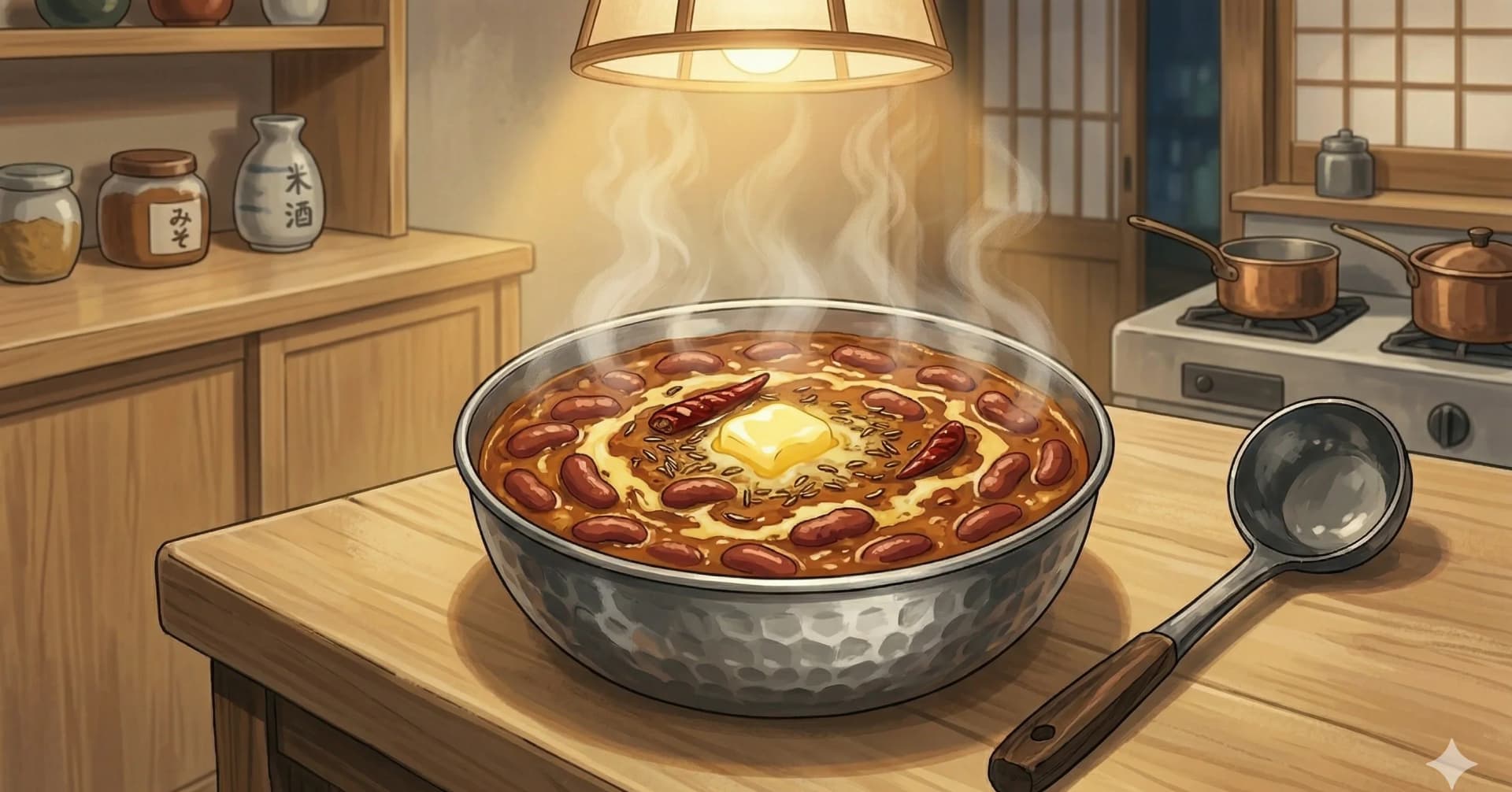
Red kidney beans braised in a spiced onion-tomato masala
Rajma is one of those dishes that defines a region's home cooking more than its restaurant output. In Punjab, and across the North Indian plains where kidney beans thrive, rajma chawal is Sunday lunch. Kidney beans with plain rice. It is not elaborate. It is reliable, filling, and deeply satisfying in the way that only a long-simmered bean dish can be.
The technique here is classical: the kidney beans are soaked overnight, boiled until genuinely tender (not merely cooked but beginning to soften into their gravy), then folded into a masala where red chilli paste and tomato have reduced into something deeply savoury. The masala cooks until cheenk (the moment when the oil separates and begins to pool on the surface of the paste), which signals that the water from the onion and tomato has fully cooked off and the spices have fried rather than merely simmered in moisture.
The finishing details matter: fresh coriander and fresh ginger stirred in just before serving, a squeeze of lemon juice to brighten the whole bowl, and the tadka (a final tempering of oil) poured crackling over the top. These are small things that pull a slow-cooked bean dish forward into the present tense, cutting through the richness with freshness.
Rajma is one of the most forgiving dishes in the repertoire. It holds well on the stove for hours, improves the next day, and is one of the most reliable freezer meals in North Indian cooking.
At a Glance
Yield
Serves 4–6
Prep
10 minutes (plus overnight soaking)
Cook
1 hour 30 minutes
Total
1 hour 40 minutes (plus soaking)
Difficulty
Easy
Ingredients
- ½ lbdried red kidney beans (soaked overnight in cold water)
- ¼ cupred chilli paste (or 1 tablespoon red chilli powder mixed with 2 tablespoons water)
- 1¼ tbspginger and garlic paste (combined)
- 1⅓ tspcumin powder
- 1⅔ tspcoriander powder
- ¾ cupfresh coriander, roughly chopped
- 1½ tspfresh ginger, finely chopped
- 2⅓ tbspneutral oil
- 1¾ ozonion, finely chopped
- 3½ oztomatoes (about ½–1 tomato), finely chopped
- ⅔ tspsalt
- —Lemon juice, to finish (about 1 tablespoon)
Method
- 1
Soak and boil the kidney beans. Drain the soaked kidney beans and rinse under cold water. Place in a large pot and cover with fresh cold water by at least 5 cm, as kidney beans expand significantly during cooking. Bring to a vigorous boil and boil hard for at least 10 minutes (this is important for kidney beans; see notes below). Then reduce to a strong simmer, partially covered, and cook for 50–70 minutes until the beans are completely tender throughout. They should crush easily between two fingers with no resistance at the centre. Drain, reserving the cooking liquid.
- 2
Build the masala. Heat the oil in a wide, heavy-based pan over medium-high heat. Add the chopped onions and fry, stirring regularly, for 10–12 minutes until deep golden brown. The onions should be genuinely dark and sweet-smelling. This is a richer masala base than a lighter dal. Add the ginger-garlic paste and stir for 2 minutes.
- 3
Add chilli, spices, tomatoes (100 g). Add the red chilli paste (25 g) and stir well for 1 minute. Add the cumin powder (¾ teaspoon) and coriander (14 g) powder (1 teaspoon). Stir for 30 seconds. Add the chopped tomatoes and stir to combine. Cook over medium heat for 8–10 minutes, mashing the tomatoes down and stirring frequently, until the oil begins to separate from the masala. The mixture will look slightly glossy and the oil will pool at the edges. This is the *cheenk* moment, and it means the masala is properly cooked.
- 4
Add the beans. Add the cooked kidney beans to the masala. Stir to coat. Add the salt (¾ teaspoon) and 200–250 ml of the reserved bean cooking liquid (or water if you prefer a lighter gravy). Bring to a boil, then simmer uncovered for 15–20 minutes, pressing a few beans against the side of the pan with the back of a spoon as you stir. This partial mashing thickens the gravy naturally. Taste and adjust salt and chilli.
- 5
Finish. Turn the heat off. Stir through the fresh coriander, fresh ginger (3 g), and lemon juice. Serve immediately, with plain rice.
Key Ingredient Benefits
Red kidney beans (Phaseolus vulgaris) are among the most nutritionally dense legumes available: high in protein, very high in dietary fibre, a significant source of folate, iron, potassium, and several B vitamins. They have a relatively low glycaemic index; their high fibre and resistant starch content slows the absorption of carbohydrates significantly, which research associates with more stable blood glucose response compared to many other carbohydrate sources. In Punjabi cooking, rajma is considered substantial and sustaining. A meal that carries you through the day.
Coriander powder (Coriandrum sativum) contributes a warm, slightly citrusy, slightly earthy note that rounds the chilli heat in this masala. In Ayurvedic tradition, coriander is considered cooling despite being a spice, used in preparations where warming chilli is present to create balance. Both fresh leaves and ground seed are used in this recipe, providing both the cooked-in warmth of the ground spice and the fresh, bright flavour of the herb.
Lemon juice added at the end is an acid brightener. It lifts the finished dish out of heaviness and creates the contrast between the rich, cooked masala and a clean, fresh top note. Fat-soluble spice compounds in the masala are balanced by the water-soluble acid of the lemon, creating a more complete flavour experience than either would alone.
Why This Works
The vigorous 10-minute boil at the start of kidney bean cooking is not optional. It is a food safety requirement. Kidney beans contain phytohaemagglutinin (PHA), a lectin that causes significant gastrointestinal illness if not denatured. Boiling vigorously for at least 10 minutes destroys PHA completely. Slow-cooking from cold (as in a slow cooker set to low) without a prior rapid boil may not reach temperatures high enough to fully denature the toxin. Always boil hard before reducing to a simmer.
The mashing of some beans while the gravy cooks is the technique that gives rajma its characteristic thick, clinging sauce. The starch released from the partially mashed beans acts as a natural thickener, creating a gravy that coats the beans rather than pooling beneath them. The goal is texture variety: some beans fully intact, the sauce thickened by the few that have been pressed.
Deep-frying the onions to genuine dark golden is what separates restaurant-quality rajma from a quickly assembled version. The Maillard reactions occurring during this extended frying create complex flavour compounds that give the masala its savoury depth. An onion fried for 4 minutes and one fried for 12 are performing entirely different roles in the finished dish.
Substitutions & Variations
Pressure cooker: Soak the beans, then cook in a pressure cooker with plenty of water for 15–20 minutes on medium pressure (skip the pre-boil as pressure cooking reaches sufficient temperature to denature PHA). Proceed with the masala.
Canned kidney beans: Drain and rinse two 400 g cans of kidney beans. Skip the soaking and boiling. Begin from step 2 and add the beans at step 4 with 100 ml of water. Total cook time reduces dramatically.
Kashmiri chilli for colour: Replace the red chilli paste with Kashmiri chilli powder for a darker, more vivid red colour with moderate heat.
Black kidney beans: Small black kidney beans (kali rajma from Jammu) have a distinctly earthier, more complex flavour than the standard large kidney bean and are considered the superior variety for this dish by many Punjabi cooks. Use in the same quantities.
Serving Suggestions
Rajma chawal (rajma with plain boiled rice) is the canonical pairing, and one of the great simple combinations of Indian food. The thick, spiced gravy coats the rice; the beans provide substance. A spoonful of plain yoghurt on the side and thinly sliced raw onion with a squeeze of lemon complete the traditional accompaniment. At a larger table, rajma works alongside jeera pulao and a dry vegetable dish like aloo gobhi. It is the kind of food that is deeply satisfying without being showy.
Storage & Reheating
Rajma keeps exceptionally well: 4 days in the refrigerator, and up to 2 months in the freezer. It thickens overnight as the beans continue to absorb liquid; loosen with a splash of water and reheat over medium heat, stirring. Many cooks argue it tastes better on day two than day one. Freeze in single or family portions; reheat from frozen over low heat with added water.
Cultural Notes
Rajma (राजमा, "kidney beans") is the Punjabi curry of red kidney beans slow-simmered in an onion-tomato gravy spiced with cumin, coriander, garam masala, and the dish's defining kashmiri red chili powder. The dish is one of the foundational Punjabi vegetarian preparations and among the most strongly Punjabi of all north Indian dishes: the combination called rajma chawal (rajma over plain steamed rice) is the comfort food that Punjabi children grow up on, that Punjabi families serve for Sunday lunch, and that Punjabi diaspora communities prepare to maintain a connection to home. The dish carries cultural weight as the iconic everyday Punjabi meal, treated with the same affection that other regional cuisines reserve for their own signature comfort foods.
The kidney bean variety matters. The traditional choice is the Jammu rajma, a small dark red bean from the Bhaderwah region of Jammu and Kashmir that is prized for its thin skin, creamy interior, and ability to hold its shape during long cooking. The larger, paler kidney beans common in Western markets work too, but Punjabi cooks consider them inferior. The beans are soaked overnight, then pressure-cooked or simmered for an hour to soften them, then transferred to the prepared gravy and simmered for another forty-five minutes to an hour so the beans absorb the gravy and the gravy thickens into a rich coating consistency. Some traditional preparations cook the soaked beans directly in the gravy from the start, which extends the total cooking time to two to three hours but produces an especially deep, melded flavor.
The cultural pairing with rice is the dish's defining ritual. Plain long-grain basmati rice is the standard accompaniment, with the rajma ladled generously over the rice and the diner mixing the two together at the plate. Some families serve a small dollop of plain yogurt or a side of pickled onions to cut the richness. The dish has a particular emotional weight in Punjabi families: it appears at Sunday lunch as the comfort meal that gathers extended family, at homecoming meals for travelers, and as the dish that Punjabi cooks living abroad teach their children first as part of culinary heritage. Madhur Jaffrey's Indian Cooking documents the home Punjabi version, and the dish has become a fixture of Indian restaurant menus internationally as one of the most accessible vegetarian options.
Nutrition Facts
Calories: 185kcal (9%)|Total Carbohydrates: 28g (10%)|Protein: 10.4g (21%)|Total Fat: 4.1g (5%)|Saturated Fat: 0.6g (3%)|Cholesterol: 0mg (0%)|Sodium: 670mg (29%)|Dietary Fiber: 7.8g (28%)|Total Sugars: 3.1g
You Might Also Like
Ratings & Comments
Ratings & Comments
Ratings
Share your thoughts on this recipe.
Sign in to rate and comment