Indian Cuisine
Roshogolla
Soft, spongy chhena balls simmered in fragrant rose syrup
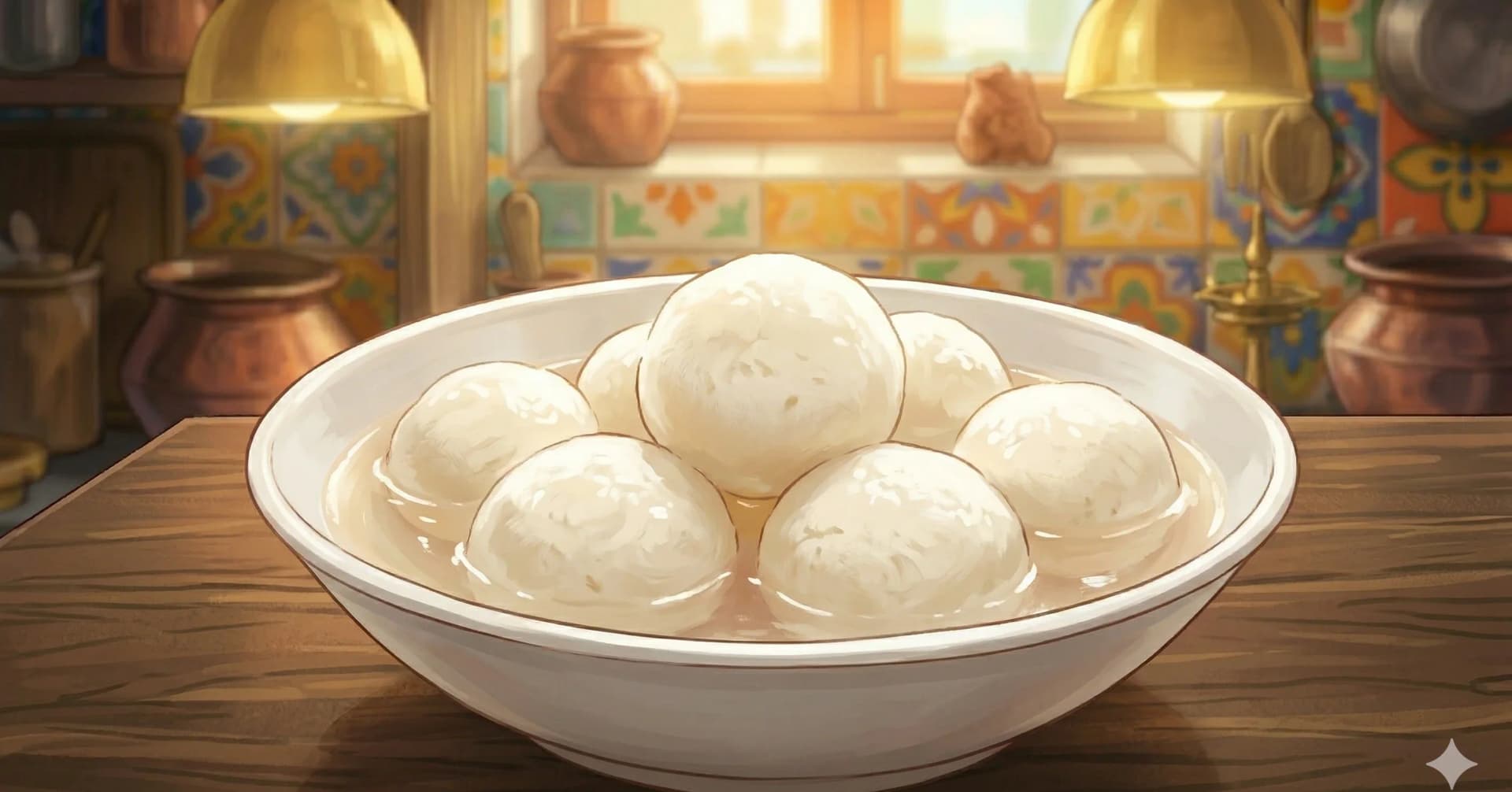
There is a moment when a perfect roshogolla yields to a spoon (a gentle resistance, then a soft, pillowy give) that is unlike any other sweet in the Indian canon. The ball is bone-white, almost luminous, floating in a clear syrup barely touched with the perfume of roses. It tastes clean: milky, delicately sweet, faintly floral. Nothing is hidden. Nothing competes. That simplicity is the achievement.
Roshogolla is Bengal's most iconic sweet, and Bengalis are fiercely, lovingly protective of it. The sweet is believed to have been created in the nineteenth century in Kolkata, where it became the defining product of the city's famed sweet shops, the mishti dokan. A state of West Bengal versus Odisha geographical indication dispute over the sweet's origin was finally settled in 2017, with West Bengal receiving the GI tag for "Banglar Rosogolla." It remains a point of cultural pride eaten at festivals, weddings, and as an everyday comfort.
The base is chhena: fresh milk solids made by curdling hot full-fat milk with lemon juice or vinegar, then draining and kneading. The kneading is everything. Underkneaded chhena will produce hard, grainy balls; overkneaded chhena will make them rubbery. You are looking for the moment the mass becomes smooth, slightly greasy to the touch, and holds together without cracking. About ten minutes of steady palm-heel pressure.
The practical insight that changes results: the syrup must be vigorously boiling when the balls go in, and the pan must be covered immediately. Steam pressure is what causes the roshogolla to puff and double in size. Keep the heat steady at medium. Too high and the balls crack; too low and they stay dense. When they are done, they will bob to the surface and feel spongy when pressed lightly with the back of a spoon.
At a Glance
Yield
16–18 pieces
Prep
30 minutes
Cook
30 minutes
Total
1 hour + chilling
Difficulty
Medium
Ingredients
Method
- 1
Curdle the milk. Bring the milk to a full boil in a heavy pan, then take it off the heat and wait a minute so it settles just below boiling. Dilute the lemon juice with an equal amount of water and add it a spoonful at a time, stirring gently. The milk will break into soft curds and thin greenish whey. Stop as soon as the whey runs clear; excess acid gives tough, sour chhena.
- 2
Rinse and drain. Pour the curds into a muslin-lined sieve and hold the bundle under cold running water for 30 seconds. This washes out the acidity and firms the protein slightly. Twist the cloth to squeeze out as much water as you can, then hang it for 30 minutes. The chhena should be moist but not wet: a squeezed handful should hold together without weeping.
- 3
Knead until smooth. Turn the chhena onto a clean surface and knead with the heel of your hand for a full 10 minutes, pushing away and gathering back. It will go from crumbly to smooth, then to soft and slightly tacky with a faint sheen of fat on the surface. That sheen is the sign it is done. Uneven kneading leaves uneven protein bonding, which shows up later as hard or grainy centres.
- 4
Roll the balls. Divide into 16 to 18 portions and roll each between your palms into a completely smooth ball with no cracks or seams. Work with light pressure and a circular motion. A crack now becomes a split ball in the syrup, so smooth any that appear with a damp fingertip before moving on.
- 5
Make the syrup. Combine the sugar and water in a wide, deep pan and bring to a rolling boil, stirring until the sugar has dissolved. The syrup should stay thin. This is not a thick sugar syrup; the balls need room to move and space to swell.
- 6
Boil covered. Lower the balls into the boiling syrup, cover the pan, and boil hard for 15 minutes. Do not lift the lid to check and do not lower the heat. The trapped steam is what pushes into the protein matrix and inflates the centres, the same way a covered steamed bun rises. The balls will roughly double and start to bob at the surface.
- 7
Cool in the syrup. Take the pan off the heat and stir in the rose water and cardamom powder. Leave the roshogolla to cool completely in the syrup, at least 2 hours. They shrink slightly as they cool, which is normal, and go on drinking syrup the whole time.
- 8
Chill and serve. Refrigerate for at least 2 hours. Serve cold, two or three to a bowl with a generous spoonful of the syrup. A properly made roshogolla springs back when pressed and releases syrup when you bite it.
Key Ingredient Benefits
Full-fat milk is non-negotiable here. The fat content in whole milk is what allows the chhena to become supple and smooth when kneaded. Low-fat milk produces a dry, crumbly chhena that will not hold together through cooking.
Lemon juice vs. vinegar: Lemon juice produces a slightly softer chhena with a cleaner flavour. White vinegar produces firmer curds that are easier to work with for beginners. Both produce excellent roshogolla. The choice is practical.
Rose water is made by distilling rose petals in steam. In Bengali and broader South Asian sweets-making, it has been used for centuries as a finishing perfume. A little goes a long way; the floral note should be a whisper, not a shout.
Sugar and carbohydrates: Roshogolla is a traditional festive sweet with a significant sugar content from both the chhena and the syrup. It is intended to be enjoyed as an occasional treat, not an everyday food.
Why This Works
The acid and heat reaction causes the milk proteins (casein) to coagulate into a soft, workable fresh cheese. The amount of acid determines the texture. Too little and the curds are loose; too much and the chhena becomes tough and sour.
Kneading develops a smooth protein matrix that gives the balls their characteristic elasticity. Under-kneaded chhena has uneven protein bonding, resulting in hard or grainy centres after cooking.
Covered boiling with steam pressure allows the chhena balls to puff and achieve their signature spongy interior. The expansion is caused by steam penetrating and inflating the matrix, the same principle at work in a covered steamed bun.
Rinsing the chhena with cold water serves two purposes: it removes the acidity from the lemon juice or vinegar, and the cold shock firms the protein structure slightly, making kneading easier and the final texture cleaner.
Substitutions & Variations
Vinegar instead of lemon juice: Produces slightly firmer chhena, good for beginners who want more structural confidence.
Kesar Roshogolla: Add a small pinch of saffron strands to the warm syrup for a golden tint and additional perfume.
Smaller balls: Roll the chhena into smaller, cherry-sized balls for bite-sized sweets. Reduce cooking time to 10–12 minutes.
No rose water: The sweet is perfectly complete without it if you prefer a purer milk flavour. Some traditional recipes omit it entirely.
Serving Suggestions
Serve roshogolla well chilled, in small individual bowls with a spoonful of the rose syrup. In Bengal, they are often served as a standalone sweet after a full meal, or as the centrepiece of a mishti (sweets) platter at festivals and ceremonies. A few crushed pistachios scattered on top add colour and a subtle contrast.
Roshogolla pairs well with a cup of strong, milky chai. The astringency of the tea balances the sweetness of the syrup.
Storage & Reheating
Store roshogolla submerged in their syrup in an airtight container in the refrigerator. They keep well for up to 5 days. The texture improves after the first 24 hours as the balls absorb more syrup and become softer throughout.
Do not freeze. Freezing damages the delicate protein structure and produces a grainy, crumbly texture on thawing.
Roshogolla is a cold sweet and does not require reheating. Serve directly from the refrigerator.
Cultural Notes
Rosogolla (রসগোল্লা, also spelled roshogolla in Bengali transliteration; rasgulla in Hindi) is the Bengali fresh-cheese sweet of small white spongy balls made from chhena (fresh paneer-style curd cheese) cooked in a thin sugar syrup. The dish is one of the most internationally famous Bengali sweets and one of the founding preparations of the broader Indian chhena-based sweet tradition that includes rasmalai, sandesh, and dozens of related preparations. The modern form of rosogolla is credited to the Kolkata confectioner Nobin Chandra Das, who is documented as having developed the recipe in 1868 at his shop in Bagbazar, Kolkata.
The dish was the subject of a long-running and high-profile geographical-indication dispute between the Indian states of West Bengal and Odisha, both claiming the dish as their originating regional sweet. Odisha argued that a similar chhena-based sweet called Pahala rasgulla had been offered at the Jagannath Temple in Puri for centuries before the documented Bengal recipe. The dispute was formally resolved in 2017 when the Indian government's geographical indication office granted GI tags to both regions for their distinct versions: "Banglar Rosogolla" (the Bengal version) in November 2017 and "Odisha Rasagola" in July 2019, recognizing the two as distinct regional sweets with shared ancestry.
The technique is precise about the chhena handling. Whole milk is brought to a boil and curdled with lemon juice or vinegar, the curds are drained in muslin, and the chhena is kneaded for ten to fifteen minutes until completely smooth and slightly sticky (the kneading develops the texture and is the single most important variable in whether the finished rosogolla turns out spongy and light or dense and rubbery). Small balls of chhena are rolled smooth and dropped into a thin sugar syrup at a vigorous boil, where they swell to twice their original size as the spongy interior absorbs the syrup. The balls cook for ten to fifteen minutes, then rest in the syrup for several hours to absorb sweetness throughout. The dish is served chilled in small bowls, typically two or three rosogollas per serving with a small ladle of the cooled syrup. KC Das (a descendant company of Nobin Chandra Das, founded by his grandson) remains the canonical reference for the Bengal version and continues to operate shops across Kolkata and beyond.
Nutrition Facts
Calories: 72kcal (4%)|Total Carbohydrates: 13g (5%)|Protein: 2g (4%)|Total Fat: 1.5g (2%)|Saturated Fat: 1g (5%)|Cholesterol: 5mg (2%)|Sodium: 20mg (1%)|Dietary Fiber: 0g (0%)|Total Sugars: 12g
You Might Also Like
Ratings & Comments
Ratings & Comments
Ratings
Share your thoughts on this recipe.
Sign in to rate and comment