Punjabi · Indian Cuisine
Whole Garam Masala
The foundational Punjabi spice blend — slow-dried and ground to order
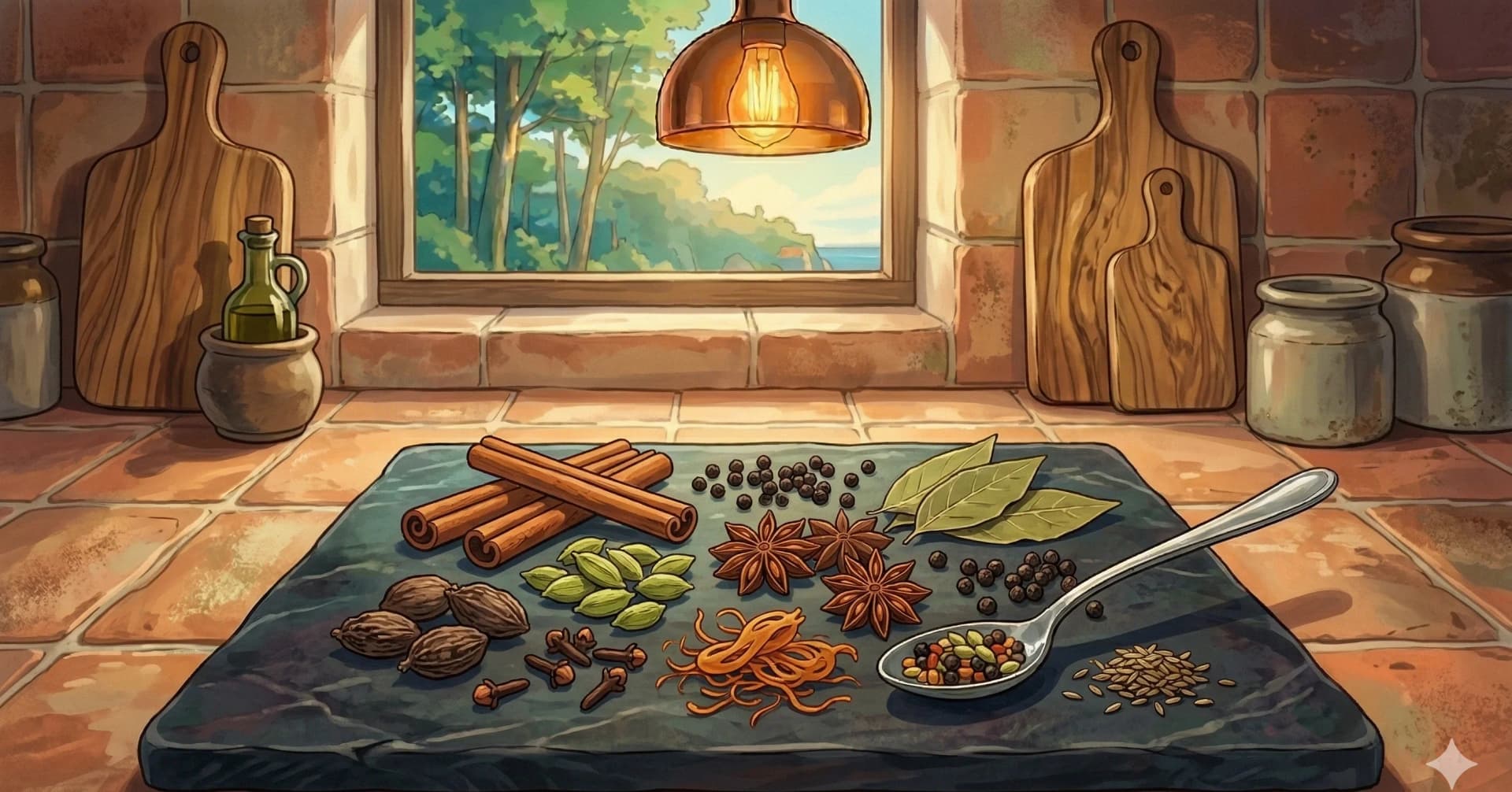
Garam masala is not a fixed recipe. There are as many versions as there are households and regional traditions. The ratios shift between North and South, between Punjabi and Bengali, between one family's kitchen and the next. What they share is the principle: garam means warm, and the blend is composed of spices considered warming in the Ayurvedic sense (black pepper, cloves, cardamom, cinnamon) rather than hot in the capsaicin sense. This is a spice blend that warms the body from the inside rather than setting the mouth on fire.
This Punjabi recipe is professional-kitchen calibration. The proportions reflect the balance used in North Indian restaurant cooking where the blend must be versatile enough to finish curries, enrich biryanis, and season kebab preparations without dominating any single dish. Cumin anchors the base, providing earthy warmth. Coriander adds a citrusy, slightly floral note. The cardamom (both green and black) provides the perfume: green cardamom with its bright, eucalyptus-like fragrance; black cardamom with its smoky, camphor depth. Cloves and cinnamon contribute sweetness and warmth; mace and nutmeg add a slightly sweet, almost tropical complexity.
The slow-drying process (four days over a low tandoor in the original professional method) removes residual moisture from the whole spices before grinding. This is worth approximating at home: damp spices grind unevenly and produce a less fragrant powder that goes stale faster. Even a brief low-oven drying achieves a meaningfully better result than grinding straight from the jar.
At a Glance
Yield
Makes approximately 1 kg (professional batch; scale down as needed)
Prep
5 minutes
Total
50 minutes
Difficulty
Easy
Ingredients
- 4 cupwhole cumin seeds
- 2 cupwhole coriander seeds
- 3½ ozgreen cardamom pods
- 3¼ ozblack cardamom pods
- ⅓ cupcinnamon sticks
- ½ cupwhole cloves
- 1 ozbay leaves
- ½ cupmace blades
- ½ cupdried ginger / soonth powder (or use dried ginger slices)
- 1½ tbspwhole nutmeg (about 2–3 nutmegs)
- ½ cupblack peppercorns
- ¼ cupwhole cumin seeds
- 2½ tbspwhole coriander seeds
- ¼ ozgreen cardamom pods
- ¼ ozblack cardamom pods (about 3–4 pods)
- 1¼ tspcinnamon sticks
- 1⅓ tspwhole cloves
- ¼ ozbay leaves
- 1⅔ tspmace blades
- 1¾ tspdried ginger powder or 2–3 dried ginger slices
- ½ tspwhole nutmeg (about ¼ nutmeg)
- 2 tspblack peppercorns
Method
- 1
Dry the spices. Preheat the oven to its lowest setting, ideally 50–60°C (120–140°F), which is a "dehydrate" or "warm" setting if your oven has one. Spread all the whole spices in a single layer on a baking sheet lined with parchment. Place in the oven and dry for 30–45 minutes until all the spices feel completely dry to the touch and crackle when broken. Stir or turn them once halfway through. The bay (2 g) leaves (30 g) should be fully crisp; the cardamom pods (100 g) should feel dry and light. Allow to cool completely. *Alternatively (stovetop):* Dry-roast the spices in a wide, heavy-based pan over the lowest heat, stirring gently and constantly, for 8–10 minutes until they are fragrant and feel completely dry. Do not let them colour significantly. You are drying, not toasting. Cool completely before grinding.
- 2
Grind. Working in batches if necessary, grind the dried spices in a spice grinder or high-powered blender to a fine, even powder. The cardamom pods (90 g) can be ground with the husks. The fibrous husk adds little flavour but grinding smoothly takes patience; alternatively, split the pods and use seeds only for a finer result. Pass the ground masala through a fine sieve to remove any fibrous cardamom husk pieces that haven't ground completely.
- 3
Store. Transfer to a clean, dry, airtight jar. Label with the date. Store away from direct light and heat.
Key Ingredient Benefits
Green cardamom (Elettaria cardamomum) is sometimes called the queen of spices and is one of the most highly valued aromatics in both cooking and traditional medicine. Its warm, eucalyptus-like fragrance comes from cineole and other volatile terpenes in the seed oils. In Ayurvedic tradition, green cardamom is considered tridoshic, meaning balancing for all three doshas, and is used in preparations to support digestion and freshen breath. Research has begun to explore its relationship with digestive enzyme activity and antioxidant properties.
Black cardamom (Amomum subulatum) is a different species from green cardamom, with a distinctly smokier, camphor-like character from its fire-dried seed pods. In Unani medicine it is used as a warming spice to support respiratory function and as a digestive aid. Its role in this blend is to add depth and a faint smokiness that anchors the brighter, sweeter top notes of the other spices.
Cloves (Syzygium aromaticum) are among the most antimicrobial spices in the pantry, a property that historically made them valuable in food preservation as well as flavour. Their primary aromatic compound is eugenol, also used in dentistry for its antiseptic and anaesthetic properties. In Ayurvedic tradition, cloves are strongly warming and are used sparingly in blends because of their intensity.
Mace is the dried aril surrounding the nutmeg seed. They share a family of aromatic compounds (primarily myristicin and elemicin) but mace has a warmer, slightly more floral profile than nutmeg. It is one of the more expensive ingredients in this blend; its contribution is subtle but noticeable in a side-by-side comparison with and without it.
Why This Works
Drying the spices before grinding is the step that distinguishes house-made garam masala from simply grinding what's in the spice rack. Spices that have absorbed atmospheric moisture, especially in humid environments, do not grind to a fine powder consistently. They tend to clump or grind unevenly, producing a finished masala with coarse particles that feel gritty on the palate. Dry spices grind clean and even, and the low heat also drives off any surface volatile compounds that have oxidised, giving the finished masala a cleaner, more vivid aroma from the freshly released interior compounds.
The ratio of cumin in this blend (by far the largest quantity) is the Punjabi way. Northern Indian garam masala is cumin-forward, earthier and more savoury than the sweeter, more cardamom-heavy blends common in other regions. This makes it versatile across a wide range of preparations without sweetening dishes it shouldn't.
Grinding the full spices (not using pre-ground) is important because ground spices have a much larger surface area exposed to oxygen and light, which means they oxidise and lose aromatics significantly faster than whole spices. Freshly ground masala has a fragrance and potency that no commercial pre-ground product, however well-sealed, can match after months on a shelf.
Substitutions & Variations
Skip the black cardamom: If unavailable, simply omit it. Do not substitute green cardamom; it is a different flavour profile entirely. The masala will be slightly less smoky but still excellent.
Pre-ground ginger: The recipe calls for dried ginger (soonth), not fresh ginger powder. Soonth has a more concentrated, resinous warmth that is different from fresh ginger. If using commercial ginger powder from a jar, taste before using; some brands are sharper and more intense than others.
Smaller home batch: The home-batch quantities listed produce approximately 75 g of masala, roughly 3–4 months' supply for a household that cooks Indian food regularly. Scale further down if cooking less frequently; freshness matters more than stock.
Serving Suggestions
Whole garam masala is a base spice blend, not a finished dish. It is used as the foundational spice profile in countless North Indian preparations. Common applications:
Curry bases: Added at the start of cooking (whole spices in hot oil) for butter chicken, chicken tikka masala, lamb curry, and many other tomato-onion-based curries. The whole spices bloom and infuse the cooking oil.
Biryanis and pulaos: Added to the layering of chicken biryani, lamb biryani, vegetable pulao. The whole spices flavor the rice during the long cooking.
Dals and lentil preparations: Added to the tempering oil for dal makhani, chana masala, and various other lentil preparations.
Meat marinades: Ground whole garam masala (about 1 teaspoon per pound of meat) is used in marinades for tandoori chicken, seekh kebab, and other grilled preparations.
Finishing spice: A pinch of freshly ground garam masala (made by grinding small quantities of the whole blend) is sprinkled at the end of cooking for final aromatic impact.
Tea (chai): Ground whole garam masala (about 1/4 teaspoon per cup of tea) is the foundation of masala chai. The whole spices steeped in milk and tea produce the characteristic chai aroma.
Pickles: Added to mango pickle, lemon pickle, and other Indian pickles for additional warmth and complexity.
Storage tip for use: Keep whole spices in airtight containers in a cool, dark place. Toast and grind small quantities (about 2 tablespoons at a time) for the freshest results. The flavor degrades within 2 to 3 weeks of grinding.
Storage & Reheating
Store in a sealed jar away from direct light and heat. Properly dried and ground garam masala keeps well for 3–4 months before the top notes begin to fade significantly. Label with the date. After 6 months, the masala will still be safe but noticeably less fragrant. Make a fresh batch rather than adding more of a flat older one.
Cultural Notes
Garam masala (गरम मसाला, "warm spice blend" in Hindi) is one of the most foundational spice blends in Indian cooking and a defining preparation of North Indian cuisine. The name reflects Ayurvedic concepts of "warming" spices — those believed to raise body temperature and aid digestion — rather than indicating spicy heat (which would be expressed as teekha in Hindi).
The blend has roots in Ayurvedic medicine and Mughal court cuisine. The combination of warming spices — cardamom, cinnamon, cloves, black pepper, cumin, coriander, nutmeg, mace — has been used for centuries in Ayurvedic preparations to support digestion and warmth. Mughal court cooks adapted these medicinal preparations into culinary blends, refining the ratios and adding spices like saffron, dried rose petals, and other aromatic ingredients to create the elaborate flavor profiles characteristic of Mughlai cuisine.
The blend exists in countless regional variations across the Indian subcontinent. Punjabi garam masala (this version) tends to be balanced and aromatic, used in curries, dals, and tandoori preparations. Kashmiri garam masala is more elaborate with additional spices like black cardamom and saffron. Bengali garam masala is simpler — typically just cardamom, cinnamon, and cloves. South Indian garam masalas are rare (South Indian cooking uses different spice traditions), though Hyderabadi versions exist due to Mughal influence.
The whole vs. ground distinction is significant. Whole garam masala (as in this recipe) is added at the start of cooking, where the whole spices bloom in hot oil and infuse the cooking fat. Ground garam masala is typically added at the end of cooking as a finishing spice, providing aromatic impact without prolonged cooking. Many traditional cooks keep both — whole spices for cooking, ground for finishing.
The blend's significance extends beyond cooking into Indian cultural identity. Garam masala is one of the spice blends most associated with Indian cooking in Western perceptions, and the smell of garam masala blooming in hot ghee is often described by Indian diaspora cooks as the smell of home. The blend appears in virtually every North Indian cookbook, restaurant menu, and home kitchen.
The shift from commercial pre-ground to home-toasted, freshly-ground has become a marker of Indian cooking skill. Commercial garam masala (often imported from India in pre-ground form) is acceptable for casual cooking, but skilled home cooks and chefs increasingly toast and grind their own blends for maximum freshness and aroma. The technique itself — toasting whole spices in a dry pan until aromatic, then grinding while still warm — is one of the small details that distinguishes everyday Indian cooking from restaurant-quality preparation.
The recipe represented here is the Punjabi household standard — a balanced blend suitable for most North Indian applications. Adjusting the ratios produces different effects: more cardamom for sweeter, more aromatic blends; more black pepper for heat; more cumin for earthier character. Many Indian families have their own household ratios passed down through generations, reflecting personal and regional preferences.
Nutrition Facts
Calories: 18kcal (1%)|Total Carbohydrates: 3g (1%)|Protein: 1g (2%)|Total Fat: 1g (1%)|Saturated Fat: 0g (0%)|Cholesterol: 0mg (0%)|Sodium: 10mg (0%)|Dietary Fiber: 1g (4%)|Total Sugars: 0g
You Might Also Like
Ratings & Comments
Ratings & Comments
Ratings
Share your thoughts on this recipe.
Sign in to rate and comment