Rajasthani · Indian Cuisine
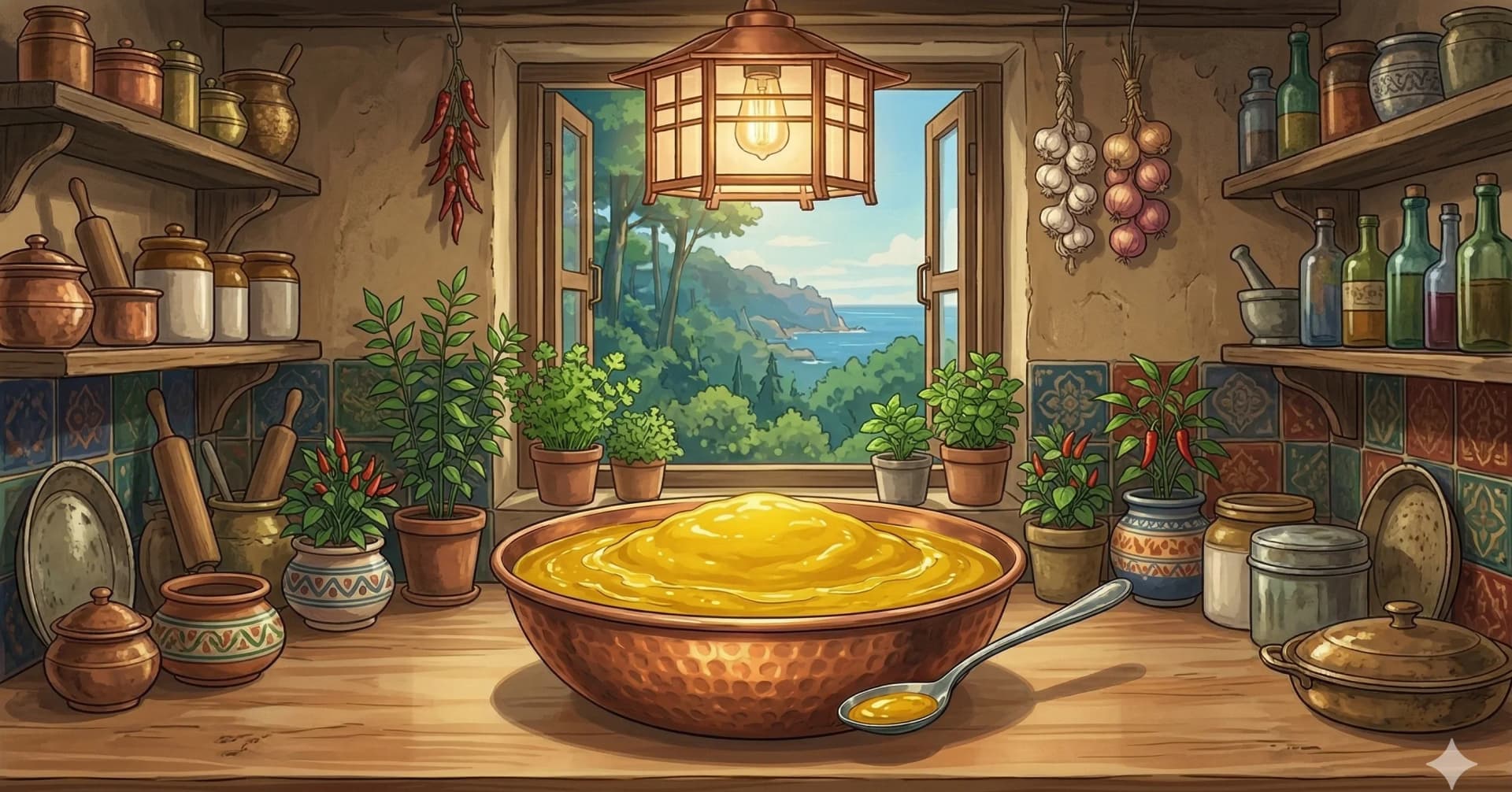
Yellow Gravy
A mild, golden onion, cashew, and yoghurt base for Rajasthani vegetarian dishes
Every serious regional kitchen has its foundational sauces, the building blocks from which individual dishes are quickly assembled. In Rajasthani cooking, two of the most important are the red makhni-style gravy (chilli, tomato, butter) and this: the yellow gravy, pale gold from turmeric, mild and slightly sweet from cashew, with the faint tang of yoghurt stabilised by besan. It is the gravy that underpins paneer preparations, vegetable dishes, and kofta in the Rajasthani vegetarian tradition.
The technique involves two specific approaches that set this apart from simpler onion-based sauces. First, the onions are cooked until only translucent rather than golden or browned — this preserves the light, clean colour of the final sauce. Second, after straining, the leftover solids are blended to a smooth purée and strained back into the gravy. This is an efficiency technique from professional kitchens that ensures no flavour is lost: what would otherwise be waste becomes a thickener that adds body and richness to the finished sauce.
Removing the whole spices after they bloom (before the onions go in) keeps the sauce clean in both appearance and flavour. The whole spices do their work in the hot oil and are then taken out rather than being strained awkwardly at the end.
The finished gravy is mild, fragrant, slightly nutty, and entirely versatile. Make it in a batch and keep it in the refrigerator — with a supply of yellow gravy on hand, a range of dishes are only minutes away.
At a Glance
Yield
Makes approximately 500 ml (base for 4–6 servings)
Prep
20 minutes
Cook
40 minutes
Total
1 hour
Difficulty
Medium
Ingredients
- 1¼ tbspginger-garlic paste (combined)
- 5 ozonion (about ½–1 onion), thinly sliced
- 2¼ ozplain yoghurt, beaten
- ⅓ tspturmeric powder
- 1⅓ tsproasted cumin powder
- 1⅔ tspcoriander powder
- 3 tbspbesan (gram/chickpea flour)
- ⅔ tspsalt
- 1¼ ozcashew paste
- ⅔ tspwhole garam masala (1 small piece cinnamon, 2 green cardamom pods, 2 cloves, 1 bay leaf)
- 3⅓ tbspneutral oil
Method
- 1
Make cashew paste (35 g). Soak 35 g of raw cashews in enough hot water to cover for 20 minutes. Drain, then blend with just enough fresh cold water to get the blender moving, to a completely smooth paste with no graininess. Set aside.
- 2
Make the yoghurt-besan mixture. Whisk the besan (17 g) into the beaten yoghurt (65 g) until completely smooth. No lumps. Set aside.
- 3
Bloom and remove whole spices. Heat the oil in a wide, heavy-based pot over medium heat. Add the whole garam masala (2 g): cinnamon, cardamom, cloves, and bay leaf. Stir for 30–45 seconds until fragrant. Using a slotted spoon, remove and discard all the whole spices. Leave the spice-flavoured oil in the pan.
- 4
Cook the onions. Add the sliced onions to the spiced oil. Cook over medium heat, stirring regularly, for 8–10 minutes until the onions are fully softened and translucent but not golden. The moment they begin to colour, the finished gravy will turn from golden to brown.
- 5
Add ginger-garlic and spices. Add the ginger-garlic paste (17 g) and stir for 1–2 minutes. Add the turmeric (¼ teaspoon), roasted cumin powder (¾ teaspoon), coriander powder (1 teaspoon), and salt (¾ teaspoon). Stir for 1 minute.
- 6
Add cashew paste. Add the cashew paste and stir well. Cook for 3–4 minutes, stirring constantly, until the fat begins to separate slightly from the paste.
- 7
Add the yoghurt-besan mixture. Remove the pan from the heat momentarily. Add the yoghurt-besan mixture and stir immediately. Return to low heat. Cook, stirring constantly, for 8–10 minutes until the mixture thickens and the besan smell has cooked out. The raw grain smell should be gone and the gravy should smell fragrant and slightly nutty. The oil will eventually begin to separate and appear at the edges.
- 8
Strain. Pass the gravy through a fine-mesh sieve or strainer, pressing firmly to extract all the liquid. Reserve the strained solids.
- 9
Blend and re-strain the solids. Transfer the pressed solids to a blender. Add 100–150 ml of water and blend until completely smooth. Pass this purée through the same sieve into the strained gravy, pressing to extract as much as possible. Discard only the fibre that cannot be pushed through.
- 10
Final heat. Return the combined gravy to the pot. Heat gently for 5 minutes, stirring. Taste and adjust salt. The finished gravy should be smooth, pale golden-yellow, and thick enough to coat a spoon. Store or use immediately.
Key Ingredient Benefits
Cashew paste provides the characteristic gentle richness of this yellow gravy. Cashews are high in monounsaturated fats (similar to olive oil) and contain iron, magnesium, and zinc. In Ayurvedic tradition, nuts are considered bala (strengthening) and cashews are particularly associated with preparations for building physical strength and supporting the nervous system. As a paste, cashew creates an emulsion with the cooking liquid that gives the sauce its characteristic silky body.
Besan (chickpea/gram flour) is both a stabiliser and a nutritional contributor here. As a thickener, it provides fibre and protein that cream or cornstarch do not. Its starch molecules form long chains when heated with liquid, which is what creates the sauce's stable, clinging texture. In Ayurvedic tradition, gram preparations are considered digestive-friendly when cooked sufficiently — which is why the extended cooking step to eliminate the raw flour smell is important both for flavour and for digestibility.
Turmeric (Curcuma longa) provides the characteristic golden colour of this gravy. Curcumin, turmeric's primary active compound, has been studied extensively for anti-inflammatory and antioxidant properties. Importantly, curcumin's bioavailability is significantly enhanced by fat (present here in the oil and cashew paste) and by black pepper, making its use in oil-based cooking a nutritionally sound application.
Why This Works
The besan in the yoghurt mixture performs two functions simultaneously: it stabilises the yoghurt against splitting during cooking (the starch gelatinises and holds the dairy proteins in suspension) and it acts as a thickener, giving the finished gravy the body it needs without using cream. This is a practical and traditional technique from both Rajasthani and restaurant Indian cooking. Besan-stabilised yoghurt is more stable under sustained heat than plain yoghurt alone.
Removing the whole spices after blooming and before the onions go in is a deliberate choice for this sauce. The whole spices have done their work — their volatile oils have dissolved into the hot fat — and their physical presence is no longer needed. Leaving them in would create an inconsistent texture in the strained sauce and potentially over-spice it during the longer cooking stages.
The two-strain technique (straining the cooked gravy, then blending and re-straining the solids) is a professional kitchen efficiency method. The solids, which hold a significant amount of cooked-in flavour, are rescued rather than wasted. Blending them smooth and returning them to the gravy both deepens the flavour and improves the body without adding any additional ingredients.
Substitutions & Variations
No cashew paste: Replace with 2 tablespoons of almond paste (blanched almonds soaked and blended) or with 2 tablespoons of thick cream. The character changes slightly but the result is still a good, mild yellow gravy.
Saffron addition: A pinch of saffron soaked in 2 tablespoons of warm milk, added at the end, creates a richer yellow colour and a floral fragrance.
Thinner sauce: Add additional hot water during the final heating step to reach a looser, more flowing consistency, suitable for koftas or paneer that will sit in the gravy rather than be coated by it.
Serving Suggestions
Yellow gravy is a base preparation, not a finished dish — it's designed to be the foundation for other Rajasthani vegetarian preparations rather than served on its own. Common applications:
Paneer dishes: Paneer korma and malai kofta both use yellow gravy as the base. Add cubed paneer or fried kofta balls and simmer briefly.
Vegetable preparations: Mixed vegetable curries (navratan korma-style), aloo gobi variations, and seasonal vegetable korma all build on this gravy.
Marwari traditions: Yellow gravy is the foundation of many sweet-mild Marwari (Rajasthani Brahmin and Marwari business community) vegetarian preparations. The mildness suits the satvik cooking philosophy of avoiding aggressive spices.
With breads: Serve any yellow gravy-based dish with naan, tandoori roti, or paratha. The mild, creamy character pairs beautifully with charred breads.
With rice: Jeera rice (cumin rice) or plain steamed basmati both work as rice accompaniments. The yellow gravy's golden color contrasts beautifully with white rice on the plate.
Garnish suggestions: Finish dishes built on this gravy with fresh cilantro, a swirl of cream, a sprinkle of toasted slivered almonds, or a few rose petals for special occasions.
Storage & Reheating
The base yellow gravy keeps refrigerated for up to 4 days, or frozen for up to 2 months. It thickens on cooling; add a splash of water and stir over low heat when reheating to restore consistency. Freeze in 125 ml portions. One portion is enough for two servings. Reheat from frozen over low heat, stirring, with added water.
Cultural Notes
Yellow gravy is a foundational sauce base in Rajasthani vegetarian cuisine, particularly associated with the cooking traditions of Marwari and Brahmin communities of western Rajasthan. The gravy's distinctive yellow color comes from turmeric, cashew paste, and slow-cooked onions, and its mild profile suits the satvik (pure, balanced) cooking philosophy that avoids aggressive spices, garlic, and excessive onion.
Rajasthani vegetarian cuisine is one of India's most refined vegetarian traditions, developed in part because of the region's arid climate (which historically limited meat consumption) and in part because of the strong influence of Jain and Brahmin religious traditions that prioritize ahimsa (non-violence) and vegetarianism. The cuisine developed sophisticated techniques for creating depth of flavor from vegetarian ingredients alone — pulses, dairy, nuts, and a wide variety of indigenous vegetables and grains.
Yellow gravy represents one of three foundational gravy bases in Rajasthani cooking, alongside red gravy (tomato-based, spicier) and white gravy (cashew-cream, used for richer preparations). Each base produces dishes with different character; the yellow gravy's golden, slightly sweet, mildly spiced profile suits gentler vegetable and paneer preparations.
The technique of building flavor through slow-cooked onion paste, cashew paste, and yogurt is borrowed from the broader Mughal-influenced cooking of North India but adapted to the Rajasthani vegetarian tradition. The gravy reflects the cross-cultural exchange between Rajput royal cuisine (which embraced Mughal techniques) and the indigenous vegetarian traditions of the region.
In modern Rajasthani restaurant cooking and home cooking, yellow gravy is often pre-prepared in large batches and used as the base for whatever vegetable or paneer preparation a household chooses. The gravy stores well refrigerated for several days and freezes for months, making it an extremely practical foundation for daily cooking.
Nutrition Facts
Calories: 161kcal (8%)|Total Carbohydrates: 7g (3%)|Protein: 3g (6%)|Total Fat: 14g (18%)|Saturated Fat: 2g (10%)|Cholesterol: 2mg (1%)|Sodium: 520mg (23%)|Dietary Fiber: 1g (4%)|Total Sugars: 3g
You Might Also Like
Ratings & Comments
Ratings & Comments
Ratings
Share your thoughts on this recipe.
Sign in to rate and comment