Bay Leaves
Also known as: Tej Patta, Indian Bay Leaf, Malabar Leaf, Cinnamomum tamala, Laurus nobilis
"Bay leaf" is one of the most consequential cases of shared common name in the culinary world: two entirely different plants, from two different botanical families, used in strikingly similar ways across the globe, but with meaningfully different flavor profiles. Understanding which bay leaf you are working with is not a minor botanical technicality. It determines what a dish will taste like.
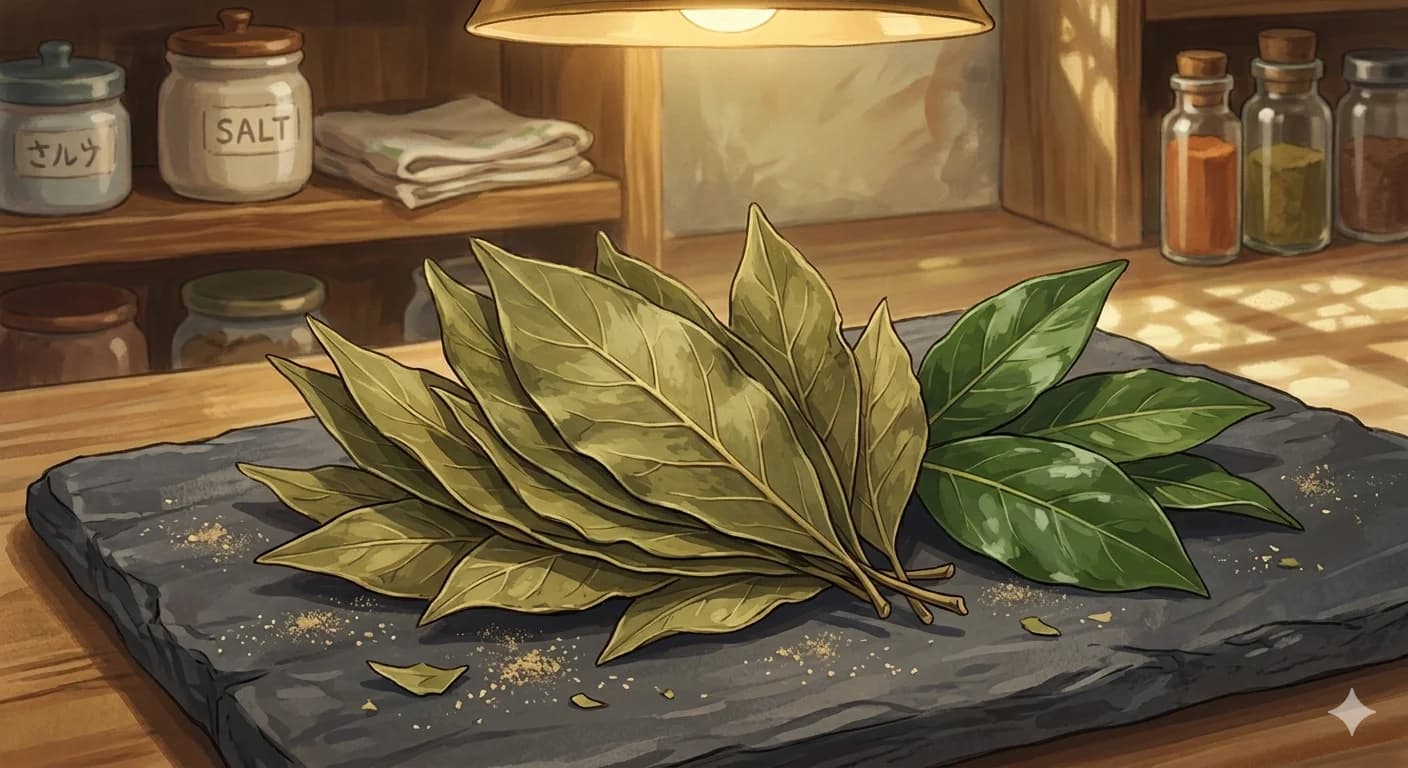
Indian bay leaf, tej patta, comes from Cinnamomum tamala, a member of the laurel family closely related to the cinnamon tree. Its leaves are long, broad, and marked with three prominent parallel veins running along the blade, a reliable visual identifier. The flavor is warm, sweet, and reminiscent of cinnamon and clove with a subtle eucalyptus undertone.
This is the bay leaf of North Indian biryanis, kormas, and garam masala. When you smell a pot of biryani as it opens, the warm, cinnamon-edged fragrance that rises alongside the spiced rice is in large part tej patta.
Mediterranean bay laurel, Laurus nobilis, comes from a different family entirely. Its leaves are narrower, with a single midrib rather than three veins, and the flavor is sharper, more eucalyptus-forward, with herbal and slightly bitter notes but without the cinnamon warmth. This is the bay leaf of French bouquet garni, Italian bolognese, and Greek braised lamb.
It is also the variety most commonly found in Western supermarkets, sold dried in glass jars. When a European or American recipe says "bay leaf," it almost certainly means Laurus nobilis.
Key facts at a glance:
- Indian bay — Leaf, tej patta, comes from Cinnamomum tamala, a member of the laurel family closely related to the cinnamon tree.
- It determines — What a dish will taste like.
- When a — European or American recipe says "bay leaf," it almost certainly means Laurus nobilis.
- Understanding which — Bay leaf you are working with is not a minor botanical technicality.
- Its leaves — Are long, broad, and marked with three prominent parallel veins running along the blade, a reliable visual identifier.
- The flavor — Is warm, sweet, and reminiscent of cinnamon and clove with a subtle eucalyptus undertone.
Flavor Profile
Origin
Mediterranean, India, Nepal
Traditional Medicine Perspectives
Ayurveda:
Tej patta is classified as warming, pungent, and bitter in taste, with deepana (digestive fire-kindling) and pachana (digestive) properties. It is used to support digestion, particularly for conditions of sluggish agni and ama accumulation, and its affinity for the respiratory system is also noted. The aromatic volatile oils are considered helpful in kapha-type respiratory conditions and cold-induced congestion. Classical formulations for digestive tonics frequently include tej patta alongside long pepper, dry ginger, and other warming spices. Its relationship to the cinnamon family means it shares some of cinnamon's warming, anti-spasmodic properties in Ayurvedic understanding.
Traditional Chinese Medicine:
Bay laurel appears in Chinese medical literature primarily as an externally used ingredient, with volatile oil preparations used for pain relief in conditions of cold-stagnation in the joints and muscles. Internally, it is occasionally used to promote digestion and dispel cold in the middle jiao. It is not a primary herb in the classical Chinese pharmacopoeia, but its use illustrates the transmission of aromatic herbs along Silk Road trade routes.
Modern Scientific Research
Both Laurus nobilis and Cinnamomum tamala contain significant concentrations of aromatic terpene compounds. Linalool, 1,8-cineole (eucalyptol), and eugenol are among the dominant volatiles characterized in Laurus nobilis. These compounds have demonstrated anti-inflammatory and antimicrobial activity in laboratory studies.
Eugenol, shared with cloves and cinnamon, has well-established analgesic and anti-inflammatory properties at the molecular level.
Studies on Laurus nobilis have investigated its effects on blood glucose regulation. A controlled trial by Khan, Zaman, and Anderson published in the Journal of Clinical Biochemistry and Nutrition in 2009 found that giving 1 to 3 grams of ground bay leaves daily for 30 days to patients with type 2 diabetes reduced serum glucose by 21 to 26 percent and total cholesterol by 20 to 24 percent. The mechanism is not fully established, but the findings line up with the traditional use of bay leaf as a digestive and metabolic tonic across multiple herbal traditions.
Cultural History
Laurus nobilis carries one of the richest symbolic histories of any plant. In ancient Greece and Rome, bay laurel was sacred to Apollo, associated with prophecy and poetic inspiration, and the laurel wreath was the crown of victors, generals, and poets. The word "laureate," as in poet laureate or Nobel laureate, derives directly from the Latin for the laurel crown.
The Oracle at Delphi was said to chew bay leaves to induce prophetic states. This cultural weight attached to a culinary herb is almost without parallel.
Tej patta carries its own historical depth in South Asian cooking. Cinnamomum tamala grows wild across the foothills of the Himalayas and has been used in Indian cooking and medicine since the period of the earliest Sanskrit texts. It appears in the Charaka Samhita and Sushruta Samhita, the foundational texts of Ayurvedic medicine, and is a consistent ingredient in the garam masala blends used in Mughal court cooking.
The Ain-i-Akbari, a 16th-century administrative document of the Mughal court, records spice blends and cooking practices of the imperial kitchen, and tej patta appears among the whole spices used in the aromatic rice and meat dishes of the era.
The confusion between the two bay leaves has historical roots in European botanical classification and colonial-era spice trading. Both leaves were shipped into European markets as "bay" and traded through overlapping channels. The distinction was often collapsed in export catalogues and recipe writing.
The practical consequence persists: many English-language Indian recipes call for "bay leaves" without specifying which variety, and cooks using the Mediterranean version achieve a flavor quite different from the original intent.
Culinary Uses
Both bay leaf varieties are used whole and removed before eating. The leaf itself is leathery and unpleasant to consume, and even after hours of cooking it remains fibrous. Its role is purely aromatic: the volatile compounds extract into the cooking liquid, fat, or steam over the cooking time and diffuse through the dish without the leaf itself being consumed.
Tej patta is standard in North Indian biryani, layered into the rice along with other whole spices during the dum (slow-steam) cooking process. It appears in the whole spice tempering for pulao, korma, and various meat-based curries, added to the hot oil at the start of cooking. In garam masala, it may be ground with other whole spices for a powdered blend, or used whole in its dried form.
For dum cooking, one to two tej patta leaves per dish is typical.
Laurus nobilis is essential to French bouquet garni (tied with thyme, parsley stems, and leek), Italian braising liquids for beef and lamb, and Greek dishes such as stifado and braised octopus. It is added to pasta sauces, bean soups, and pickling brines. Unlike tej patta, it can withstand long braise times of several hours and continues to contribute flavor throughout.
One or two leaves is standard for a pot serving four to six.
Preparation Methods
Both varieties are used in dried form for most applications. Fresh bay laurel leaves are occasionally available and have a slightly greener, more herbal flavor, but dried leaves are standard and preferable for intensity in long-cooked dishes. Dried tej patta should be deep green to olive colored; pale gray or brown leaves have lost most of their volatile oils.
There is no preparation required beyond ensuring the leaves are added whole at the beginning of cooking so they have time to release their aromatics. For particularly long braises or stocks, crush the dried leaf lightly in your hand before adding to release more volatile compounds. Always remove before serving.
Store dried bay leaves of both varieties in sealed glass jars away from light. Properly stored, they retain useful flavor for 6 to 12 months. Crush a leaf and smell it: if no fragrance is released, discard and replace.
Traditional Dishes
- Biryani
- Korma
- Pulao
- Garam masala blend
- Dal makhani
- French pot-au-feu
- Bolognese sauce
- Bouquet garni
- Greek stifado
- Béchamel sauce
- Bay-spiced pickling brine
- Nihari
Recipes Using Bay Leaves
- Bubur Ayam (Indonesian Chicken Rice Porridge)
- Prawns in Coconut Cream (Chingri Malai Curry)
- Punjabi Chicken Curry
- Spiced Minced Mutton (Mutton Keema)
- Massaman Curry (Gaeng Massaman)
- Spiced Meat & Rice (Meat Chawal)
- Chana Masala
- Bossam (Boiled Pork Belly Wraps)
- Egg Curry (Anda Curry)
- Pot-Braised Lamb Korma (Handi Gosht Korma)
- Whole Garam Masala
- Chinese Tea Eggs (茶叶蛋)
- Peking Duck
- Bengali Dry Mutton Curry (Kasha Mangsho)
- Beef Tendon Noodle Soup (牛筋面)
- Lanzhou Beef Noodle Soup (兰州牛肉面)
- Taiwanese Beef Noodle Soup (紅燒牛肉麵)
- Prawn Pulao
Comments
Share your thoughts on this ingredient.
Sign in to comment0 Comments