Chana Dal
Also known as: Split Bengal Gram, Split Desi Chickpeas, Cicer arietinum var. desi (split)
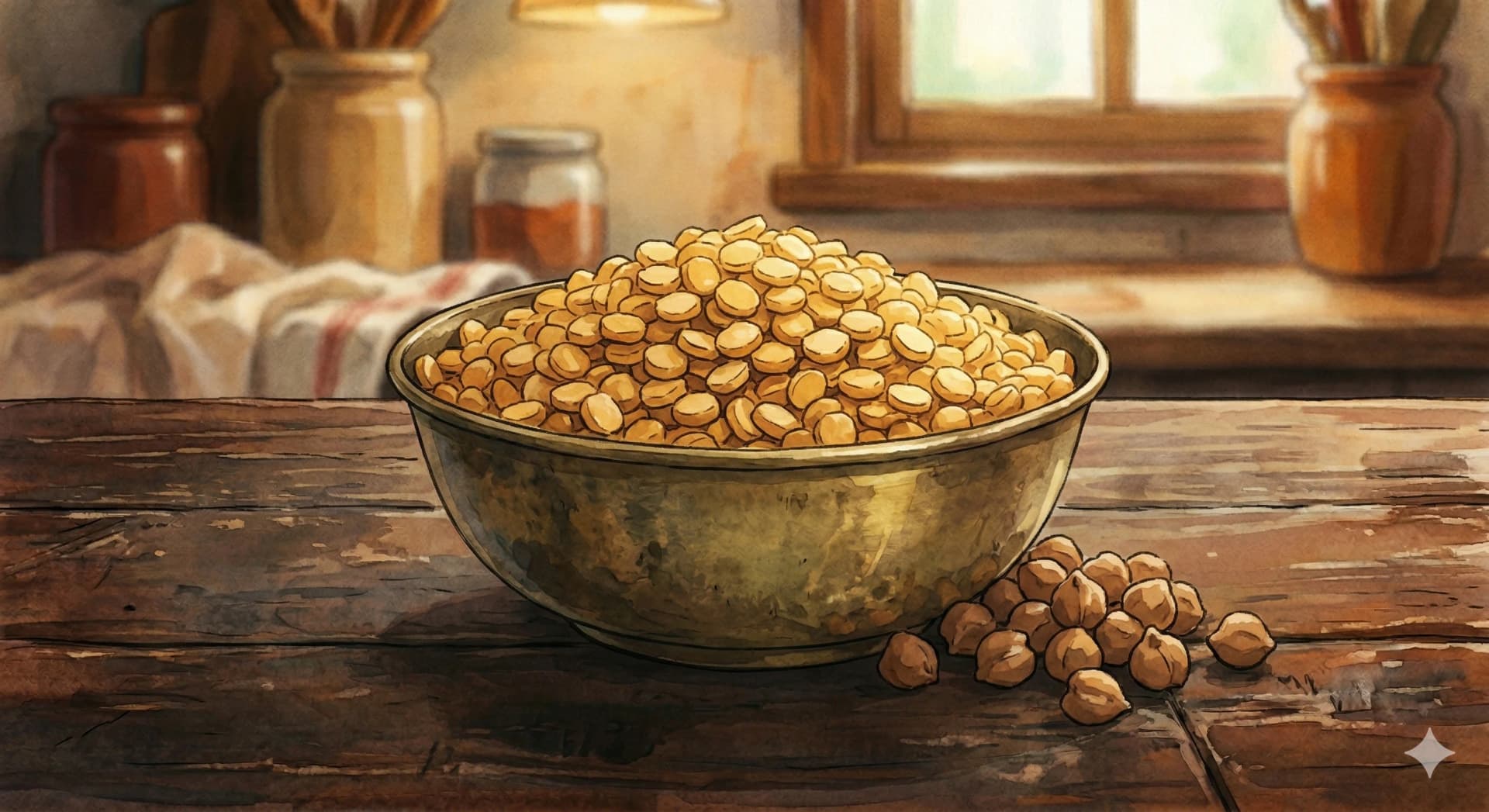
Chana dal is the split and husked form of the desi chickpea, the small, dark, wrinkled variety of chickpea native to the Indian subcontinent. After splitting and removing the husk, the inner cotyledon is revealed: pale yellow, slightly curved, and distinctly larger than yellow split peas. This is an important distinction.
Chana dal and yellow split peas (from field peas, Pisum sativum) look similar in a photograph and are sold side by side in many stores, but they are different plants, different ingredients, with different flavors, cooking times, and culinary roles. Chana dal is nuttier, sweeter, and more assertively flavored. Yellow split peas are milder and more starchy.
The flavor of cooked chana dal is one of the most satisfying among the lentil and dal family. It has a pronounced sweetness that develops during cooking, layered over a deep nuttiness that comes from the natural oils in the desi chickpea. Unlike masoor dal, which dissolves completely, or moong dal, which softens to a creamy consistency, chana dal retains some structural integrity even when fully cooked.
Individual pieces remain distinct and slightly firm in the center. This texture-holding quality makes it particularly suited to preparations where bite and body are desired: dal baati, panchmel dal, and thick, spoonable dal preparations.
The same desi chickpea, when ground whole (unhusked), produces besan, the chickpea flour that is one of the most important non-grain flours in Indian cooking. Besan is the base of pakoras, kadhi, missi roti, and dozens of sweets. This dual role of the desi chickpea, as both a whole dal and the source of a major flour, makes it one of the most versatile legumes in the Indian pantry.
Key facts at a glance:
- Chana dal — Is the split and husked form of the desi chickpea, the small, dark, wrinkled variety of chickpea native to the Indian subcontinent.
- The flavor — Of cooked chana dal is one of the most satisfying among the lentil and dal family.
- It has — A pronounced sweetness that develops during cooking, layered over a deep nuttiness that comes from the natural oils in the desi chickpea.
- After splitting — And removing the husk, the inner cotyledon is revealed: pale yellow, slightly curved, and distinctly larger than yellow split peas.
- This is — An important distinction.
- Yellow split — Peas are milder and more starchy.
Flavor Profile
Origin
Indian subcontinent
Traditional Medicine Perspectives
Ayurveda:
Chana dal is considered Pitta and Kapha reducing, with some Vata-aggravating potential due to its drying qualities and gas-producing nature. It is considered a heavier, more substantive food than moong dal and is not recommended for those with weak digestion or during acute illness. However, its lower glycemic index, higher fiber content, and substantial protein make it well-regarded for healthy adults. Cooking with digestive spices, particularly asafoetida, cumin, and ginger, is recommended. It is considered one of the more nourishing dals for building strength (bala) and tissue.
Traditional Chinese Medicine:
Split chickpeas are considered sweet and neutral, tonifying to the Spleen and Stomach. Their ability to support digestion and Qi production is valued, though their somewhat heavy and gas-producing nature means they are prescribed in moderate amounts to those with deficient digestive fire.
Modern Scientific Research
Chana dal has one of the lowest glycemic indices of any legume. The International Tables of Glycemic Index and Glycemic Load Values list chickpea (Bengal gram) at a GI in the single digits to low teens, well under whole chickpeas (around 38) and far below kidney beans (around 50). The combination of substantial fiber, intact starch granules that resist rapid breakdown, and roughly 22 grams of protein per 100 grams dry weight makes it one of the more blood-sugar-friendly carbohydrate sources in the Indian pantry.
The resistant starch in chana dal also acts as a prebiotic, feeding Bifidobacterium and Lactobacillus species associated with gut health. The 2013 Advances in Nutrition review by Birt and colleagues, "Resistant Starch: Promise for Improving Human Health" summarizes the mechanisms and the human evidence base behind this.
Besan (chana dal flour), the ground product of the same legume, carries similar nutritional properties. It is higher in protein than wheat flour (about 22 grams per 100 g versus roughly 13 grams for all-purpose flour) and contains useful amounts of thiamine, folate, and iron. For those avoiding wheat, besan is one of the more nutritionally substantial flour alternatives.
Cultural History
The desi chickpea has been cultivated on the Indian subcontinent for at least 4,000 years. It predates the kabuli variety (the large, smooth chickpea) in South Asia by centuries, as the kabuli type is believed to have arrived from Central Asia during the medieval period. In Bengal, chana dal developed a distinct culinary tradition: Bengali chana dal is typically cooked with coconut, dried red chilies, and a finish of ghee, resulting in a preparation quite different from the North Indian versions.
Bengali cooking uses chana dal in sweet preparations as well, including stuffings for pitha (rice cakes) and halwa-style desserts.
In Rajasthan, chana dal is one of the five dals in panchmel dal (also called panchkuti or mixed dal), the region's signature preparation combining toor, moong, urad, chana, and masoor dals. Cooked together and seasoned with local spices including dried red chilies, the panchmel preparation celebrates the region's pantry staples. Dal baati churma, Rajasthan's most iconic dish, uses chana dal as the primary dal component, cooked rich and well-spiced and eaten with hard-baked wheat balls (baati) and sweet churma.
In Maharashtra, chana dal appears in a distinctive sweet preparation: puran poli, a flatbread stuffed with a sweet chana dal filling cooked with jaggery and cardamom. This dish, eaten at festivals and celebrations, demonstrates chana dal's ability to take on sweetness without losing its structural character. The dal must be cooked just to the point of mashability: soft enough to incorporate jaggery but not so dissolved that the filling lacks body.
Culinary Uses
Chana dal requires soaking (1 to 2 hours minimum, overnight preferred) before cooking. Even with soaking, it cooks more slowly than masoor or moong dal, requiring 30 to 40 minutes in a pressure cooker (3 to 4 whistles) or up to an hour on the stovetop. The longer cooking time is not a flaw: the slow development of the dal's flavor through heat is part of what gives chana dal preparations their depth.
For tadka-style chana dal, cook the dal until soft but intact, then combine with a separately prepared masala of onion, tomato, ginger, garlic, and spices. The dal should hold its shape in the finished dish. For puran poli filling, cook the dal very soft and drain thoroughly before mashing with jaggery.
For panchmel dal, the chana dal is often started earlier than the other dals since it cooks most slowly.
Chana dal also works beautifully as a texture addition in rice dishes and pulao, where the par-cooked dal is added partway through the rice cooking to finish together, providing protein-rich nuggets throughout the grain.
Preparation Methods
Soaking: Cover with cold water and soak 1 to 2 hours (or overnight). Drain and rinse before cooking. This step is important for chana dal; unsoaked dal will cook unevenly, with soft outer edges and resistant centers.
Pressure cooker: 1 cup soaked chana dal to 2.5 cups fresh water. 3 to 4 whistles on stovetop (or 15 to 18 minutes high pressure with natural release on electric). Dal should be tender throughout but pieces still visible.
Stovetop: In well-salted water, 40 to 60 minutes from a simmer with soaked dal. Check frequently toward the end.
For chana dal tadka: Prepare a masala of onion, tomato, ginger, garlic, turmeric, red chili powder, and coriander. Cook until oil separates. Add cooked dal with some of its cooking water. Simmer 10 to 15 minutes to merge flavors. Finish with a tadka of ghee, cumin, and asafoetida poured over the top.
Traditional Dishes
- Chana dal tadka
- Dal baati churma (Rajasthani)
- Bengali chana dal with coconut
- Panchmel dal (Rajasthani five-dal)
- Chana dal khichdi
- Puran poli filling (Maharashtrian)
- Chana dal halwa
- Dal palak (with chana dal)
- Sindhi dal pakwan
Comments
Share your thoughts on this ingredient.
Sign in to comment0 Comments