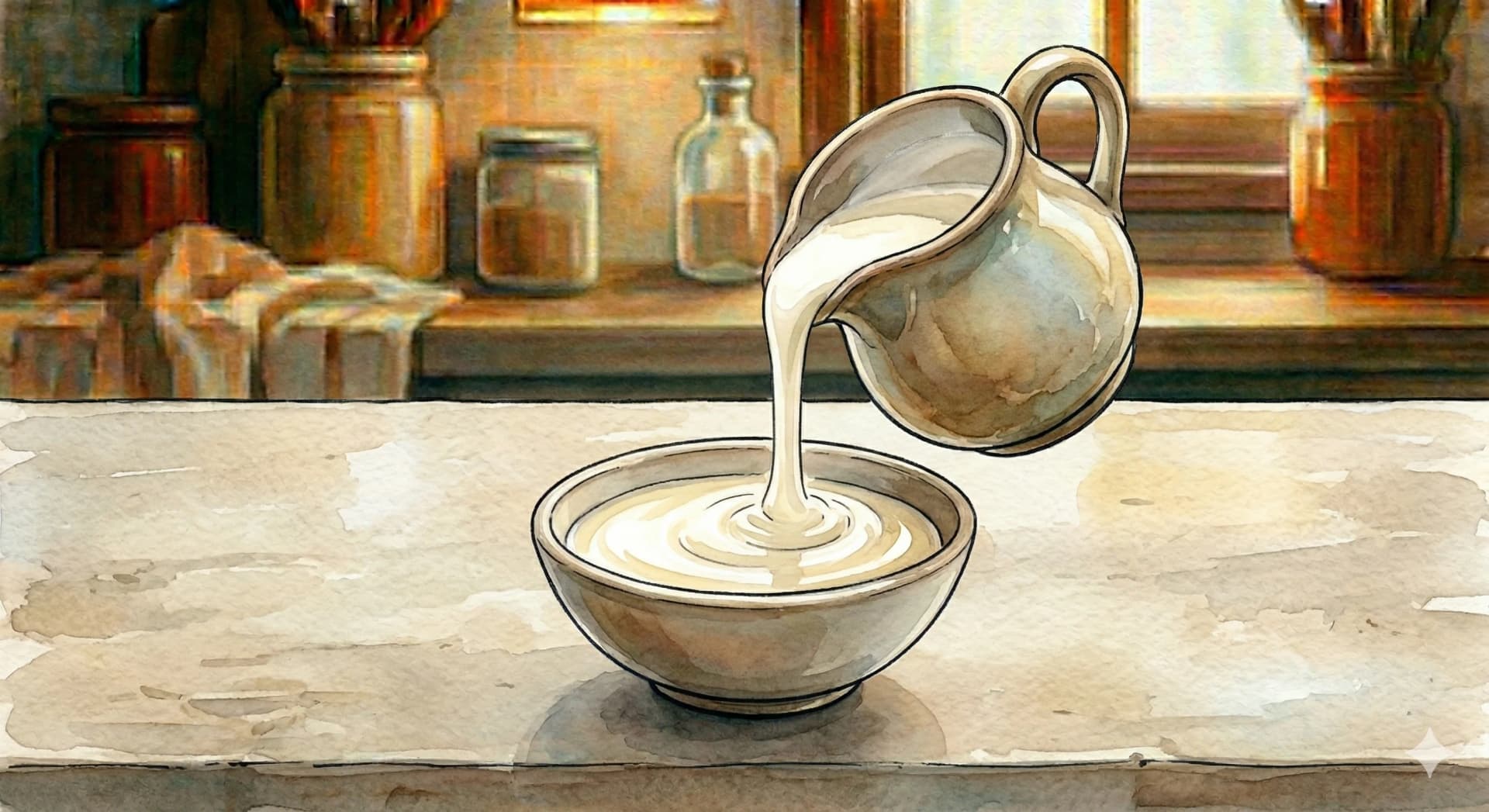
Cream
Also known as: Malai, Fresh Cream, Cooking Cream, Whipping Cream, Heavy Cream
Cream in Indian cooking takes two distinct forms that behave very differently in the kitchen. The first is fresh liquid cream, the kind skimmed or poured from whole milk, which is stirred into gravies and kormas at the finishing stage to add richness, temper heat, and create a silky, restaurant-style texture. The second and more culturally specific form is malai, the thick layer of clotted cream that forms on the surface of whole milk when it is slowly brought to a near-boil and then cooled undisturbed. Malai has a more complex, slightly cooked, faintly caramelized flavor that distinguishes it sharply from the neutral richness of liquid cream.
Both forms share the same fundamental quality: they are fat-rich dairy products that enrich, soften, and carry flavor in ways that lower-fat dairy cannot. A tablespoon of cream stirred into a spiced tomato gravy rounds out sharp edges, binds the sauce, and shifts the dish's character from rustic to refined. Malai, eaten as a topping on hot pooris or stirred into sweets, contributes a specific nostalgic richness that is tied to the experience of milk boiled slowly on a stovetop rather than anything that comes from a supermarket shelf.
The practical distinction matters to cooks: liquid cream can curdle if added to very hot, acidic sauces and must be incorporated carefully. Malai, being already heat-treated, is more stable and can be cooked more aggressively.
Key facts at a glance:
- Malai has a more complex — Slightly cooked, faintly caramelized flavor that distinguishes it sharply from the neutral richness of liquid cream.
- Cream in Indian cooking — Takes two distinct forms that behave very differently in the kitchen.
- The second and more culturally specific form — Malai, the thick layer of clotted cream that forms on the surface of whole milk when it is slowly brought to a near-boil and then cooled undisturbed.
- Both forms share the — Same fundamental quality: they are fat-rich dairy products that enrich, soften, and carry flavor in ways that lower-fat dairy cannot.
Flavor Profile
Origin
Indian Subcontinent, Universal
Traditional Medicine Perspectives
Ayurveda:
Cream and malai are classified as heavy, unctuous, and nourishing (guru, snigdha, brimhana) in Ayurvedic dietetics. They are considered particularly beneficial for increasing ojas (vital essence), strengthening the body, and calming Vata disorders associated with dryness, anxiety, and depletion. Their high fat content supports the absorption of fat-soluble herbs and spices. Ayurvedic texts recommend cream and fresh butter for children, the elderly, and those recovering from illness. Excess consumption is cautioned for those with high Kapha or sluggish digestion, where the heaviness of cream may impede digestive fire (agni).
Modern Scientific Research
Cream is primarily composed of fat, with heavy cream containing 36 to 40 percent fat by weight. The fat in dairy cream contains a mixture of saturated and monounsaturated fatty acids, along with fat-soluble vitamins A, D, E, and K2. The role of saturated dairy fat in cardiovascular health has been extensively re-examined in recent decades, with meta-analyses suggesting that full-fat dairy consumption is not clearly associated with increased cardiovascular risk in the context of a varied diet, and may in fact be associated with lower incidence of type 2 diabetes.
Malai, as a heat-concentrated dairy product, shares these nutritional characteristics but with an additional nuance: the slow heating process produces Maillard and caramelization products that contribute to its complex flavor and also alter some of its proteins and sugars. Reduced whole milk products like kulfi have a higher concentration of naturally occurring milk sugars and proteins compared to fresh cream, giving them a distinct nutritional and glycemic profile from Western cream-based desserts.
Cultural History
The use of cream in cooking is closely tied to the Mughal court tradition that shaped North Indian haute cuisine between the 16th and 18th centuries. The Mughals, arriving from Central Asia with a culinary heritage already steeped in dairy, found in the rich milk of the Indian subcontinent the raw material for an entirely new category of cooking. Dishes prefixed with "shahi" (royal) or "malai" in their names are direct descendants of this court tradition: the use of cream, reduced milk, ground cashews, and saffron to build sauces of extraordinary richness was a deliberate marker of social status and culinary refinement.
Malai as a specific product has deep roots in North Indian daily life that predate the Mughal period. Households that kept cows or buffaloes collected malai over several days, layering it until enough accumulated to make butter or ghee. The malai itself, before it was churned, was eaten as a prized food, particularly valued by children and the elderly for its easy digestibility. Daulat ki chaat, a winter street food of Old Delhi, is made entirely from whipped malai set with morning dew, a dish so delicate it vanishes within hours of being made.
In the context of South Asian sweets, malai appears prominently in rasmalai (soft cheese dumplings soaked in thickened, saffron-scented malai-milk) and malai kulfi (South Asian ice cream made not from churned cream but from reduced, thickened whole milk and malai, resulting in a denser, more intensely flavored frozen dessert than Western ice cream).
Culinary Uses
In North Indian and Mughlai cooking, cream is typically added in the final minutes of cooking a gravy, poured in a slow stream while stirring, and allowed to heat through without boiling. Bringing cream to a hard boil in an acidic sauce risks breaking it into fat and solids. The standard technique in restaurant cooking is to blend the base sauce until smooth, then stir in cream off or at the edge of direct heat, finishing the dish with a swirl of additional cream for presentation.
Malai is used differently. In sweets like rasmalai, whole milk is reduced over low heat for an extended period, often 40 to 60 minutes, to produce a thickened, cream-enriched milk (known as rabri or rabdi) that is flavored with saffron, cardamom, and rosewater. For kulfi, the same reduced milk is mixed with malai and frozen in sealed molds without churning, producing a dense, creamy, intensely flavored ice cream whose texture is closer to gelato than to churned American-style ice cream.
Preparation Methods
To collect malai at home, heat whole buffalo or cow's milk slowly until it just reaches a simmer. Remove from heat and allow to cool completely undisturbed.
A thick skin of malai will have formed on the surface. Skim it carefully and transfer to a container.
Repeat daily, layering malai until you have collected enough for your intended use. Store refrigerated and use within 3 to 4 days, or freeze for longer storage.
To make rabri (reduced cream milk) for sweets: heat 1 liter of full-fat milk in a wide, heavy-bottomed pan over medium heat. Stir frequently until it reduces by half to two-thirds, skimming the malai layer as it forms and stirring it back in rather than discarding it. The milk will thicken, yellow slightly, and develop a rich, concentrated flavor. Season with sugar, cardamom, and saffron at this stage.
Traditional Dishes
- Butter Chicken (murgh makhani)
- Shahi Korma
- Kulfi
- Malai Kofta
- Rasmalai
- Malai Paneer
- Daulat ki Chaat
- Rabri
- Shahi Tukda
- Phirni
- Malai Lassi
- Malai Toast
- Dal Makhani (finishing cream)
Comments
Share your thoughts on this ingredient.
Sign in to comment0 Comments