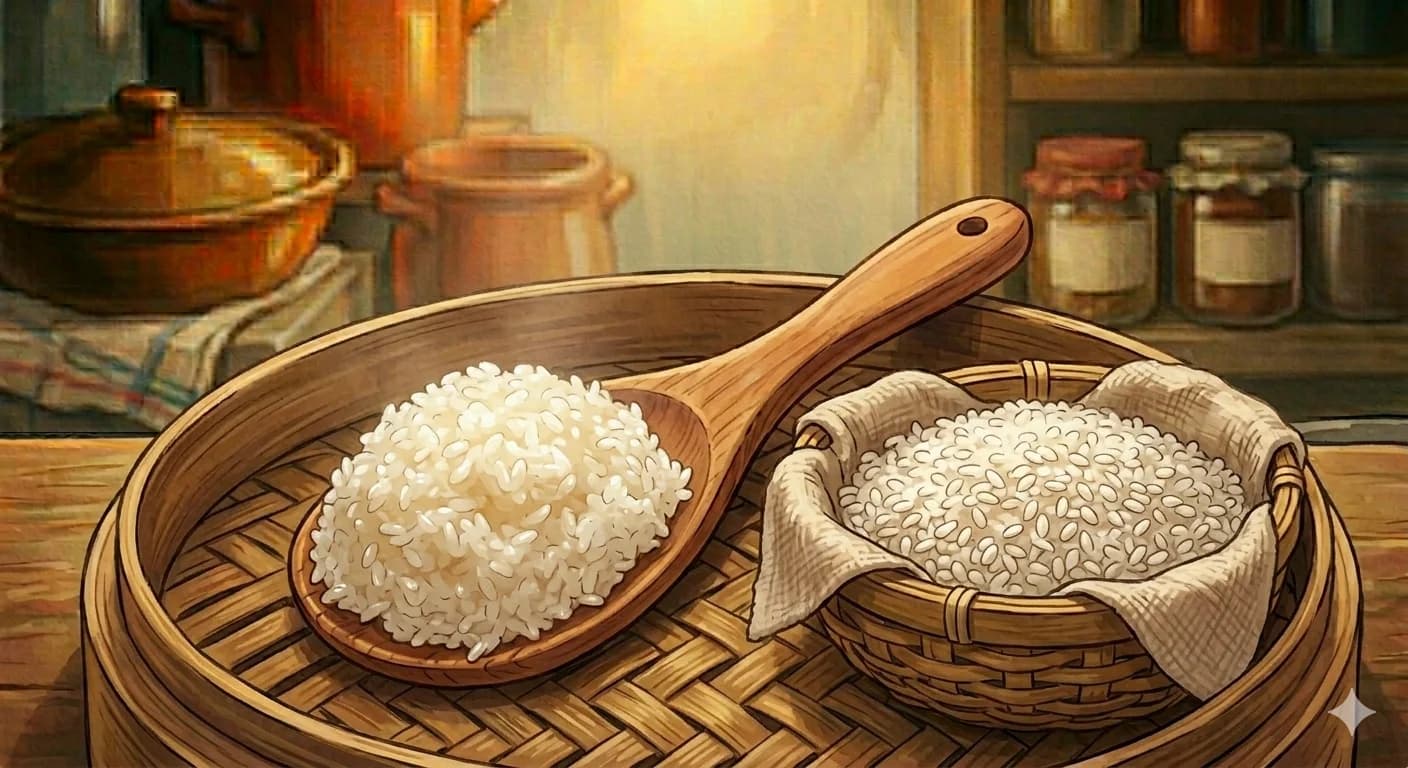
Glutinous Rice
Also known as: Sweet Rice, Sticky Rice, Nuo Mi, Chapssal, 찹쌀, Mochi Rice
Glutinous rice — despite its name, completely gluten-free — is a special variety of rice that becomes extraordinarily sticky and chewy when cooked, thanks to its high amylopectin starch content and near-absence of amylose.
The cooked grains are pearly, translucent, and cling together in a satisfying mass that can be shaped, pounded, or wrapped. The flavor is subtly sweet and almost milky, providing a neutral but comforting base for both savory and sweet preparations.
Across East and Southeast Asia, glutinous rice occupies a ceremonial and celebratory role that ordinary rice does not. It is the rice of festivals, offerings, and special occasions — from Korean tteok (rice cakes) and Chinese zongzi (wrapped rice dumplings) to Japanese mochi and Thai sticky rice with mango.
Key facts at a glance:
- Completely gluten-free — the name refers to its glue-like stickiness, not gluten protein
- High amylopectin, low amylose — the starch composition that creates its sticky texture
- Ceremonial grain — used in festivals, offerings, and celebrations across East and Southeast Asia
- Versatile forms — steamed whole, pounded into cakes, ground into flour, fermented into wine
- Multiple names — sticky rice, sweet rice, mochi rice, nuo mi, chapssal
Flavor Profile
Origin
Southern China, Southeast Asia, Korea, Japan
Traditional Medicine Perspectives
Traditional Chinese Medicine
Glutinous rice (Nuo Mi) is classified as sweet and warm, entering the Spleen, Stomach, and Lung meridians. It is used to tonify the Spleen, warm the Stomach, and supplement qi. It is traditionally recommended for poor appetite, loose stools from Spleen deficiency, and excessive sweating. However, it is considered hard to digest in excess and not suitable for those with damp-heat conditions.
Modern Scientific Research
The key difference between glutinous and non-glutinous rice is starch composition. Glutinous rice contains almost entirely amylopectin (a branched starch) with very little amylose (a linear starch). This gives it a higher glycemic index than regular rice.
Glutinous rice contains almost entirely amylopectin starch — the branched molecule responsible for its characteristic sticky, chewy texture.
Because of its starch structure, glutinous rice has a higher glycemic index than regular long-grain rice. However, in traditional consumption patterns — eaten in moderate portions with protein, vegetables, and fat — the glycemic impact is moderated.
Fermented glutinous rice products contain Lactobacillus and other beneficial microorganisms, and rice wine fermentation has been studied for its production of bioactive compounds.
Cultural History
Glutinous rice has been cultivated in East and Southeast Asia for thousands of years, with archaeological evidence of its cultivation in China dating back over 4,000 years. In much of Laos, Thailand's Isan region, and parts of southern China, glutinous rice is actually the primary daily staple — not the special-occasion grain it is elsewhere.
In Korea, glutinous rice (chapssal) is essential for tteok (rice cakes), which mark every major life event — from a baby's first birthday (doljanchi) to weddings, Lunar New Year, and ancestral rites. The pounding of rice into tteok is itself a communal ritual.
Glutinous rice occupies a ceremonial and celebratory role that ordinary rice does not — it is the rice of festivals, offerings, and special occasions.
In China, glutinous rice is the grain of the Dragon Boat Festival (zongzi), Mid-Autumn Festival (mooncakes), and New Year celebrations. It is also fermented to make jiuniang (sweet rice wine) and various regional rice wines.
Culinary Uses
Soak overnight and steam (do not boil) for the best texture. Glutinous rice should be steamed in a bamboo steamer or cloth-lined steamer basket over boiling water for 25-40 minutes until translucent and tender throughout.
Use soaked glutinous rice as the base for zongzi (wrapped in bamboo leaves with pork, mushrooms, and chestnuts), yakbap (Korean sweet rice with jujubes and pine nuts), or stuffed inside chicken for samgyetang.
Always soak glutinous rice before cooking — at least 4 hours, ideally overnight. Unlike regular rice, it must be steamed, not boiled, for proper texture.
Pound freshly steamed glutinous rice for tteok (Korean rice cakes) or mochi (Japanese rice cakes). Ground into flour, it becomes the base for tangyuan (sweet filled dumplings), mochi, and countless other sweets across Asia.
Preparation Methods
The most important rule: soak before cooking. Glutinous rice must be soaked for at least 4 hours, preferably overnight, to achieve even cooking. Without soaking, the outer layer cooks while the center remains hard.
Steam, do not boil. Place the soaked, drained rice in a cheesecloth-lined steamer and steam over high heat for 25-40 minutes. Sprinkle water over the rice partway through if needed.
Glutinous rice flour (sold as "sweet rice flour" or "mochiko") is not interchangeable with regular rice flour. It creates a much chewier, more elastic texture and is essential for mochi, tteok, and tangyuan.
Traditional Dishes
- Zongzi
- Tteok
- Mochi
- Yakbap
- Tangyuan
- Sticky rice with mango
- Samgyetang stuffing
- Jiuniang
Comments
Share your thoughts on this ingredient.
Sign in to comment0 Comments