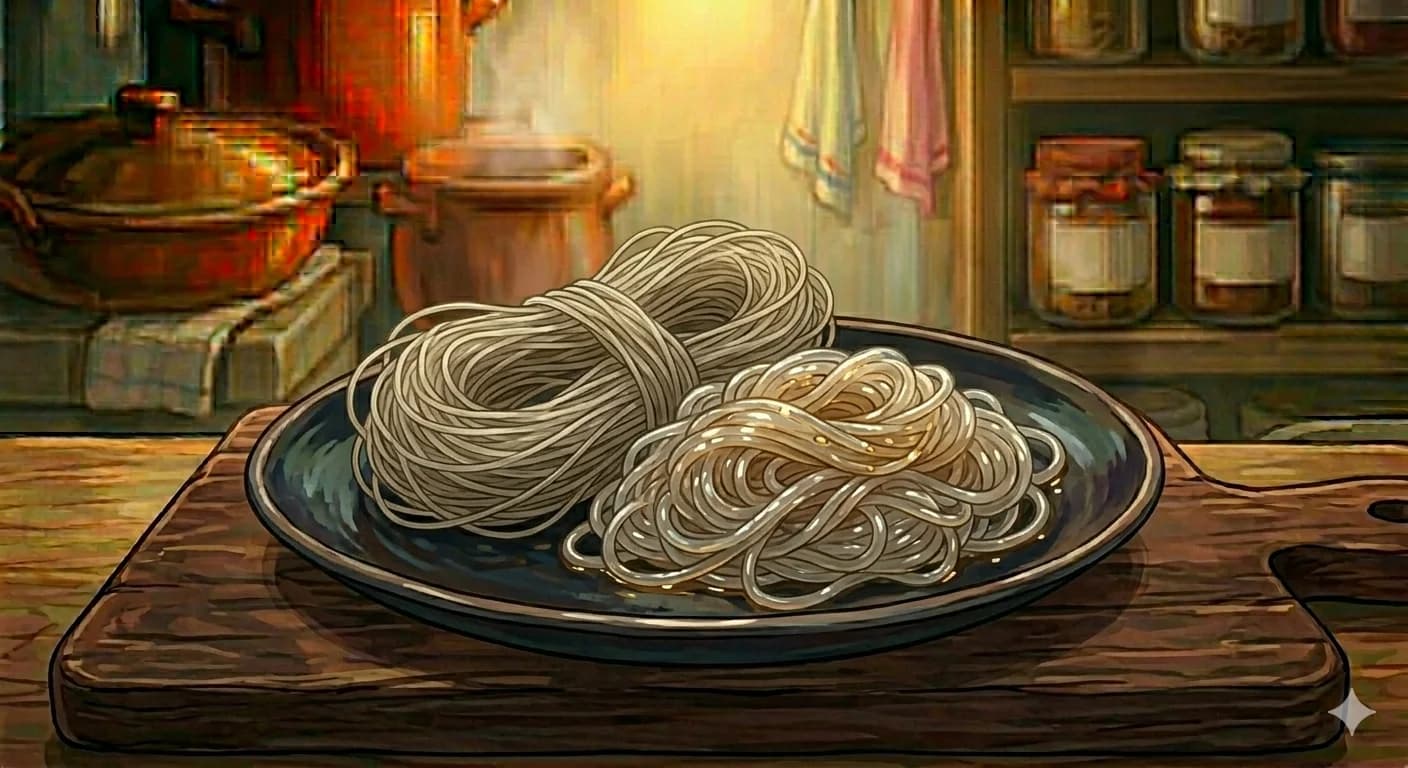
Korean Sweet Potato Starch Noodles
Also known as: Dangmyeon, 당면, Sweet Potato Vermicelli, Korean Glass Noodles
Korean sweet potato starch noodles (dangmyeon, 당면) — the bouncy, translucent, glass-like noodles that are the soul of japchae — are made from sweet potato starch and water, producing a noodle with an addictively chewy, springy texture that no other noodle can replicate.
When cooked, dangmyeon becomes glassy and translucent, with a slippery surface and a satisfying chew that bounces back against your teeth. They absorb sauce and seasoning beautifully while maintaining their structural integrity, making them ideal for stir-fries and soups.
Though they share the "glass noodle" category with mung bean vermicelli and other starch noodles, dangmyeon's sweet potato starch base gives it a distinctly chewier, bouncier texture — thicker, sturdier, and more satisfying than the delicate mung bean version.
Key facts at a glance:
- Made from sweet potato starch — distinctly chewy and bouncy
- Translucent when cooked — glassy, glass noodle appearance
- Essential for japchae — Korea's most famous noodle dish
- Different from mung bean noodles — thicker, chewier, more substantial
- Also used in soups and hot pots — maintains texture in liquid
Flavor Profile
Origin
Korea
Traditional Medicine Perspectives
Traditional Korean Medicine
Sweet potato starch noodles are not considered medicinal in traditional Korean medicine. However, sweet potato itself is considered neutral and nourishing, associated with the Spleen and Stomach. The noodles are considered a relatively gentle, easy-to-digest starch that is suitable for most constitutions.
Modern Scientific Research
Dangmyeon is primarily composed of sweet potato starch, which is high in amylose content — the linear starch molecule that contributes to the noodle's firm, chewy texture and its ability to maintain structure during cooking.
Sweet potato starch's high amylose content is responsible for dangmyeon's distinctive chewy, bouncy texture — the quality that makes japchae so satisfying.
The noodles are gluten-free by nature, making them suitable for those with celiac disease or gluten sensitivity. They are relatively low in fat and protein, serving primarily as a carbohydrate source.
Sweet potato starch contains some resistant starch, which resists digestion in the small intestine and may function as a prebiotic in the large intestine. However, the amount varies with cooking method and is generally modest in cooked noodle form.
Cultural History
Dangmyeon was introduced to Korea during the Japanese colonial period (early 20th century), originally made from mung bean starch. Korean producers later switched to sweet potato starch — more abundant and affordable domestically — creating a noodle with a distinctly different (and many would argue superior) texture.
Japchae, the stir-fried noodle dish that is dangmyeon's most famous application, has a much older history. It originated as a royal court dish in the Joseon dynasty — though the original version used only vegetables and mushrooms, without noodles. Dangmyeon was added to japchae in the 20th century and has since become its defining ingredient.
Today, japchae is served at virtually every Korean celebration — birthdays, holidays, weddings, and family gatherings. It is one of the dishes that defines Korean festive cooking.
Culinary Uses
Cook dangmyeon in boiling water for 6-8 minutes until translucent and chewy but not mushy. Drain and rinse briefly with cold water to stop cooking, then cut into manageable lengths with scissors (the noodles are very long).
The essential preparation is japchae — toss the cooked noodles with separately stir-fried vegetables (spinach, carrots, mushrooms, onions), beef, soy sauce, sesame oil, and sugar. Each component is cooked individually to maintain its texture and color, then combined.
Add to Korean soups and hot pots — dangmyeon holds up well in brothy dishes without disintegrating. Use in sundae (Korean blood sausage) stuffing, or stir-fry with vegetables for a quick weeknight meal.
Preparation Methods
Boil in plenty of water for 6-8 minutes — test frequently, as overcooked dangmyeon becomes mushy and loses its signature chew. Drain and rinse with cold water immediately.
Cut with scissors after cooking — dangmyeon noodles are extremely long (sometimes over a meter) and difficult to eat without cutting. Cut into 15-20cm lengths for stir-fries.
Do not confuse dangmyeon with thin mung bean vermicelli (the kind used in Chinese and Southeast Asian cooking). Dangmyeon is thicker, chewier, and made from sweet potato starch — the results are not interchangeable.
For japchae, toss the drained noodles immediately with a splash of sesame oil and soy sauce to prevent clumping while you prepare the other components.
Traditional Dishes
- Japchae
- Sundae (Korean blood sausage)
- Tteok-bokki with dangmyeon
- Korean hot pot
- Jjim-dak (braised chicken)
Comments
Share your thoughts on this ingredient.
Sign in to comment0 Comments