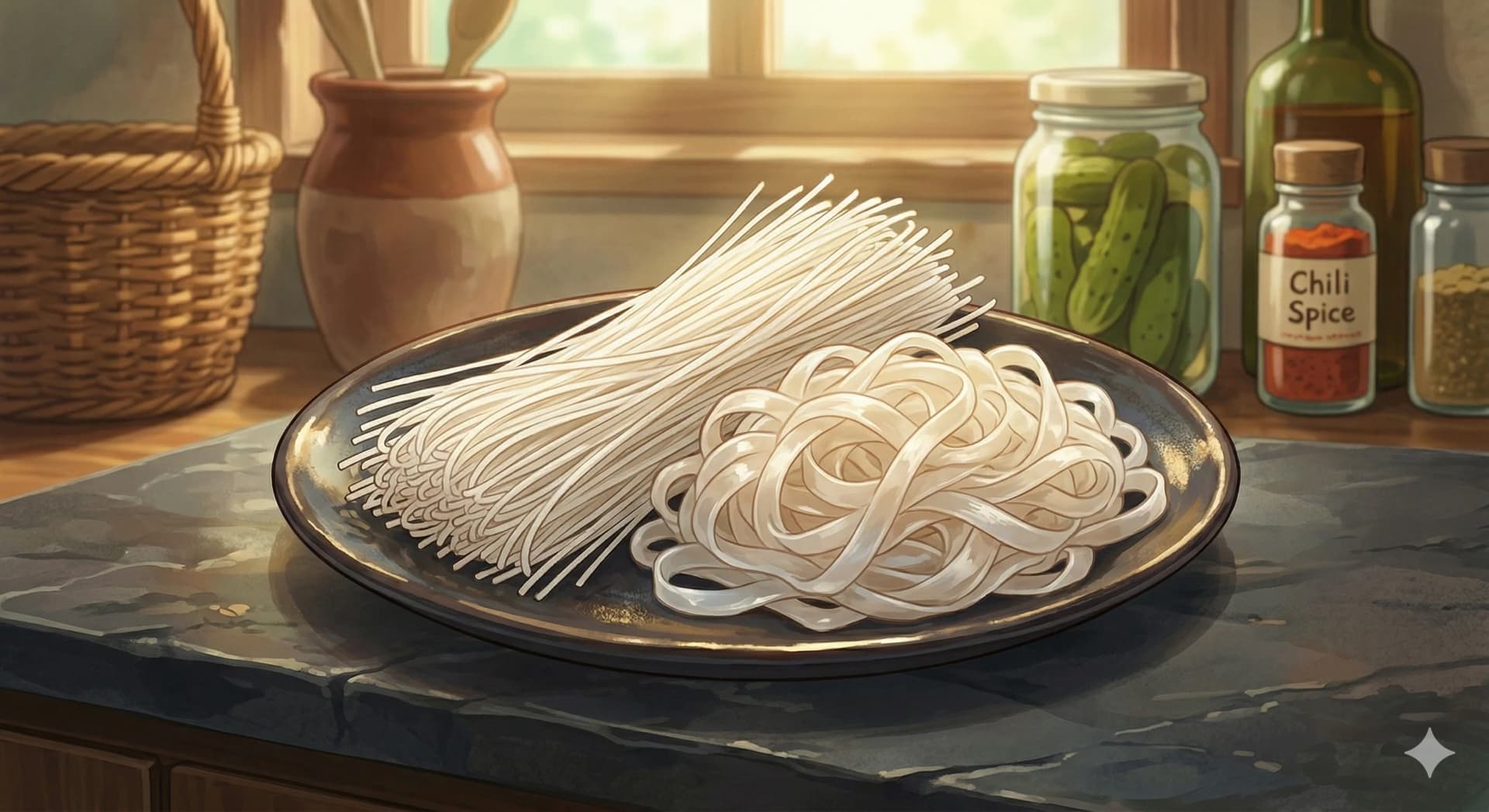
Rice Noodles
Also known as: Mi Fen, Rice Vermicelli, Ho Fun, Rice Stick Noodles, Banh Pho, Kway Teow
Rice noodles are made from rice flour and water — the simplest of noodle formulas — and come in a remarkable range of widths and forms, each suited to different preparations.
Thin rice vermicelli (mi fen) cook instantly and absorb sauces beautifully; wide flat rice noodles (ho fun) are silky and substantial, ideal for stir-frying; rice stick noodles (banh pho) are the medium between the two. Rice noodles are naturally gluten-free, with a mild, clean flavor that makes them a pure vehicle for the sauces and broths that surround them.
Key facts at a glance:
- Rice flour and water — the simplest noodle formula
- Naturally gluten-free — suitable for celiac disease and gluten intolerance
- Originated in southern China — Guangdong, Guangxi, and Fujian
- Three main widths — vermicelli (mi fen), stick (banh pho), flat (ho fun)
- Handle gently — rice noodles tear easily when stir-fried
Flavor Profile
Origin
Southern China, Guangdong, Southeast Asia, Vietnam
Traditional Medicine Perspectives
Traditional Chinese Medicine
Rice noodles share the TCM properties of rice — neutral and sweet, associated with the Spleen and Stomach. Used to tonify Qi, nourish the middle burner, and calm the Stomach. Being made from rice rather than wheat, they are considered more suitable for people with wheat sensitivities or digestive weaknesses. The neutral, easily digestible nature of rice makes rice noodles appropriate during illness and recovery.
Modern Scientific Research
Rice noodles are high in carbohydrates and low in protein and fat. They are naturally gluten-free, making them appropriate for those with celiac disease or gluten intolerance.
The glycemic index varies by preparation: rice noodles eaten with fat, protein, and fiber have a lower glycemic impact than eaten alone. Research on rice consumption shows benefits for gut health from resistant starch formed during cooling and reheating.
Cultural History
Rice noodles originated in southern China, where rice cultivation dominates and wheat is less available than in the north. The tradition is particularly associated with Guangdong, Guangxi, and Fujian — regions with close cultural ties to Southeast Asia.
Vietnamese pho noodles (banh pho), Thai pad thai rice noodles, and Malaysian char kway teow all descend from this southern Chinese tradition. Wide fresh rice noodles (cheung fun) steamed in sheets and cut into rolls are a beloved dim sum item.
The spread of rice noodles from southern China into Southeast Asia mirrors the broader cultural and culinary connections between these regions.
Culinary Uses
Thin rice vermicelli: use in soups, salads, and spring rolls. Medium rice stick noodles: use in pad thai, stir-fries, and Vietnamese soups.
Wide flat rice noodles: use in chow ho fun (stir-fried with beef, scallions, and soy); handle gently to prevent tearing.
Preparation Methods
Thin rice vermicelli: soak in cold water 10–15 minutes until pliable. Wide rice noodles: if dried, soak 30–45 minutes; if fresh, separate gently.
For stir-frying: use a very hot wok and toss gently — rice noodles tear and break if handled aggressively.
Comments
Share your thoughts on this ingredient.
Sign in to comment0 Comments