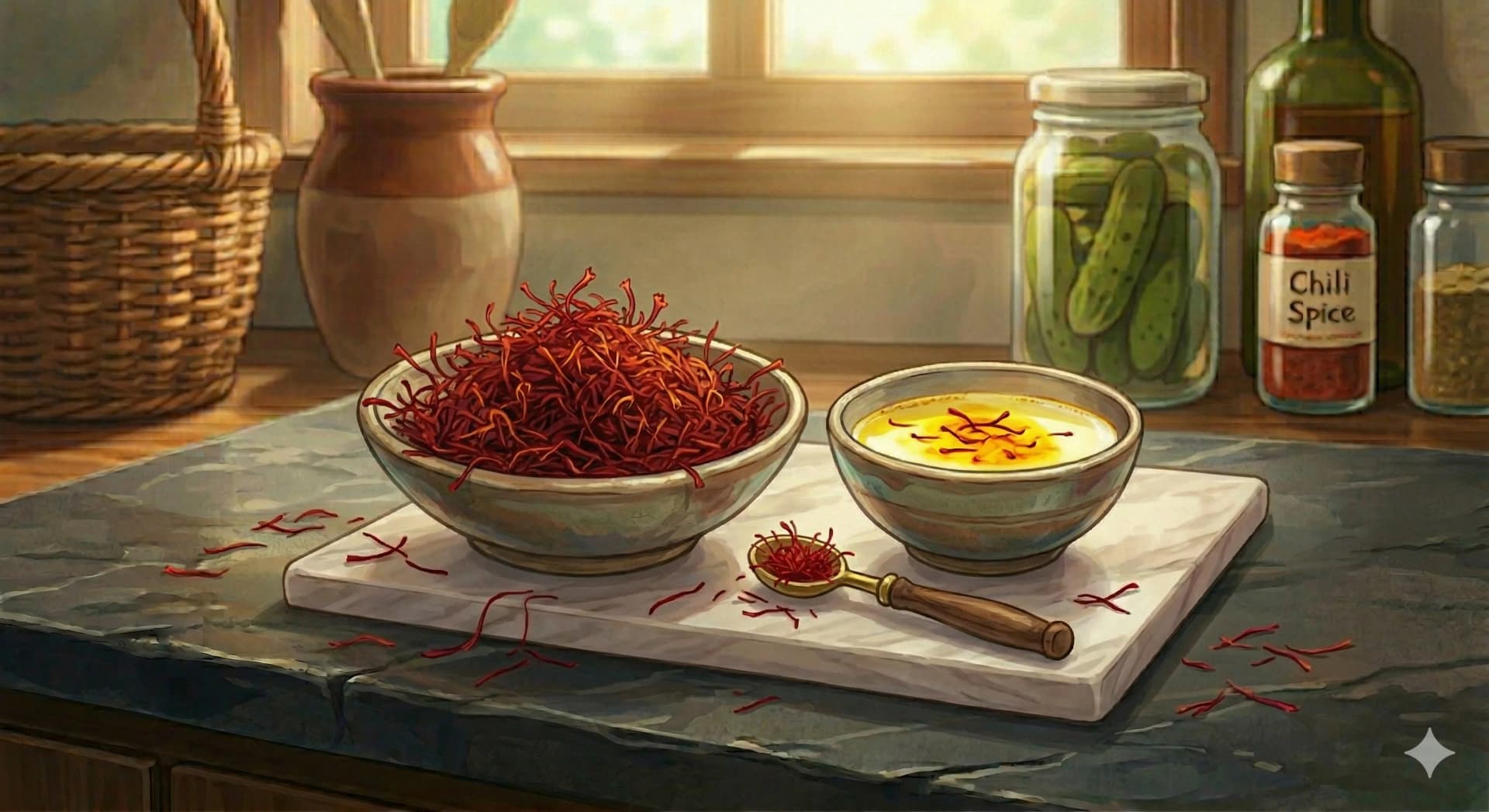
Saffron
Also known as: Kesar, Zafaran, Crocus sativus
The world's most expensive spice by weight, saffron consists of the dried stigmas of the Crocus sativus flower. Each flower produces only three stigmas, all harvested by hand. Its flavor is floral, honeyed, and slightly metallic — unlike anything else in the spice world.
Key facts at a glance:
- Most expensive spice by weight — each flower yields only three hand-harvested stigmas
- Origin in ancient Persia — cultivated for over 3,000 years
- Clinically studied for mood — as effective as low-dose antidepressants for mild depression
- Active compounds — crocin and safranal with antioxidant and neuroprotective properties
- Must be bloomed — steep in warm liquid 15-30 minutes before use
Flavor Profile
Origin
Persia (Iran), Kashmir, Spain, Greece
Traditional Medicine Perspectives
Ayurveda
Saffron (Kumkuma) is considered warm and sweet in Ayurveda. It is used to stimulate digestion, improve circulation, and support reproductive health. It is often prescribed in Ayurvedic formulations for women's health and as a general tonic mixed with warm milk.
Traditional Chinese Medicine
In TCM, saffron (Xi Hong Hua) is used to invigorate Blood, dispel stasis, and relieve emotional depression. It is prescribed for menstrual irregularities, pain from Blood stagnation, and conditions where emotional constraint has caused physical symptoms.
Modern Scientific Research
Saffron has been studied for its effects on mood — several clinical trials show it to be as effective as low-dose antidepressants for mild to moderate depression, with fewer side effects.
Its active compounds, crocin and safranal, show antioxidant, neuroprotective, and anti-inflammatory properties in research.
Studies also suggest potential benefits for memory and cognitive function in early Alzheimer's disease.
Cultural History
Saffron cultivation dates to ancient Persia (modern Iran), where it has been used for over three thousand years in cooking, medicine, and dye. Persian poetry and cuisine are intertwined with saffron.
The Mughal court in India adopted it enthusiastically — it became central to biryanis and kormas. In Spain, saffron arrived with the Moors and became essential to paella and other rice dishes.
Saffron's simultaneous importance in Persian, Indian, and Spanish cuisines reflects the spice trade routes that connected these civilizations for millennia.
Culinary Uses
Saffron must be bloomed before use — steep threads in warm water, milk, or broth for 15 to 30 minutes to release color and flavor.
A small pinch (20 to 30 threads) is sufficient for most dishes. Essential to Persian polo rice, Milanese risotto, Provençal bouillabaisse, and Indian biryani.
Preparation Methods
Crush threads lightly with your fingers before steeping. Bloom in a small amount of warm (not boiling) liquid for at least 15 minutes.
Add the saffron water along with its threads to the dish. Never add dry threads directly to a dish — the flavor will not fully develop.
Comments
Share your thoughts on this ingredient.
Sign in to comment0 Comments